
Company Liquidation Definition: UAE Winding-Up Explained


The most repeated piece of advice about closing a UAE company is also the most incomplete. Cancel the trade licence, settle the last invoice, hand back the keys, and the company is gone. Founders hear it from a friend, a broker, sometimes from a PRO who means well. It leaves out the part that decides whether the closure holds: a cancelled licence is an administrative status, while a company with unpaid suppliers, staff or bank facilities remains a legal person that still owes money to people who know its name.
Three things get tangled together constantly. Deleting the trade licence is a filing. Dissolution is the legal decision or event that ends the company's purpose. Liquidation is the work that follows, done by a named person, on a clock, in front of creditors. Most explanations of the company liquidation definition stop at the phrase "winding up" and never mention that the entity stays alive during the winding up. That omission is where founders get hurt.
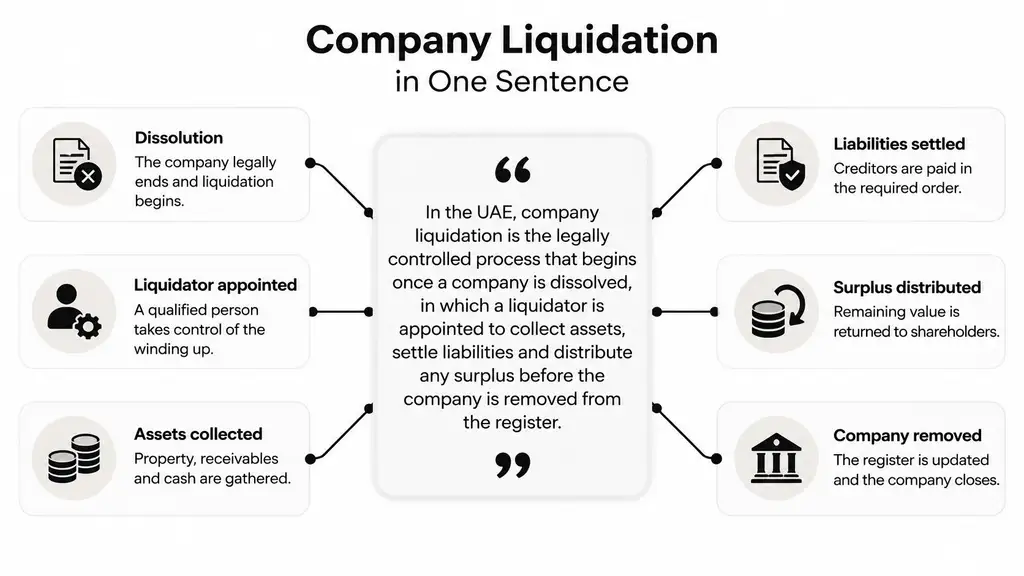
Company Liquidation in One Sentence
In the UAE, company liquidation is the legally controlled process that begins once a company is dissolved, in which a liquidator realises its assets, settles its debts and obligations, distributes any residual value and removes the entity from the commercial register.
That sentence holds three moving parts. A decision or event starts it, which is dissolution. A person runs it, which is the liquidator. An outcome closes it, which is deregistration, after any surplus has gone back to the people who own the company. Read it that way and liquidation stops being a synonym for "shutting down" and becomes a job with a beginning, a middle and an end.
Here is the whole sequence on one page.
The company does not switch off at dissolution
This is the rule that separates a real liquidation from an abandoned one. Under Federal Decree-Law No. 32 of 2021, dissolution does not immediately eliminate the company's legal personality. The entity remains legally existing to the extent necessary to complete liquidation, and every company debt becomes immediately payable at that moment.
Think of posting a letter. Dropping it in the box is the decision, the sorting office is the liquidation, and delivery is the deregistration. You cannot skip the sorting office and claim the letter arrived.
Because the company is still alive, someone has to act for it. The liquidator collects receivables, identifies and realises assets, settles liabilities, resolves creditor claims, prepares the final liquidation account and distributes any residue by legal priority. Creditors must be notified by registered letter with acknowledgment of receipt and invited to submit claims. None of that happens if the only step taken was a licence cancellation.
Cancelling a trade licence is an administrative act
A licence cancellation changes a record held by a licensing authority. Liquidation is an evidentiary, creditor-facing process that produces notarised minutes, a published notice, a claim window, a final report and clearances. A business can be licence-free on paper while supplier invoices, payroll arrears, tax registrations, a live lease and an open bank account still attach to it.
The practical rule: if anyone still has a claim against the company, the licence is not the thing that ends it.
Three readers should care about this distinction. A founder closing voluntarily needs the sequence right so the exit is clean and defensible. An owner who already stopped trading needs to know that stopping is not a legal status and that dormant liabilities keep accruing. A creditor checking a debtor should treat a bare licence cancellation as evidence of nothing at all, and ask instead for the liquidation file.
The Four Types of Liquidation and Who Starts Each
One question routes almost every reader to the right procedure. Can the company pay every creditor in full, on the day it stops trading? If yes, the liquidation is solvent and usually voluntary. If no, it is insolvent, and the route has to be built around creditor protection rather than shareholder convenience.
The comparison below sets the four routes side by side. Notice that the difference is not cosmetic. Each route changes who holds the pen, who the process serves and how much public notice the world gets.
| Type | Trigger | Who appoints liquidator | Mainly protects | Notice period |
|---|---|---|---|---|
| Members' voluntary liquidation | Shareholders' or partners' resolution; the company can pay its debts | Partners or the general assembly | Shareholders receiving any residual value | 45-day claim window under the mainland procedure |
| Creditors' voluntary liquidation | Insolvency; creditors' interests dominate the process | Creditors effectively determine the appointee | Creditors | 45-day claim window under the mainland procedure |
| Compulsory liquidation | Court judgment, or an interested party's application to the court | The court | Creditors and objecting parties | Set by the terms of the court order |
| Free-zone licence termination | Termination application filed with the free-zone authority | As set by the authority's own rules | The authority, creditors and the register | Fixed by the zone's termination rulebook, not the mainland window |
Who holds the pen
Under the commercial companies law, liquidation may follow the expiry of the company's term, a partners' or shareholders' decision, or a court judgment, and the liquidator is appointed by the partners, the general assembly or the court depending on how the process began, as the Commercial Companies law sets out.
The court route exists for a reason founders discover late. Where the board fails to call the general assembly, or the assembly fails to decide on dissolution and liquidation, an interested party may approach the competent court. Deadlock is a recognised trigger, not an excuse to drift.
There is also an independence bar that catches people who appoint the first qualified name they find. The liquidator cannot be the company's current auditor, or an auditor who audited its accounts during the previous five years.
Two readers, two routes
Take a partner in a dormant mainland LLC with no debts and no activity. The route is a members' voluntary liquidation. The partners resolve, appoint a liquidator who is not the auditor, publish, wait out the claim window, file the final report and clear the residual files. Nothing dramatic, but every step leaves a document behind, and those documents are what let the partners prove years later that the entity was closed properly.
Now take a DMCC licence holder with a bank loan still open. The free zone's own termination procedure governs the licence, and the bank sits outside it entirely. The loan is accelerated or settled on its own terms, the bank issues its release, and only then does the authority's termination file make sense. Free-zone termination does not extinguish a lender's claim, and the register entry is not the same thing as the debt.
If you need to prove where a company stands, either your own or a counterparty's, the 2026 founder's guide to company status explains what each status document certifies and, just as usefully, what it does not.
Why Companies Liquidate and When Restructuring Fits Better
The law recognises a short list of triggers. The company's term expires. The partners or shareholders decide. A court hands down a judgment. Or the deadlock case, where the board will not call the assembly or the assembly will not decide, which is precisely what lets an interested party ask a court to move things along.
Split those into voluntary and forced and the picture sharpens. Voluntary triggers are a founder exit, a dormant entity nobody needs, a market the company is leaving, a project that has run its course. Forced triggers are creditor action, a court order and regulatory pressure.

The boardroom version of the decision usually arrives later than it should, after the cash position has already been discussed three times without anyone writing it down.
The contrarian point
Public-facing explanations tend to frame liquidation as the natural endpoint of a failed company. The restructuring evidence points somewhere else. Deloitte's 2025 GCC restructuring pulse reports that stakeholders expected restructuring and insolvency activity to increase, but lenders still preferred informal, management- or adviser-led restructuring, with liquidation and administration expected to be considerably less common.
Translate that for a UAE SME. If the underlying business is viable and the problem is a cash-flow gap, early creditor negotiation, an asset sale or an operational restructure can preserve more value than an immediate shutdown. Waiting makes it worse, because creditor exposure grows and recoveries shrink as the position deteriorates.
Liquidation is a legal closure mechanism. It is not automatically the best financial strategy.
The line that decides everything
The solvency test from the previous section does the routing, so apply it carefully rather than hopefully. A solvent company can choose liquidation as an orderly exit. An insolvent company needs advice on creditor protection, negotiated restructuring or a formal insolvency route before anything is filed.
Liquidation also makes a poor hiding place. The registered-letter notices, the newspaper publication and the claim window exist so creditors cannot be surprised. An owner who wants to walk away unnoticed will find that the machinery does the opposite.
Three questions before any filing. Can we pay everyone in full? If not, is the business itself worth saving? And what does an orderly exit cost compared with a restructure? If you are planning an exit rather than a rescue, the MyOfficeOps exit planning guide sets out how to prepare the business so the closure is a planned event rather than a reaction.
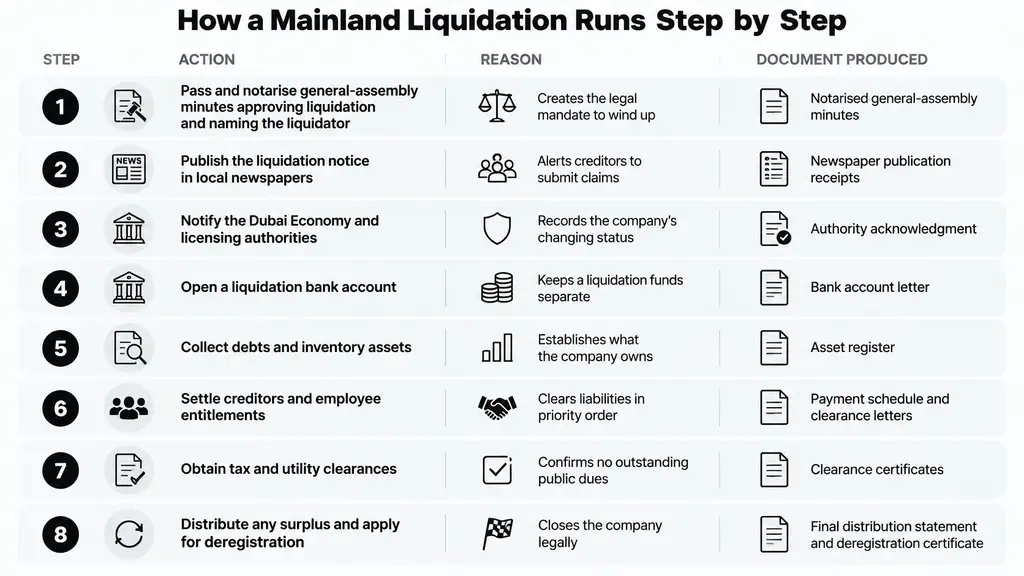
How a Mainland Liquidation Runs Step by Step
The sequence below is the Dubai mainland path for a commercial company. Each step produces a document, and each document is what the next authority asks to see. Treat them as a chain rather than a checklist.
Pass and notarise the general-assembly minutes. The resolution approves liquidation and names the liquidator. Without it, nobody has authority to sign anything downstream, and the notary's stamp is what turns a decision into a mandate.
File the liquidator's acceptance and pay AED 520. The acceptance letter and professional documents accompany payment of AED 520 for the dissolution and liquidator-appointment certificate, subject to legal-adviser approval, according to the UAE government mainland closure guide. The application is submitted by the liquidator and applies to all legal forms of commercial companies. One reminder from the appointment rules: the appointee cannot be the current auditor or one who audited the accounts in the preceding five years.
Notify creditors by registered letter with acknowledgment of receipt. The acknowledgment is the point. It converts "we told them" into a document with a date and a signature.
Publish in two Arabic local newspapers for one day. Publication opens a 45-day window in which debtors and creditors submit claims. This is the step that makes the process public and the one that most often surprises founders who assumed closure was private.
Freeze new commitments and reconcile the books. While the window runs, stop signing contracts, reconcile the general ledger and VAT records, and document who owns which asset. Anything left tangled here resurfaces at the final report.
Submit the closing file. That means the original newspaper publication, the liquidator's final report, and a declaration from the liquidator and partners that no objections were received during the window.
Clear immigration, labour, bank, tax and utility files. Each authority releases the company separately, and an open bank account can outlive the trade licence by months.
Obtain final closure approval and deregister. Only here does the register reflect what everyone assumed was true at the start.
The milestones and their costs sit together more clearly in a table.
| Step | Document or action | Fee or deadline |
|---|---|---|
| 1 Notarised general-assembly minutes | Approve liquidation and name the liquidator | Signed before any certificate application |
| 2 Liquidator acceptance | Acceptance letter, professional documents and dissolution certificate | AED 520, subject to legal-adviser approval |
| 3 Creditor notice | Registered letter with acknowledgment of receipt | Sent once dissolution makes debts fall due |
| 4 Publication | Two Arabic local newspapers for one day | 45-day claim window |
| 5 Closing file | Original publication, final report and declaration that no objections were received | Filed after the claim window closes |
| 6 Clearances and deregistration | Immigration, labour, bank, tax and utility files; final closure approval | Completed before the company is treated as closed |
The timeline is a floor, not a finish line
The claim window is a minimum period of external notice. It is not a duration for the whole project. Unresolved claims, an asset that will not sell, an employee gratuity calculation in dispute or a clearance that stalls will each push the end date out, and none of them care about the calendar.
Free zones run the same shape on a different rulebook. The authority's own termination rules set the publication requirement and the clearance order, so a mainland checklist applied to a free-zone entity will miss steps. Licence cancellation is one line near the end of the file, not the opening move, which is why trade licence cancellation should be read as the closing act rather than the plan.
What to assemble before step one
Build the file first, then start. Payroll and immigration status for every employee. The bank position, including any facility or guarantee. VAT and corporate tax filings, current and reconciled. The lease exit terms. A creditor schedule with amounts, contacts and supporting invoices. Accounting evidence for the assets the company claims to own. For an existing business, the pack may also include the company's financial statements and a letter of intent.
Stakeholders and Two Myths That Still Mislead
The same liquidation looks completely different from each chair around the table. Four matter most.
The owner should expect little or nothing from a distressed entity. Personal liability does not automatically follow a company liquidation, but unresolved filings, bounced obligations, director conduct and unpaid wages can travel. Residual value is distributed only after every liability and legal priority has been settled.
Employees are part of the winding up, not adjacent to it. End-of-service entitlements and visa cancellations are settled inside the process, and labour and immigration clearances gate the final closure.
Creditors get one formal opportunity to assert claims, and the registered-letter notice means nobody can later claim they were never told. The claim window is the deadline that matters, and it is short by design.
Banks and landlords issue their own releases. Account closure and lease exit are separate negotiations with separate documents, and neither follows automatically from a licence status change.
What going quiet actually costs
Say a Dubai café stops trading, hands back the keys and lets the licence lapse. Two years later a supplier files a claim for unpaid deliveries. The licence is long gone, but the company was never liquidated, so there is no final report, no declaration that no objections were received, and no evidence that the supplier was ever notified. The owner now answers a claim they thought was closed.
Then take a trading LLC whose partners resolve to wind up. The bank loan agreement treats dissolution as an event of default, so the facility accelerates the moment the resolution passes. The lesson is unglamorous: read the finance documents before the minutes are notarised, not after.
Two myths worth retiring
The first is that liquidation always means failure. A solvent members' voluntary liquidation is a legitimate exit, used to return capital, simplify a group or close a dormant entity cleanly. Nothing has gone wrong.
The second is that an expired term with no partner resolution is a dead end. It is a deadlock, and the court route exists to break it when the board will not call the assembly or the assembly will not decide.
Two documents hold up more closures than anything else: a reconciled creditor schedule and complete accounting evidence. Tax files belong in that pile too, because unpaid VAT and corporate tax obligations do not vanish when a licence does, and corporate tax compliance records are exactly what a liquidator needs to close the file without a later surprise.
Decide Whether to Liquidate or Restructure First
The decision rule is short. If every creditor can be paid in full, plan a solvent voluntary liquidation and treat it as an orderly exit. If they cannot, take advice on restructuring and creditor negotiation before filing, because once dissolution is resolved the debts fall due and the clock starts whether or not the company is ready.
Whoever runs it should be independent of the company's recent audit, able to handle the full chain rather than only the paperwork, and transparent about fees. That chain runs from notarised minutes and newspaper publication through creditor notifications and the final report, then on to immigration, labour, bank, VAT and utility clearances. A firm that stops at the forms leaves the founder holding the rest. If the closure work is likely to distract from running the remaining business, Hire Accountants can keep the bookkeeping and filings current while the winding up proceeds.
Smart Classic Business Hub, a Dubai management consultancy in Baniyas Square, provides liquidation alongside company formation, PRO services, offshore registration, tax residency certificates, VAT-compliant accounting and audit, so the accounting clean-up and the closure sit with one team. If a restructure is on the table instead, an independent view of what the business is worth changes the negotiation, and business valuation services give creditors a number to argue with rather than an impression.
Three first moves. Assemble the creditor schedule and accounting records. Confirm which licensing authority governs the entity and what its publication rule is. Get a fixed-scope quote before signing an engagement.
If you are weighing up whether to wind up or restructure, Smart Classic Business Hub can map the full route for your entity, from notarised resolutions and creditor notifications to tax clearances and final deregistration, and handle the accounting clean-up in the same engagement. Its team works across mainland, free zone and offshore structures, so the procedure matches the licence you hold rather than a generic checklist. Visit Smart Classic Business Hub to talk through your position before anything is filed.