E Trader Licence UAE: Who Qualifies and How to Apply

The advice you'll find in most videos and comparison pages follows the same script. An e trader licence is the cheapest way to start selling online in Dubai, it comes back in a day or two, so apply first and sort out the details later. The order is backwards, and the mistake is expensive in a quiet way.
Two questions outrank price. What is your nationality, and what activity will you run? The UAE has no single federal e trader licence with one price and one rulebook. Each emirate runs its own programme, drawn around a particular group of people and a particular list of activities. A permit that looks affordable can turn out to exclude the very thing you plan to sell.
The checks below are the ones that decide the answer, and they cost nothing to run. Work through them in order and you'll know whether the cheap route is open to you before a single fee is due.
Who Qualifies for an E Trader Licence in the UAE
The question that settles everything isn't about price or processing time. It's blunt. Can you hold an e trader licence at all, in the emirate where you live, for the activity you plan to run?
There's no single federal e trader licence in the UAE. The UAE Ministry of Economy's e-commerce sector mapping sets the programmes side by side. Dubai's e trader licence permits UAE nationals and GCC nationals residing in Dubai to conduct business activities through social-media networks. Ras Al Khaimah's programme is restricted to UAE citizens resident there, and Sharjah's Eitimad licence is restricted to UAE nationals resident in Sharjah. Same idea in each emirate, different doors.
Compare the programmes before you compare the fees
| Programme | Who qualifies | What to confirm |
|---|---|---|
| Dubai e trader licence | UAE and GCC nationals residing in Dubai | Activity list, and whether non-UAE applicants can use specific activities |
| Ras Al Khaimah programme | UAE citizens resident in Ras Al Khaimah | Current activity list and fees |
| Sharjah Eitimad licence | UAE nationals resident in Sharjah | Eligibility rules and approved sales channels |
| Abu Dhabi Trader Licence | UAE citizens and residents | Specific commercial activities permitted |
Read the second column before anything else. An expatriate entrepreneur in Dubai should not assume an e trader licence is available merely because they hold UAE residency. Nationality, emirate of residence, approved activity and sales channel all get measured against the issuing authority's current rules first.
Three questions build your realistic shortlist.
- Nationality: which programmes name your nationality at all?
- Residence: which emirate issues your Emirates ID, and does its programme cover residents or citizens only?
- Activity and channel: does the specific activity you need appear on the approved list, and does it match how you'll sell?
Check this first: the activity code your business needs must be open to your nationality in the emirate where you live. The fee is the last thing worth comparing.
The outcome of this exercise is a shortlist, usually one or two programmes, and one fact to confirm with the issuing authority before any money moves: whether the exact activity you plan appears on the approved list for someone in your position.
What the Dubai E Trader Licence Allows and Forbids
An e trader licence works like a market-stall permit moved online. It gives one individual seller a legal footing for trading through social media, without premises, staff or partners. The Dubai e trader licence is a specialised UAE mainland licence designed for individuals doing business through social-media platforms. Dubai Economy and Tourism issues it, it may be registered under one owner only, and it is available to UAE nationals and GCC nationals residing in Dubai.
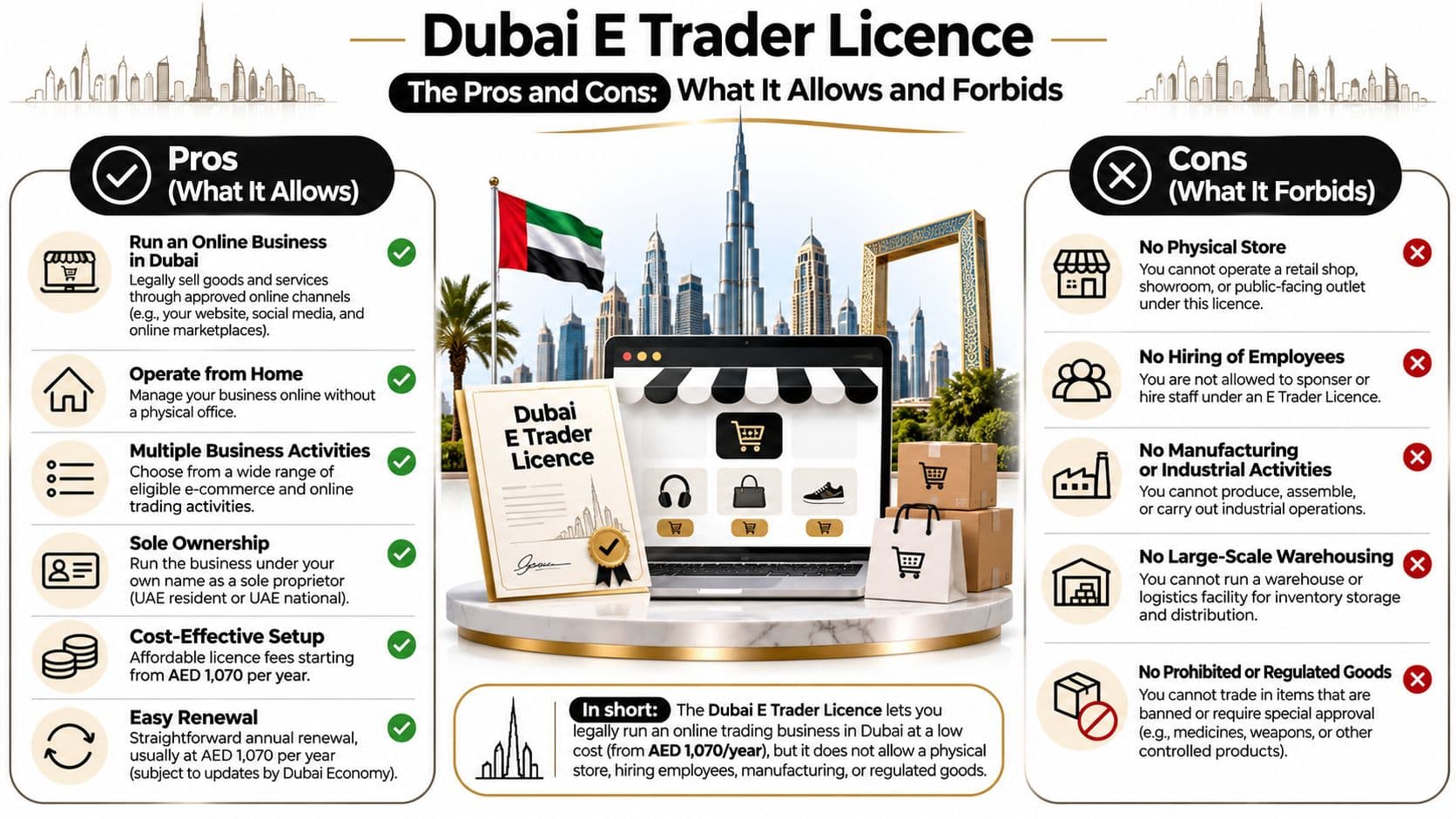
What the licence buys is legitimacy. Trading that already happens through Instagram, WhatsApp and TikTok gets a formal footing, and the licensee stops operating as an informal seller. That matters for customer trust, for payment providers that ask for a licence number, and for anyone who needs to show they are trading lawfully.
One distinction prevents most of the confusion here. The licence legitimises the person. It does not create a company.
The boundaries, as plain yes and no
- A physical shop, no. The licence does not permit retail premises.
- Residence visas, no. It cannot sponsor staff or family.
- Partners or shareholders, no. Registered under one owner, so there is nothing to divide.
- Personal liability, yes. If a legal dispute arises, the individual licensee remains personally responsible.
Those four limits keep the instrument simple, and they are also what push growing businesses elsewhere. A conventional commercial licence can support corporate structures, premises, staffing and visa-related requirements. This one cannot, by design. Because the fee is low, the cost of a wrong choice tends to surface later, when the business needs something the licence was never built to provide.
When a company licence is the right tool instead
The application itself starts with a DED Trader account and a registered activity that matches the operating model. Two fields into the form, the question is whether that activity covers what you do.
The test is quick. If the plan needs employees, a retail location, immigration files or several owners, the e trader licence is the wrong instrument, and a full e-commerce licence is the next option to evaluate. Once goods start crossing borders, customs and trade compliance sit outside the licence altogether, and the Million Dollar Sellers trade compliance guide explains what import rules ask of a seller before the licence question even comes up.
Matching Your Business Model and Nationality
Two applicants can pay the same fee and walk away with very different rights. Nationality and activity decide which rights, and no price table captures that.
| Business model | Likely fit | What to confirm |
|---|---|---|
| Social-media sale of locally sourced goods | Often fits if the activity is on the approved list | Activity code and sales channel match the plan |
| Imported goods held as stock | Often outside an individual online licence | Customs permissions and storage arrangements |
| Regulated products such as food or health items | Not covered by the licence alone | Sector regulator approval |
| Digital services or online promotion | Fits only where the activity wording covers the service | Activity wording matches what you deliver |
| Sales outside Dubai | Outside the Dubai licence scope | Licence scope and any additional emirate approvals |
The distinction most summaries skip is the one that decides expatriate applications. As Dubai Economy Center's e trader licence guide explains, professional activities may be available to eligible non-UAE nationals, while commercial product-trading activities are generally limited to UAE and GCC nationals. That same guide notes one reported exception, the Online Seller activity (6312009), described as open to all nationalities, with the caveat that third-party summaries conflict and the position must be confirmed directly with Dubai's licensing authority.
Three founders, three different answers
The consultant. An expatriate offering design or marketing services online usually sits inside a professional activity, provided the wording on the licence matches the service they deliver. Consulting, coaching and digital services behave differently from goods trading because there's no inventory to hold or import.
The reseller. An expatriate buying locally sourced stock and selling it through social media depends entirely on whether the trade activity is open to their nationality. Cheap licences fail at this point. If your route is digital rather than physical, it's worth comparing online earning routes in the UAE before committing to an activity description.
The importer. A founder bringing stock in to sell across the Gulf needs customs permissions, storage arrangements and probably a company licence. An individual permit doesn't reach into a warehouse operation or across borders, whatever the activity title suggests.
The cheapest licence can be the wrong licence when the business depends on physical inventory or international fulfilment.
Separate the licence from everything layered on top of it: product approvals, customs permissions, consumer-protection duties and advertising or sector permits are different documents from different authorities. Abu Dhabi's Department of Economic Development describes its own Trader Licence as an electronic licence issued for specific commercial activities to UAE citizens and residents, and the Ministry of Economy's sector mapping notes that e-trade licensing frameworks require Telecommunications and Digital Government Regulatory Authority involvement in the UAE e-commerce environment. Regulated goods, payment services, telecoms, financial promotion, health products or food may need approvals the licence never covers.
Before applying, write down the exact goods or services, customer geography, sales channel, fulfilment method, payment flow and whether stock is imported or locally supplied. Then match that description to the approved activity list.
How to Apply for a Dubai E Trader Licence Step by Step
The sequence below keeps you from paying for a licence that doesn't cover your business. Each step comes with the slip that catches most applicants.
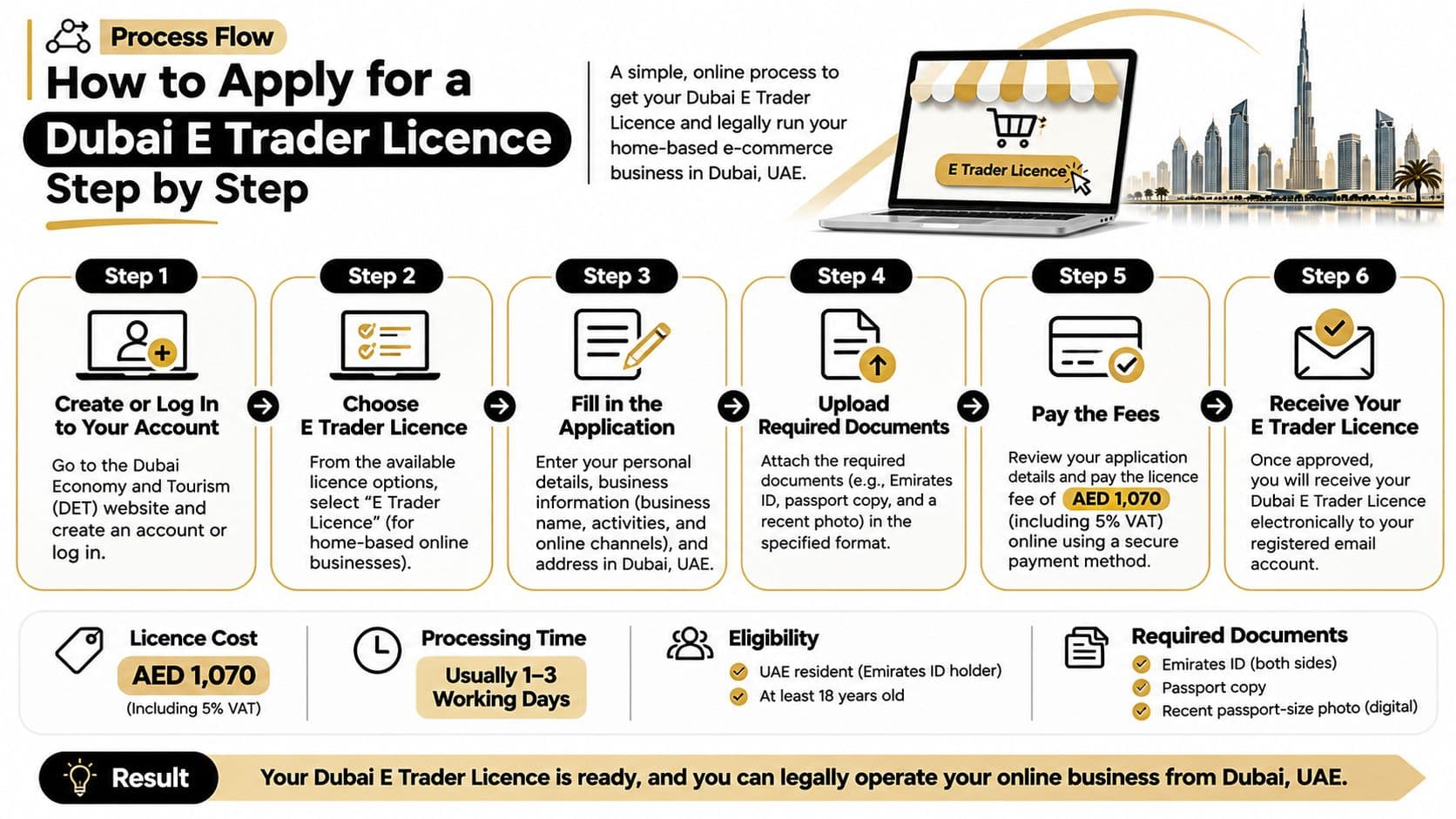
- Confirm eligibility before anything else. Nationality, emirate of residence and planned activity decide whether this route exists for you. Skip the check and you risk an application under an activity that either gets refused or, worse, gets approved too narrowly to trade.
- Create a DED Trader account. That's the starting point in the official guidance, and it's where your identity details attach to the file. Match your name and ID details exactly, because mismatches send the application back for resubmission.
- Register the activity that matches your operating model. Choose wording that covers your sales channel rather than the broadest-sounding option on the list. The common slip is selecting an online-trading activity when the actual plan involves imports, warehousing or regulated goods.
- Prepare identity documents and a written description. Expect to supply your passport copy, Emirates ID, proof of residence, and a short plain-language account of what you'll sell and how. The issuing authority reads that description against the approved activity list, so write it the way an inspector would read it.
- Pay the government fees shown on the official schedule. Not the figure on a comparison page. Published totals move with the emirate and activity, and third-party tables go stale quickly.
- Receive the licence and read every line. Confirm the owner's name and the approved activities printed on the document. If an activity you need is missing, correct it before launch, not after a payment provider or customs broker queries it.
Where applications usually go wrong
Two failures account for most wasted fees. The first is a mismatch between the activity registered and the business run, such as a licence for online promotion used to sell imported stock. The second is skipping a sector approval because the licence looked like blanket permission.
Document lists also change. Verify each requirement on the official portal for the emirate issuing your licence before you submit anything, rather than relying on a checklist from last year.
A correct outcome looks unglamorous: a licence showing one owner and the exact activities the business will run, with nothing aspirational added for comfort.
Costs, Renewals and Limits to Budget For
The fee you see quoted is one line of a longer budget. Budget by category, then confirm amounts.
| Cost item | What drives it |
|---|---|
| Initial issuance fee | Emirate and activity selected |
| Annual renewal | Licence type and activity list |
| Adding an activity | Number and type of activities |
| Sector or regulator approval | Regulated goods or services |
| Customs and import costs | Imported versus locally sourced stock |
Confirm each figure on the Dubai Economy and Tourism or DED schedule for the year you apply. The total shifts with the activity you choose, and any extra approval your goods require adds to it. Our team works through trade licence costs the same way, starting with the activity list rather than the headline fee.
Budgeting rule: price the licence only after the activity list is settled, then add the cost of every approval the goods need.
Renewal is the next line to plan for. It runs annually, it's driven by the licence type and the activities on it, and a renewal filed on the wrong activity description creates a mismatch that surfaces later. Keep your records current: what you sell, where you sell it, and where stock comes from.
What changes after issuance matters more than the fee. The moment the business needs employees, a retail location or stock held in a warehouse, the individual permit stops being the right instrument and the structure has to be reassessed. Growing into those needs isn't a failure. It's the licensing question arriving on schedule.
Confirm Your Route Before You Apply
Four actions turn this from reading into a decision.
- Write a one-page business summary. Cover nationality, emirate of residence, planned activity, goods or services, sales channels, sourcing and payment flow. One page forces the ambiguity out.
- Check the activity against the official list. Use the issuing emirate's current approved activities, and confirm any borderline wording directly with the licensing authority rather than a summary page.
- Identify sector approvals. List every regulator whose permission the goods or services need, and note which ones the licence doesn't touch.
- Book an initial consultation. Our first step with any client is an assessment where we learn your business requirements and objectives and work out which PRO services you need, whether that's company registration, visa processing or government approvals. From there we guide you through the right jurisdiction and legal structure to obtaining an investment licence.
Do the summary before the consultation and the conversation gets specific fast. Do it after, and you'll spend the first meeting explaining your own model.
This week, complete that one page and book the assessment before you submit a single document. It's a small piece of work that decides whether the cheap licence is your licence.
Smart Classic Business Hub helps founders in Dubai and across the UAE answer this question: whether an individual e trader licence covers the plan, or whether employees, premises or several owners push it towards a company structure. We handle trade licence applications, government approvals and renewals, and we'll say plainly when the cheaper route isn't the right one. Visit Smart Classic Business Hub to book a consultation and confirm your route before you apply.