
Professional Indemnity Insurance UAE Guide


Professional indemnity insurance in the UAE isn't compulsory for every company. It becomes mandatory only where a regulator or a profession-specific rule says so, which is why a private notary must carry at least AED 1 million of cover for errors in notarial work while an international expertise house must carry AED 6 million, and a marketing consultancy selling advice to the same kind of client may face no statutory requirement at all.
So why does the question keep returning at every licence renewal, every tender and every client onboarding pack?
Because three different things get called "mandatory" in the same conversation. A statute, a licensing condition and a clause on page nine of a client contract all create a duty to insure, and none of them sets the same limit, the same insurer or the same duration. Founders who treat this as one yes-or-no question end up either buying cover they never needed or discovering at renewal that the certificate in their file doesn't satisfy the rule that applies to them.
This guide separates the three. It covers which activities carry a real legal duty, what the published dirham floors are, what a UAE policy pays for, where cyber and AI losses fall outside the standard wording, and how to place cover so the certificate and the licence tell the same story.
When Cover Is Required and When It Is Not
No single UAE law makes professional indemnity cover compulsory for every business. The duty usually arrives from one of three places: the regulator that licenses your activity, a profession-specific statute, or a clause in a client or tender document. The professional indemnity overview from businessinsurance.ae draws the same line, separating activities where cover is a licensing condition from ordinary consulting work where it stays contract-driven.
Place your own licence in this table before you read anything else.
| Activity or structure | Typical trigger | Who sets the limit | What to check first |
|---|---|---|---|
| Private notaries | Profession rule | Ministerial decision | Valid UAE policy for the registration period |
| Court-appointed experts and expertise houses | Profession rule | Ministerial decision | Individual versus house status |
| Translators and translation houses | Profession rule | Ministerial decision | Individual versus house status |
| Lawyers and legal consultants | Licensing condition | Legal profession rules | Policy from a UAE-licensed insurer |
| Auditors, brokers and many healthcare roles | Often a licence condition | Sector regulator | Whether the firm policy names each practitioner |
| DIFC or ADGM regulated firms | Regulator rule for that activity | DFSA, FSRA or relevant body | Authorisation conditions, not a mainland assumption |
| Mainland or free-zone IT, marketing and management consultants | Usually a client or tender clause | The contract | Required limit, retroactive date and territory |
| Ordinary SME with no regulated advice | Often none at formation | Commercial choice | Client indemnities and subcontractors |
Trigger one, the regulator names your activity
Lawyers and legal consultants, registered court experts, private notaries and translators sit under profession rules that require a policy issued by a UAE-licensed insurer. Healthcare practitioners, auditors, insurance brokers and firms authorised in the DIFC or ADGM usually arrive at the same position through a sector regulator rather than through general commercial law.
Trigger two, the licence is silent
A mainland Department of Economy and Tourism licence, or a free-zone licence, for IT services, marketing, management consulting or design doesn't normally require professional indemnity as a formation condition. That isn't permission to skip it. It means no regulator will ask for the certificate at renewal, so the decision becomes commercial and you have to be able to defend it in a client meeting.
Trigger three, the client writes the rule
Most UAE firms that end up buying cover do so because a client, a tender panel or a landlord's vendor pack asked. Those documents set the limit, the retroactive date, the territory and sometimes a minimum insurer rating, and they do it without using the word mandatory anywhere.
Practical rule: read the insurance clause in your largest live contract before you read a single quote. A client asking for a UAE-licensed insurer and a retroactive date reaching back three years has already decided more than any statute will.
Then run four checks in order. Name the authority that issued your licence. List every service line you sell, not only the ones printed on the licence. Read the professional registration rules for each regulated activity. Read the insurance clause in live contracts and in the next tender you intend to answer.
Treat the client's dirham limit and jurisdiction clause as commercially decisive, and confirm the position with the licensing body before assuming a company formation package includes insurance. It usually doesn't.
Statutory Minimum Limits for Regulated Work
UAE floors are activity-specific. No national number covers every profession, and the 2024 ministerial decisions sit several million dirhams apart depending on whether the insured is an individual or a house. The figures below come from Norton Rose Fulbright's analysis of the new UAE laws mandating professional indemnity cover, which tracks federal legislation introduced in 2022 and implemented through ministerial decisions issued in 2024.
| Profession | Minimum limit | Decision | Continuity rule |
|---|---|---|---|
| Private notary | AED 1 million | Ministerial Decision No. 208/2024 | UAE insurer, at least three years, not conditional or revocable |
| Individual court-appointed expert | AED 1 million | Ministerial Decision No. 211/2024 | UAE insurer, at least three years, not conditional or revocable |
| Locally established expertise house | AED 5 million | Ministerial Decision No. 211/2024 | UAE insurer, at least three years, not conditional or revocable |
| International expertise house | AED 6 million | Ministerial Decision No. 211/2024 | UAE insurer, at least three years, not conditional or revocable |
| Individual translator | AED 1 million | Ministerial Decision No. 215/2024 | UAE insurer, at least three years, not conditional or revocable |
| Translation house | AED 5 million | Ministerial Decision No. 215/2024 | UAE insurer, at least three years, not conditional or revocable |
The spread is the point. The same category of court work carries a different floor for a sole practitioner and for an international house, and the source describes the framework as activity-specific rather than governed by one universal limit.
The dirham figure is only half the obligation, because the same decisions dictate who may issue the policy and how long it must run.

The conditions beside the number decide whether the certificate passes
Three requirements travel with every one of those tiers. The policy must be issued by a UAE insurance company. It must remain valid for at least three years. It cannot be conditional or revocable during the relevant professional registration period.
Those conditions do more work than the dirham amount. A one-year policy that the insurer can cancel mid-term fails the test even at the right limit. A certificate issued by an offshore parent, however large the group programme, fails it too.
Where the statute stays quiet
Lawyers, auditors and DIFC or ADGM authorised firms are also required to hold cover from a UAE-licensed insurer, but the same public floors aren't published for those activities in the same way. The licence condition and the client's own figure both apply, and the higher of the two governs what you carry. A firm that buys to the licensing minimum and then signs a contract demanding double is in breach of the contract, not the licence.
A limit chosen to match annual turnover can still fail a registration renewal, because the test is the floor in the decision, not your revenue.
What a UAE Policy Actually Responds To
Professional indemnity is liability cover for a client's financial loss caused by a negligent act, error, omission or breach of professional duty in the services you declared. It sits under your advice like a safety net, not over your office like a fire policy. A visitor who slips in reception belongs to public liability. A report that misleads a client into a bad acquisition belongs here.
In the UAE it's treated as a form of liability insurance, and policies covering liabilities arising in the country generally must be placed with an insurer licensed under UAE insurance legislation, as the UAE insurance legislation framework sets out. Buying through an overseas parent can leave a consultancy holding a policy that satisfies neither a regulator nor a client's vendor check.
The policy that answers is the one in force when the claim lands
Most wordings here are claims-made. The policy that responds is the one in force at the moment the client makes the claim, not the one that was in force when you did the work. That single mechanism explains most disputes about old projects.
Two terms decide whether yesterday's work is still protected. The retroactive date is the earliest date of work the policy will reach back to, so a retroactive date set years after you started trading leaves the early projects naked. Continuity protects that original date when you switch insurers, and a gap in cover at renewal can leave everything delivered before the gap uninsured for later claims.
Five checks before you bind
- Insurer licensing: confirm the insurer is authorised to write UAE liabilities, not just part of a group you recognise.
- Territory and jurisdiction: make sure the wording responds to work performed in the UAE and to claims brought here, and check it covers the cross-border clients you serve.
- Defence costs: establish whether legal costs sit inside the limit or in addition to it. Inside the limit, a long defence eats the cover before any settlement.
- Aggregation: check how related claims are grouped, because one technical error can generate several client claims and a single regulatory complaint at once.
- Named insureds: a firm policy doesn't automatically cover every partner, employee, subcontractor or separately registered professional, so check who appears on the schedule.
The definition is easy to state. The gaps are where claims go.

Ask the broker to walk the schedule line by line before binding: insured entities, covered activities, retroactive date, notification clause and excess. Then ask what happens to that schedule if you add a service line, hire a specialist or take on a client in another country.
Exclusions Cyber Losses and AI-Assisted Work
A policy that pays for a wrong tax computation can still pay nothing for the ransomware attack that encrypted the same client file. Professional indemnity works like cover for the advice; cyber cover responds to the incident around the systems.
A typical UAE wording pays a client's financial loss from a negligent act, error, omission or breach of duty in the declared professional services. The usual gaps are consistent.
- Known circumstances: facts or complaints you were already aware of before inception, and did not disclose, fall outside the cover.
- Dishonest acts: fraud and deliberate wrongdoing by the insured are excluded.
- Contractual penalties: guarantees, penalties or liabilities accepted by contract beyond what the law would impose anyway usually are not insured.
- Territory exclusions: work performed in, or claims brought in, the USA or Canada is commonly carved out, which matters if your client group is headquartered there.
- Activities off the schedule: anything outside the professional services listed on the policy is not covered, however routine it feels.
The advice error and the data breach are two different claims
The boundary problem is now visible in UAE disputes. Chambers' insurance litigation trends for the UAE notes that policyholders are attempting to claim ransomware, data-exfiltration and system-outage losses under property, business-interruption or professional indemnity policies where no standalone cyber cover is in place.
Split the two examples and the allocation becomes clearer. Negligent advice that costs a client money, such as a miscalculated tax position, is the claim professional indemnity was built for. A cloud breach that exposes the client's files is an incident-response, notification-cost and business-interruption claim, and it belongs to cyber cover. Neither should be assumed to pay regulatory fines.
A wrong tax computation and a cloud breach of the same client's files are two different claims, handled by two different policies.
AI-assisted work sits on the edge of the definition
The same commentary identifies a growing argument over whether an error made by an automated system falls within the policy's definition of a covered professional act. If a drafting tool produces flawed advice that you pass to a client, expect the insurer to ask where the human review was.
That question has a practical answer. Keep a record of who checked the output, what they checked it against, and which parts were changed before delivery. A file that shows review is easier to defend than a file that shows the tool's draft went straight to the client.
Insurers in data-intensive sectors such as healthcare, education and retail often ask how personal data is stored, shared and protected, so have those answers ready. Your licence jurisdiction, regulated activity and client wording decide which duties matter; there is no single UAE-wide PI wording that settles them for you.
Test four things against the actual wording rather than the summary: your AI use, your subcontractors and cloud providers, cross-border data transfers, and the indemnities you have signed in client contracts. If the schedule is silent on cloud failure, AI outputs or US and Canada claims, treat that silence as a gap to negotiate before renewal, not as cover by implication.
How to Price and Place the Policy
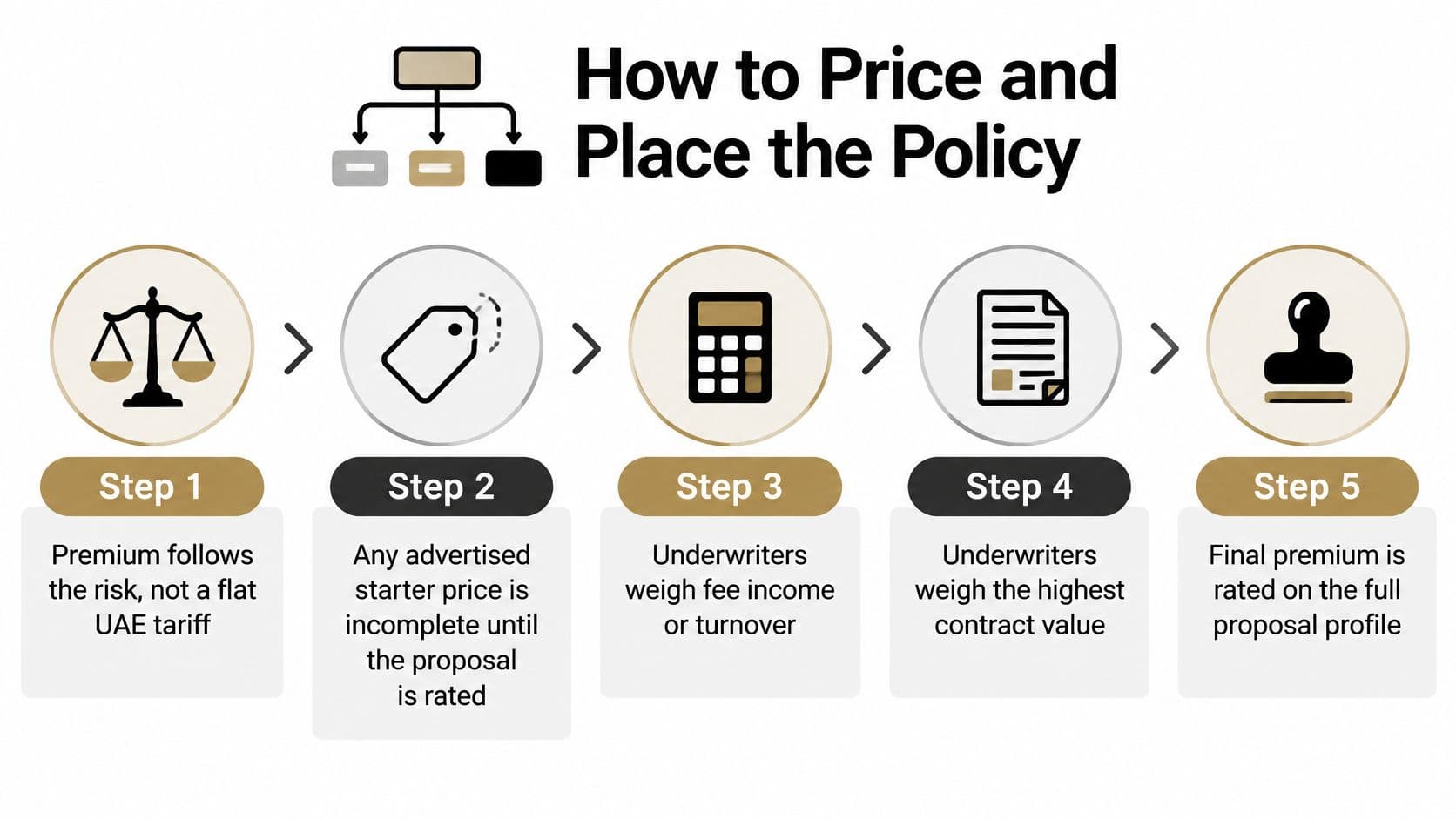
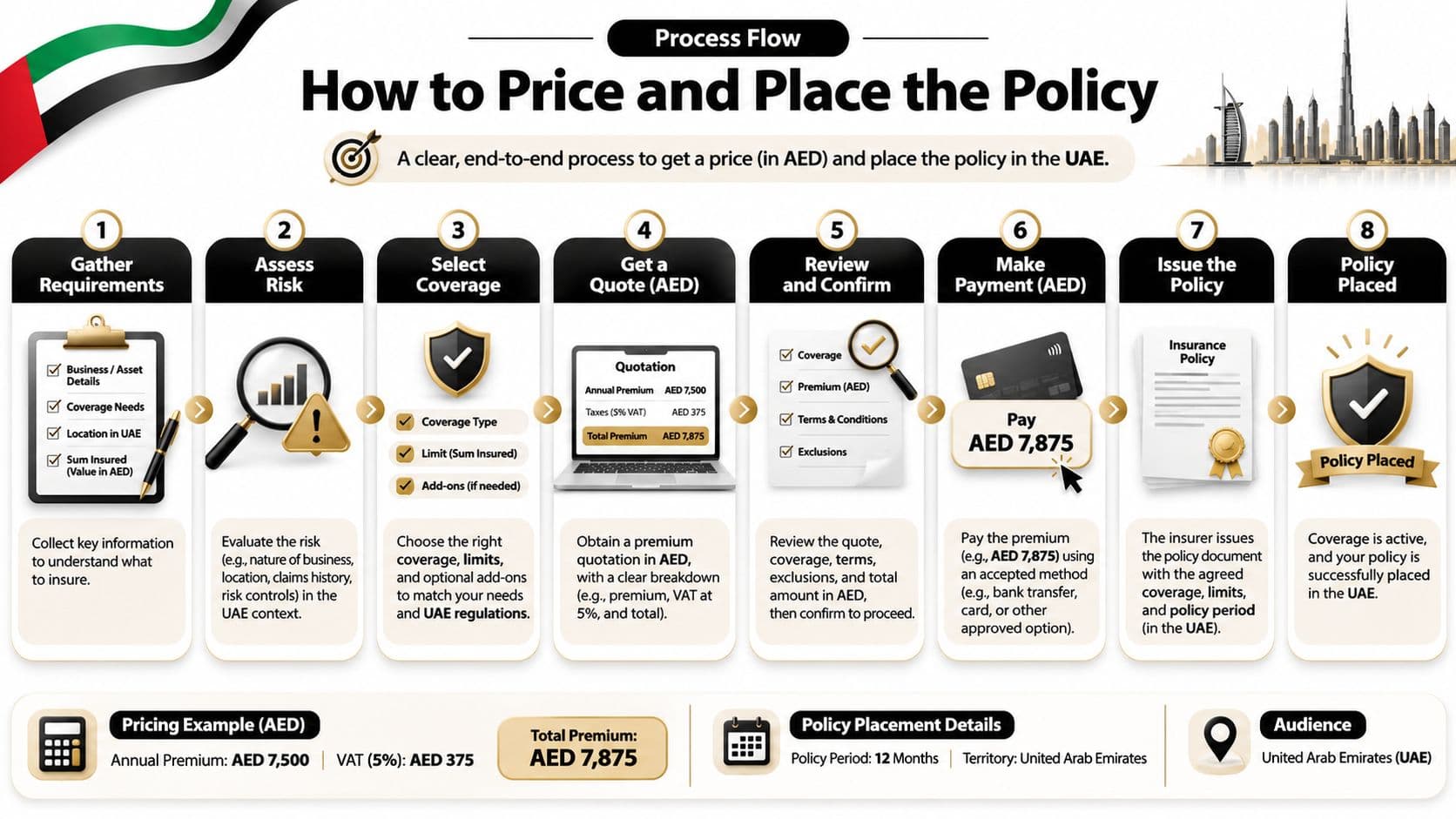
Premium follows the risk, not a published UAE tariff. Any starter price advertised online is incomplete until an underwriter has rated your own proposal, so treat a headline figure as the beginning of a conversation rather than a budget.
Underwriters weigh fee income or turnover, the highest single contract value you've signed, the services described, your claims history, how many years you've traded, the subcontractors you rely on, overseas clients, and the limit and excess you're asking for. A sole consultant with modest fees and a clean record pays far less than an engineering or audit firm seeking a multi-million dirham limit, even where both describe themselves as consultancies.
For regulated activities the policy isn't a risk-management preference at all. UAE legislation governing lawyers and legal consultants requires submission of a valid professional-liability policy issued by an insurer duly licensed in the UAE, and registered experts must maintain valid cover unless the firm's policy covers them. The operational consequence is simple: map each service line and each individual practitioner against the relevant regulator before anyone sets a limit.
What to have ready before you approach an insurer
Bring the trade licence, the professional registration where the activity is regulated, the completed proposal form, fee income split by activity, your largest contracts, CVs or qualifications for key staff, a claims declaration, and any client wording the policy has to match. Missing documents are the usual reason a quotation stalls for a week.
Six steps that get the certificate filed on time
- Set the limit at the higher of the statutory floor and the client clause, then write down which document drove the number.
- Complete the proposal fully, disclosing known problems, complaints and circumstances that could become claims.
- Approach only insurers licensed to write UAE liabilities, and ask each to confirm its local licensing position in writing.
- Compare quotes on structure, not premium alone: the excess, whether the client's required endorsements are included, and how defence costs count against the limit.
- Bind, then diary the renewal, so a three-year registration policy or an annual policy never lapses mid-term.
- File the certificate with the licensing body or the client's vendor team, and keep a copy where a renewal audit will find it.
A firm-wide policy may not protect every partner, employee, subcontractor or separately registered professional, so the proposal should list every entity and practitioner who will be named under the schedule.
How Claims Work for Consultants and SMEs
Say a mainland management consultancy delivers a market study for a retail client. The client uses the numbers in a board paper, the expansion underperforms, and the client alleges the figures were wrong. Fees get withheld, and six months later a legal notice arrives demanding damages.
The instinct is to argue the analysis in writing and settle the fee question. Both instincts can cost the cover. Notification is the step that matters, and it happens before anything else.
The order of events after a complaint
Notify the insurer immediately, attaching the notice, the engagement letter and the deliverable. Don't admit liability or offer a refund without the insurer's consent, because many wordings release the insurer where an insured acknowledges liability unilaterally. Let the insurer appoint defence if the wording gives it that right, and cooperate with whoever it instructs. Keep the full file, including working papers, drafts and emails.
Late notification and a retroactive date that stops short of the work are the two fastest routes to a declined claim. Both are administrative, and both are avoidable.
The first email after a complaint goes to the insurer. The reply to the client can wait one day.
Three patterns that cost SMEs their cover
- The freelance visa holder: they insured only the new free-zone company, so sole-trader work delivered before incorporation sits outside the retroactive date and outside the policy.
- The unnamed subcontractor: a specialist was brought in to deliver part of the project but never appeared on the schedule, so the claim falls on work the policy doesn't cover.
- The undisclosed complaint: a client grumbled about a deliverable, the firm said nothing at renewal, and the eventual claim traced back to the known circumstance.
Habits protect the cover better than any wording. Keep engagement letters that define scope and exclusions clearly, match the services described on the proposal to the activities on the trade licence, diary the notification deadline, and store the certificate with the licence renewal file rather than in a partner's inbox.
One distinction saves a lot of argument. A fee dispute, where the client refuses to pay, may not be treated as a liability claim at all. A demand for damages caused by negligent work is exactly the claim the policy exists for, and it deserves immediate notification even if the amount looks small.
Match the Policy to Your Licence Renewal
The last action is administrative, and it's the one that decides whether the certificate survives contact with a regulator. Put the policy in the same file as the licence, then bring three documents to the placement meeting: the trade licence, any client or tender insurance clause, and the draft schedule.
Check that the insured legal name matches the licensed entity exactly. A certificate issued to a trading name, a parent company or a sister branch is a common reason a free-zone renewal or a client vendor check fails, and it's usually discovered at the worst moment.
The licence, the activity and the named person
Make sure every activity the company sells appears in both the licence and the covered-activities wording. Then confirm that any visa or professional registration sits on the same person named as the insured professional. A licence activity described one way and a policy schedule described another gives an insurer room to argue about scope later.
Compliance discipline: align the licence activities, the professional registration and the insurance certificate in one file, so the renewal date and the policy date get reviewed together rather than a month apart.
A setup and compliance partner earns its place here. Smart Classic Business Hub is a Dubai management consultancy that handles mainland, free-zone and offshore business setup and Company PRO work, and informs clients about the upcoming yearly compliances every company must follow when operating in the UAE. Book a consultation with the licence and the client clause in hand, and ask the adviser to confirm the insurer is licensed for UAE liabilities before anyone ranks quotes by premium.
Professional indemnity is one part of a compliance file that has to hold together, and Smart Classic Business Hub builds that file with you, from Dubai mainland, free-zone and offshore company formation through Company PRO services, trade licence renewals and the yearly compliance calendar that keeps a licence valid. Bring your trade licence, your largest client contract and your renewal dates, and we'll help you work out whether cover is a legal condition, a client condition or a commercial decision for your activity. Visit Smart Classic Business Hub to book a consultation and get the licence, the registration and the insurance certificate pointing at the same entity.