
Financial Year in UAE: Rules and Filing Deadlines


The UAE financial year is either the Gregorian calendar year or any consecutive 12-month period a business uses to prepare its financial statements, and it sets the Corporate Tax period.
If that's your company's reporting year, does it also tell you when to file VAT returns or renew your trade licence? No, and treating those obligations as one calendar is where founders can go wrong. Your accounts, tax filings and licence records need to work together, but they don't necessarily share a closing date.
A useful financial calendar starts with the period shown in your accounts. You then add the Corporate Tax deadline, your assigned VAT periods and your licence-renewal dates as separate obligations, each with its own preparation tasks and owner.
What the UAE Financial Year Is and Which Rules Set It
For Corporate Tax purposes, the financial year in the UAE generally follows the period a business uses to prepare its financial statements, rather than a universal year-end imposed on every company. The Federal Tax Authority's Corporate Tax FAQs explain that this can be the Gregorian calendar year, 1 January to 31 December, or another 12-month accounting period, and that a business which doesn't prepare financial statements defaults to the calendar year.
That distinction matters before you configure your accounting software or commission your first accounts. A non-calendar reporting cycle is possible, but it should be properly established and used consistently, not selected informally when a filing deadline approaches.
Think of the financial year as the boundary around the transactions reported in your annual accounts. Your accountant uses that boundary to establish the closing balances, prepare financial statements and determine the corresponding Corporate Tax reporting period.
Common UAE year-ends and their Corporate Tax deadlines
The Ministry of Finance's Corporate Tax guidance sets the general return and payment deadline at nine months after the relevant tax period ends; applying that rule gives the normal calendar below.
| Year-end | Financial year | Corporate Tax period | Return and payment due |
|---|---|---|---|
| Calendar year, 31 December | 1 January to 31 December | 1 January to 31 December | 30 September of the following year |
| 30 June year-end | 1 July to 30 June | 1 July to 30 June | 31 March of the following year |
| 31 March year-end | 1 April to 31 March | 1 April to 31 March | 31 December of the same year |
| 31 May year-end | 1 June to 31 May | 1 June to 31 May | 28 February of the following year |
| No financial statements prepared | Defaults to calendar year | 1 January to 31 December | 30 September of the following year |
These are normal annual-period examples, not a substitute for confirming the period recorded for your business. A transition period or an unusual first accounting period needs its own review.
Filing and payment belong together in your cash forecast. Finishing the return doesn't complete the process if a tax payment remains outstanding. Give your accountant an internal completion target that leaves room for review, corrections and payment arrangements.
New companies need a deliberate first closing date
In certain incorporation circumstances, the first financial year can run from 6 to 18 months, and it can become the first Corporate Tax period when it begins on or after 1 June 2023, under the Ministry of Finance guidance linked above. A founder incorporating late in the calendar year therefore shouldn't assume that accounts must close after only a few weeks.
Agree the first reporting period before issuing accounts. Check that the constitutional documents, accounting settings and tax position support it, rather than relying on a date entered during setup without further discussion.
Practical rule: Use the reporting period printed on your financial statements as your starting point, not the anniversary of your trade licence.
The company's financial year is also distinct from the federal government's budget year. Government budgeting concerns public revenue and expenditure; it doesn't select your company's accounting cut-off.
Before planning any filing, check the period-end date on your latest financial statements and reconcile it with your tax records. If those records disagree, resolve the discrepancy before treating either date as your filing timetable.
VAT Periods That Run Apart From Your Year-End
VAT follows the tax period assigned by the FTA, not automatically the annual period used for your accounts. The Federal Tax Authority's VAT filing and payment guidance requires returns and payment within 28 days after each VAT tax period ends, with a standard period of three months, although the FTA assigns the actual cycle.
Standard quarterly VAT periods and due dates
The common calendar-quarter pattern produces these dates under that filing rule.
| Assigned VAT tax period | Return and payment due |
|---|---|
| January to March | 28 April |
| April to June | 28 July |
| July to September | 28 October |
| October to December | 28 January of the following year |
These dates are subject to the FTA's weekend and public-holiday rule: a deadline falling on either moves to the first business day. Check the applicable deadline rather than assuming the unadjusted date always applies.
A business can therefore be preparing its annual accounts while also completing a VAT return for an overlapping period. Neither process should hold up the other. Your bookkeeping needs to support both without waiting for the annual audit or final Corporate Tax calculation.
Keep the records connected, not the deadlines
Use a repeatable reconciliation routine:
- Close the bookkeeping monthly. Post sales invoices, supplier bills, credit notes and bank transactions promptly, with supporting documents attached.
- Reconcile each assigned VAT period. Compare sales and purchase records with the VAT control accounts, then investigate missing invoices, incorrect tax codes and unexplained differences.
- Retain a filing reconciliation. Save the calculation supporting each submitted return, including adjustments, so your accountant can trace the figures later.
- Carry reconciled balances into annual accounts. Don't create a disconnected spreadsheet total that nobody can match to the ledger.
Input VAT and output VAT should remain traceable through the accounting records. That doesn't mean VAT returns and financial statements display identical totals, since they serve different reporting purposes. It means the accountant can explain the relationship between them.
Keep a separate VAT calendar beside the Corporate Tax calendar. Record the assigned period, submission deadline, payment deadline and person responsible. Confirm the cycle in your FTA account before copying a standard quarterly template.
Choosing a Year-End Without Regret
A year-end is an operating and cash-flow decision, not a familiar date on a form. Choose a period that your team can close accurately and that allows you to prepare for the resulting tax payment.
Never pick a year-end to postpone a tax bill. A reporting cycle should reflect a defensible accounting arrangement, with the tax consequences understood before you adopt it.
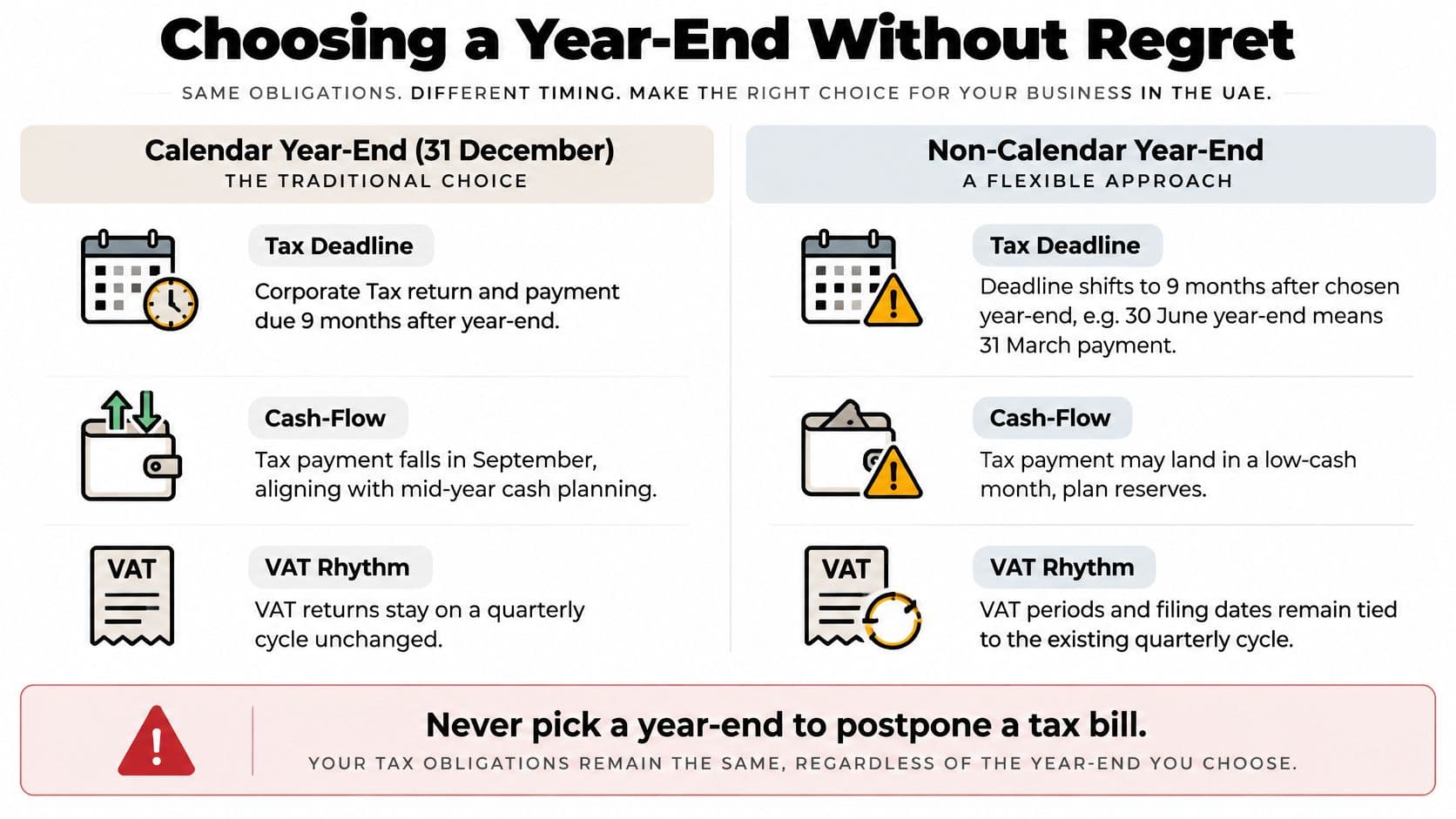
Calendar year-end against an off-cycle year-end
Use the following comparison as a set of questions to investigate, rather than assumptions about every business.
| Criterion | Calendar year-end (31 December) | Off-cycle year-end (30 June) |
|---|---|---|
| Group alignment | Fits a foreign parent that reports on a calendar year | Fits a parent or group using the same off-cycle reporting period |
| Audit timing | Requires agreement on auditor availability during the early-year close | May offer a quieter window, subject to the auditor's capacity |
| Seasonal trading | Can place the close immediately after a holiday trading peak | Places the close in a different trading phase, which should be checked against the sector |
| Licence renewals | Renewal dates follow the licence, not the accounting year-end | Renewal dates follow the licence, not the accounting year-end |
For a foreign-owned subsidiary, start with the parent's reporting requirements. Matching the group's year-end can reduce the need for separate reporting packs prepared on different cut-off dates. Still, confirm that the UAE entity's own documents and tax records support the selected period.
For a seasonal retailer, consider what happens around the proposed closing date. Stock counts, returns, supplier rebates and unsettled customer balances can make an already busy trading period harder to close. A quieter operational window may be more useful than a familiar calendar convention.
Choose against your actual constraints
A new company without group-reporting requirements may prefer the calendar year for administrative simplicity. That's a reasonable starting preference, not proof that it's the right choice for every business.
Ask the accountant and auditor about the work involved before deciding. Consider when staff can complete inventory counts, when customers normally settle receivables and whether the eventual tax payment will coincide with a cash-intensive trading period.
Choose a year-end your team can close reliably and your business can fund, not one that merely looks convenient.
List your most important criteria and score the candidate periods against them. Record the reasons for your choice before the first accounts are issued.
Track licence renewals separately using the actual licence record. Moving the accounting year-end isn't a reason to move a renewal reminder or assume that an existing licence obligation has changed.
How to Change Your Financial Year Without a Compliance Gap
Changing your financial year isn't just editing a date in accounting software. It can change the period covered by the return, the transition accounts, audit planning and the timing of the cash needed for tax.
The FTA's clarification on the first tax period explains the significance of first financial years lasting 6 to 18 months and notes that companies whose first financial year began before 1 June 2023 generally move into a subsequent 12-month tax period beginning on or after that date. Those first-period provisions shouldn't be treated as a general permission to extend an established reporting cycle.

A controlled sequence for the change
Confirm the existing period. Compare your latest financial statements with the period recorded in your tax registration. Resolve any mismatch first, because an incorrect starting date will undermine the transition plan.
Model the proposed transition. Write down the old closing date, proposed new closing date and dates covered by the transition accounts. Calculate the resulting filing and payment timetable, checking that no transactions or reporting periods disappear between the old and new arrangements.
Agree the accounting and audit plan. Ask your accountant and auditor to confirm the cut-off procedures, reporting requirements and delivery schedule. They need to know which period they're preparing or reviewing before they begin closing work.
Document the corporate decision. Obtain the appropriate shareholder or board resolution and update constitutional or registration records where required. Keep the signed approval with the accounting-period assessment so the reason for the change remains clear.
Update systems and calendar labels. Change the accounting system's reporting periods carefully and preserve access to historical reports. Review VAT calendar labels and reconciliations without assuming the assigned VAT periods themselves have changed.
Confirm the tax treatment with the FTA. Establish the applicable application, approval and registration-update requirements before implementing the new period. Don't assume that a corporate resolution alone changes the tax period accepted by the authority.
Start before the current period closes
Prepare a transition file containing the resolution, period map, correspondence, accounting instructions and revised deadlines. Give responsibility for maintaining it to a named person, rather than leaving separate advisers to work from different versions.
Timing safeguard: Begin the review before the existing period closes. Don't use a year-end change as a shortcut for moving a Corporate Tax payment.
Continue working toward existing obligations unless the applicable change has been confirmed. A proposed reporting date isn't a replacement for an established filing responsibility.
Calendar Examples for Founders, SMEs and Foreign Investors
Different businesses can need different closing dates without needing different bookkeeping standards. The FTA's Corporate Tax General Guide explains that the tax period normally follows the financial year, including a non-calendar cycle such as 1 April to 31 March, and that incorporation circumstances can affect the first accounting period.
The following are hypothetical planning scenarios, not confirmation of a particular company's registered periods. Each founder should establish the accounting period first and then build the filing tasks around it.

A startup and an established trading SME
The tech startup incorporates during the year and wants a calendar-year close. Its founder must decide whether the initial accounts will cover a shorter opening period or another permissible first-period arrangement, rather than assuming the maximum available duration is automatically appropriate.
The first-month decision is to agree and document the initial accounting cut-off. The accountant can then calculate the first Corporate Tax deadline from the accepted period, while VAT obligations, if applicable, continue on the assigned cycle.
The trading SME already uses a mid-year close. Its finance team should schedule inventory counting, supplier-statement reconciliation and receivables review around that closing window, then set an internal completion target ahead of the tax deadline.
Its first-month decision is operational: who owns the stock-count plan and the closing timetable? Calendar-quarter VAT filings, where assigned, remain separate workstreams rather than being absorbed into the annual close.
A group subsidiary and a seasonal retailer
The foreign investor's UAE subsidiary follows its parent's spring reporting close. The local accountant prepares the UAE accounts while also meeting the parent's consolidation-pack requirements, which may require earlier delivery than the tax filing timetable.
The initial decision is which group-reporting instructions apply locally. Confirm the cut-off, supporting schedules and review process before assuming the parent's reporting pack is sufficient for UAE compliance.
The seasonal retailer selects a late-spring close because its stock-counting and returns work can be completed after its own peak trading period. The decision only makes sense if the business's actual sales and inventory pattern supports it.
Its opening-month task is to compare the proposed close and eventual tax-payment window with its cash forecast. A consultancy using a calendar close would make the same funding assessment against its own receivables pattern instead.
For every profile, use the FTA-assigned VAT period, not the business label or the financial year-end, to build the VAT schedule.
Your Year-End Checklist and Next Step
A useful compliance checklist identifies the evidence behind each date, the person responsible and the preparation needed before filing. A reminder that says “tax due” won't tell your team whether the accounts, review and payment arrangements are ready.
Verify the calendar against the records
- Financial statement period. Confirm the opening and closing dates on the accounts and retain the documents supporting the selected financial year.
- Corporate Tax obligation. Check the recorded tax period, return deadline and payment deadline. Give the preparer and reviewer separate internal completion targets.
- Assigned VAT periods. Confirm the periods in the FTA account and enter their actual submission and payment dates, including any applicable holiday adjustment.
- Audit completion. Agree when the auditor needs the trial balance, reconciliations, inventory evidence and supporting schedules.
- Licence renewals. Copy expiry and renewal information from the licence records, with an owner responsible for the supporting documents.
- Record alignment. Ensure the accounting system and Corporate Tax records reflect the correct financial year. Keep VAT records aligned with their own assigned periods, rather than forcing them into the annual reporting cycle.
- Payment readiness. Review the cash forecast and identify who will authorise and execute each payment.
Resolve uncertainty before closing
Schedule an annual compliance review while there's still time to correct ledger entries, obtain missing documents and adjust the audit timetable. An early review is particularly useful after incorporation, a group restructure or a proposed change of reporting period.
At Smart Classic Business Hub, we inform clients about upcoming yearly compliances for companies operating in the UAE. Our team includes Faisal as VAT, Corporate Tax and Bookkeeping Specialist, and Shammas as Accounts Specialist.
Bring the latest financial statements, your FTA period information and licence records to the review. The objective is a confirmed calendar, with each obligation supported by the correct record and assigned to someone who will complete it.
Smart Classic Business Hub offers VAT, Corporate Tax and bookkeeping support to help you check your year-end alignment and prepare for the applicable filing deadlines. Visit Smart Classic Business Hub to book a consultation if any date in your checklist is unclear, and confirm your reporting period before your next filing.