
Import Export Company Dubai: 2026 Setup Guide


The most popular advice about starting an import-export company in Dubai is to compare licence packages and buy the cheapest one. That's the wrong starting point. Choose the structure that can handle your cargo, then calculate how much cash the shipment consumes before your customer pays.
A licence won't fund supplier deposits, fix an incorrect customs declaration or stop storage charges while you chase a missing permit. Build the business around where you'll sell, who'll import the goods and how you'll finance each shipment. The formation paperwork should follow those decisions, not dictate them.
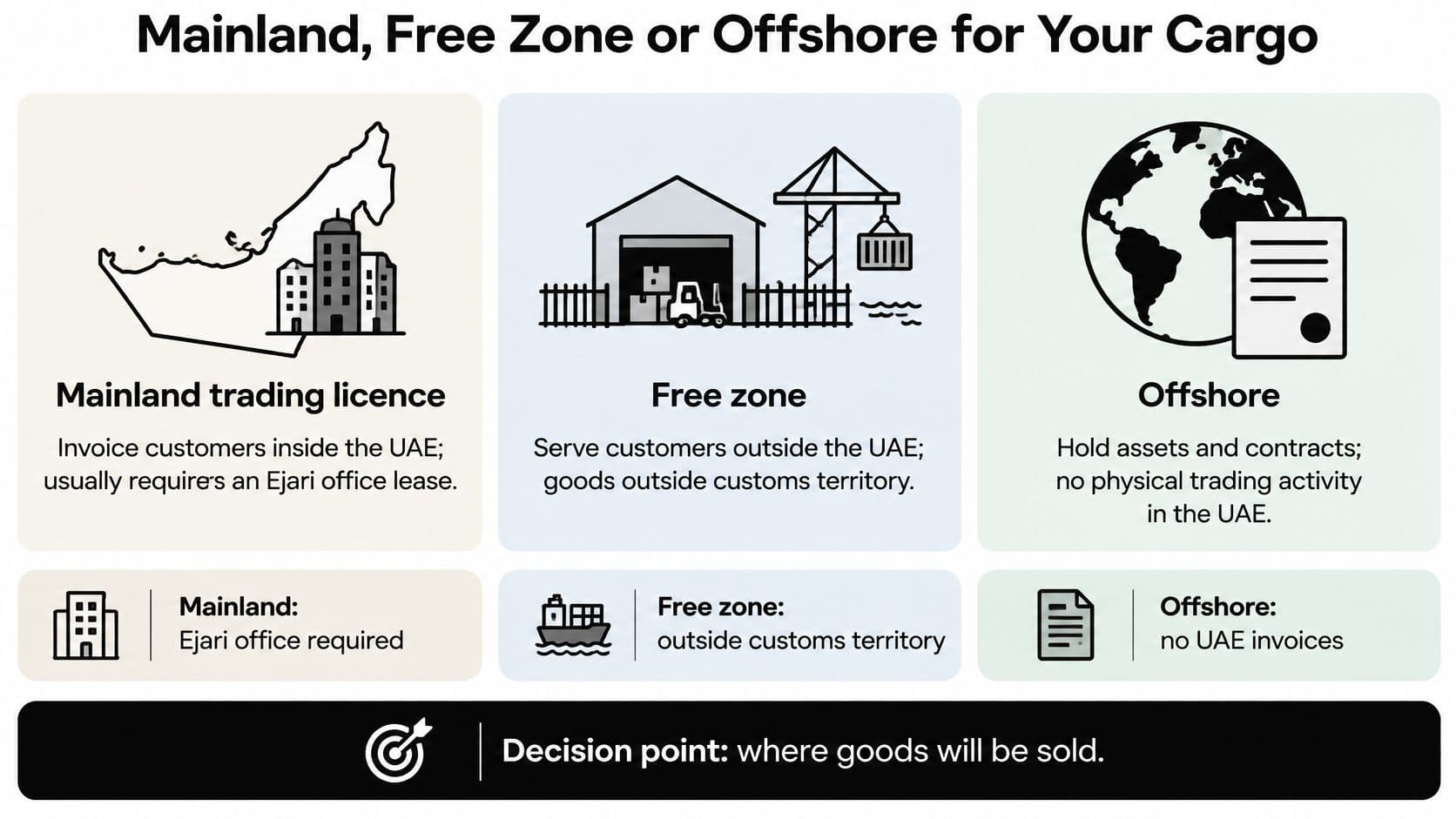
Mainland Free Zone or Offshore for Your Cargo
Where will the goods be sold? Answer that before choosing an authority, office or visa package. A business supplying UAE retailers needs a different operating arrangement from a distributor holding stock for overseas buyers.
For direct domestic distribution, a mainland trading licence is usually the practical choice. Confirm the permitted product activities with Dubai's Department of Economy and Tourism, the accepted premises arrangement and any product-specific approvals. Don't assume a broad activity description authorises every category you intend to import.
A logistics free zone, such as Jebel Ali Free Zone beside Jebel Ali Port, suits businesses that need warehousing, consolidation and re-export facilities. However, free-zone registration doesn't make mainland deliveries an internal stock transfer. Decide who will handle mainland importation before promising delivery to a UAE buyer.
Where to base an import-export company in Dubai
| Structure | Sell inside the UAE | Customs position | Visas | Typical timeline |
|---|---|---|---|---|
| Mainland trading licence | Yes, within licensed activities | Import into UAE customs territory | Investor and employee routes, subject to approvals | Schedule after activity, premises and external approvals are confirmed |
| Jebel Ali Free Zone or similar logistics zone | Mainland sales need an authorised mainland import route | Bonded storage and re-export under the relevant customs procedure | Free-zone sponsorship, subject to package and premises eligibility | Schedule after zone, facility and cargo requirements are accepted |
| Offshore company | No local physical goods trading through the offshore entity | Not the vehicle for clearing commercial cargo into Dubai | Not a normal operating-company residence visa route | Obtain the registrar's written processing schedule after document review |
An offshore company may fit overseas contracts or asset-holding arrangements. It's not a substitute for an operating trader that needs customs registration, warehouse access and staff in Dubai.
Budget for the operating structure, not the headline package
There's no defensible universal fee band for these alternatives without identifying the authority, activities, premises and visa requirements. Use a current, itemised authority quotation, not a promotional starting price.
Separate the quotation into:
- Authority charges: Name reservation, incorporation, licence issuance and activity approvals.
- Premises costs: Accepted office or warehouse arrangements, tenancy documentation and deposits.
- Immigration costs: Establishment documentation and the visa applications you need.
- Professional charges: Formation support, document preparation and ongoing administration.
Ask for renewal charges alongside initial costs. A low entry price can hide an unsuitable facility package or exclude the documents needed to operate.
Practical rule: Choose mainland for direct UAE distribution, a logistics free zone for bonded storage and re-export, and offshore for genuinely overseas contracting without local cargo operations.
If your business combines domestic sales and overseas distribution, map both routes before filing. The cheapest licence is a poor saving when you later need another entity or an unplanned importer to move the stock.
How to Register the Company and the Visas
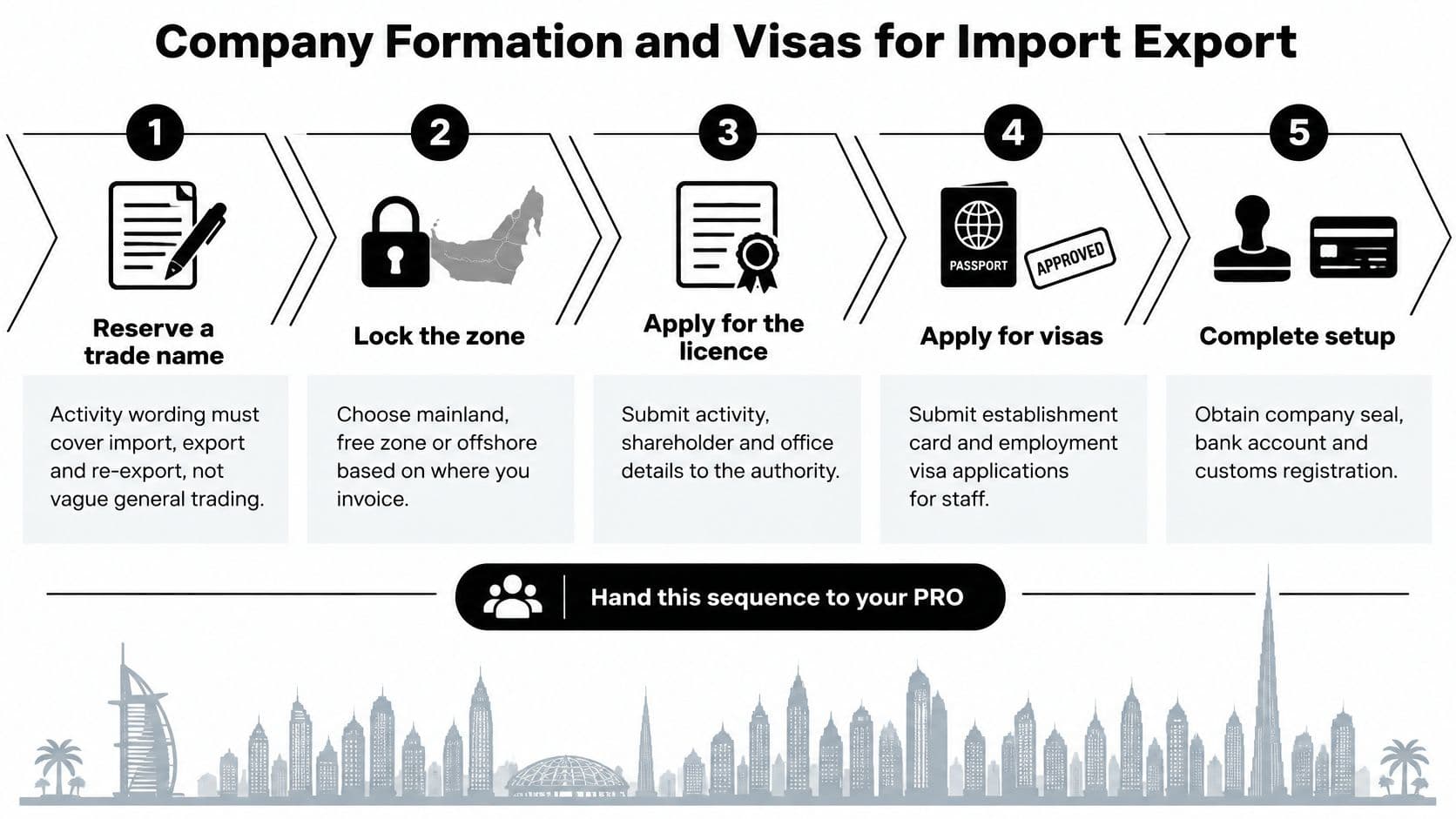
Treat formation as a coordinated file, not a series of disconnected applications. Your PRO, accountant and freight forwarder should work from the same description of the business: products, suppliers, buyers, storage location and expected shipment route.
The sequence below is the working checklist. Banking and immigration can progress alongside other tasks where permitted, but neither should be treated as automatically completed when the licence arrives.
Build an application that matches the business
Reserve the name and confirm the activities. Select activity wording that matches the goods and transactions you intend to undertake, including re-export where relevant. The document that can block progress is the activity approval: a supplier's product list won't override an unsuitable licence.
Lock the jurisdiction and premises. Secure an office, desk or warehouse arrangement accepted for the chosen activity. For a mainland application requiring registered tenancy, organise the Ejari documentation. A missing or unsuitable tenancy agreement can stop an otherwise complete file.
Assemble the shareholder documents. Prepare passport copies, photographs, address evidence and the authority's shareholder forms. Corporate shareholders need their own supporting corporate documents. Check name spellings and signature consistency before submission.
Authorise the representative properly. If someone files or signs on your behalf, confirm the required scope and execution of the power of attorney. An unsigned document or authority that doesn't cover the transaction can prevent the representative from completing it.
Submit, pay and collect the company documents. Obtain the trade licence and relevant constitutional and establishment documents. Check the issued activity wording immediately, rather than discovering a mismatch during customs registration or banking.
Complete the operating registrations
Prepare the corporate bank application. Present the licence, constitutional documents, ownership information and premises evidence requested by the bank. Include a credible supplier list, intended buyer markets and transaction narrative. Unsupported turnover estimates and unexplained payment routes create avoidable questions.
Arrange customs and tax readiness. Obtain the appropriate Dubai Customs client registration before commercial cargo arrives. Have the accountant assess VAT registration against actual and expected activity, rather than assuming every newly formed company must register immediately.
Complete immigration and employee administration. Organise establishment documentation, the relevant investor or partner visa process, medical fitness requirements, biometrics and Emirates ID. Set up the employment administration needed for staff, then record renewal and expiry obligations.
Don't accept a single promised completion date that bundles licensing, banking and visas without explaining the dependencies. Request separate milestones for application acceptance, licence issuance, bank review and immigration completion.
At Smart Classic Business Hub, our Company PRO services support mainland, free-zone and offshore businesses. We also provide trade licence services, government approvals, investor visa applications and licence renewals, so the formation file can be coordinated with the administrative work that follows.
A licence-ready company isn't necessarily shipment-ready. Confirm the bank, customs registration and product approvals before releasing the supplier's dispatch instruction.
How to Clear a Shipment with Dubai Customs
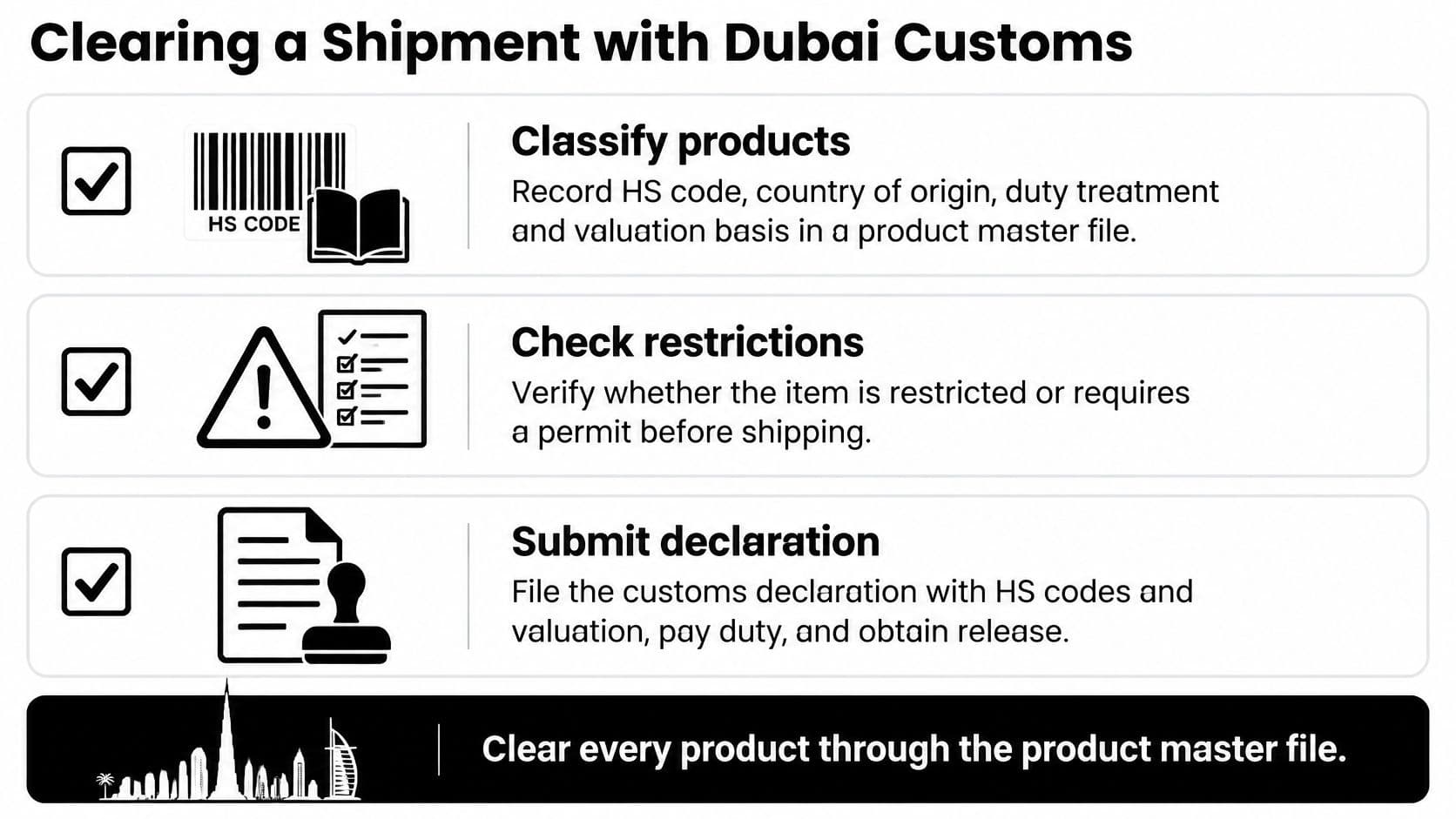
The licence is the easy part. Shipment-level costs and records determine whether your import clears cleanly and whether you have enough working capital to keep trading. Start by confirming the product classification before booking freight. The HS code affects duty treatment, restrictions and the information required in the declaration. A forwarder can file the entry, but your company remains responsible for supporting the product description and declared value.
Dubai Customs' reporting framework uses HS-code classification, automated verification and validation. Keep product records consistent across shipments instead of guessing anew each time.
Run a controlled clearance file
Build a product master. Record each SKU's precise commercial description, HS code, country of origin, duty treatment, permit requirements and valuation basis. Keep technical specifications and classification evidence with the record.
Check restrictions before dispatch. Identify health, food, telecommunications or other product-authority requirements. Obtain applicable approvals before the supplier loads the cargo. An invoice does not replace a product permit.
Prepare matching shipment documents. Assemble the commercial invoice, packing list, certificate of origin and bill of lading or air waybill. Check that quantities, weights, consignee details and descriptions agree throughout.
Choose the right customs regime. Tell the declarant whether the movement is an import, export, transit, transfer or temporary admission. Stock intended for another destination should not be filed under a default import instruction.
Review sensitive declarations independently. Have another person check high-value or controlled goods before submission. Confirm classification, value, origin and permit references, not just spelling.
Reconcile after release. Match the accepted declaration against warehouse receipts, inventory movements, and purchase and sales records. Investigate quantity differences promptly, and attach the declaration reference to the stock transaction.
Prevent errors before the cargo arrives. A broker chasing a held shipment cannot replace correct classification, complete paperwork or permits.
Use advance decisions and parcel facilities carefully
If a product's customs treatment is uncertain, seek a binding advance ruling before committing to the shipment. A forwarder's informal view may help with planning, but it is not a binding decision.
The UAE trade-data guidance describes conditional e-commerce facilities: duty waivers for eligible shipments with CIF value up to AED 1,000, declaration-registration fee waivers for shipments up to AED 30,000, and duty refunds on qualifying returns within 60 days.
Treat each facility as an eligibility question, not an automatic saving. Confirm the applicable programme, cargo conditions and return procedure before factoring a waiver into your price. Keep electronic orders, payment evidence, origin documents, valuation support and records linking a return to its original shipment. Automation can reduce manual entry; it cannot correct inaccurate source records or make restricted goods eligible.
VAT Accounting and Tax Residency Rules
Customs duty, import VAT and corporate tax need separate calculations. Duty may become part of inventory cost. Recoverable VAT is a receivable when the rules allow recovery. Corporate tax applies to taxable business income, not the value of a container.
Cash timing still matters. You may need to fund import VAT before reclaiming it or collecting payment from your customer. Confirm the import VAT payment or accounting method with your accountant before estimating the cash required at clearance.
UAE VAT and corporate tax thresholds
Use these figures to set up your tax checklist, then confirm how the rules apply to your company and transactions.
| Item | Value |
|---|---|
| Standard VAT rate | 5% |
| Mandatory VAT registration | AED 375,000 in taxable supplies and imports |
| Voluntary VAT registration | AED 187,500 in taxable supplies, imports or eligible expenses |
| Corporate tax rate | 0% on taxable income up to AED 375,000; 9% above AED 375,000 |
| Free-zone preferential rate | 0% on qualifying income for a qualifying free zone person that meets the applicable conditions; other taxable income is subject to the relevant corporate tax rules |
A free-zone licence does not make all income tax-free. Have an accountant assess the company's status, income and eligibility conditions. If the company has mixed activities, do not assume that the treatment of one income stream applies to every receipt.
Free-zone customs arrangements do not decide the VAT treatment of every supply, import or stock movement. Review each transaction on its own facts and keep the supporting records with it.
Keep a shipment-level accounting trail
Assign each shipment a reference that connects the purchase, border and tax records:
- Purchasing: Supplier invoice, freight, insurance and payment evidence.
- Customs: Declaration, assessed charges and release documents.
- Inventory: Goods received, shortages, transfers and customer dispatches.
- Tax reporting: VAT treatment, recovery evidence and accounting entries.
Separate recoverable amounts from permanent expenses. Otherwise, you can overstate gross margin by leaving genuine border costs out, or understate it by treating recoverable tax as a permanent charge. Reconcile the records shipment by shipment.
A tax residency certificate serves a separate purpose. It supports a residency position in the relevant tax context. It does not authorise imports, replace customs registration or guarantee treaty relief in another country.
Prepare an application using the applicant's actual circumstances and required supporting evidence. If the company or founder has overseas interests, assess the residency position alongside foreign obligations. UAE incorporation alone does not settle how another jurisdiction treats the applicant.
Accounting control: The customs declaration, inventory ledger and tax records should describe the same transaction. Explain and support any differences.
Working Capital Every Shipment Actually Needs
A shipment consumes cash before it produces collected revenue. Supplier deposits, freight bookings and border charges may fall due while your buyer is still waiting for delivery. Profit on the sales invoice doesn't mean you can finance the next purchase order.
The scale of the opportunity doesn't remove that risk: UAE trade data reports that non-oil imports exceeded AED 2.1 trillion in 2025, growing 25.7% year-on-year. Build your funding plan around your own payment dates, not national trade growth.
Walk the shipment through the cash cycle
Consider a mainland distributor buying stock from an overseas manufacturer. The supplier requires a deposit before production and the balance before releasing the shipping documents. The customer pays only after delivery and acceptance.
Start with the product purchase price. Add freight and insurance without counting amounts already included in the supplier's agreed delivery terms. Establish the customs value separately, because it isn't another expense to add to the purchase cost.
Then apply the confirmed duty treatment and import VAT accounting arrangement. Add declaration charges, handling, inspection, transport to the warehouse and storage. Include finance charges and a reserve for a credible delay.
The working-capital calculation is:
Peak shipment funding = cumulative cash paid before collection, less supplier credit, customer deposits and financing available.
That's different from landed cost. Landed cost measures the cost of getting saleable goods into the intended location, while peak funding measures the cash you must have available at the most demanding point.
Cash tied up by shipment type
| Cost item | Mainland import | Free-zone re-export | Courier e-commerce |
|---|---|---|---|
| Customs duty | Budget the confirmed HS-code treatment | Suspension may apply under the relevant bonded procedure; mainland entry needs separate treatment | Apply a waiver only after confirming eligibility |
| Import VAT | Budget the actual payment or accounting mechanism and recovery timing | Assess stock movements and supplies under the applicable VAT rules | Assess place of supply, importer responsibility and registration |
| Declaration and handling | Obtain regime-specific customs and broker charges | Include inbound and outbound processing | Separate courier charges from eligible government fee relief |
| Storage and demurrage | Reserve cash for clearance delays and equipment return | Budget warehouse dwell time and delayed outbound bookings | Include failed delivery, return handling and consolidation |
| When cash returns | Customer collection date, not invoice date | Overseas buyer's cleared payment | Payment-provider settlement, less refunds and retained amounts |
Read the mainland column as a funding commitment through delivery and collection. Negotiate customer deposits or staged payments where the supplier demands cash upfront. Don't promise generous customer credit unless you've funded the resulting gap.
For free-zone re-export, suspended duty doesn't make the shipment cash-free. Stock, warehouse occupancy, handling and outbound freight still need financing. Confirm the overseas buyer's readiness before holding inventory indefinitely.
For courier parcels, settlement can precede final resolution of returns. Retain a refund reserve and reconcile the courier, payment provider and stock records before treating the balance as available profit.
Measure the costs you can control
Track declaration first-pass acceptance, customs-release cycle time, landed-cost variance, demurrage per shipment and gross margin after border costs. Assign an owner to each exception rather than recording unexplained monthly totals.
Dubai Customs' trade-flow reporting distinguishes imports, exports and re-exports. Your internal records should preserve those distinctions too, including the outbound declaration supporting a re-export.
Reject an order if its margin or cash requirement doesn't survive a realistic delay. A cheap licence won't compensate for an unfunded supplier balance.
Choose a Dubai Setup Partner and File
Choose a filing partner by the decisions it documents, not the package headline. A useful proposal should explain why the structure suits your cargo and identify what remains outside the quoted scope.
Start with the exact activity wording and issuing authority. Then establish the accepted premises, visa eligibility and renewal obligations. If the proposal describes everything as general trading without checking your product list, it hasn't answered the operating question.
Require a written division of responsibilities
Before paying, make sure the proposal identifies:
- Formation deliverables: Name reservation, activity approval, company documents and licence issuance.
- Operational registrations: Who handles the customs client code, tax assessment and any product-authority applications.
- Document responsibilities: What you must supply, what needs certification and who can sign.
- Fee ownership: Government and zone charges separated from professional fees, premises and third-party costs.
- Delivery milestones: A week-by-week target schedule, with dependencies and client actions clearly marked.
- Ongoing administration: Responsibility for licence renewal, establishment records, visas and accounting handover.
Check the treatment of rejected applications, additional approvals and changes to the original scope. These belong in the engagement terms, not in a conversation after you've paid.
Our business setup services cover mainland, free-zone and offshore formation, alongside PRO support and investor visa services. We also provide VAT-compliant accounting and related financial support, which helps connect incorporation decisions with the records an operating trader needs.
Remove avoidable signing and renewal problems
Don't book a flight solely to sign a power of attorney without checking the available process. Our UAE Power of Attorney service can be completed online without physical visits, subject to arranging the appropriate authority for the intended matter.
We're based in Baniyas Square, Dubai, and inform clients about upcoming yearly compliance obligations. Keep those reminders within your own compliance calendar too, with a named person responsible for each deadline.
The filing decision should end with an approved structure, a funded shipment plan and a written scope. It shouldn't end with a payment receipt and unanswered questions about who can import the goods.
- Choose the operating structure. Confirm the customer market, importer responsibility and warehouse route before authorising formation.
- Reserve shipment funding. Build the cash schedule through supplier payment, clearance, delivery and customer collection, including a delay reserve.
- Book the scoping consultation and approve the proposal. Bring the product list, supplier terms, intended buyer markets and staffing requirements. Obtain the written responsibilities, fee breakdown and milestone schedule before paying a licence fee.
Smart Classic Business Hub offers mainland, free-zone and offshore company formation, PRO services, investor visa support and VAT-compliant accounting for businesses establishing operations in Dubai. Visit Smart Classic Business Hub to arrange a scoping consultation, and bring your cargo list, sales destinations and supplier payment terms so the setup recommendation addresses the shipment you need to move.