
The numbers should change how you think about online earning in uae. The UAE’s e-commerce sector reached AED 32.3 billion in 2024 and is projected to surpass AED 50.6 billion by 2029, while the country added 372,000 internet users between January 2024 and January 2025 (UAE earning apps market data). That isn’t a side-hustle story. It’s a mature digital market getting bigger, faster, and more competitive.
Most advice online still treats the topic like a list of apps, gigs, and hacks. That approach fails in the UAE because the primary bottleneck usually isn’t demand. It’s compliance. People can find clients, open seller accounts, and collect a few payments. Then the friction starts. Banks ask questions. Platforms want proper documents. Visa status matters. Payment flows get interrupted. In some cases, people discover too late that the way they’re working isn’t properly licensed.
If you want online income that lasts, treat it like a business from day one. Pick the right legal structure. Match your activity to the correct licence. Separate your residency status from your trade permissions. Keep your records clean. That’s how you avoid the expensive mistakes that wipe out momentum just when revenue starts to come in.
The New Digital Gold Rush in the UAE
The opportunity is already established. What separates profitable online operators in the UAE from the ones who stall out is usually not demand. It is whether the business can stand up to licensing checks, bank reviews, platform verification, and tax administration.

I see the same pattern often. Someone starts selling services, digital products, coaching, or training online. Revenue comes in. Then a bank asks for a trade licence, a platform asks for business documents, or a client asks for a proper tax invoice. The business looked simple at the start, but the compliance gap shows up as soon as money begins to move consistently.
That is why online earning in the UAE should be treated as a regulated commercial activity early, not as an informal side arrangement you fix later.
The room for online income is broad. Freelancers can sell specialist services. E-commerce sellers can build direct-to-consumer brands. Consultants can package expertise into retainers, audits, or advisory offers. Educators can build digital products and courses, and if that is your model, this guide on how to start making money with online courses is a useful reference for the commercial side. In the UAE, each of those models can work. Each also creates different licensing, visa, payment, and bookkeeping requirements.
Why Compliance Creates a Competitive Advantage
A proper structure does more than reduce risk. It makes the business easier to run and easier to grow.
- Banking gets easier: Banks are more comfortable when your licence activity matches the source of funds hitting the account.
- Client onboarding gets faster: Larger companies often ask for a licence copy, contract, and compliant invoice before they release payment.
- Platform friction drops: Marketplaces and payment processors often request verification documents once volumes increase.
- Immigration exposure goes down: Earning through the wrong visa status can create avoidable problems.
- Growth options stay open: Hiring, sponsorship, VAT registration, and supplier relationships all depend on having the basics set up correctly.
This is the part many articles miss. In the UAE, compliance is not a back-office detail. It directly affects whether you can collect money reliably and keep operating without interruption.
A lot of new earners confuse access with approval. They can open a seller account, post an offer on social media, or send an invoice to an overseas client, so they assume the structure behind it must be acceptable. That assumption causes expensive delays. The UAE is open to digital business, but the activity, licence, residency position, and banking profile still need to line up.
What serious earners check early
The better question is not how to make money online fast. The better question is whether the income model can be documented, licensed, invoiced, and banked properly in the UAE.
Serious operators ask:
- What am I selling?
- Which licence activity fits that work?
- Do I need a freelance permit, a free zone company, or a mainland licence?
- Will I need residency through the business, or am I already covered?
- How will I receive funds without creating banking issues later?
- When do accounting records and VAT become part of the setup?
These are not administrative details. They are the foundation of sustainable online income in the UAE.
Mapping Your Online Income Path
Not every online model fits the UAE equally well. Some are fast to start but difficult to formalise. Others take longer to build but become more bankable, more scalable, and easier to defend from a compliance standpoint.
The best path depends on what you’re selling. Skill-based services, digital products, e-commerce, and audience-led businesses each behave differently.
Freelancing and service work
For most professionals, freelancing is the cleanest starting point. It converts existing skills into revenue without the overhead of stock, warehousing, or large upfront spend. In the UAE, that includes design, copywriting, SEO, paid media, development, video editing, consulting, virtual assistance, and newer digital niches like AI support services.
The commercial case is strong. The UAE freelance platforms market is projected to grow from USD 101.7 million in 2025 to USD 420.1 million by 2033. In the same market, certified Fiverr Pro sellers in the UAE report average monthly earnings of AED 5,000 to AED 25,000, with top performers exceeding AED 50,000 monthly (UAE freelance platforms outlook).
That said, freelancing only works well if you stop behaving like a bidder and start behaving like a specialist. General profiles get ignored. Narrow offers sell.
If your profile says you do “design, marketing, content, admin, and strategy”, clients hear that you’re unfocused. If it says you help UAE clinics run paid ads or write conversion copy for SaaS landing pages, they know where to place you.
A useful extension of this model is education-based income. If your expertise can be packaged, you can pair services with digital training. For creators and consultants exploring that route, this guide on how to start making money with online courses is a practical companion to a service-led business.
E-commerce and product-led selling
E-commerce suits founders who want to build an asset rather than bill for time. The UAE is a strong market for product-led online business because digital shopping behaviour is already established and logistics expectations are high. That creates demand, but it also means buyers expect quick fulfilment, clear policies, and reliable customer support.
There are several operating styles under the e-commerce umbrella:
- Reselling: Faster to start, but margins can be tight.
- Private label: Better brand control, but more operational complexity.
- Dropshipping: Low stock risk, but quality control and delivery standards can damage reputation quickly.
- Niche storefronts: Often stronger than broad catalogues because they sharpen positioning.
What usually fails is treating e-commerce like a passive income shortcut. It isn’t. Product sourcing, returns, ad spend, platform rules, consumer protection expectations, and payment reconciliation all need active management. If you want an online business that can eventually run with staff and systems, this model has potential. If you want simplicity, it rarely delivers that in the early stage.
Content creation and audience businesses
Content-led income attracts people because entry barriers are low. You can begin with a phone, a niche, and consistency. In practice, though, content businesses are harder than they look because monetisation usually lags behind audience growth.
This route works best for people who understand one thing clearly. The audience is not the business. The offer is the business. Content only becomes commercially useful when it leads to one or more revenue streams such as sponsorships, affiliate revenue, consulting, memberships, or digital products.
The UAE market is particularly responsive to content that combines trust and specificity. Broad lifestyle content is crowded. Category expertise is easier to monetise. Finance education, beauty, fitness, career development, business advisory, and local market explainers usually perform better as commercial platforms than vague motivation content.
Affiliate marketing and referral income
Affiliate income has appeal because you don’t handle fulfilment. You recommend products or services and earn when conversions happen. The difficulty is that many people approach it backwards. They start with links and no audience. That rarely produces serious income.
Affiliate work tends to perform better when it sits on top of another asset:
- A niche blog
- A YouTube channel
- An email list
- A trusted social audience
- A comparison or review site
This model can be useful in the UAE, especially in business services, software, education, and consumer niches where trust matters. But it’s rarely the best first model if you need immediate income. Service work pays faster. E-commerce builds a brand asset. Affiliate income usually needs patience and distribution.
A practical way to choose
If you need cash flow quickly, services are often the best first move. If you want a brand with resale potential, e-commerce may fit better. If you’re strong on camera or in writing, content can become a long-term engine. If you already have traffic, affiliate income can add a profitable layer.
The mistake isn’t choosing the wrong model forever. The mistake is choosing one that doesn’t match your current skills, tolerance for admin, and ability to operate legally in the UAE.
Choosing Your Legal Foundation Mainland vs Free Zone
The legal structure is where most online earners either protect their future or limit it. In the UAE, the main options are a mainland company, a free zone company, or a freelance permit. Each can work. Each can also become the wrong choice if it doesn’t match how you’ll earn.
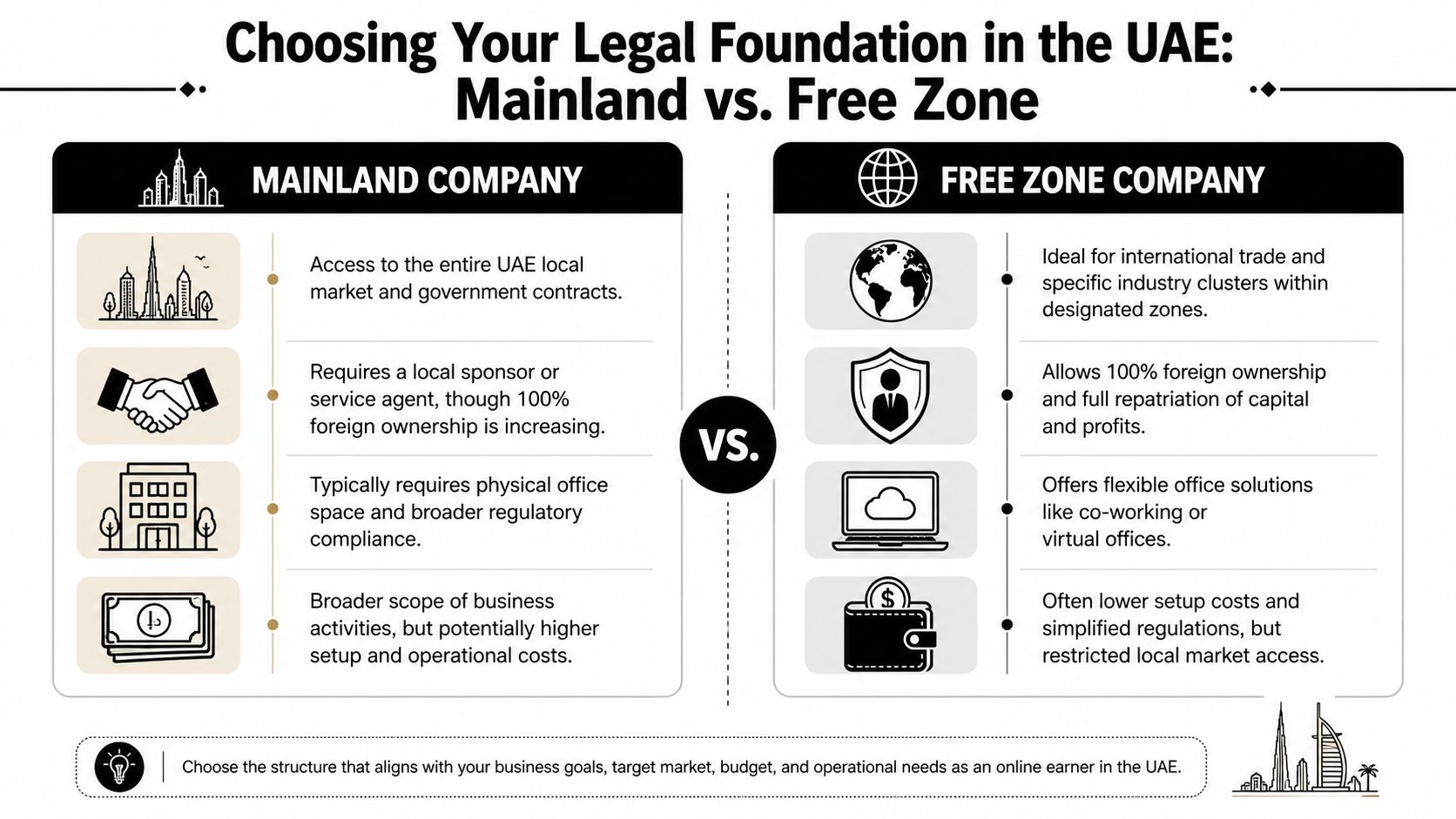
A lot of bad setups come from people asking only one question: “What is cheapest?” Cost matters, but scope matters more. A cheaper structure that blocks your banking, limits your activity, or forces a restructure later can be more expensive in practice.
The three routes at a glance
| Feature | Mainland Company | Free Zone Company | Freelance Permit |
|---|---|---|---|
| Best for | Businesses targeting the UAE local market broadly | Online businesses serving regional or international clients | Solo professionals selling personal services |
| Ownership | Depends on activity and structure | Commonly chosen for full foreign ownership | Usually suited to one individual operator |
| Business scope | Broad local trading and service flexibility | Strong for digital, remote, and cross-border work | Narrower, tied to approved freelance activities |
| Operational style | Better for firms planning teams, premises, or broad commercial activity | Efficient for lean online operations | Best for one-person service businesses |
| Residency path | Can support investor or partner residency route | Can support investor or partner residency route | Often paired with freelance visa route |
| Scalability | Strong for long-term expansion inside the UAE | Strong for digital-first growth | Good for starting, weaker for larger teams |
| Typical fit | Agency, consultancy, e-commerce operator, trading business | Consultancy, tech, services, digital brand, international seller | Designer, writer, developer, marketer, consultant |
For a broader breakdown of business setup options, this guide to mainland vs free zone in Dubai is useful if you’re weighing market access against operational simplicity.
When mainland makes sense
A mainland structure is usually the better call when you want broad access to the UAE market. If your plan involves serving local companies at scale, taking on bigger contracts, operating across multiple activities, or building a team with room to expand, mainland deserves serious consideration.
This route is often stronger for businesses that won’t remain “just online” forever. For example, an agency may start with remote service delivery but later need office space, staff visas, and a wider activity scope. A product seller may begin online and later move into local distribution, retail partnerships, or government-linked opportunities.
Mainland isn’t automatically the right answer for solo earners, though. It can bring more administration and may be more structure than a one-person operation needs in the early stage.
When free zone is the better fit
Free zone setups are often the most efficient option for digital businesses. They suit consultants, online service firms, digital agencies, creators with monetised operations, and cross-border businesses that don’t need unrestricted local trading in the same way a broader mainland business might.
This is why many online earners gravitate to free zones. The structure is often easier to align with remote work, digital delivery, and lean operations. If your clients are international, your product is digital, or your model depends on online sales rather than physical local presence, a free zone company often gives enough structure without excessive overhead.
The right free zone isn’t the one with the loudest marketing. It’s the one whose approved activities actually match what you sell and how you get paid.
That point matters more than people realise. A mismatch between stated activity and actual operation can create issues later when dealing with banks, payment processors, or counterparties doing due diligence.
Where the freelance permit fits
For many individuals, the freelance permit is the most practical entry point. It’s especially suitable for solo professionals who are selling their own time and skill rather than building a multi-service company immediately.
According to UAE freelance permit guidance, obtaining a freelance permit from a free zone such as SHAMS or GoFreelance typically costs AED 7,500 to AED 15,000 annually including a visa. The same source states a 95% approval rate for complete applications, and reports that 70% of permitted freelancers reach over AED 10,000 per month within six months. The same guidance also notes a serious risk on the non-compliant side. Attempting to work without a licence can lead to fines up to AED 50,000.
Those numbers are useful, but the structural lesson is more important. The freelance permit works well when your business is still centred on you. It becomes less ideal once you want multiple staff, broader commercial activities, or a bigger brand that isn’t tied to one person’s profession.
What works and what doesn’t
Some patterns are consistently sound.
- Freelance permit works well for a designer, copywriter, developer, consultant, or solo marketer with direct clients.
- Free zone company works well for a digital agency, online shop, coaching business, education brand, or international service firm.
- Mainland company works well for a business planning wider UAE market activity, broader commercial scope, or operational expansion.
Other patterns create trouble.
- Using a freelance permit for a business that’s already operating like a company
- Choosing a free zone purely on price without checking permitted activities
- Operating informally because the first few client payments came through without issue
- Assuming visa status alone gives commercial permission to earn online
A simple decision filter
Ask yourself these questions before choosing:
- Am I selling my own labour or building a broader business?
- Will I mainly serve UAE clients, overseas clients, or both?
- Will I stay solo, or do I expect to hire and expand?
- Do I need the simplest legal entry, or do I need room to scale?
- Will my banking story make sense when the bank reviews my transactions?
If you answer those truthfully, the right structure usually becomes obvious. The expensive part is not setting up. The expensive part is fixing the wrong setup after revenue starts.
Securing Your UAE Residency and Visa
A business licence and a residence visa are connected, but they aren’t the same thing. People mix them up all the time. A licence gives you the legal basis to conduct the approved activity. A visa gives you the right to reside in the UAE under the relevant status.
If you’re serious about online earning in uae, this distinction matters. You can have a valid commercial structure and still need the correct residency path. Or you can hold a residence status that doesn’t automatically authorise the business activity you’re carrying out. Clean setups align both.

The freelance visa route
For solo professionals, the freelance route is often the clearest path. Recent UAE freelance visa reforms have reduced processing time to as little as 48 hours and lowered fees. A freelance permit and visa package costs around AED 7,500 annually for renewal and allows earners to operate legally while benefiting from the UAE personal income tax framework, where earnings up to AED 375,000 are tax-free (UAE freelance visa reforms).
For a focused breakdown of this route, the guide to a freelance visa in Dubai is a useful reference.
This option is usually strongest for independent professionals whose income comes from personal services. It keeps the structure close to the person doing the work. That simplicity is exactly why it appeals to designers, developers, writers, consultants, and media professionals.
The investor or partner visa route
If you’ve chosen a company structure rather than a personal freelance route, the visa path usually sits under your role as owner or partner in that business. This fits founders building a firm rather than just monetising their own personal skill set.
In practical terms, this route often makes more sense when:
- You plan to trade under a brand name rather than only your own name
- You expect to hire or sponsor others
- Your activity spans more than one personal service
- You want a structure that can outgrow you personally
The visa process is still an operational step, not just a formality. Medicals, Emirates ID processing, and document alignment all need to be handled properly. Delays usually happen when people submit mismatched documents, choose the wrong activity, or try to force a visa type that doesn’t fit how the business is structured.
What applicants get wrong
Most visa problems aren’t about eligibility. They’re about planning.
Don’t choose the visa first and then try to force the business into it. Choose the right business structure first, then let the visa follow that logic.
Three common mistakes come up repeatedly:
- Treating a tourist or visit status like a workable long-term earning solution
- Assuming a residence visa alone replaces the need for a proper commercial licence
- Ignoring renewal planning until the last minute
Those issues don’t always hurt immediately. They become painful when you need a bank account, a proper invoice trail, or a formal client contract.
What a clean sequence looks like
A well-managed setup usually follows this order:
- Define the exact business activity
- Choose the legal structure
- Apply for the licence or permit
- Process the appropriate visa
- Complete ID, banking, and operating setup
- Begin trading with documents that all tell the same story
That last point matters. In the UAE, your licence, visa, invoices, contracts, and banking profile should all support the same commercial narrative. If one says you’re a freelance media professional, another says you run general trading, and your bank history shows unrelated activity, you create avoidable friction.
Financial Compliance VAT Banking and Accounting
Once the legal side is in place, the next challenge is operational credibility. Many online businesses in the UAE then begin to grasp the significant difference between earning online casually and running a compliant business.
Money has to move properly. That means the right bank setup, clean invoicing, organised records, and an eye on tax obligations as revenue grows.
Banking is not a minor admin task
Opening a bank account is often where poorly planned setups get exposed. Banks don’t just look at whether a licence exists. They look at whether the business activity makes sense, whether the documents align, and whether the expected transaction pattern is credible.
For online earners, issues usually appear in these situations:
- The licence activity is vague or mismatched
- The business model isn’t explained clearly
- Incoming payments don’t resemble the stated activity
- Personal and business transactions are mixed carelessly
If you’ll be working with clients abroad, you also need to think about payment collection early. Cross-border payment friction can slow cash flow, complicate reconciliation, and frustrate clients. For founders comparing methods to accept international payments, it helps to review the practical trade-offs before choosing a provider stack.
A clean payments setup should answer simple questions. Who is paying you? For what service or product? Under which legal entity or permit? Into which account? Against which invoice?
VAT becomes relevant when revenue grows
VAT is the point where many small online businesses realise they can’t keep winging it with spreadsheets and screenshots. In the UAE, VAT registration becomes mandatory once your taxable turnover reaches the applicable threshold. The key threshold relevant here is AED 375,000. That’s the point at which founders need to stop treating bookkeeping like an afterthought and start treating it like a compliance function.
If you need the formal process, this guide on how to register for VAT in UAE is the practical next step.
The common mistake is waiting until the threshold is already crossed, with months of messy invoices behind you. By then, records are often incomplete. Expense support is inconsistent. Revenue categories haven’t been tracked properly. Fixing that retroactively is tedious and expensive.
Working rule: Keep VAT-ready books before you need VAT registration. It’s much easier to switch on formal compliance than to rebuild it from a mess.
What proper accounting looks like for an online business
You don’t need a finance department on day one. You do need discipline.
A workable baseline includes:
- Separate business and personal spending
- Issue invoices consistently
- Track revenue by client or platform
- Keep contracts, receipts, and payment confirmations
- Reconcile incoming payments regularly
- Review turnover before compliance deadlines surprise you
The businesses that struggle are usually not the ones earning too little. They’re the ones earning with no structure. Revenue arrives from several platforms, some through personal accounts, some through wallets, some through direct transfers. No one knows what was billed, what was paid, or how much of the annual turnover is taxable activity.
The financial habits that save trouble later
A few habits have disproportionate value:
| Habit | Why it matters |
|---|---|
| Use one clear invoicing process | Clients pay faster and records stay consistent |
| Store supporting documents centrally | Bank and tax checks become easier to handle |
| Review turnover monthly | You won’t miss key compliance triggers |
| Keep activity descriptions consistent | Your invoices and banking profile will align better |
| Reconcile platform payouts | Marketplace income often becomes confusing without it |
Online businesses often think of finance as back-office work. In the UAE, it’s part of market access. If your money trail is clean, you’re easier to bank, easier to verify, and easier to scale.
Your Launch and Scale Checklist
A UAE online business rarely runs into trouble on day one. Problems usually show up after the first clients, the first platform payouts, and the first serious bank review.
That is why the checklist properly begins after setup.
By day 100, the pattern is familiar. Revenue is coming in, but from mixed sources. One client pays by bank transfer, another through Stripe or a marketplace, and a third sends money to a personal account because the business account is still being reviewed. The founder is busy selling, so paperwork slips. Then a bank asks for invoice support, a payment processor requests business proof, or a corporate client wants a contract that matches the licensed activity. That is where many online businesses in the UAE lose momentum.
Use this checklist to test whether the business is ready to grow without payment friction or compliance issues.
1. Check whether your money trail still makes sense
Early-stage founders often patch payment methods together to keep sales moving. That approach creates problems once volume increases.
Review these points:
- Every incoming payment should match an invoice or platform statement
- The receiving account should match the business structure you operate through
- Your activity description should read consistently across licence, invoices, proposals, and bank records
- Refunds, commissions, and platform fees should be recorded, not guessed later
If money enters through too many channels with weak records, banks get cautious and accounting becomes unreliable.
2. Test whether your licence still matches what you now sell
This is one of the most overlooked scale issues in the UAE.
A founder may start with social media management, then add training, digital products, affiliate income, or recruitment support. Commercially, that looks like growth. From a compliance perspective, it can create a mismatch between licensed activity and actual revenue.
Ask three direct questions:
- What are clients paying for today, line by line?
- Do those services or products sit comfortably within the approved activity?
- Have new income streams appeared that were never part of the original setup?
If the answer is unclear, fix it before a bank, client due diligence team, or regulator raises it for you.
3. Audit your client documents before a larger buyer does
Small clients often pay with minimal paperwork. Larger UAE companies do not.
Before you approach corporate clients, check whether you can produce the basics without scrambling:
| Document | What should be true |
|---|---|
| Proposal or scope of work | Matches the service you invoice for |
| Contract or signed approval | Shows who bought, what was delivered, and on what terms |
| Invoice | Uses the same business details as your licence and bank profile |
| Proof of delivery | Clear evidence that work was completed or product was supplied |
| Payment record | Traceable to the invoice amount and client |
This is a practical sales issue as much as a compliance issue. Larger clients delay payment when documents are inconsistent.
4. Watch for the three scale signals
Growth usually creates pressure in the same areas first.
Signal one: banking friction.
Transfers are questioned more often, account reviews take longer, or payment gateways ask for extra verification.
Signal two: activity creep.
You are earning from services, products, subscriptions, or marketplaces that were not part of the original plan.
Signal three: admin overload.
Invoices, renewals, tax checks, and client records now depend on memory instead of a process.
When two or more of these appear together, the business has outgrown its original setup.
5. Decide what needs to change before it breaks
Founders usually have four practical options at this stage:
- Keep the structure and tighten operations
- Add or amend business activities
- Move from a solo or freelance model into a company setup
- Add proper bookkeeping and tax support before volume increases further
The right move depends on the revenue pattern, client type, and where the business plans to sell next. Cheap setups often become expensive when they block banking, delay corporate onboarding, or force later corrections.
A simple day-100 review
Use this once the business has real traction:
| Area | Question |
|---|---|
| Revenue | Can every dirham received be traced to a client, invoice, or platform statement? |
| Licence fit | Does the current activity cover what you are actually selling today? |
| Banking | Are payments landing through channels that make sense for the business structure? |
| Documents | Could you pass a bank or client file review without chasing old records? |
| Tax and records | Do you know your turnover, filing position, and document trail at any time? |
| Growth readiness | Would more sales create profit, or just more admin risk? |
The UAE is still one of the better places to build an online business. The operators who last are the ones who treat compliance as part of the commercial model. That is how you stay bankable, payable, and scalable.
If you want expert help setting up a compliant online business, securing the right licence or visa, handling VAT, or structuring your UAE operation for growth, Smart Classic Business Hub can help you move faster with fewer mistakes. Their team supports founders, freelancers, SMEs, and investors across company formation, PRO services, accounting, tax compliance, and ongoing business support in Dubai and across the UAE.