
You’re probably in one of three situations right now. You’ve found a job lead in Dubai and want to know how the visa works. You’re planning a short trip first, then hoping to stay longer if the opportunity is right. Or you already have family in the UAE and want a clear path from first entry to long-term residency without making an expensive mistake.
That mix of excitement and confusion is normal. Dubai is attractive for Filipino professionals, freelancers, investors, and families, but the visa path can feel fragmented because most guides stop at the tourist visa. They tell you how to enter. They don’t tell you how people move from entry to residency, from residency to business ownership, or from individual status to family sponsorship.
That gap matters. The right visa choice at the start affects your documents, your timeline, your sponsor, and whether you can move smoothly into a work, freelance, investor, or Golden Visa route later.
Your Dream of Dubai Starts with the Right Visa
A common pattern looks like this. A Filipino applicant starts by searching “dubai visa filipino”, sees several visa types, then tries to compare tourist, visit, job seeker, work, freelance, investor, and family options all at once. That usually creates more confusion, not less.

In practice, the process gets easier when you stop thinking about “the Dubai visa” as one thing. It isn’t. It’s a sequence. First, identify why you need to enter the UAE. Then match that purpose to the right visa category. After that, prepare documents in the format immigration systems and sponsors expect, not just the format that seems reasonable to you.
Why many Filipino applicants get stuck early
The first problem is usually not eligibility. It’s documentation discipline. Names don’t match across records. A passport is close to expiry. A hotel booking is missing. A family document isn’t translated or properly prepared. These issues slow applications down even when the applicant’s purpose is valid.
If your paperwork includes civil records, legal forms, or business documents, it helps to understand when professional translation is needed. A useful reference is Translators USA official translation services, especially for immigration or business use cases where formatting and certification standards matter.
Good visa planning starts before submission. It starts when every document tells the same story.
What a practical roadmap looks like
The most reliable way to approach the dubai visa filipino process is to think in stages:
- Initial entry: tourist visa, visit visa, or job seeker visa
- Settling in: employer-sponsored residency or self-sponsored business route
- Long-term base: freelance, investor, or Golden Visa
- Family move: dependent visas once your own status is stable
That sequence is how many successful relocations happen. Not all at once. In order.
Understanding the Main Dubai Visa Categories for Filipinos
Think of Dubai visas as different keys. One key lets you enter for a short stay. Another gives you access to residency through a job. A third lets you sponsor yourself because you’re building a business, freelancing, or investing.
For Filipino citizens, this matters because you must secure a visa before travelling to Dubai. Filipinos don’t have visa-free or visa-on-arrival access to the UAE, and the Philippine passport ranked 69th globally with access to 65 countries and territories as of February 2026, while pre-arranged Dubai visas often process within 24 to 72 hours according to visa requirements for Philippine citizens.
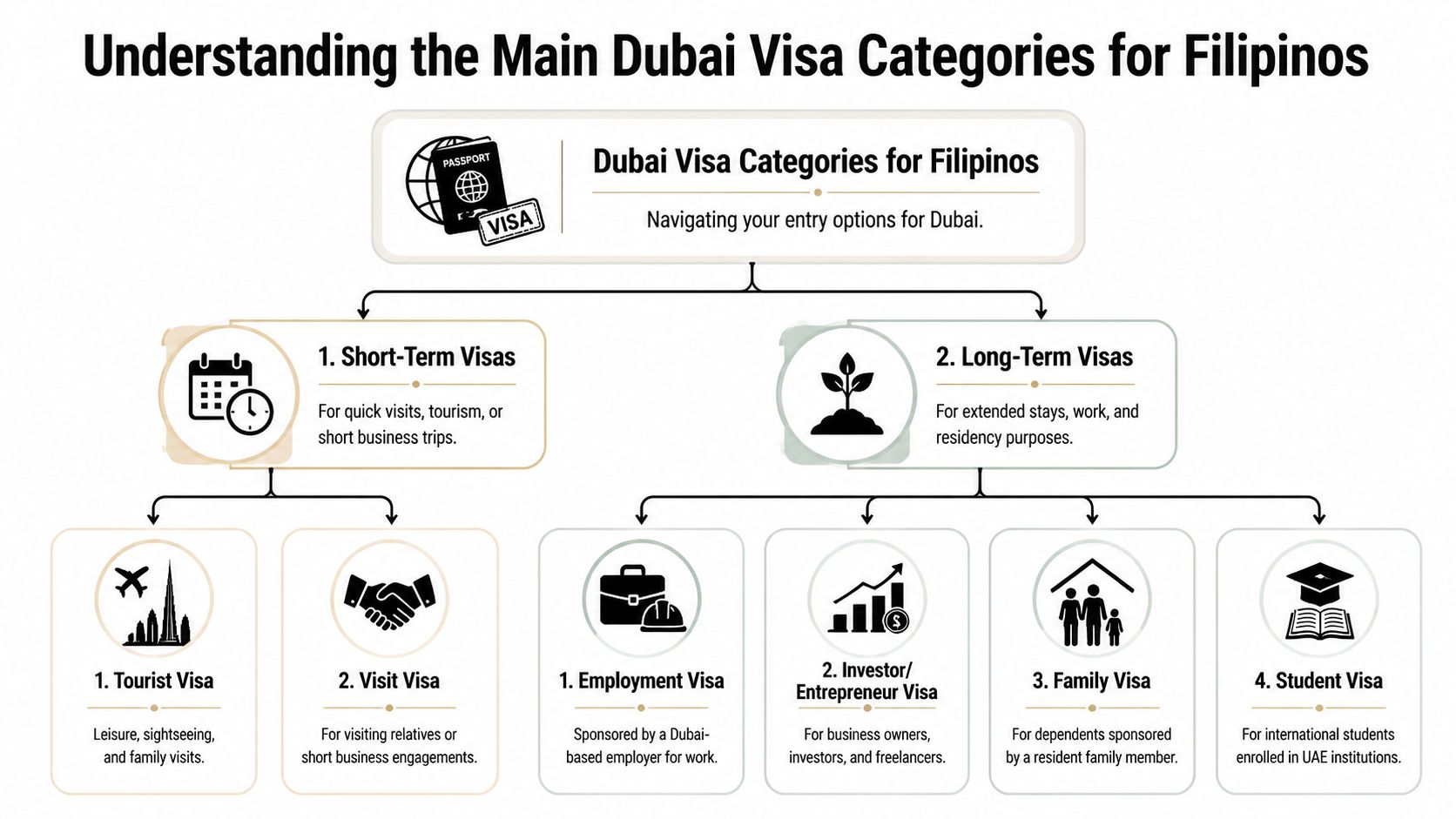
Short-term visas
These are your temporary keys. They’re for entry, not for building permanent status by themselves.
The most common options are:
- Tourist visa for leisure, short visits, and initial exploration
- Visit visa for family visits or sponsor-based short stays
- Job seeker visa for applicants who want to look for work while in the UAE
Short-term visas work well when you need to attend meetings, explore neighbourhoods, assess schools, speak to free zones, or interview in person. They don’t replace long-term residency status, but they can be a practical first step.
Long-term visas
These are the keys that let you live in Dubai under a valid residency structure.
They usually fall into these groups:
| Visa path | Who drives the process | Best for |
|---|---|---|
| Employment visa | Employer sponsor | Professionals with a job offer |
| Freelance or investor route | Applicant through approved business structure | Freelancers, founders, consultants |
| Golden Visa | Applicant based on qualifying category | Investors, entrepreneurs, eligible talent |
| Family visa | Resident sponsor | Spouse, children, dependants |
| Student visa | Educational institution or sponsor | Enrolled students |
The simplest way to choose correctly
Ask one question first. Who will sponsor or support your stay?
If the answer is “an airline, hotel, travel agency, family contact, or temporary sponsor,” you’re in short-stay territory.
If the answer is “my employer,” that points to an employment visa.
If the answer is “my own business, freelance activity, or qualifying investment,” you’re looking at self-sponsored residency routes.
Practical rule: Don’t choose a visa because it seems easiest. Choose it because it matches what you’ll actually do after arrival.
The mismatch is where trouble starts. A person planning to build a company shouldn’t think only about a cheap entry visa. They should think about whether that entry method supports the next move. The strongest dubai visa filipino strategy isn’t the fastest approval alone. It’s the cleanest path from where you are now to where you want to be in the UAE.
Securing Short-Term Visas for Tourism and Exploration
Short-term entry is a common starting point. Even applicants who eventually become employees, freelancers, or investors often start with a tourist or visit visa because they want to see the market, attend meetings, or spend time with family before making a bigger move.
For Filipino applicants, short-term visas are straightforward when the file is complete. They become messy when people treat them casually.
What you need before you apply
For a Dubai tourist eVisa, Filipino applicants need a passport valid for at least six months, a colour passport copy, a front-facing photo on a white background, and confirmed round-trip flights. Processing typically takes 3 to 5 working days, and not carrying a printed copy of the approved visa can lead to an AED 30 reprint fee at Dubai airport immigration, according to Sherpa’s UAE visa guide for Filipino citizens.
That core checklist should be treated as your minimum file. In practice, many applications also move more smoothly when the supporting documents are consistent and easy to verify.
A clean short-stay file usually includes:
- Passport validity: at least six months from travel date
- Photo format: recent, clear, white background
- Travel proof: confirmed round-trip booking
- Accommodation proof: hotel details or sponsor-based stay proof
- Financial support records: bank statements or payslips if requested
- Application accuracy: names, passport number, and dates must match exactly
Typical visa cost ranges Filipinos should expect
Costs vary by visa type and entry pattern. The practical benchmarks in the verified data are:
| Visa type | Typical range |
|---|---|
| 30-day single-entry tourist visa | ₱5,500 to ₱7,000 or AED 350 to 450 |
| 60-day tourist visa | ₱9,500 to ₱12,000 or AED 600 to 760 |
| 30 to 60-day multiple-entry visa | ₱12,500 to ₱18,000 or AED 800 to 1,150 |
| Visit visa sponsored by UAE family or friends | ₱6,300 to ₱9,500 or AED 400 to 600 |
The right choice depends on behaviour, not optimism. If you know you’ll enter once, a single-entry visa is cleaner. If you expect regional travel during your stay, multiple entry may save you from avoidable disruption.
What works and what usually causes delays
Applicants often focus on fees and overlook sponsor logic. A tourist visa generally works well for straightforward travel. A visit visa makes more sense when a UAE-based relative or contact is part of the application. If the sponsor category is wrong, the file can stall.
These habits reduce problems:
- Submit early enough to absorb corrections. Don’t build your entire trip around best-case timing.
- Print the visa approval. Digital copies help, but printed proof avoids airport stress.
- Keep your booking story consistent. Flights, accommodation, and stated purpose should line up.
- Check passport details character by character. One mismatch can create boarding problems.
A useful starting point for entry-related options is this guide to the UAE entry permit process.
The short-term visa isn’t just about getting approved. It’s about entering the UAE with a file that won’t create problems at boarding or immigration.
When a short-term visa is the smart choice
A tourist or visit visa is often the right move if you want to:
- Scout business locations: especially if you’re comparing mainland and free zone options
- Meet possible employers: before accepting a formal role
- Reconnect with family: while assessing whether relocation makes sense
- Test the market: before committing to a freelance or investor route
What it doesn’t do is create long-term status on its own. Treat it as a legal entry route, not as a substitute for residency planning.
The Path to Residency Through Employment Visas
For many Filipinos, the most stable route into Dubai is still employer sponsorship. This is the point where responsibility shifts. With a tourist or visit visa, you carry most of the preparation burden yourself. With a work route, the employer becomes central.
Filipinos are one of the largest expatriate communities in the UAE, exceeding 700,000, and the Job Seeker Visa allows a 60 to 120-day stay for on-ground job hunting, with fees of about ₱12,000 to ₱24,000 or AED 760 to 1,520, as reflected in GDRFA open data.

How the employment route usually unfolds
Once you have a genuine job offer, the employer typically handles the main sponsorship steps. That doesn’t mean you can switch off. You still need to provide correct personal records, educational documents if requested, and any employer-specific paperwork on time.
The workflow usually looks like this:
- Job offer accepted
- Entry permit or employment processing begins through the employer
- Arrival in the UAE if required under the process
- Medical fitness test
- Emirates ID biometrics and issuance steps
- Residence visa completion under the employer’s sponsorship
For first-time overseas hires, the in-country stages often feel unfamiliar. The medical test is mandatory. Biometrics for Emirates ID are not optional. Labour and residency processing depend on the employer’s approved channel and category.
Where the Job Seeker Visa fits
The Job Seeker Visa is useful for applicants who want to be in Dubai while interviewing. It gives you legal time on the ground to attend meetings, compare offers, and understand what employers are offering rather than relying only on online listings.
That said, it only makes sense if you’re prepared. Arriving in Dubai without a strong CV, clear target sector, and realistic housing budget can turn a useful visa into an expensive waiting period.
What to verify before you commit to an employer
The biggest practical mistake isn’t failing the process. It’s joining the wrong sponsor.
Before you proceed, confirm:
- Who is the legal employer: not just the recruiter or intermediary
- What expenses are covered: especially employment-related processing steps
- Whether the offer matches the contract: title, salary, benefits, and work location
- When residency steps begin: vague timelines usually create stress later
If the employer can’t clearly explain your visa process, ask more questions before you travel.
What works better than rushing
A good employment move is organised, not rushed. The applicants who settle fastest are usually the ones who bring complete documents, respond quickly to HR requests, and understand that work status is tied to sponsorship.
This path suits people who want predictable residency, a formal employer relationship, and a clear legal base in the UAE. If your longer-term goal is entrepreneurship, employment can still be a valid first chapter. Many people establish themselves professionally first, then shift into self-sponsored routes later when the timing is right.
The Entrepreneur and Investor Path to Long-Term Residency
The dubai visa filipino journey now becomes more strategic. You’re no longer asking only, “How do I enter Dubai?” You’re asking, “How do I build legal residency around my own work, business, or investment?”
That shift changes everything. Sponsorship, planning, compliance, and documentation all become more deliberate.
There’s a growing trend of Filipinos moving from short-term entry to business-based residency. In 2025, the UAE recorded a 25% increase in freelance visas issued to Filipino nationals, while GDRFA data from H2 2025 showed an 18% rejection rate for business visa applications with incomplete documentation, according to this Dubai visa guide for Filipinos.

The three serious self-sponsored routes
For most Filipino founders and independent professionals, the long-term options cluster into three practical routes.
Freelance pathway
This suits consultants, creatives, digital specialists, and independent professionals who want legal status tied to their own activity rather than to an employer. In real life, this route works best for people who already know what service they sell and who their clients are.
What tends to work:
- A clearly defined service
- Consistent personal branding and work history
- Documents that support your professional identity
- A plan for invoicing, compliance, and renewal obligations
What doesn’t work is treating a freelance route like a vague backup plan. Immigration and licensing systems respond better when your file shows a coherent business purpose.
Investor or entrepreneur pathway
This route is for applicants setting up a company and using that structure as the basis for residency. Some people first enter Dubai on a short-term visa to meet service providers, compare jurisdictions, and decide whether mainland, free zone, or another setup makes sense. That can be sensible if done legally and in the correct order.
You’ll need more than enthusiasm. You’ll need a viable business structure, supporting records, and proper submission quality. If you’re reviewing requirements in detail, this overview of UAE investor visa requirements is a useful starting point.
A business residency strategy is usually strongest when it answers these questions clearly:
| Question | Why it matters |
|---|---|
| What activity will the company perform | Activity selection affects licence and visa pathway |
| Who owns the business | Ownership documents must align with the application |
| Where will the company be formed | Jurisdiction affects process and compliance |
| What documents support the founder | Incomplete files create rejection risk |
| What happens after approval | Banking, tax, accounting, and renewals still matter |
Golden Visa pathway
The Golden Visa is the premium long-term route for qualifying investors, entrepreneurs, and other eligible categories. In the verified data, Filipinos may qualify through property investments above AED 2 million or through qualifying business activity linked to significant employment creation under the wider Golden Visa framework described in the earlier verified materials.
This route is attractive because it offers long-duration residency and more independence from day-to-day sponsorship concerns. But it isn’t a casual application. The file must be complete, and the legal basis for eligibility must be clear.
The real trade-off between speed and control
Employment sponsorship is usually simpler because the employer carries much of the process. Business-based residency gives you more autonomy, but it also gives you more responsibility.
That means:
- You control the direction of your work
- You’re also responsible for maintaining the legal structure behind it
For some applicants, that trade-off is worth it immediately. For others, it makes more sense to enter on a short-term visa, validate the market, and only then move into business setup and residency.
A strong investor or freelance application doesn’t look ambitious only on paper. It looks organised.
Why incomplete business files fail
The most common failure point is not lack of potential. It’s weak preparation. Missing ownership records, unclear activity descriptions, mismatched personal documents, and poorly handled supporting paperwork cause avoidable setbacks.
Business visas reward clarity. If your file shows who you are, what you’re building, and how the legal structure supports that purpose, your path is much smoother. If it looks improvised, scrutiny increases.
For Filipino entrepreneurs, this is often the best long-term route when the goal is independence, business growth, and eventually family sponsorship under your own UAE status.
Bringing Your Loved Ones with a Family Visa
Once your own UAE status is secure, the next priority is often family. Many applicants approach this stage less carefully because they assume dependent visas are routine. They aren’t. They’re detail-heavy, and financial verification matters.
Family visas for Filipinos increased sharply in 2025, with a 32% surge linked to Golden Visa expansion, but 22% of family visa applications were rejected due to unverified sponsor finances. The same verified data notes mandatory health insurance at around AED 1,500 per year for each family member, based on the information compiled in this UAE visa FAQ for Filipinos.
What family sponsorship really depends on
The central issue is simple. Can the sponsor prove stable, verifiable capacity to support the dependants in the UAE?
That usually means authorities will look closely at:
- Sponsor financial standing
- Accommodation proof
- Relationship evidence
- Insurance compliance
- Consistency across all records
If your salary evidence, bank history, or accommodation records are unclear, the application becomes vulnerable even when the relationship itself is genuine.
Documents that deserve extra attention
Family files often involve more civil documents than individual visa files. That creates more room for mismatch.
Prepare these carefully:
- Marriage certificate: if sponsoring a spouse
- Birth certificates: for children
- Passport copies: for each dependant
- Sponsor residency records: including current status documents
- Accommodation proof: matching the family size and sponsorship claim
- Health insurance records: for each family member where required
For applicants exploring the process in more detail, this Dubai family visa guide can help frame the document path.
What works best in practice
A family visa application should be built like an audit file. Every document should support the same story without gaps.
The strongest files usually have these traits:
- Finances are easy to verify
- Civil records are clean and legible
- Names match across passports and certificates
- Insurance is arranged before the final push
- Accommodation evidence is ready, not promised later
Family visa approvals often depend less on intention and more on proof.
If you plan to bring your spouse or children later, prepare for that early. Keep certificates accessible. Check whether any document will need translation, attestation, or updated issuance. Family sponsorship is manageable, but only when the sponsor treats it as a formal legal process, not an informal extension of their own visa.
How Smart Classic Business Hub Streamlines Your Visa Journey
By this point, the pattern is clear. The Dubai visa system isn’t impossible. It’s structured. But it’s also unforgiving when the wrong visa is chosen, the sponsor logic is weak, or the documents don’t align.
That’s especially true for applicants whose plans don’t fit into a single simple category. A tourist who wants to explore business setup. A job seeker who may later shift into self-sponsorship. An investor who wants to add family members after securing residency. These are real-world situations, and they need joined-up handling.
Where professional support makes the biggest difference
Professional help is most valuable when your next move depends on getting the current move right.
That includes:
- Choosing the right first visa: so you don’t enter the UAE on a path that blocks your actual goal
- Preparing business-linked files: where incomplete documents can derail investor or freelance applications
- Handling family sponsorship properly: especially where finance checks and insurance matter
- Coordinating PRO steps: so immigration, company setup, and compliance don’t become separate problems
A good consultant doesn’t just submit forms. They pressure-test the sequence.
Why sequencing matters more than speed alone
Some applicants focus only on fast approval. That’s understandable, but it’s not always the smartest metric. Fast approval for the wrong pathway can create more delay later.
What you want is:
| Priority | Why it matters |
|---|---|
| Correct visa type | Prevents legal and procedural mismatch |
| Clean document file | Reduces avoidable objections |
| Sponsor clarity | Avoids confusion between visit, work, and self-sponsored routes |
| Business and residency alignment | Matters for entrepreneurs and investors |
| Family planning | Helps avoid repeat work later |
If your move involves relocation support beyond the visa itself, lifestyle planning also becomes relevant. For readers comparing that side of the move, Approved Lux Personal Assistant gives a useful explanation of what concierge support can include in high-touch relocation contexts.
The practical reason people use a specialist
The value is simple. A specialist sees the full chain. Entry permit. Residency route. Business structure. Family add-ons. Ongoing compliance.
That matters because Dubai rewards applicants who are organised. It also penalises preventable errors. If your paperwork is strong and your pathway is matched to your real goal, the system is workable. If your file is pieced together from generic online advice, problems tend to surface late, when they cost more to fix.
If you want personalized guidance on the right visa path, business setup, PRO support, or family sponsorship in the UAE, speak with Smart Classic Business Hub. Their team helps Filipino professionals, entrepreneurs, investors, and families move from first entry to long-term residency with a plan that fits the goal, not just the application form.