
Professional Licence in Dubai: Costs, Setup and Renewal


You've chosen a business name, drafted a proposal and found a client who's ready to sign. Then the setup questions arrive: does your consultancy need a professional licence, will a freelance permit work, and can you start invoicing as soon as the licence is issued?
The answer starts with what you'll sell. A professional licence in Dubai authorises specified service activities, but some services also need approval from a separate professional regulator. Getting that distinction right helps you choose a suitable structure, budget beyond the advertised permit fee and avoid accepting work you aren't yet authorised to deliver.
What a Professional Licence in Dubai Covers
A professional licence is Dubai's mainland authorisation for businesses selling intellectual, technical or artistic expertise rather than trading goods or manufacturing products. Dubai's official business guidance identifies the Department of Economy and Tourism, or DET, as the mainland registration and licensing authority and describes professional services as activities based on intellectual or artistic abilities.
That makes the category relevant to consultancies, designers, IT providers, marketing firms and other expertise-led businesses. Education and engineering can also involve professional activities, although the right economic licence doesn't remove any separate requirements governing the profession.
Think of the licence as a restaurant permit with an approved menu attached. Permission to serve the listed dishes wouldn't automatically authorise every other food business you might want to run. Likewise, an approved marketing activity shouldn't be treated as permission to offer unrelated financial or legal advice.
The licence authorises the activities written on it, and nothing else.
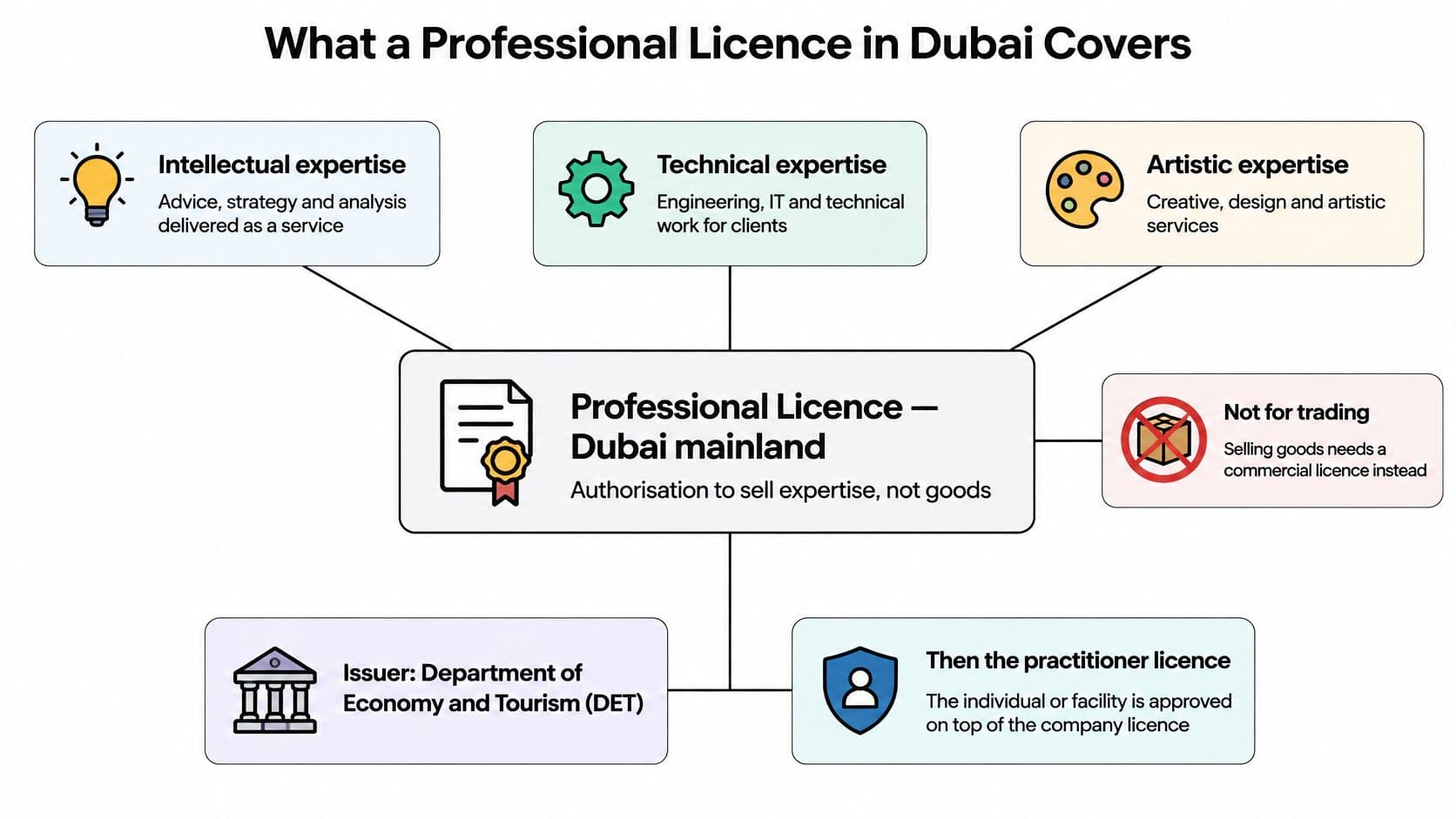
Expertise, goods and mixed businesses
The distinction is about the activity, not whether you describe yourself as a consultant or creative entrepreneur. Advising a retailer on its website is a service. Buying stock and reselling it through that website is trading.
The UAE framework separates professional licensing from commercial, industrial, tourism, agricultural and crafts licensing. Trading, retail, wholesale and import-export generally fall under commercial licensing; manufacturing belongs to the industrial category rather than being another form of professional service.
A mixed business needs particular care. A designer might charge for brand development while also selling printed merchandise. Those revenue streams shouldn't be grouped together because the same customer buys both.
The broader explanation of what a UAE trade licence means helps distinguish the general business permission from its activity category and legal structure.
Test your service list before choosing a category
Write each planned offer as a plain sentence:
- Advice: I help businesses develop their marketing strategy.
- Technical work: I configure software for customers.
- Creative work: I design packaging for manufacturers.
- Goods: I purchase finished products and resell them.
Then separate expertise from goods. If an offer contains both, split it into distinct activities before asking for a licence quotation. That gives the licensing authority a clearer description than a broad label such as business solutions.
Who Needs One and Which Regulator Applies
For a mainland service business, DET provides the appropriate economic licence. Where a service is regulated, the practitioner, firm or facility must also obtain the sector regulator's approval before delivering that controlled service.
Dubai's Legal Affairs Department applies professional eligibility and experience requirements to legal consultancy, while the Dubai health-professions framework%20of%202024%20Regulating%20the%20Practice%20of%20Health%20Professions.html) requires DHA facility licensing and individual professional standards; the supplied legal-consultancy requirements include at least two consecutive years of UAE practical legal experience.
Who needs what
| Activity | Licence route | Extra approval | Check before billing |
|---|---|---|---|
| Marketing, design, IT or general consultancy | Dubai professional licence from DET | Usually no profession-specific approval for ordinary services; confirm the exact activity | Activity text matches each service sold |
| Legal consultancy | Professional licence plus Legal Affairs Department registration | Practising legal-consultant registration or eligibility, with the required practical experience | Registration status, professional indemnity insurance, office tenancy and AML/goAML compliance |
| Healthcare facility or practitioner | Appropriate business licence, DHA facility licence and practitioner registration | Professional registration activated into a licence to practise | Qualifications, good standing and primary-source verification |
| Accounting, engineering, education or financial services | DET professional route, subject to activity classification | Treat external approval as unconfirmed until the competent authority confirms the requirement | Specific regulator and authorisation for the exact service |
General consultancy needs careful interpretation. Advising on internal business processes isn't a reason to assume you can provide regulated investment advice, clinical recommendations or legal opinions.
For legal consultancy, the Ministry of Economy's business-establishment guidance provides the licensing context for checking additional conditions, including eligibility, professional registration, insurance, premises and anti-money-laundering obligations. Professional indemnity insurance covers specified claims arising from professional work; goAML is a reporting platform associated with anti-money-laundering compliance.

Resolve specialist services before accepting bookings
Healthcare founders must distinguish the organisation's permission from the clinician's active permission to practise. Primary-source verification means checking credentials with the organisation that originally issued them, rather than accepting a copy at face value.
For a clinic considering hyperbaric treatment, Hyperbaric Business Solutions' explanation of do clinics need HBOT certification can help identify training questions. It isn't a substitute for DHA confirmation of the proposed service's local requirements.
Oversight continues after incorporation: the Government of Dubai Legal Affairs Department reported completing 7,134 applications through its Legal Professions System during 2024. Those applications covered advocates and legal consultants, illustrating an actively administered professional framework.
A business licence establishes the company's economic permission. It doesn't automatically confer professional authorisation.
Eligibility and Activity Matching Before You Apply
Under Dubai Law No. 13 of 2011%20of%202011.html), economic activity in the emirate must be conducted through a business licensed by the competent economic authority. For an applicant, the practical consequence is straightforward: the approved activity must match what the business markets, contracts to provide and delivers.
Don't begin with the cheapest package and try to fit your business into it afterwards. Begin with a service list, then identify the activity wording, legal structure and approvals that support it.
Build an application file around the work
Match each deliverable to an activity. Put your proposed website services, quotation descriptions and invoice descriptions beside the official activity wording. A broad trading name doesn't expand a narrow licensed activity.
Flag controlled work. Mark any offer involving healthcare, legal practice, engineering, education, accounting or financial services for a specific regulator check. Describe the actual task, not just the industry.
Gather qualification and experience evidence. Keep qualifications, employment records and evidence of relevant practice together. Where experience must be demonstrated, a short CV may not provide the documentation the regulator needs.
Check founder-specific eligibility. Confirm whether nationality, overseas qualifications or foreign-issued documents affect the application. Attestation means obtaining the required official authentication of a document; don't assume every overseas certificate follows the same process.
Resolve insurance and premises conditions. If the profession requires indemnity cover or an office tenancy, establish the acceptable evidence before committing to a policy or lease. A workspace suitable for correspondence may not satisfy a practice-specific premises requirement.
Set an approval gate for client work. Keep regulated services unavailable for booking and billing until their required authorisations are active. Build this restriction into your sales process so an enthusiastic salesperson can't promise an unlawful start date.
Check contracts as well as licence forms
Say your proposal promises business strategy, contract drafting and investment recommendations. Calling the package management consultancy doesn't settle the classification of every deliverable. Review each promise separately and remove anything your approved scope doesn't cover.
Application check: Compare the licence wording with what the client will receive, not merely with the heading on your proposal.
Keep a working sheet showing the service, proposed activity, regulator, supporting documents and approval status. Save written clarification alongside it, especially where similar activity names describe different work.
Operating outside the approved activity can create regulatory exposure and require an amendment or additional approval. It's easier to resolve that mismatch before signing a client contract than after committing to deliver it.
Setup Options and What They Really Cost
| Setup route | Published permit fee | Typical delivery | Best fit |
|---|---|---|---|
| Freelancer or sole professional licence | AED 7,500 plus AED 10 Knowledge Dirham and AED 10 Innovation Dirham | About two working days, estimated | An individual delivering permitted personal services; confirm staffing and activity limits |
| Mainland professional company | Obtain an activity-specific, itemised quotation | Confirm after activity, structure and external approvals are identified | A business planning staff, several compatible activities or corporate contracts |
| Free zone professional licence | Obtain the chosen authority's itemised package quotation | Confirm with the chosen free zone | Activities and operating arrangements the selected zone permits |
The freelancer figures and estimated delivery above are published by the Dubai Development Authority, which lists AED 7,500, the additional AED 10 Knowledge Dirham and AED 10 Innovation Dirham, and an estimated two-working-day service time. Its requirements can also include a no-objection certificate, often called an NOC, or a self-declaration.
That is a published permit price, not a complete launch budget. It also belongs to a particular authority's route, not every licence described online as a Dubai freelance licence.
Build the first-year budget
Request a quotation with separate lines for:
- Licence and establishment charges: Distinguish the permit from any company or immigration establishment costs.
- Residence and immigration: Confirm visa eligibility and which application expenses are included.
- Premises: Identify the acceptable office or workspace and its separate cost.
- Professional readiness: Include required insurance, credential verification and regulator approvals.
- Administration: Budget for accounting, tax-registration support where needed and compliant invoicing arrangements.
- Renewal: Obtain the continuing-cost schedule, not just an introductory package price.
For a broader budgeting framework, the Dubai trade licence cost guide helps organise the questions to ask before comparing quotations.
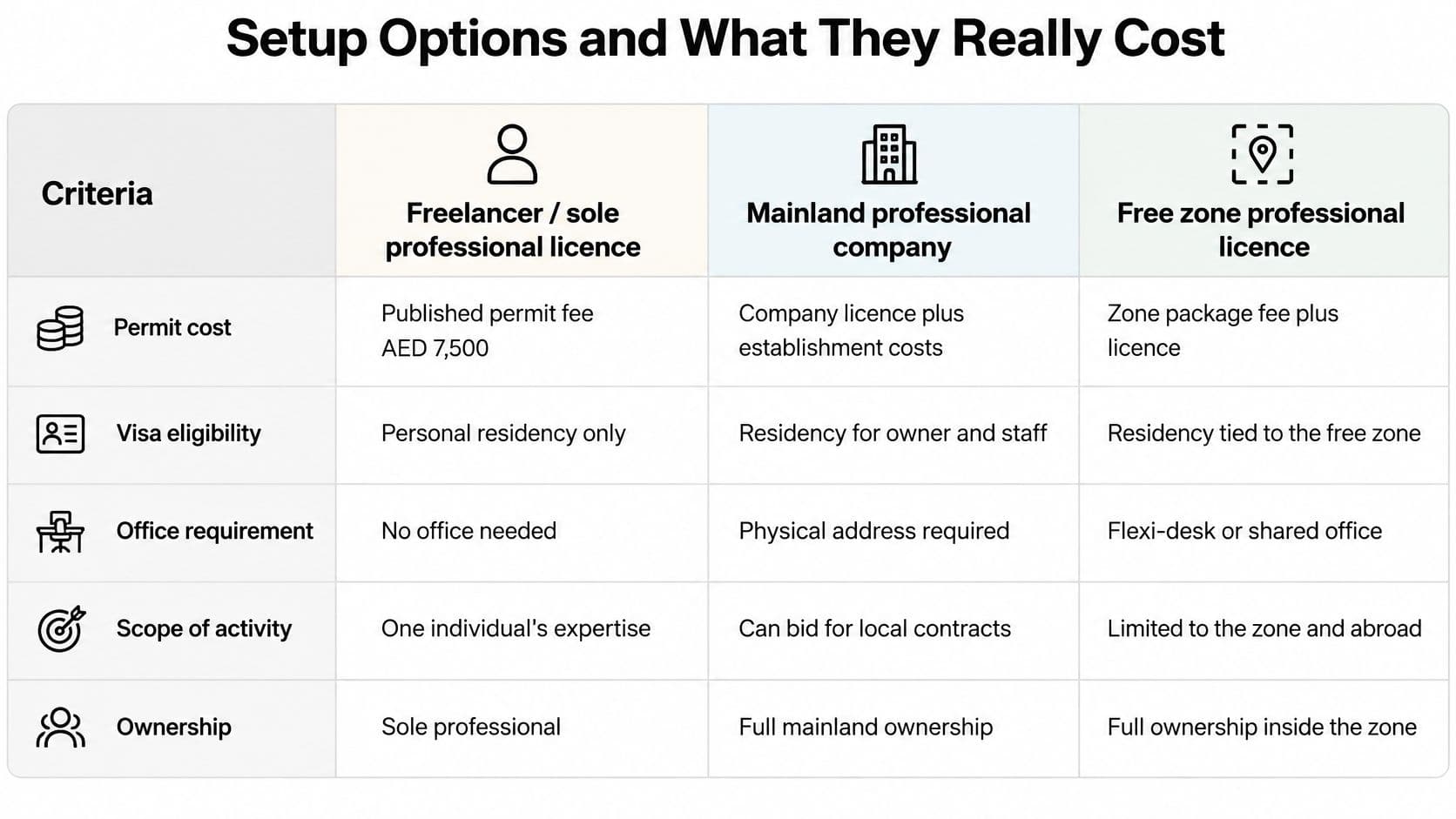
Treat visual comparisons as an orientation, not confirmation of eligibility. Visa, staffing, workspace, ownership and geographic operating conditions must be checked against the selected authority and activity; there isn't a universal rule that every freelance permit requires no office or every free zone business can operate only inside its zone.
Buy the capability your business needs
A solo professional and a company aren't interchangeable merely because both can issue an invoice. Check who signs the client contract, whether staff can be employed, which activities can be combined and whether the intended premises are acceptable.
A low-priced route can become unsuitable when your business plan requires employees, additional activities or regulated facilities. Conversely, choosing a company structure without understanding your needs can add administration you didn't budget for.
Budget rule: Compare total first-year cost and operating capability, not the permit fee alone.
Ask for exclusions in writing. An estimated licence delivery time shouldn't be interpreted as a promise that residency, banking, premises and professional approvals will all be ready on the same date.
Renewal Obligations and Staying Compliant
A licence is an ongoing permission, not a document to file away after launch. Track the expiry of the business licence separately from the expiry of any practitioner, firm or facility authorisation.
Don't assume a renewal application automatically extends permission to operate. Confirm the status with the issuing authority and avoid scheduling regulated work across an unresolved expiry.
Renewal and amendment obligations
| Obligation | Triggered by | Timing | If missed |
|---|---|---|---|
| Renew the business licence | The company | Before the printed expiry date; confirm processing lead time with the issuing authority | The business may be operating without a valid licence |
| Renew regulator registration | Practitioner or firm | Before its separate expiry, allowing time for required evidence and approval | Regulated practice may not be permitted while expired |
| Amend the licence for a new activity | The company | Before offering the new service | Work falls outside the licensed activity |
| Update changes in staff, address or ownership | The company | Check notification and amendment requirements when planning the change | Official records no longer reflect the business |
The useful renewal date is the date by which you need to start preparing, not just the final expiry date. If an authority requires refreshed supporting documents, leave time to obtain and correct them.
The practical guide to renewing a Dubai trade licence can help organise the business-licence task. Keep sector approvals on their own checklist rather than assuming the economic renewal includes them.
Prevent the common slips
Service changes are easy to miss. A marketing agency might add specialist advisory work to a proposal without anyone checking whether the existing activity authorises it.
Administrative changes need attention too. Moving premises, changing ownership or appointing regulated personnel may affect authority records or approval conditions, even when the trading name stays the same.
- Assign an owner: Make a named person responsible for each renewal and amendment.
- Record evidence: Store current licences, expiry details, submission receipts and regulator correspondence together.
- Review new offers: Add a licensing check to the approval process for new services and proposal templates.
- Verify status: Confirm that renewed permissions are active before relying on them for continued work.
An application receipt is evidence that you submitted something. It isn't necessarily evidence that the authority granted permission.
After issuance, your operating scope remains tied to the approved activities. If a new offer falls outside that scope, resolve the amendment before selling it; where the service is controlled, also confirm the relevant professional approval.
Examples From Consultants, Designers and Clinics
A consultant chooses a route before checking her hiring plan
In this illustrative scenario, a Dubai marketing consultant plans to work alone and considers a freelancer permit. She initially compares only the advertised licence charge, then discovers her launch budget must also accommodate her residency arrangements, workspace and insurance.
Later, a prospective corporate customer asks her to provide a larger delivery team. She needs to confirm whether the selected route supports that operating model rather than assuming she can add employees to an individual permit.
Preventive step: Write down the intended staffing and contract arrangements before choosing the freelancer option. The right comparison is between routes that can support the planned business, not just permit prices.

A design studio adds products to a creative proposal
In another illustrative scenario, a studio offers brand identity, packaging artwork and website design. A customer then asks it to source and resell branded products alongside the design work.
The studio treats the product order as a convenient extension of its creative service. But buying and reselling goods introduces a trading activity, so the founder needs to confirm the appropriate commercial authorisation instead of placing everything under design consultancy.
Preventive step: Separate service deliverables from goods in both the proposal and the activity review. Check the marketing-and-design activity match, then resolve the trading requirement before accepting the product order.
A clinic confuses incorporation with clinical readiness
In this illustrative scenario, a physiotherapy clinic finishes its business setup and begins preparing an appointment calendar. The owner assumes the company paperwork means the therapists can start treating patients.
Before opening bookings, the manager checks the DHA status and finds that the facility and practitioner permissions haven't all reached the required active stage. The team must complete that process before clinical work begins.
Preventive step: Use a clinical-opening checklist that separately verifies facility licensing and each practitioner's active permission to practise. The healthcare route requires more than a business document bearing the clinic's name.
These scenarios involve different mistakes, but each can be caught during a proposal review. Ask what work will be performed, who will perform it, which entity will contract for it and which permission must be active on the delivery date.
Confirm Your Licence Path Before You Sell
Before accepting a deposit or promising a start date, turn your business idea into a short approval plan. It should be clear enough that a colleague can distinguish authorised work from services still awaiting clearance.
Check every service individually. Use the activity-and-regulator checklist for each offer, including optional extras. Treat regulator-controlled services as unavailable until the necessary approval is active, and retain written confirmation of any uncertain classification.
Arrange a focused consultation. Book a consultation with our Dubai-based team at Smart Classic Business Hub to confirm the proposed activity wording and map the approval path before the first sale. Bring your service list, sample proposal, hiring plans and intended premises so the discussion addresses your actual business.
Diarise ongoing obligations. Record the business licence expiry alongside any separate regulator renewal dates. Assign responsibility for checking changes in activities, personnel and premises rather than leaving compliance until a renewal reminder arrives.
Keep the approved activity descriptions accessible to whoever prepares quotations and invoices. That small operational habit helps prevent the sales team from promising work the business isn't authorised to provide.
The licence is a permission for named activities, not a badge of credibility.
At Smart Classic Business Hub, we offer UAE trade licence services, government approvals, investor visa application services and trade licence renewals. Visit Smart Classic Business Hub to discuss your service activities, intended setup and approval requirements before you commit to a licence route.