How to Open a Restaurant in Dubai: Licences to Launch


Nearly 1,200 new restaurant licences were issued in Dubai in 2024, according to the Dubai Department of Economy and Tourism's gastronomy industry report. That's evidence of opportunity, but also of how many operators are competing for the same customers. To open a restaurant in Dubai, you need more than an appealing concept and a trade licence. You need written confirmation that your proposed activity, premises and kitchen can follow a workable approval path before you commit to rent.
Test Demand and Differentiation Before Signing Anything
A growing restaurant market doesn't guarantee demand for your restaurant. The Dubai Department of Economy and Tourism's annual visitor report recorded 18.72 million international overnight visitors in 2024, but a citywide visitor total won't tell you whether customers will enter a particular unit at lunchtime.
Start with the catchment, not the cuisine. Walk the approach to the site during your intended trading periods, inspect neighboring menus, and distinguish people passing through from people who can realistically become customers.
Test the buying occasion
Build the demand assessment around observable behavior:
- Customer base: Separate nearby residents, office workers and tourists. They have different reasons to visit and different repeat potential.
- Spend per cover: Test the intended bill against comparable meals customers can buy nearby.
- Daypart: Identify whether lunch, dinner, breakfast or late service must carry the operation.
- Delivery share: Check whether the food travels well and whether delivery demand can support its own costs.
- Seasonality: Challenge assumptions about outdoor seating, holiday periods and Ramadan trading patterns.
Differentiation can come from cuisine, price point, location, service format or operating occasion. It needs to matter to the customer, not just look distinctive in a presentation. A growing supply of outlets can spread demand across more competitors and require more spending to attract each customer.
Say you're comparing a compact chef-led counter in a business district with a larger casual Italian restaurant in a mall. The counter depends on reservations, specialist labor and a deliberate dining occasion. The mall restaurant needs accessible pricing, family appeal and reliable throughput. They can't use the same rent, staffing or average-check assumptions.
Decide what would justify proceeding
Use a restaurant feasibility study to connect the customer proposition to the operating model. For resident-led concepts, retention deserves attention before launch. Loyal Customer's guide can help you compare restaurant loyalty programs, especially whether rewards encourage another profitable visit rather than discount an existing habit.
Go or no-go test: Write down who buys, why they choose you over nearby competitors, and the monthly covers needed to support rent and labor. If those answers rely on optimistic footfall, keep testing before signing.
Approvals and the Lease Gate
A restaurant opening is a chain of approvals, not a single application. Use this approval map to establish the sequence, then obtain written confirmation of the requirements for your jurisdiction, activity and address.
Restaurant approvals in Dubai by stage
| Approval | Issuing authority | When to secure it | What it unlocks |
|---|---|---|---|
| Trade licence | Department of Economy and Tourism (DET) or free zone authority | After jurisdiction, activity and premises are confirmed, before the lease becomes unconditional where possible | Legal right to carry on the licensed activity |
| Civil Defence approval | Dubai Civil Defence | Before fit-out starts, through the applicable drawings approval process | Approved construction and fire-safety works |
| Food establishment registration | Dubai Municipality | Before opening, using the final kitchen layout and establishment details | Entry into the food-establishment approval process |
| Food-safety inspection | Dubai Municipality | After fit-out and food-safety documentation are ready | Confirmation that the establishment can proceed to opening |
| Staff health cards | Dubai Municipality-approved medical centres | Before each food handler starts work | Eligibility for shifts involving food handling |
Treat the table as a project checklist, not evidence that every approval follows an identical route. Ask the relevant authority to confirm who issues each document, what must accompany the application and which conditions apply to your premises.
Follow the dependency order
Choose the jurisdiction and activity. Decide between mainland and a suitable free zone route, then confirm that the proposed food-service activity covers your operating model and address. Don't assume a general commercial activity includes restaurant operations.
Secure the premises conditionally. Establish control of the unit in the form needed for the application, while negotiating protection against an unusable site. Where premises documentation must precede licence issuance, agree the conditions before making the commitment unconditional.
Obtain the applicable trade licence. Keep the commercial activity, company documents and premises details consistent. A Dubai trade licence checklist helps organize that application, but the authority's written requirements govern the submission.
Submit coordinated fit-out and food-safety drawings. The kitchen designer, mechanical contractor and fire-safety specialist should work from the same revision. Conflicting plans create avoidable approval queries.
Build and install against approved drawings. Control substitutions carefully. A replacement appliance can change power, ventilation or space requirements even when its purchase price looks attractive.
Complete registration and inspection requirements. Keep the establishment file ready alongside the physical works. Resolve inspection observations before treating the restaurant as operational.
Authorize opening only after the gates clear. Release customer bookings and staff deployment against confirmed approvals, not the contractor's expected completion date.
The common trap is signing a lease before food service is confirmed for the activity code and address. If the proposed activity doesn't fit, you may need to revise or reapply while contractual costs continue.
Ask these questions before payment
Put the answers in writing with the landlord and licensing adviser:
- Activity: Which activity code covers the intended food service at this address?
- Infrastructure: Can the premises accommodate the planned extraction, drainage and equipment loads?
- Fit-out: What submission, landlord consent and authority steps determine the works schedule?
- Lease commencement: Which approvals should be secured before rent starts, and what happens if they aren't?
- Handover: How do deposits, fit-out access and rent milestones relate to documented handover?
For staff administration, BacteriaFAQ.com's sanitation exam and renewal steps provide a useful comparison checklist, not a substitute for Dubai-specific requirements.
At Smart Classic Business Hub, our Business Setup in Dubai services include mainland trading licence packages, UAE trade licence applications, government approvals, investor visa applications and renewals. Define the scope of assistance clearly so responsibility for technical drawings and inspections remains explicit.
Finish with a one-page approval sheet listing the owner, submission date, dependency and written status of every approval. No lease should be signed before the licence path is confirmed in writing.
How to Build Food Safety Into the Kitchen Design
The menu drives the kitchen, and food safety belongs in the design. The Dubai Municipality Food Code establishes a risk-based food-safety approach built on HACCP principles. A commercial trade licence doesn't replace food-establishment authorization.
A designer needs to know what arrives, what gets prepared on site, what gets cooled and what leaves the pass. A concept description such as casual dining isn't enough to size storage or separate incompatible tasks.
Turn the menu into an operating system
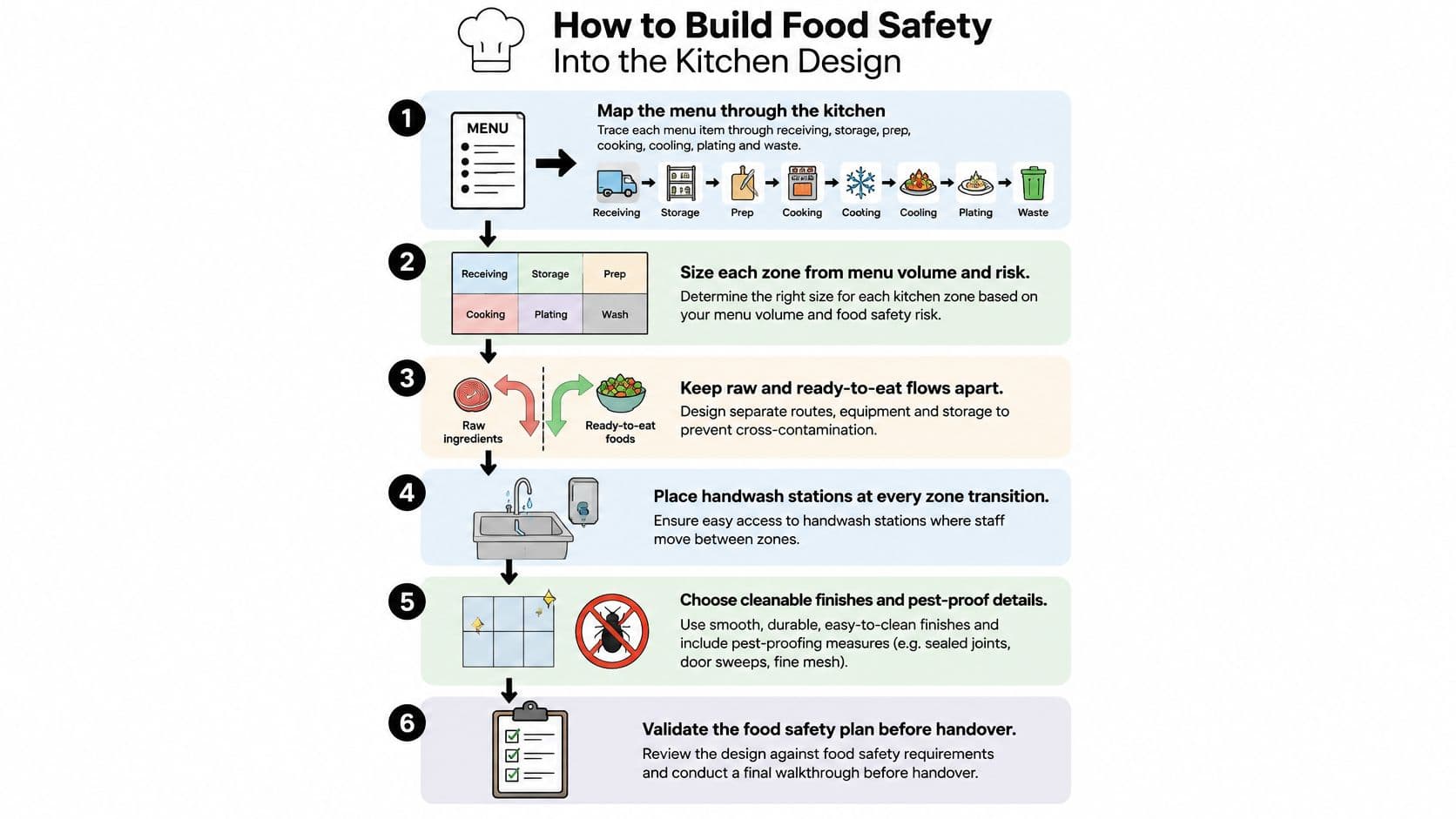
Map every menu category. Trace ingredients through receiving, storage, preparation, cooking, cooling and service. Include takeaway packing and waste removal so the plan reflects the whole operation.
Identify hazards at each stage. Consider biological contamination, cleaning chemicals and physical contaminants. Mark where raw ingredients, ready-to-eat food, dirty utensils and staff movements could cross.
Define critical controls and measurable limits. Specify the relevant cooking, cooling and holding controls for the actual process. Use limits validated against the applicable requirements, rather than copying settings from an unrelated menu.
Assign monitoring and corrective action. State who checks each control, where they record it and what happens when it fails. Include verification so a manager checks that the procedure works rather than merely collecting completed forms.
Build the operating file. Include supplier approval, pest-control records, cleaning schedules, temperature logs and staff hygiene procedures. Keep the documents accessible where supervisors use them.
Freeze the menu and equipment layout before fit-out. Review ventilation, drainage, cold storage, waste movement and raw-to-ready segregation together. Late changes can require redesign and reinspection.
Complete establishment registration and inspection. Submit the kitchen layout and food-safety documentation in the required form. Check that the installed kitchen matches the submitted version before requesting inspection.
Train staff against their actual tasks. Ask employees to demonstrate receiving checks, safe preparation and corrective actions. Keep evidence that responsible personnel understand the controls, not just that they attended training.
Check the plan against real service
A generic HACCP template copied from another establishment can omit the hazards your menu creates. The problem isn't where the template originated. It's the mismatch between its procedures and your premises, equipment and staff responsibilities.
Say a dish requires cooking ahead, cooling and reheating. Its flow needs suitable equipment capacity and documented controls throughout, not a refrigerator drawn beside the preparation bench.
A kitchen plan is ready for construction when the team can explain how food, people, utensils and waste move through it without relying on improvised workarounds.
Draft a one-page flow for each menu category and lay it beside the kitchen drawing. Ask the chef and kitchen engineer to resolve every crossing, bottleneck and missing control before ordering fixed equipment.
Premises, Staffing and Costs That Set Your Break-Even
Dubai Municipality figures cited by the USDA Foreign Agricultural Service's food-service report recorded 8,617 restaurants in the emirate and 5.2 million tonnes of food imports during the first half of 2024. That scale makes procurement, cold-chain reliability and wastage serious operating considerations, not secondary details behind rent.
Restaurant cost lines and how to model them
| Cost line | What drives it | How to model it |
|---|---|---|
| Rent and service charges | Location, floor area, lease length | Fixed monthly line tested against downside sales |
| Fit-out and kitchen extraction | Menu, ventilation, drainage, cold storage | One-off cost, recovered only over the lease term |
| Food cost | Menu mix, import dependence, supplier terms | Cost per dish by channel, updated monthly |
| Labour | Opening hours, kitchen roster, hiring lead times | Split into fixed and variable, with recruitment time |
| Delivery commissions | Platform share, delivery mix | Margin per order after commission and packaging |
Test the unit, not just the headline rent
A cheaper unit can become the expensive option if it needs extensive extraction, electrical or drainage work. Inspect access for deliveries, customer parking, refuse collection and maintenance before comparing offers.
Check service charges and the period over which you can recover fit-out spending. Don't treat a possible lease renewal as guaranteed recovery time. Equipment resale value also won't necessarily compensate for fixed works left in the premises.
Model the roster from opening hours and production tasks. Include preparation, cleaning, receiving, breaks and supervision, not just customer-facing service. Separate the core team you must pay regardless of sales from additional shifts you can adjust, and account for recruitment and visa processing before fixing start dates.
Calculate covers from contribution
Test rent as a share of expected sales against your own stated affordability assumption, not an unsupported industry benchmark. Then lower sales while holding rent constant. If that leaves no room for staffing, maintenance and cash reserves, the premises don't fit the concept.
Use these calculations:
- Contribution per cover: Average net revenue per guest minus the variable costs attributable to that guest.
- Monthly break-even covers: Monthly fixed costs divided by contribution per cover.
- Daily break-even covers: Monthly break-even covers divided by planned trading days.
Keep the treatment of labor consistent so it isn't counted twice. For delivery, calculate contribution per order separately because commission and packaging change the economics.
Finally, compare required covers with practical seating capacity, service speed and catchment demand. A spreadsheet can produce a break-even volume that the kitchen cannot physically serve.
Stress-Test the Budget With a 13-Week Cash Forecast
Don't use an anecdotal restaurant survival rate as a Dubai benchmark. The Associated Press reports high failure concerns among industry veterans and notes the absence of an official closure-rate series. Your decision needs outlet-level cash thresholds, not an apparently precise probability of success.
Build a 13-week cash forecast showing opening cash, receipts, payments and closing cash. Separate dine-in, takeaway, delivery-platform and catering receipts because their payment timing and operating costs differ.

Run the downside cases
- Slower sales ramp-up: Move receipts below plan while preserving committed payments. Identify when cash falls below the amount needed to meet payroll and supplier obligations.
- Food inflation or supply disruption: Increase ingredient costs or replace an unavailable product. Test whether substitutions preserve both dish contribution and the promised experience.
- Fixed rent and labor against falling revenue: Leave contractual costs unchanged and reduce sales. This exposes how little flexibility remains after the core roster and premises are committed.
Use a cash-flow statement template as a starting structure, then add restaurant-specific payment dates. A deposit leaves the bank when it's paid, even if the accounting expense appears later. Platform receipts should enter the forecast when cash is expected, not when orders are placed.
Reduce exposure before expanding
Where the licensing route permits, prove the menu in a smaller operating format before committing to greater seating or staffing. Measure contribution by dish and channel, then remove low-margin complexity that consumes preparation time or creates excess stock.
Lease commitments, extraction, civil works, approvals and imported equipment can be difficult to recover after a weak launch. That makes a controlled opening more useful than an ambitious sales forecast unsupported by trading evidence.
Keep a weekly dashboard covering revenue, average check, covers, labor percentage, food cost, waste, delivery share, repeat customers and cash runway. Assign an owner to each measure and record the action taken when performance misses plan.
Cash control: A reserve isn't money left over after fit-out. It's funding protected for the period when the restaurant is trading but hasn't yet reached sustainable sales.
Negotiate fit-out and rent milestones and establish the working-capital reserve before signing. Update the forecast with actual receipts and payments, then extend it as each week closes.
Opening Timeline From Lease to First Service
Build the calendar around gates and dependencies. Enter a date only after the responsible authority, landlord or contractor confirms it in writing, and treat the licence route confirmed at the lease stage as the spine every later activity hangs from.
| Phase | Gate to clear | Dependency | Duration |
|---|---|---|---|
| Jurisdiction, activity and premises confirmed | Written confirmation of the proposed route | Concept and site documents | Completed before any rent is committed |
| Trade licence issued | Applicable commercial licence obtained | Accepted activity and premises documentation | Set by the issuing authority's quoted processing time (typically several weeks) |
| Fit-out drawings approved | Required Civil Defence and related drawing approvals | Coordinated technical submissions | Set by the issuing authority's quoted processing time (typically several weeks) |
| Fit-out and equipment installed | Works completed under lease milestones | Approved drawings and site handover | Set by the agreed fit-out programme |
| Food establishment registration and inspection | Municipal requirements completed | Finished kitchen and operating documentation | Set by the issuing authority's quoted processing time (typically several weeks) |
| Food-handler readiness | Required health cards issued before food handling | Medical arrangements and staff documentation | Set by medical scheduling and card issuance |
| Delivery listings and first service | Internal release after municipal approval | Operational and staffing gates cleared | Set by your internal sign-off once prior gates clear |
Schedule from confirmed dependencies
Convert each quoted processing time into a dated commitment. When an authority or contractor gives you a range, schedule against the long end and recover the slack later. A plan built on the short end produces a public opening date you cannot defend.
Approved drawings and the municipal inspection sit at the centre of the critical path. If the drawings remain unresolved, construction and equipment connections may move. If inspection observations remain open, a finished dining room still does not establish readiness to serve.
Run parallel work only where it will not create irreversible spending. Menu photography and supplier negotiations can progress while technical submissions are reviewed; permanently installing equipment against unapproved layouts is a different risk.
For service rehearsal, 10Seat's guide to preparing your bistro's opening night offers a useful planning companion. Schedule the rehearsal against confirmed operational readiness rather than a publicity deadline.
Give every gate a target date, a named owner and a predecessor. Record which later activity it blocks so an approval slip triggers an immediate calendar revision instead of a last-minute dispute about the opening date.
Common Delays and How to Avoid Them
Opening delays become harder to resolve when nobody owns the dependency. Track the symptom, identify the missing decision and assign the fix to someone with authority to complete it.
Drainage or extraction is inadequate at inspection. The likely cause is a technical layout that wasn't checked against the finished menu and equipment schedule. Require a kitchen engineer's coordinated review before works, with written confirmation of the proposed capacities and routes.
Civil works are waiting for landlord consent. Contractor access, penetrations or connection permissions weren't settled during handover negotiations. Put those permissions and the party responsible for obtaining them into the lease milestone schedule.
Food handlers aren't cleared to start. Recruitment progressed without a matching medical and documentation plan. Coordinate appointment availability when offers are accepted, and keep uncleared staff off food-handling duties.
Overseas recruits cannot arrive as planned. Hiring began only after construction was nearly complete, leaving immigration and mobilization outside the opening calendar. Start the recruitment dependency plan at the lease stage, while distinguishing a conditional offer from a confirmed work start.
Delivery listings are released prematurely. Marketing treated the launch date as approval to accept orders. Require documented operational sign-off before listings become orderable, even if photography and menu uploads are already complete.
Keep a live dependency log
Structural rework and landlord permissions can require substantial rescheduling. Administrative issues may be easier to resolve when caught early, but don't promise recovery dates until the responsible party confirms them.
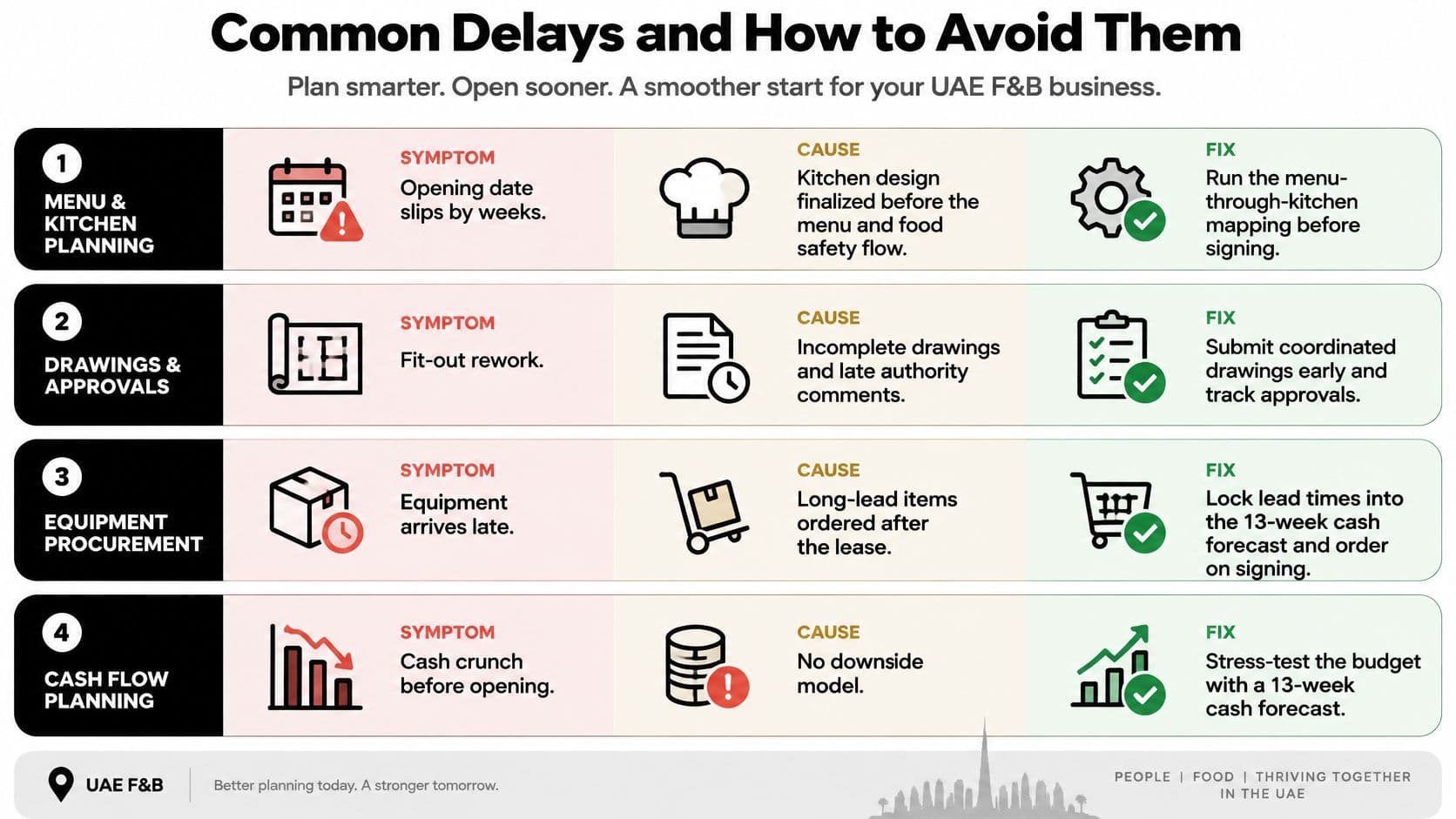
Maintain a log with the blocked task, root cause, owner, next action, promised date and evidence of closure. Review it weekly with the landlord representative, contractor and licensing coordinator.
Close issues with documents, not verbal reassurance. An approved drawing, issued card or signed handover record is usable evidence. A message saying the matter is being handled isn't.
Smart Classic Business Hub offers business setup, trade licence and government approval support, alongside feasibility studies and financial planning for founders preparing to open a restaurant in Dubai. Visit Smart Classic Business Hub with your proposed menu, premises details and draft budget to discuss the licence path and commercial decisions before committing to a lease.