
You've shortlisted a licence, found premises and started discussing launch dates. The revenue forecast looks promising, but a partner asks how many customers have committed, and the bank wants to know when cash receipts will cover repayments. Suddenly, the missing piece isn't another presentation. It's evidence that the business can survive the gap between paying suppliers and collecting from customers.
A useful business feasibility study answers that question before you commit capital. For a UAE venture, it must connect customer demand, operating permissions, launch timing and cash flow to a clear decision: proceed, change the model, wait or stop.
Feasibility Study Outline at a Glance
A feasibility study tests whether an idea deserves investment. A business plan describes how you'll execute it. Writing the execution plan first can leave you defending a concept that hasn't passed its most basic commercial tests.
The risk isn't theoretical. In Wamda's review of more than 60 MENA startup failures, including UAE companies, lack of market need accounted for 27.3% of failures. A strong study therefore starts with buyers, not incorporation paperwork.
Feasibility study modules, outputs and typical effort
These are planning estimates for a single venture, not delivery commitments. Evidence collection and authority responses determine the actual workload.
| Module | Question it answers | Output you hand over | Typical effort (estimate) |
|---|---|---|---|
| Market demand | Is there paying demand at a viable price? | Customer evidence log and sized market | Longest research workstream |
| Technical and operational | Can we deliver at the forecast cost and date? | Requirements checklist and launch timeline | Supplier checks and capacity assessment |
| Legal and licensing | Which licence and approvals fit the model? | Jurisdiction comparison and approval map | Authority confirmation and document review |
| Financial model | Does the monthly cash flow work? | Cash-flow forecast and break-even analysis | Detailed build followed by reconciliation |
| Sensitivity and risk | What breaks the plan, and how fast? | Scenario table, risk register and runway estimate | Model testing and management review |
| Decision criteria | Go, pause or stop? | Scored verdict with conditions and triggers | Final decision workshop |
The sequence matters. Demand determines delivery volume; volume determines capacity and staffing; those requirements determine costs. Building the financial model before establishing these relationships produces precise-looking guesses.
Establish the evidence trail
Start by defining the customer problem and target emirate. Validate the proposed offer, then assess mainland and free-zone operating assumptions separately, including licensing, VAT administration, premises, staffing, financing and compliance.
Only then should you stress-test cash flow and recommend a decision. An unresolved licensing dependency should remain visible, not disappear inside a general contingency allowance.
Practical rule: Open an assumptions register immediately. Tag every entry as evidence, supplier quote or estimate, with its owner, date and supporting document.
Keep that register beside the model. A lender or partner should be able to trace an important forecast input without asking you to reconstruct your reasoning.
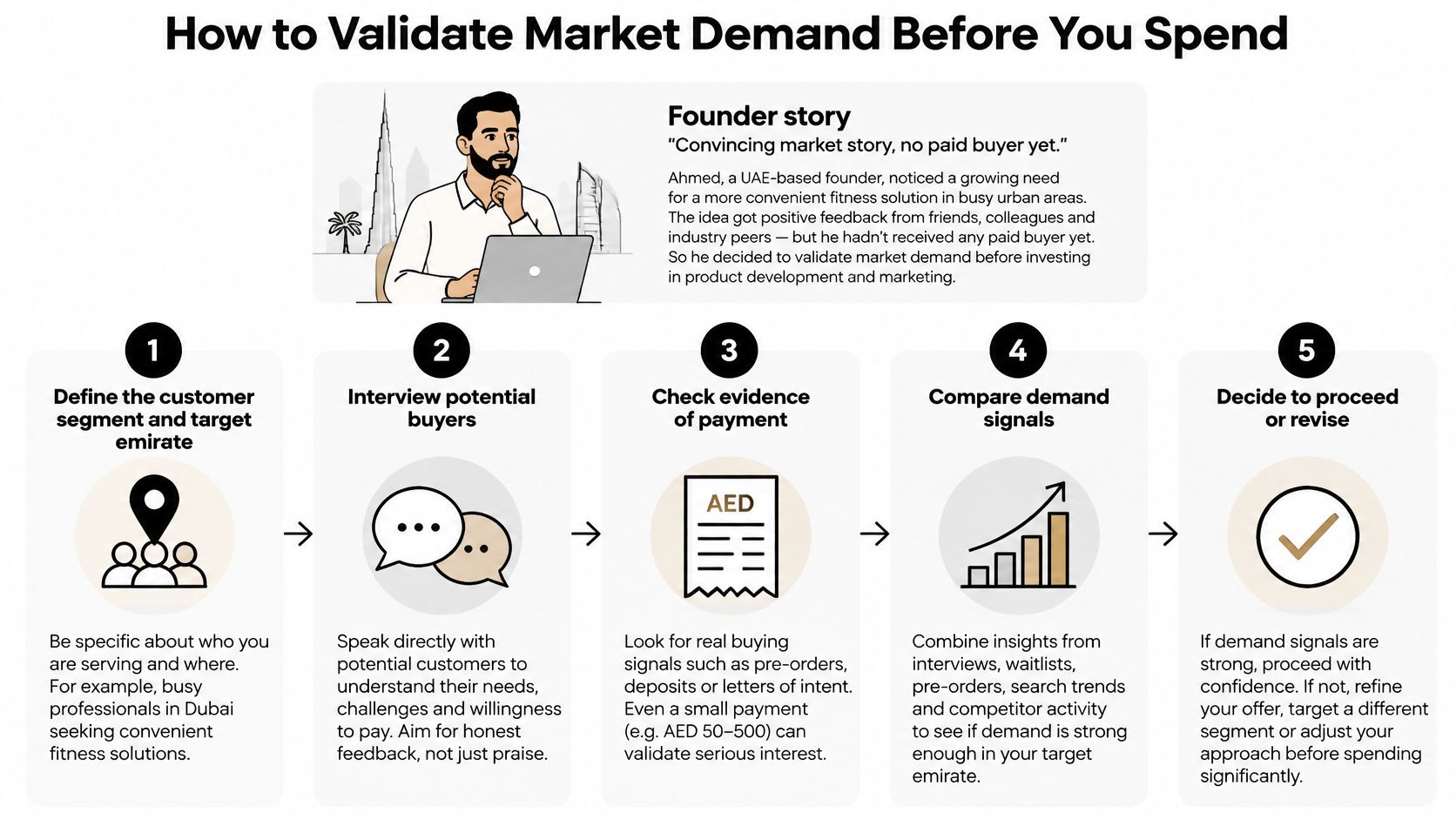
How to Validate Market Demand Before You Spend
A founder can explain why Dubai needs a service and still have no buyer willing to pay for it. The warning sign is a forecast built from broad enthusiasm rather than a named customer's purchasing process.
Treat demand validation as a purchasing investigation. Find out who controls the budget, what they currently spend and what would make them change suppliers.
Follow the buyer, not just the sector
Define the segment and location. Specify the customer, target emirate and service area. For a cleaning company, a serviced-apartment operator's procurement manager is a more useful buyer definition than hospitality businesses.
Map alternatives. Record direct competitors' prices, coverage, contract terms and exclusions. Include indirect alternatives, such as an operator's own housekeeping team, because customers compare your offer with whatever they already do.
Interview purchasing decision-makers. Ask about recent purchases, current frustrations, supplier replacement procedures and payment terms. Questions about actual behaviour reveal more than asking whether someone likes your idea.
Check official sector evidence. Use it to understand the opportunity's scale, not to substitute for customer conversations. The UAE Ministry of Economy and Tourism reports that non-oil activities represented approximately 75.6% of real GDP in 2024, while transport and storage expanded by 9.6% and construction by 8.4%. Those are national baselines, not sales forecasts for your venture.
Reconcile market-sizing methods. Compare a top-down sector estimate with a bottom-up calculation using reachable accounts, realistic purchase frequency and achievable prices. If they disagree sharply, investigate the customer definition or assumed access.
Ask for a commercial commitment. Test a paid pilot, lawful pre-order arrangement or signed letter of intent with defined scope and conditions. Don't accept a friendly meeting as equivalent evidence.
For initial sector mapping, a guide to industries in Dubai can help organise your shortlist. The final customer list still needs named organisations and identifiable buyers.
Replace assumed demand with serviceable demand
Say you're assessing a cleaning service for serviced apartments in Business Bay. Your initial estimate includes every apartment you can identify, multiplied by an assumed cleaning frequency.
Interviews may reveal that operators already employ housekeeping staff, outsource only overflow work and require short-notice attendance. Your addressable demand becomes outsourced overflow jobs you can reach and fulfil, not every apartment turnover.
That smaller demand estimate is more useful. It changes staffing, travel allowances, equipment requirements and the price needed to make each job worthwhile.
Record each prospect's buyer, proposed scope, buying date, payment terms and commitment status in a demand scorecard. Count money and specific signed commitments separately from expressions of interest.
How to Test Technical and Operational Feasibility
The cheapest incorporation option isn't necessarily the cheapest way to operate. A low setup quote can become expensive if the proposed activity needs additional approvals, different premises or a structure that supports the intended customer transactions.
Your operational test is straightforward: can this legal and delivery structure fulfil the promised service at the forecast cost and launch date? Confirm permissions with the relevant authority rather than assuming that similar licence names permit identical activities.

Turn requirements into dependencies
Build a checklist with a cost, lead time, responsible person and prerequisite for every material requirement:
- Activity and jurisdiction: Compare mainland, free-zone and, where relevant, offshore structures against the actual proposed transactions.
- Approvals and premises: Confirm external approvals, permitted premises use, zoning, fit-out conditions and sector permits.
- People and delivery: Verify staffing permissions, visa capacity, recruitment lead times and required qualifications.
- Equipment and technology: Obtain supplier lead times, installation requirements, maintenance terms and software integration costs.
- Tax administration: Establish applicable VAT registration and corporate tax obligations with an appropriately qualified adviser.
For support with the comparison process, Goodhand's guide to choosing a UAE company formation advisor provides context for assessing advisers. Keep the decision grounded in the specific activity and authority requirements, not a headline package price.
Three launch cases compared
The delayed case below is an illustrative modelling scenario, not an estimate of authority processing time. “None” means no additional loss relative to the planned compliant launch.
| Case | Payroll during delay | Lost revenue |
|---|---|---|
| Fastest compliant launch | None | None |
| Delayed approval, illustrative three-month delay | Monthly committed payroll × delay duration | Revenue scheduled during the blocked trading period |
| Restricted activity scope | None | Forecast revenue from activities the licence doesn't permit |
For each case, attach quoted licence and premises costs, amendment charges, deposits and any replacement fit-out expenditure. Recalculate break-even using the revised overhead and permitted revenue mix.
Don't confuse lost revenue with cash loss. For funding purposes, calculate the contribution lost after avoidable delivery costs, then add payroll, rent and other unavoidable payments during the delay.
A jurisdiction becomes uneconomic when its restrictions or extra costs push the venture beyond its approved funding limit or required return.
Contact the relevant authority before finalising the study. Finish with an operational readiness sheet and a critical-path timeline showing which unresolved approval can block spending, recruitment or trading.
How to Build a 36-Month Financial Model
A lender needs to understand how much cash you require, when you require it and what will fund repayments. An annual profit table can't answer those questions because it hides the timing of deposits, stock purchases, collections and financing.
Build a monthly cash-flow model with connected assumptions, profit-and-loss, working-capital and funding schedules. A 36-month workbook gives you room to examine launch, stabilisation and repayment rather than stopping at the opening year.
Build the model in layers
Separate setup expenditure from recurring operations. Setup lines can include licence and registration costs, fit-out, deposits, legal fees and initial stock; recurring lines should include rent, salaries, visas, insurance, software, marketing, accounting and audit.
Distinguish refundable deposits from expenses and capital equipment from routine purchases. They all affect cash, but they don't belong in the same accounting category.
Construct revenue from operational drivers:
- Sales volume: Qualified opportunities × conversion rate, adjusted for onboarding time and delivery capacity.
- Revenue: Delivered units × realised selling price, after discounts and refunds.
- Gross profit: Revenue minus direct delivery costs.
- Contribution per unit: Selling price minus costs that increase with each additional unit.
- Break-even volume: Fixed operating costs divided by contribution per unit.
For a cleaning contract, supplies and job-specific labour may be variable costs, while office rent remains fixed. Classify labour according to the actual employment arrangement rather than using a convenient margin assumption.
Model collections before celebrating profit
Receivable days determine when customer invoices become available cash. Payable days and inventory days determine how much of the trading cycle you must finance yourself.
Enter supplier payments, customer receipts, VAT settlement and applicable corporate tax payments in their expected months. Keep tax calculations explicit, and don't treat VAT collected as freely spendable revenue.
Grow My Acorn's practical steps for forecasting cash flow offer a useful workflow for assembling receipts and payments. Use the mechanics alongside UAE-specific tax and licensing inputs.
Minimum funding equals the peak cumulative cash deficit plus a contingency reserve. Size that reserve against unresolved risks rather than applying an unexplained percentage.
For an existing business, additional documents may include the company's financial statements and a letter of intent. Use historical results to establish the baseline, then show the proposal's incremental cash requirements separately.
Give risk a financial owner
UAE entrepreneurship research published in the Journal of Risk and Financial Management identifies competition, VAT and high licence costs among perceived business-environment challenges. Translate those concerns into actions rather than copying them into a generic risk paragraph.
| Risk | Probability assessment | Financial impact | Mitigation and owner |
|---|---|---|---|
| Regulatory change | Assess against activity | Additional compliance cost or delay | Approval monitoring, compliance owner |
| Thin local network | Assess against pipeline evidence | Slower customer acquisition | Channel partnerships, sales owner |
| Licence cost uncertainty | Assess against quote completeness | Higher setup cash requirement | Written itemised quotes, finance owner |
| Larger competitors | Assess against buyer alternatives | Lower price or conversion | Differentiated scope, commercial owner |
Keep probability assessments qualitative until you have a defensible basis for numerical probabilities. For every material risk, identify the model input it changes.
Your handover should include the monthly cash-flow sheet, break-even chart and a single minimum funding figure. Keep all inputs on one assumptions tab; financial forecasting support is most useful when the workbook needs independent challenge, not cosmetic formatting.
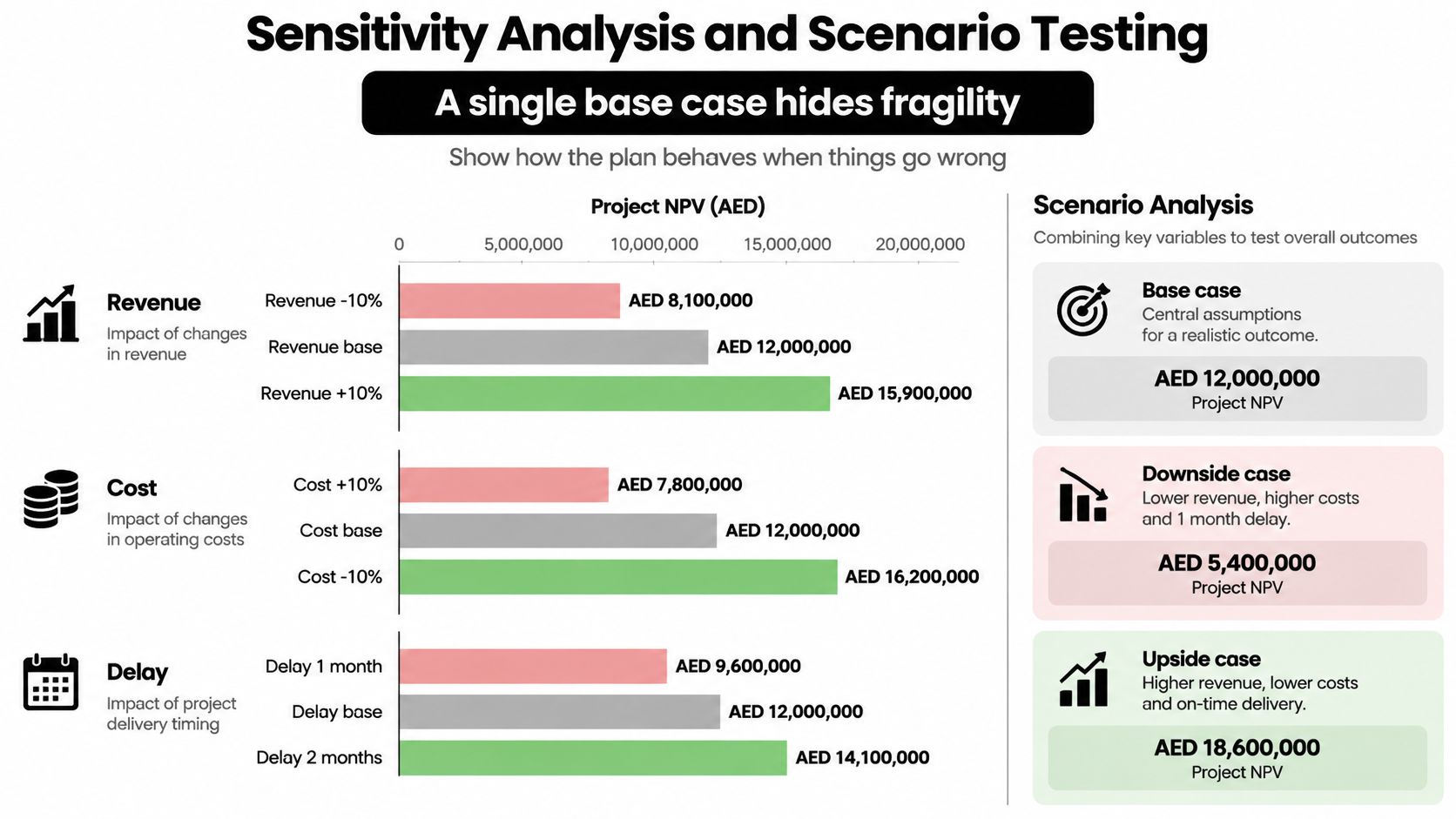
Sensitivity Analysis and Scenario Testing
A cleaning contractor can meet its sales target and still exhaust its cash if customers pay later than expected. When rent and payroll remain payable on schedule, extending collection time creates a funding requirement even without a fall in revenue.
A single base case conceals that exposure. Sensitivity analysis identifies the inputs that matter most; scenario testing shows what happens when adverse changes occur together.
Isolate the drivers first
Change sales ramp, conversion, gross margin, rent, salaries, collection timing, licence and fit-out costs, and financing cost individually. Record the resulting minimum cash balance, runway and payback date.
Use Excel's Data Tables or a comparable spreadsheet sensitivity tool. Keep the starting cash balance and other assumptions fixed during each individual test so you can identify the actual source of the movement.
The Central Bank of the UAE's June 2025 Quarterly Economic Review reports 4.0% economic growth in 2024, compared with the 4.2% projection published in March 2024. Forecasts are conditional estimates, even at national level; a founder's sales forecast deserves at least as much scrutiny.
Scenario values for stress-testing
These are illustrative scenario definitions, not market statistics or recommended universal assumptions. Replace them with changes that reflect your contracts, customer concentration and cost exposure.
| Driver | Base | Upside | Downside | Severe downside |
|---|---|---|---|---|
| Sales volume vs plan | Plan | Higher conversion supported by pipeline | Loss of largest uncommitted prospect | Loss of material customer group |
| Collection days | Contract terms | Earlier payment supported by agreement | Late payment by major customer | Prolonged delay across major accounts |
| Rent | Plan | Plan | Higher renewal quote | Higher quote plus relocation costs |
| Gross margin | Plan | Better quoted purchasing terms | Discounting needed to win business | Discounting plus delivery-cost increase |
| Licence and fit-out cost | Budget | Budget | Unquoted items added | Approval changes require redesign |
For the cleaning contractor, apply the delayed customer receipts and increased premises cost simultaneously. The severe-case survival period ends in the first month when available cash, including committed drawable funding, can't meet payments.
Don't invent a runway result from those changes alone. You also need the starting cash, invoice schedule, payroll, supplier terms and borrowing availability.
Decision discipline: Set the response before launch. A sustained sales shortfall should trigger a defined spending freeze or restructuring action, not another optimistic forecast.
Put those triggers beside the scenario outputs. Identify which manager acts, which costs can be reduced and how long the reduction takes to affect cash.
Confirm the Go or No-Go Decision Before You Commit Capital
If the venture can't survive its credible severe-downside case and no committed remedy closes the gap, it isn't ready for approval. Calling it a risky go doesn't resolve the funding shortfall.
Set decision thresholds before reviewing the final result. Otherwise, founders can keep moving the acceptance criteria until the preferred answer appears.
Go, pause or stop thresholds for a feasibility study
Use these decision rules as starting points, adjusted for sector, contractual obligations and investor requirements. They're not regulatory thresholds or promises of bank approval.
| Criterion | Go threshold | Pause if | Stop if |
|---|---|---|---|
| Cash survival under severe downside | Committed funds cover the recovery period and obligations | Survival requires funding not yet committed | Cash runs out before corrective action can work |
| Break-even volume against realistic capacity | Achievable with a meaningful operating buffer | Requires near-full utilisation | Exceeds deliverable capacity |
| Pre-sales or signed commitments | Credible commitments support the launch case | Interest exists but material terms remain open | Buyers reject the viable price or required scope |
| Payback period | Meets the investor's agreed investment horizon | Depends on unproven expansion | Fails the agreed horizon under supportable assumptions |
| Licence and approval timing | Approval fits the funded launch window | Delay is manageable but unresolved | Delay pushes launch beyond available runway |
Apply the verdict precisely:
- Go: Evidence and committed resources support the approved operating case.
- Go with conditions: Proceed only after named actions, such as reducing fixed costs or securing an approval, are completed.
- Pause: A material answer is missing, but obtaining it could change the decision.
- Stop: Demand, permissions, or economics fail a critical requirement.
Treat an unfilled funding gap as a condition precedent, not an assumption that somebody will provide the money later.
Make the funding request auditable
Present required capital, owner contribution, proposed borrowing, collateral or guarantees where relevant, debt-service capacity, monthly burn and downside survival period. Distinguish approved, available funding from applications and verbal indications.
The funding-readiness issues addressed by Mastercard's UAE SME Confidence Index reinforce the need to examine financing alongside commercial viability. A polished forecast is not proof of bankability.
Build an evidence pack with signed customer documents, documented willingness-to-pay interviews, supplier quotations, lease estimates and hiring costs. Explain cancellation rights and conditions attached to customer commitments so a reviewer can judge their strength.
A sector-specific example, such as AQEEK Coffee's Yemeni specialty café business plan, can help translate an approved concept into an operating plan. Keep the distinction between a feasibility study and business plan clear: approval must rest on tested assumptions, not presentation quality.
If the verdict is go, our Business Setup Cost Calculator can help firm up setup inputs, while our feasibility study and business plan services can support review before lender or partner discussions.
This week, collect customer evidence covering price acceptance, purchasing authority and buying timing. Enter it into the assumptions register and rerun the severe case before making another fixed-cost commitment.
Smart Classic Business Hub offers feasibility studies, business planning and corporate finance advisory for UAE investment decisions. Visit Smart Classic Business Hub to discuss your proposed venture and arrange a review of its demand evidence, funding requirement and licensing assumptions before you commit capital.