
A feasibility study tests whether your idea can work in the UAE market first; a business plan maps how you will execute it after viability is confirmed. In Dubai and across the UAE, feasibility studies commonly cost about AED 10,000–40,000, while advanced studies can reach AED 50,000–250,000+, making the order of work a serious financial decision.
A familiar problem appears in founder meetings. Someone has spent weeks polishing an executive summary, refining a five-year forecast, choosing a logo, and preparing a pitch deck, only to discover that the proposed location, customer demand, licensing route, or cost structure doesn't support the idea. The document looks complete, but it answers the wrong question.
That sequence mistake is especially costly in the UAE. The UAE business ecosystem gives startups and SMEs a formal, government-backed setting in which licensing, compliance, and financial planning matter from the outset. A feasibility study helps decide whether the proposed venture deserves further investment. A business plan then turns that decision into an operating, funding, and compliance roadmap.
Understanding the Core Difference
Most founders treat a business plan as the starting point because investors, banks, and formation advisers ask for one. The practical starting point should usually be different. Before documenting how the company will sell, hire, expand, and raise money, you need evidence that the underlying idea works for its intended UAE market.
A feasibility study is an investigative document. It tests market demand, operational practicality, regulatory fit, capital needs, financial sustainability, and key risks. Its decision is usually whether to proceed, change the concept, test an alternative, or stop.
A business plan is an execution document. It assumes the venture has passed the viability test and explains how the founders will organise the company, obtain funding, serve customers, manage people, and comply with applicable UAE requirements.
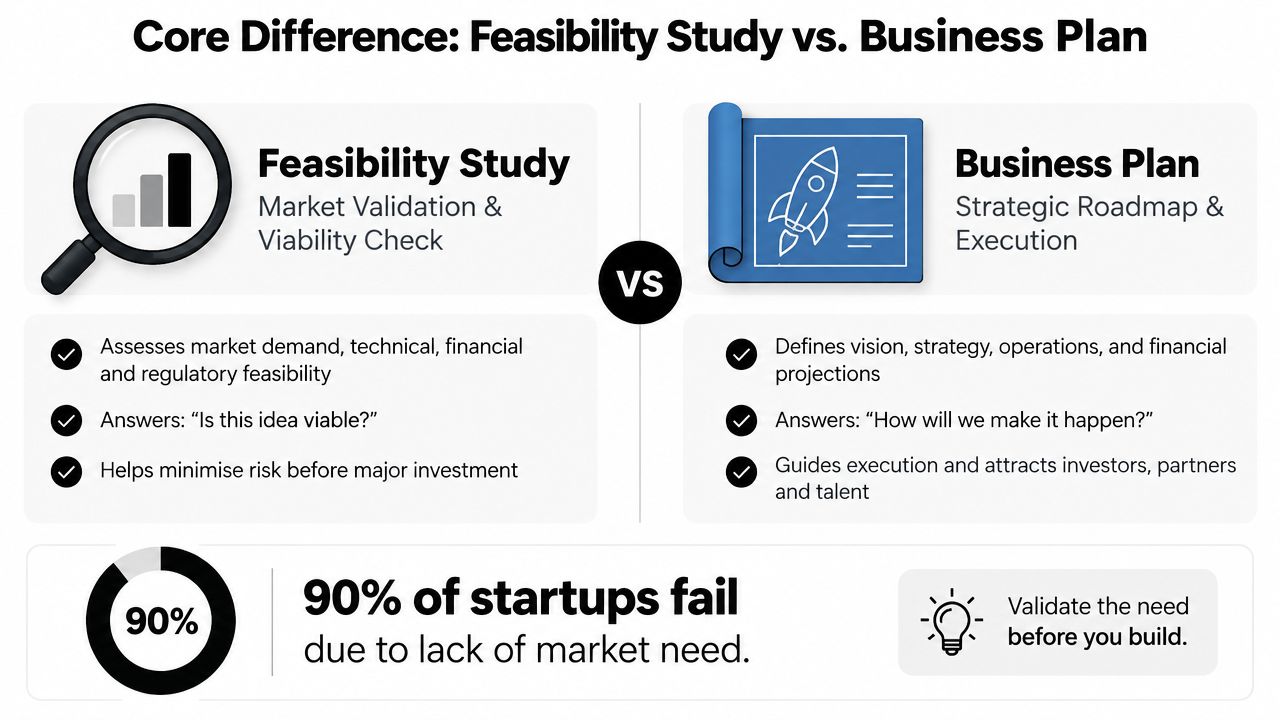
Practical rule: If you're still uncertain whether customers will pay, whether the location is workable, or whether the licensing model fits, start with a feasibility study.
The difference is not one of length. A business plan can contain market research and financial projections, but it presents them as the foundation for implementation. A feasibility study interrogates the assumptions behind those figures. It asks whether the proposed price, customer segment, staffing model, location, and legal structure survive realistic testing.
Why the sequence matters
Writing a business plan first encourages founders to defend an idea instead of examining it. Once a polished document exists, teams often become reluctant to challenge its assumptions. They may spend more on branding, incorporation, premises, or recruitment before discovering a basic commercial problem.
The UAE-specific issue is that execution choices can change the economics. Mainland and free zone structures may create different operational considerations. Activities can affect licensing requirements, staffing arrangements, premises, and compliance work. A viability decision made without examining those variables is incomplete.
The useful sequence is therefore:
- Test the idea. Use a feasibility study to examine demand, costs, operations, regulation, and risk.
- Refine the model. Change the offer, customer segment, location, capital structure, or route to market where the evidence requires it.
- Plan the launch. Use a business plan to organise implementation, funding, staffing, and compliance.
What a Feasibility Study Covers in the UAE Context
A UAE feasibility study tests whether an idea can work before founders commit to a polished business plan, licence application, premises, or recruitment. In Dubai, even a free zone choice can affect the activities permitted, premises requirements, and approval route. Our feasibility study in UAE guide explains how these decisions fit into the wider assessment.
A practical study usually brings together four to six quantitative components: market analysis, financial projections, capital requirements, break-even and sensitivity testing, operational planning, and risk review. The purpose is to expose weak assumptions early, not to make an attractive concept sound certain.
Market and commercial testing
Market analysis identifies the specific customer group, buying behaviour, competing offers, pricing logic, and location dynamics relevant to the proposed venture. A Dubai consumer concept may require a different assessment from a B2B service targeting Abu Dhabi or a technology company selling across several emirates.
The useful question is whether the offer can win enough demand at a price that supports its operating model. Broad sector trends do not answer that. The study should test likely customers, sales channels, competitors, and the conditions required for repeat revenue.
Financial viability
The financial model brings together setup costs, operating expenses, revenue assumptions, working capital, capital requirements, and cash-flow pressure. It should show how the result changes when sales, pricing, staffing, rent, supplier costs, or launch timing vary.
For UAE ventures, the model also needs relevant VAT and corporate tax assumptions. The UAE's post-2023 corporate tax environment makes documented planning more important when founders compare structures, forecast profits, or prepare information for investors and lenders.
Break-even analysis connects commercial assumptions to the level of sales the operation must achieve. Sensitivity testing identifies which assumptions create the greatest downside exposure, helping founders decide what to verify before spending.
Operations, licensing, and risk
Operational planning examines the people, suppliers, technology, premises, processes, and external support needed to deliver the offer. It should connect those requirements to the proposed licensing route, including approvals, labour arrangements, PRO support, premises, and banking.
Risk review then tests what could prevent the venture from reaching its commercial objectives. A sound report identifies regulatory, market, financial, operational, and execution risks, with a response assigned to each. The result is a test-before-invest document, not a promotional narrative.
What a Business Plan Includes for UAE Execution
A founder can spend weeks polishing a business plan before checking whether the activity, market, or licensing route makes sense. Once a feasibility study supports proceeding, the business plan has a different job. It turns tested assumptions into an operating document covering ownership, delivery, marketing, staffing, finance, and growth. The content should work for the founding team and communicate clearly with banks, investors, and formation stakeholders.
A practical UAE business plan often includes:
- Executive summary: The opportunity, business model, funding requirement, and proposed direction.
- Company description: Ownership, activity, location, legal structure, purpose, and commercial objectives.
- Products or services: The offer, customer value, pricing approach, delivery model, and differentiation.
- Market and competition: Findings from the feasibility work, converted into positioning, sales priorities, and commercial decisions.
- Organisation and management: Roles, reporting lines, recruitment needs, and external advisers.
- Marketing and sales: Channels, positioning, lead generation, conversion, partnerships, and customer retention.
- Financial plan: Revenue model, costs, cash flow, capital needs, and projections extending to three to five years, the horizon UAE lenders and free zone authorities typically expect.
- Implementation plan: Licensing, premises, staffing, banking, tax registration, compliance tasks, milestones, dependencies, and responsibilities.
- Appendices: Supporting research, management profiles, permits, supplier information, contracts, and financial schedules.
Execution under UAE conditions
In the UAE, incorporation is only one part of execution. The selected activity and jurisdiction affect licensing, visas, premises, labour arrangements, banking, VAT, and corporate tax compliance. A useful schedule maps these dependencies before assigning launch dates. It should also show which approvals, documents, or service providers could delay the plan.
The same document may serve several audiences, but each reader tests a different point. A bank will examine repayment capacity and cash flow. An investor may focus on market evidence, the team, capital requirements, and growth logic. Government or formation stakeholders may require clear details about the activity and legal structure. The plan should separate confirmed decisions from assumptions still awaiting verification.
Founders can use this UAE business plan outline to organise the document before tailoring it to their activity and jurisdiction. Teams assessing drafting software can compare business plan AI tools for workflow purposes, but software cannot replace UAE-specific commercial, tax, or licensing judgement. A polished plan remains weak if its underlying feasibility work is incomplete.
Comparing Purpose, Scope, and Timing
A founder can spend weeks polishing a business plan before discovering that the proposed activity, customer demand, or cost structure does not work. A feasibility study reduces that risk first. Both documents may examine customers, costs, operations, and financial forecasts, but they handle uncertainty differently. The study tests whether assumptions hold. The plan organises execution after those assumptions have been accepted.
| Dimension | Feasibility Study | Business Plan |
|---|---|---|
| Core question | Should the venture proceed? | How will the venture operate and grow? |
| Timing | Before significant commitment | After viability is sufficiently established |
| Primary purpose | Investigate practicality and risk | Direct execution and communicate strategy |
| Market work | Tests demand, competition, pricing, and customer fit | Uses findings to define marketing and sales |
| Financial work | Challenges costs, revenue assumptions, capital needs, break-even, and sensitivity | Converts accepted assumptions into operating forecasts and funding requirements |
| Regulatory work | Identifies licensing, tax, legal, and compliance constraints | Assigns compliance tasks, timelines, ownership, and budgets |
| Output | Go, no-go, or revise recommendation | Roadmap for launch, funding, management, and growth |
| Main audience | Founders, decision-makers, investors, and project stakeholders | Founders, investors, lenders, partners, and implementation teams |
Cost versus decision value
A feasibility study costs more investigative effort because it examines unresolved questions. Standard to investor-grade UAE studies commonly fall around AED 10,000–40,000, while assignments requiring primary research, competitor benchmarking, location analysis, interviews, and fieldwork can exceed AED 250,000, as outlined in this UAE feasibility study pricing guidance.
Business planning is usually presented as a lower-cost execution exercise. One UAE comparison places financial-feasibility work at AED 7,000–14,000 and business planning at approximately AED 12,000–20,000. That difference can make a plan seem like the sensible first purchase. It can become the more expensive choice if it delays the discovery of a regulatory, commercial, or financial problem.
The useful question is not “Which document costs less?” It is “Which uncertainty could make the investment irrelevant?”
In the UAE, the sequence matters because the proposed activity, jurisdiction, licensing route, tax position, premises, and operating model can affect one another. Unresolved demand, location, legal structure, or economics justify a feasibility study first. Once those conditions are sufficiently tested, the business plan can assign responsibilities, budgets, milestones, and funding requirements. Starting with execution before viability is established creates a polished schedule for a venture that may still need to change.
Real UAE Startup Scenarios
A document's value depends on the decision it supports. These three UAE scenarios show why founders need to match the work to their uncertainty rather than ordering the same template for every venture.
A technology founder testing Dubai demand
A technology founder has built an early product and wants to establish a Dubai company. The founder is unsure whether the strongest customers are local SMEs, larger regional groups, or international clients served from the UAE. A business plan written immediately could fill pages with assumptions about pricing, sales channels, staffing, and office requirements.
A feasibility study is more useful at this stage. It can test customer demand, competitor positioning, sales friction, delivery costs, hiring requirements, and the implications of different setup routes. The founder may then decide to adjust the product, target a narrower segment, operate with a different cost base, or proceed to a formal business plan.
For founders working through early product questions, this practical founder's validation guide offers useful context for testing the commercial foundations before formal execution.

A restaurant concept with a weak location
A restaurant entrepreneur has selected a promising Dubai neighbourhood and begins preparing a business plan for investors. The concept is attractive, but the proposed site has high occupancy costs, limited passing trade, and a customer base that may not support the planned average spend.
A location-sensitive feasibility study should come first. It can examine customer profiles, competing venues, access, delivery potential, operating hours, staffing, fit-out requirements, supplier arrangements, and downside scenarios. If the evidence doesn't support the site, the founder can change location or redesign the concept before signing a lease or ordering equipment.
That is where a feasibility study earns its fee. It can produce an uncomfortable recommendation while the founder still has options. A business plan written first may instead make the location appear inevitable.
An established SME seeking expansion finance
An existing UAE SME has a functioning operation, management accounts, customer history, and a defined expansion proposal. The central uncertainty isn't whether the company has a concept. It is how to finance and execute the next phase without weakening the existing business.
Here, a business plan may be the priority. It can explain the expansion, funding request, projected cash flow, management capacity, implementation milestones, and compliance responsibilities. A focused feasibility review may still be appropriate for a new site, product, or market, but the company doesn't necessarily need to treat the entire enterprise as an untested idea.
The practical distinction is simple. New uncertainty calls for investigation. Established viability calls for coordinated execution.
How Smart Classic Supports Your Journey
Founders often need both documents, but not at the same time. An advisory process should begin by identifying the decision that remains unresolved, then assign the right work to that decision. A feasibility study may lead to a revised concept, while a business plan may formalise the revised version for launch or funding.
Smart Classic Business Hub offers feasibility study development and business planning alongside UAE company formation across mainland, free zone, and offshore jurisdictions. Its broader services include PRO support, tax residency certificates, VAT-compliant accounting, audit, liquidation support, corporate finance advisory, and financial management. That combination can help founders keep the analytical phase connected to the regulatory and administrative work that follows.
Keeping the two phases connected
The handover between documents matters. A feasibility study should leave a clear record of the assumptions tested, the risks identified, the recommended structure, and the changes required before launch. The business plan should then use those findings instead of replacing them with generic market language.
A joined-up advisory process can support practical tasks such as:
- Financial modelling: Building assumptions around capital, revenue, expenses, cash flow, break-even, and sensitivity.
- Formation planning: Aligning the proposed activity and jurisdiction with the operating model.
- Compliance preparation: Organising VAT, corporate tax, accounting, audit, and documentation requirements.
- Operational support: Connecting the plan to PRO services, staffing, premises, recruitment, and implementation.
- Exit or adjustment planning: Supporting liquidation or restructuring if the evidence no longer supports continuation.
The same principle applies to team design. A technology founder may need local operational support, specialist contractors, or international recruitment, including options such as Hire Latin American Developers when building a distributed development team. That staffing choice belongs in the feasibility and operating model before it becomes a line item in the business plan.
Smart Classic Business Hub should be considered as one advisory option for founders who want feasibility, planning, formation, and ongoing compliance work assessed within the same UAE context. The important point is not to buy every service at once. It is to sequence the work around the decisions that carry the greatest downside.
Deciding Which Document to Prioritize
Use this decision framework before commissioning a consultant or downloading a template.
List the unresolved assumptions. Are you unsure about customer demand, pricing, location, capital, staffing, operating costs, or licensing? Several unanswered questions indicate that a feasibility study should come first.
Check whether you've tested the market. A polished idea isn't evidence of demand. Identify what direct customer, competitor, location, and pricing work supports your assumptions.
Test the UAE operating route. Confirm that the intended activity, jurisdiction, premises, labour model, tax treatment, and compliance obligations fit the commercial model. If those details remain unclear, don't finalise an execution roadmap yet.
Separate evidence from intention. A business plan can state what you intend to do. A feasibility study should show why the proposal is practical enough to pursue.
Choose the deliverable that matches the decision. Use a feasibility study for a go, no-go, or revise decision. Use a business plan when you need to coordinate launch, funding, management, and growth.
Founders considering the UAE can also review practical startup guidance for Dubai before deciding which professional support they need. The sequence is straightforward: prove viability, refine the model, then plan execution.
Smart Classic Business Hub provides feasibility studies, business plans, UAE company formation, PRO services, tax support, accounting, audit, and corporate finance guidance for founders and SMEs. Visit Smart Classic Business Hub to discuss which document your venture needs first and build a decision-ready path from validation to compliant execution.