
You're probably in one of two situations right now. Either you've got a clear business idea for Dubai or the wider UAE and want to move fast, or you've already spoken to a few setup agents and now realise everyone is giving you a different answer on cost, demand, licensing, and risk.
That's precisely where a feasibility study in UAE stops being a simple document and starts becoming a functional decision tool. It tells you whether your idea deserves capital, time, visas, lease commitments, supplier negotiations, and operational effort. Beyond that, it identifies what needs to change before you launch.
I've seen founders spend months refining a brand name, a menu, an app interface, or a product catalogue before answering the basic commercial questions. Who will buy this in the UAE. What will it cost to deliver properly. Which licence structure fits the model. How long until the business covers itself. If those answers are weak, the idea usually struggles no matter how polished the branding looks.
Your UAE Business Idea Is It Viable
A common scenario looks like this. A foreign investor sees strong footfall in Dubai, hears about business-friendly reforms, and decides to open a niche retail concept, consulting firm, medical service, cloud kitchen, warehouse operation, or tech platform. The early excitement is real. So is the uncertainty.
The first questions usually come fast. Is there enough demand outside a small personal network. Are competitors already saturated in that category. Will mainland or free zone make more sense. What will fit-out, staffing, warehousing, approvals, and working capital look like once the business is live, not just registered.
That's where a feasibility study matters. It forces the project out of assumption mode and into evidence mode. It also gives you something most founders lack at the start: a disciplined way to test downside scenarios before they become expensive mistakes. If you want a practical way to forecast business outcomes with what if analysis, that kind of scenario thinking fits naturally into a proper feasibility process.
What founders often miss early
Many people confuse “the UAE is growing” with “my business will work here”. Those are not the same thing. A market can be active and still be wrong for your price point, delivery model, location, or target segment.
A good study should challenge points like these:
- Demand reality: Are customers actively looking for what you want to sell, or do you need to educate the market first?
- Commercial fit: Can the pricing support rent, payroll, logistics, and compliance?
- Operating model: Can you source, staff, and deliver the service consistently in the UAE?
- Jurisdiction choice: Does your business model match the legal structure you're planning to use?
Go to market only after you understand what has to be true for the business to work.
For founders at the pre-launch stage, the practical sequence usually starts with validating the concept, then matching the right setup route, then building the financial case. If you're still at the company formation stage, this guide on how to start a business in UAE helps place the feasibility study in the wider setup process.
What a feasibility study really does
It doesn't just say yes or no. A useful report often says yes, but differently. Different location. Different customer segment. Smaller rollout. Higher pricing. Leaner staffing. Different supplier base. Different licence route.
That's why I treat a feasibility study as a blueprint for success, not a box-ticking exercise. In the UAE, speed matters. But speed without validation usually just means reaching the wrong decision faster.
Why a Feasibility Study Is Your First Smart Investment
No one builds a tower in Dubai by guessing the soil conditions, the load limits, or the utility plan. A serious business launch should be treated the same way. If the structure is weak at the planning stage, every later decision becomes harder and more expensive to fix.

A proper feasibility study gives you the foundation drawings. It validates demand, tests the economics, flags operational constraints, and checks whether the idea fits the UAE regulatory environment. Without it, founders often rely on optimism, isolated anecdotes, or advice from parties who are focused on getting the company incorporated rather than proving the business can perform.
What makes it especially important in the UAE
The UAE rewards decisive execution, but it also punishes shallow planning. Consumer preferences move quickly. Licensing and jurisdiction decisions matter early. Real estate commitments can lock you into the wrong cost base. Supplier arrangements that look fine on paper can turn into delivery problems once operations begin.
The upside is real when the opportunity is chosen carefully. According to data points from a UAE feasibility study, the retail market is projected to reach AED 246 billion by 2026, with e-commerce accounting for over 18% of sales. The same source notes that projected average ROI for startups in high-potential sectors such as tech and renewable energy can range from 18% to 25% by 2026, with a venture capital ecosystem projected to hit AED 2.5 billion in investments.
Those figures matter, but not in the way many founders think. They don't prove your concept will work. They prove that the market is active enough to justify serious analysis. A feasibility study translates broad opportunity into a specific commercial case.
What works and what does not
What works:
- Testing assumptions early: pricing, customer profile, location logic, and staffing model
- Building investor confidence: lenders, partners, and shareholders want structured reasoning, not enthusiasm
- Matching strategy to regulation: setup route, ownership structure, and operating scope need to fit the plan
What usually doesn't work:
- Starting with the licence only: legal setup without commercial validation creates hollow companies
- Using generic templates: a restaurant, logistics operation, clinic, and SaaS business should not be analysed the same way
- Treating the report as a sales brochure: a real study should expose weaknesses, not hide them
Practical rule: If a consultant never challenges your assumptions, you're probably not getting a feasibility study. You're getting reassurance.
A strong report should be useful even if the answer is “delay launch” or “change the model”. That kind of honesty protects capital. In practice, that's often the most valuable outcome of all.
The Core Components of a UAE Feasibility Study
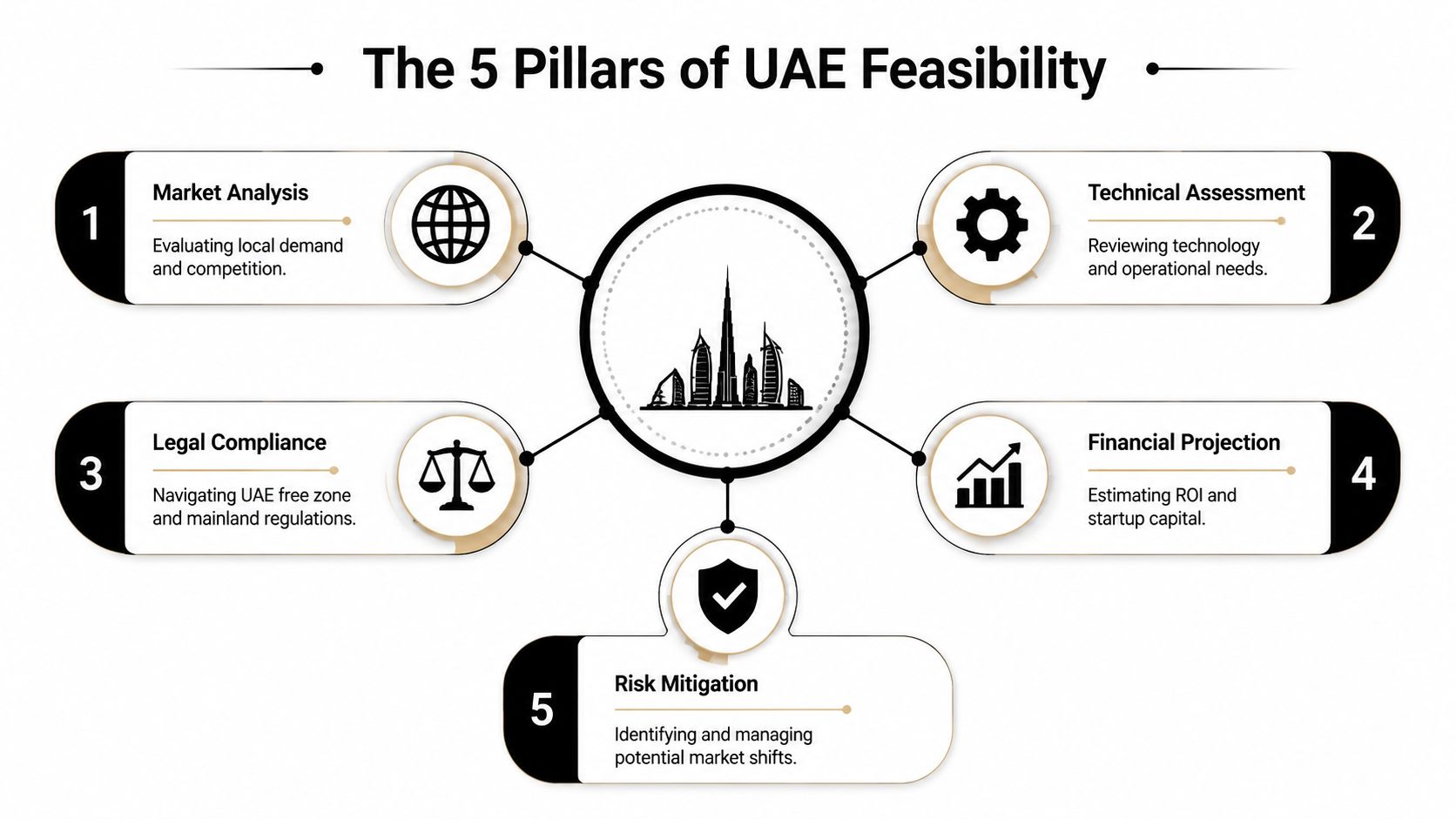
Most weak reports fail for one reason. They focus on one dimension, usually market demand or a simple revenue forecast, and ignore the rest. A proper feasibility study in UAE needs five pillars working together. If one pillar is missing, the conclusion can't be trusted.
Market analysis
Many founders expect this stage to provide a simple answer to "is there demand?". In reality, market analysis should go further. It should identify who the customer is, where they are, what alternatives they already use, what price sensitivity looks like, and how crowded the category is.
For a retail, healthcare, F&B, education, or service business, this often includes local demand mapping, competitor review, customer segment analysis, and location logic. For B2B businesses, it should test buying cycles, procurement behaviour, and whether decision-makers are accessible from your chosen setup.
Key questions include:
- Customer fit: Who exactly is the buyer in the UAE?
- Competitive pressure: Are you entering a crowded lane or a gap?
- Commercial positioning: Can you win on convenience, expertise, pricing, speed, or specialisation?
Technical and operational feasibility
At this stage, ideas either prove practical or fail. You must determine if you can source required materials and operate at the expected quality. Assess whether the infrastructure aligns with the model. Consider if climate, logistics, storage, utility, or equipment factors exist that alter the economics.
The UAE climate is one of the most overlooked technical issues. According to technical feasibility data for UAE projects, underestimating summer temperatures can lead to 20 to 30% higher cooling CapEx for facilities such as data centres. The same source notes that forecasting energy needs and specifying HVAC systems compliant with DEWA standards can improve energy efficiency by 15 to 20%.
That principle applies beyond data centres. Warehousing, food storage, manufacturing, delivery operations, and any facility-sensitive business needs local operating assumptions, not imported ones.
If your operational model depends on equipment, cooling, transport, specialist staff, or time-sensitive delivery, technical feasibility is not a back-office exercise. It is the business.
Legal and regulatory fit
The legal section should answer a practical question: can this business operate the way you intend under the licence and jurisdiction you're considering?
That means reviewing permitted activities, ownership structure, approval pathways, lease implications, compliance obligations, and where extra permissions may apply. In the UAE, the difference between what sounds similar commercially and what is allowed legally can be significant.
Financial projection
The report turns from research into a decision document at this stage. It should build realistic revenue assumptions, startup cost estimates, operating costs, cash flow expectations, break-even logic, and sensitivity checks.
If you're reviewing draft statements or historical numbers during that process, a tool like the PDF AI financial report analyzer can help extract and inspect profit and loss patterns more quickly before they feed into the model.
A useful financial model doesn't just show the upside. It shows what happens if sales are slower, costs rise, or ramp-up takes longer than planned.
Risk assessment
Risk doesn't mean writing generic threats like “competition” or “economic changes”. It means identifying the specific issues that could disrupt this business in this market and deciding how to respond.
Typical areas include supplier concentration, regulatory dependency, location exposure, staffing difficulty, pricing pressure, and rollout timing. The best studies don't stop at identifying risk. They propose mitigation steps, phasing, buffers, and contingency triggers.
Navigating the UAE Business Landscape
One of the most important decisions in a feasibility study is where the business will sit legally. In the UAE, that usually means choosing between Mainland, Free Zone, and Offshore. Founders often treat this as an admin choice. It isn't. It affects how you sell, bank, hire, contract, expand, and comply.
The practical difference
Mainland is usually the right route if you want direct access to the local UAE market with an operating presence tied to on-the-ground commercial activity. It suits businesses such as retail, restaurants, clinics, contracting operations, and service companies that need broad domestic reach.
Free Zone often works well for founders who want a structured setup environment, an internationally oriented operating model, or activity-specific ecosystems. It can suit consulting, trading, digital services, holding structures, and certain specialised sectors, depending on the free zone and the activity.
Offshore is different again. It's generally used for asset holding, international structuring, or ownership arrangements rather than active local trading in the UAE market.
| Feature | Mainland | Free Zone | Offshore |
|---|---|---|---|
| Primary use | Local UAE trading and service delivery | Structured setup for specific activities and international operations | Holding and international structuring |
| Local market access | Strong fit for direct UAE operations | Depends on the business model and structure | Not suited to active local operations |
| Office expectations | Often tied to operational presence | Varies by free zone package and activity | Usually not built for day-to-day trading presence |
| Good fit for | Retail, hospitality, contracting, local services | Consulting, trading, tech, niche services | Asset holding, cross-border ownership structures |
| Main concern | Broader compliance and operational planning | Activity restrictions and practical market access | Limited operational use inside the UAE |
How to decide properly
The wrong way is to start with the cheapest licence. The right way is to start with the operating model.
Ask these questions:
- Where are your customers? If you need direct local commercial activity, mainland may be necessary.
- How will you deliver the service? A remote consultancy and a physical retail business don't need the same setup.
- What approvals will the activity require? Some sectors need additional regulatory review.
- Will visas, substance, or residency planning matter? These aren't afterthoughts. They affect structure and cost.
The UAE also allows 100% foreign ownership in over 1,500 commercial activities, as noted in the earlier-linked feasibility data. That has widened the options for international investors, but it hasn't removed the need for proper structuring. Ownership flexibility doesn't fix a poor jurisdiction match.
The best jurisdiction is the one that fits your revenue model, delivery model, and compliance burden at the same time.
Cross-border founders also underestimate communication issues when dealing with local partners, suppliers, landlords, and authorities. A useful reference on this is the Translate AI guide for global meetings, especially if your business will involve multilingual negotiations.
If you're evaluating market entry more broadly, this guide on conquering the UAE market is a practical companion to the jurisdiction decision.
Typical Timelines and Costs for a UAE Study
Most clients ask two questions before anything else. How much will the study cost, and how long will it take. That's reasonable, especially because pricing in this space is often vague until late in the sales conversation.

The short answer is that cost depends on complexity, not just business size. A small project can still require detailed field validation if the concept is unusual, heavily regulated, or location-sensitive. A larger project may move faster if the data is accessible and the scope is tightly defined.
According to this UAE feasibility study cost and timeline breakdown, a feasibility study in 2026 can cost from AED 40,000 for a small retail project to over AED 190,000 for a large industrial venture. The same source states that a core study typically takes 4 to 5 weeks, while a premium study with fieldwork such as surveys and focus groups can take 6 to 8 weeks.
What changes the price
Three factors usually drive fees more than anything else:
- Research depth: Desk research is quicker. Primary research, supplier checks, interviews, surveys, and location validation take more time.
- Sector complexity: Healthcare, industrial, technology, education, and regulated activities usually need more specialist review.
- Model detail: A high-level opportunity memo costs less than a full commercial and financial feasibility package.
Some clients only need an initial go or no-go view. Others need a lender-ready or investor-ready report with stronger modelling and more evidence. Those are different jobs and should be priced differently.
A practical timeline
A well-run study usually follows a sequence rather than one continuous block of analysis.
| Phase | What happens |
|---|---|
| Briefing and scoping | Clarify the concept, objectives, assumptions, and decision points |
| Research and validation | Review the market, competitors, suppliers, location options, and regulatory context |
| Financial modelling | Build revenue assumptions, startup costs, operating costs, cash flow, and sensitivity cases |
| Review and conclusion | Test the findings, refine assumptions, and finalise recommendations |
Cost warning: If a consultant quotes a very low fee without defining scope, assumptions, and deliverables, the report often ends up too shallow to support a real investment decision.
The study should also reflect what kind of output you need. A founder deciding whether to proceed needs one type of report. A shareholder group seeking funding support needs another. Paying for the wrong level of study wastes money just as surely as skipping the study altogether.
Choosing Your Partner How to Hire a Consultant
A poor consultant can make a feasibility study look professional while leaving you with weak assumptions, copied market commentary, and unusable financial logic. Hiring well matters as much as commissioning the study itself.
One problem in the UAE market is pricing opacity. According to this review of UAE feasibility study planning gaps, a 2025 UAE consultancy survey by Dubai Chamber of Commerce indicated average costs of AED 15,000 to AED 50,000 for standard studies, and 68% of startups cited unclear consultancy fees as a barrier to entry. That tells you two things. First, fee ranges vary widely. Second, hidden scope is a real risk.
Questions worth asking before you sign
Don't ask only for a price. Ask how the consultant works.
- What exactly is included? Ask whether the fee covers market research, competitor mapping, financial modelling, legal review, interviews, supplier validation, and revisions.
- Who will do the work? Some firms sell through senior people and deliver through juniors with little sector knowledge.
- How UAE-specific is the methodology? A generic international template won't catch local licensing, lease, climate, or supply chain realities.
- What assumptions will be tested? If they can't explain the pressure points in your model, they probably won't analyse them well.
Red flags that usually signal trouble
A few warning signs come up repeatedly:
- Guaranteed success claims: No serious consultant can promise approval, profitability, or investor funding.
- Very fast turnaround without trade-offs: Speed is possible, but only if scope is narrow.
- No discussion of risk: If every finding sounds positive, the analysis is probably thin.
- Unclear pricing: If the fee keeps changing after the call, budgeting will become messy.
One sensible option is to look at firms that handle both setup context and financial advisory work. For example, Smart Classic's feasibility study consultants in UAE present feasibility work as part of a wider advisory process, which can be useful when the study needs to connect directly to formation, compliance, and operational planning.
Ask for a sample structure, not just a proposal. The table of contents often reveals whether the consultant actually knows how to evaluate your type of business.
The best consultant isn't the one who agrees with your idea fastest. It's the one who can test it properly and explain the trade-offs clearly.
Frequently Asked Questions About Feasibility Studies
Can I do a feasibility study myself
You can do an initial self-check, and many founders should. It helps you clarify the concept, define the customer, and identify obvious weaknesses. But a self-prepared study often struggles with local regulatory detail, market validation depth, and financial modelling discipline.
Use your own draft to sharpen the brief. Don't rely on it alone if you're committing serious capital, signing leases, or bringing in partners.
Is a feasibility study the same as a business plan
No. A feasibility study asks whether the business should proceed and in what form. A business plan usually assumes the decision to proceed has already been made and focuses on execution.
In simple terms, the feasibility study tests the idea. The business plan organises the rollout.
Is a feasibility study legally required to get a trade licence in the UAE
Not as a general rule for every activity. But that doesn't mean it's optional from a commercial perspective. Many businesses can obtain a licence without proving that the model is financially or operationally sound.
That's why founders often confuse legal setup with business readiness. The licence lets you operate. The feasibility study tells you whether operating is likely to make sense.
How detailed should the financial model be
Detailed enough to support a decision. At minimum, it should reflect startup costs, operating costs, revenue logic, cash flow pressure, and downside cases. If the business is capital-intensive or investor-facing, the model needs more depth.
When should I commission the study
Before major commitments. That means before signing a long lease, purchasing specialist equipment, hiring a full team, or choosing a structure that may not fit the business.
What should the final report give me
It should give you a decision. Proceed, revise, phase the launch, delay, or stop. If the report leaves you with more marketing language than commercial clarity, it hasn't done its job.
If you're weighing a new launch, expansion, or restructuring decision in the Emirates, Smart Classic Business Hub can help assess the commercial, financial, and regulatory viability before you commit capital. That's often the difference between opening a company and building a business that can last.