
You're comparing a mainland licence with a free zone package, asking whether your existing Sharjah client changes the answer, and discovering that the office lease costs far more than the first quote suggested. That's a normal starting point for anyone researching a trade license in Dubai. The mistake is treating the licence as a cheap formality. It's a regulated business structure that affects your activities, premises, visas, banking, customer access, renewals, and future expansion.
Dubai's official licensing system records businesses through defined activity and licence categories, not broad descriptions such as “online business” or “general services”. The Dubai Pulse mainland dataset records all mainland business licences, excludes free zones, and identifies professional, commercial, industrial, and tourism licence types. It also states that the final approved licence is issued once the requirements and payment are completed, making issuance a formal milestone rather than an informal registration step (Dubai Pulse mainland licence dataset).
This guide follows the decisions founders face: selecting the right activity, choosing a jurisdiction, calculating the complete fee stack, handling the newer free zone to mainland routes, and keeping the licence valid after issuance.
Why Dubai Founders Are Choosing Trade Licenses in 2026
An Indian founder sitting near Baniyas Square has a familiar problem. He has a service client in Sharjah, wants to reach customers across the UAE, is being asked for proof of capital, and has received an office quote that is roughly twice his initial estimate. A free zone package looks simpler. A mainland licence looks more flexible. Neither answer is automatically correct.
His first question shouldn't be “Which licence is cheapest?” It should be “Where will this business operate?” If he needs to contract directly with mainland customers, tender for government or semi-government work, or maintain a conventional Dubai office, the mainland route may justify its heavier setup requirements. If his work is primarily international, remote, or structured around a specialised zone, a free zone may be more efficient. His Sharjah client alone doesn't decide the issue.
The licence decision also affects:
- Ownership structure: The chosen activity and jurisdiction determine the applicable shareholder and agent requirements.
- Market reach: A company's ability to contract and invoice within mainland Dubai can differ from its ability to serve overseas customers.
- Visa planning: Premises and licensing packages influence establishment-card and visa capacity.
- Renewal discipline: A licence that expires can disrupt banking, visas, contracts, and routine government transactions.
Dubai continues to attract founders because it combines a business environment with established digital government channels and a broad commercial ecosystem. That opportunity comes with paperwork that rewards precision. The Department of Economy and Tourism treats business licences as a core activity indicator, while the Dubai Statistics Center tracks issued, cancelled, and renewed licences as official business-sector data (Dubai Statistics Center and DET licensing data).
The practical lesson is simple. Choose the activity before choosing the package. Choose the market before choosing the jurisdiction. Price the whole compliance stack before signing a lease.
What a Dubai Trade License Is
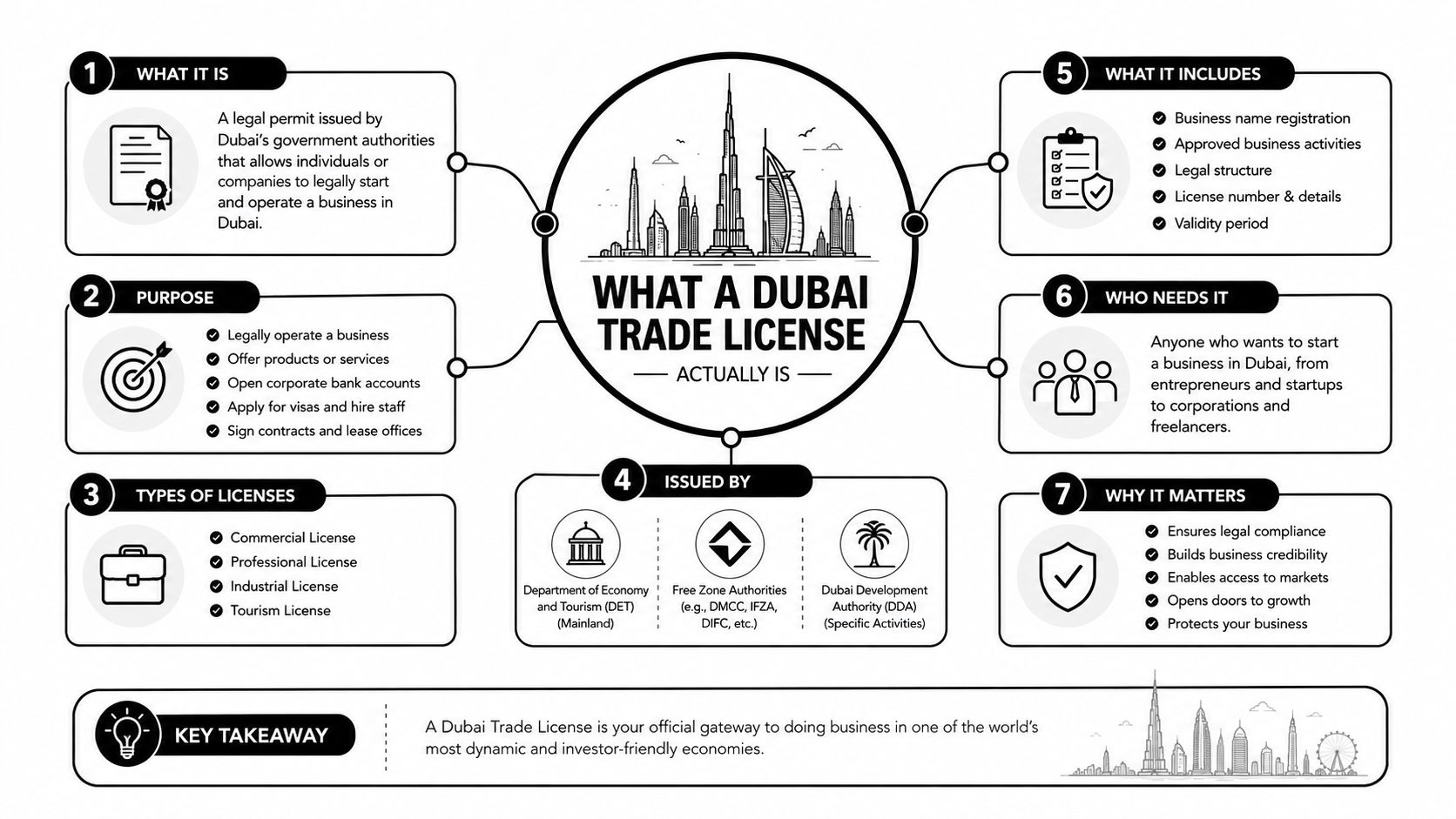
A Dubai trade licence functions as a regulatory package that records the legal entity, approved activities, legal form, trade name, and licensing status. For a mainland company, the Department of Economy and Tourism maintains these details. A free zone authority performs a comparable role for companies registered within its jurisdiction.
The licence supports more than trading. It establishes the business identity used for contracts, banking, establishment-card applications, visas, tenancy records, and government transactions. Rights depend on the approved activity and issuing authority. Treating any licence as permission for every type of commercial work creates avoidable compliance risk.
Activity classification comes first
The activity code often determines the quality of the entire application. Dubai's official mainland dataset lists four broad licence types, while the DET licensing service guides applicants through activity classification, legal-form selection, and approval stages (Dubai Department of Economy and Tourism business licensing).
The classification affects:
- Business description: The code must match what you sell or provide.
- Supporting approvals: Regulated activities may require consent from another government authority.
- Premises: Some activities require a particular office, warehouse, workshop, or tourism-related arrangement.
- Banking review: Banks compare the licence activity with invoices, contracts, website content, and expected transaction flows.
- Expansion: Adding a materially different activity may require an amendment and additional approval.
A founder who selects “consultancy” while invoicing for product trading has created a compliance mismatch. It can surface during banking, visa processing, contract review, or renewal. Fixing the classification may involve amendments, further approvals, and fresh fees.
Practical rule: List every revenue stream before selecting an activity. If the list includes goods and services, ask the licensing authority whether one licence can cover both or whether separate activities are required. Verify the final activity and status through the relevant official portal, rather than relying on a marketing blog.
Main License Types and Activity Classifications
Dubai mainland licensing uses four official categories: commercial, professional, industrial, and tourism. The category is only the starting point. The approved activity beneath it is what determines the operating boundaries.
| License Type | Example Activities | Ownership / Agent Rule | Common Misclassification Risk |
|---|---|---|---|
| Commercial | General trading, e-commerce trading, foodstuff trading, logistics | Depends on the activity and legal form. Confirm the current rule before filing. | Using a service activity while selling goods, or selecting broad trading without matching the actual product range |
| Professional | Consultancy, IT services, design, management services | Some professional structures may require a UAE national service agent. | Describing product sales as consultancy or choosing a broad service code that doesn't match the contract |
| Industrial | Manufacturing, processing, production | May require premises, technical documentation, and external approvals. | Registering trading when the business will manufacture or alter products |
| Tourism | Travel services, hospitality, inbound tour operations | Activity-specific permissions can apply. | Using a general commercial code for regulated travel or tourism work |
Commercial licences cover goods and trading
A commercial licence suits businesses that buy, sell, distribute, import, export, or otherwise trade goods. “General trading” sounds convenient, but it shouldn't be selected casually. The activity must align with the products, customs profile, supplier contracts, and bank onboarding file.
E-commerce also needs careful treatment. Selling through a website doesn't automatically turn a service business into an e-commerce trading company, nor does an online storefront remove product-specific approval requirements.
Professional licences cover services
Consulting, information technology, design, accounting-related services, and other knowledge-based activities usually sit within the professional category. The important distinction is what the company delivers to the customer. A consultancy that also resells equipment may need a commercial activity or an additional approved activity.
Founders should also check whether the chosen legal form triggers a service-agent requirement. The answer depends on the activity and structure, so it should be confirmed before paying for name reservation or drafting documents.
Industrial and tourism categories need earlier planning
Industrial activities can involve manufacturing, processing, storage, environmental controls, and civil-defence requirements. Tourism activities can involve approvals that sit outside the basic licence issuance flow. Treating either category like a simple office-based service registration creates predictable delays.
For a practical explanation of how tariffs, goods classification, and trade decisions affect small businesses, Capital Express' guide to tariffs and trade offers useful commercial context.
Before filing, match the activity against four questions:
- What exactly will you invoice for?
- Will you sell goods, services, or both?
- Will customers require a regulated approval or a particular premises?
- Does the activity match your website, contracts, bank narrative, and visa plan?
Misclassification is avoidable. Don't submit a vague activity because a formation agent says it's faster.
Mainland vs Free Zone vs Offshore
Choosing between mainland, free zone, and offshore registration starts with the business model, not the headline package. Each option sets different rules for market access, premises, visas, contracting, and ongoing compliance.
A mainland licence issued by DET usually fits founders who need direct access to the UAE market, a conventional Dubai office, or contracts with government and semi-government clients. Full foreign ownership is available for many activities under the current framework, but the exact position depends on the activity and legal form. Certain professional categories may also require an additional agent arrangement, so confirm that point before paying for incorporation documents.
Free zones such as DMCC, JAFZA, and Dubai Internet City operate through their own registration systems, office packages, and activity lists. They suit international services, technology businesses, holding structures connected to zone operations, and companies that benefit from a specialised ecosystem. The licence does not by itself give unrestricted mainland trading rights. Mainland work may require an approved route, distributor, branch, dual licence, or another permission.
Offshore structures serve a narrower purpose. JAFZA Offshore and RAK ICC structures are generally used for holding assets, international trading arrangements, intellectual property, or ownership planning. They are not substitutes for an operational UAE trading licence and do not provide ordinary UAE trading rights.
| Factor | Mainland, DET | Free Zone | Offshore |
|---|---|---|---|
| Ownership | Often allows full foreign ownership, subject to activity and structure | Usually designed for foreign ownership within the zone rules | Used for ownership and holding structures |
| Market access | Direct mainland operation, subject to the approved activity | Mainland operations may require an appropriate route, distributor, or additional licence | No ordinary UAE operational trading rights |
| Office | Mainland tenancy and Ejari requirements can apply | Zone office, flexi-desk, or facility package depends on the authority | Not an operating office solution |
| Visa eligibility | Linked to the company's premises and establishment arrangements | Linked to the zone package and premises | Not designed as a standard operating visa platform |
| Best fit | UAE-facing trading, contracting, and local operations | Zone-based, international, or specialised operations | Holding, asset, and ownership arrangements |
The major recent development is Executive Council Resolution No. 11 of 2025. It created formal routes for free zone entities to operate in mainland Dubai through a branch licence, dual licence, or temporary permit. A temporary permit can run for up to six months. A branch licence is annual and renewable. Existing free zone companies conducting mainland work must regularise within one year of the resolution's effective date, with a possible one-time extension (Reed Smith analysis of Dubai's free zone and mainland framework).
That framework makes the old blanket warning about free zone companies and mainland Dubai inaccurate. Check the formal route against the proposed activity, contract, premises, and operating period. Also compare the full fee stack, including approval, office, immigration, and renewal charges, through the relevant authority before accepting a package. Founders comparing the two main operating jurisdictions can review this mainland versus free zone Dubai comparison before committing.
Application Process and Required Documents
The application sequence is straightforward only when the information is consistent. DET mainland applications move through the Dubai government's business setup channels, while free zone applications use the selected authority's portal. Earlier decisions affect later approvals, so rushing the first step usually creates more work.
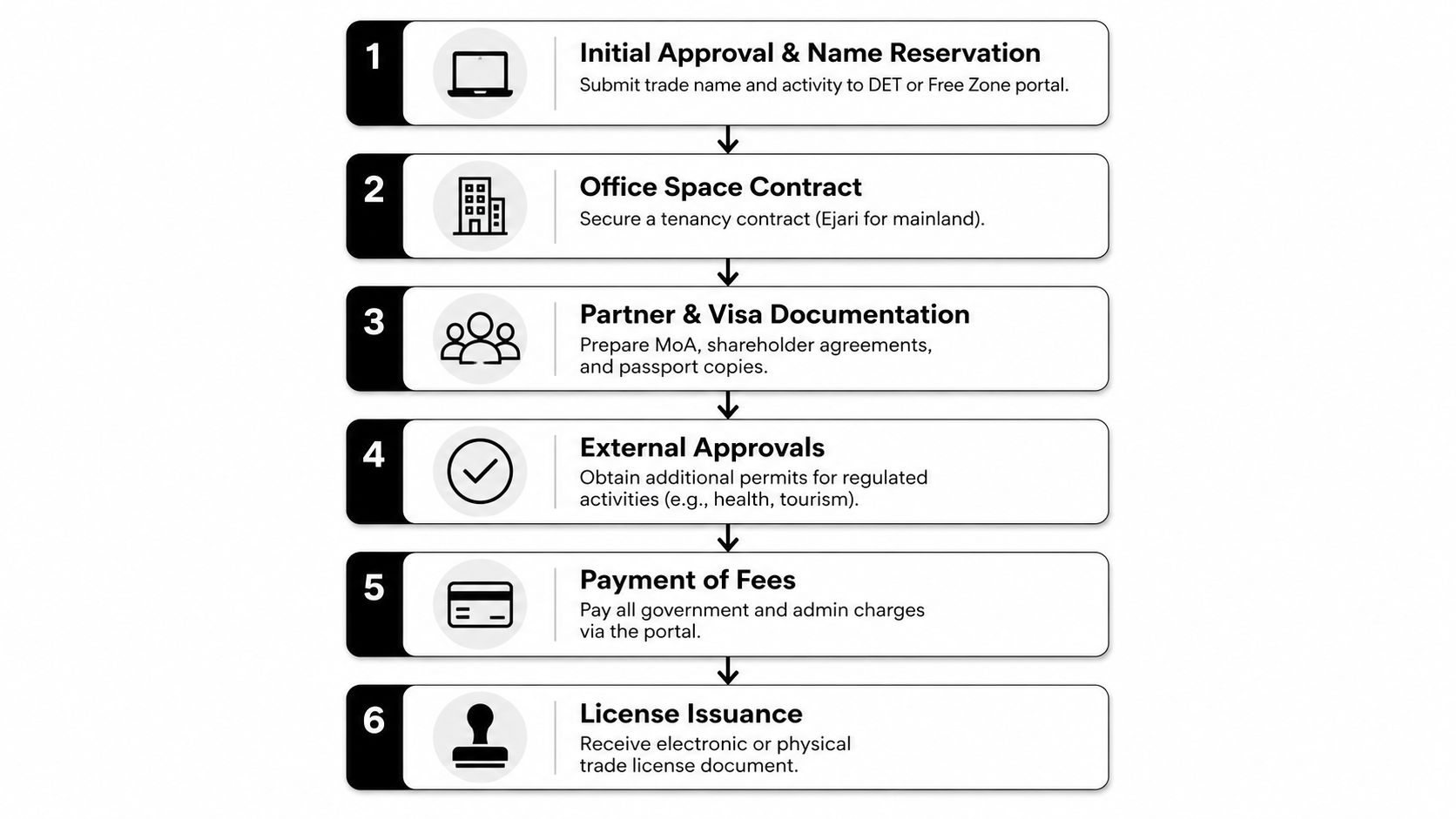
Start with the activity and trade name
Step one is activity selection. Match your revenue model to the DET activity code or the free zone's activity list. Keep invoices, website wording, shareholder descriptions, and proposed contracts consistent with that choice.
Step two is trade name reservation. Submit a name that doesn't contain prohibited references, reserved terms, or wording already associated with another entity. The name should also make commercial sense for the activity. A clever name that implies banking, government affiliation, or a regulated profession can attract scrutiny.
Step three is initial approval. DET or the relevant free zone reviews the proposed structure and confirms that the application can proceed. This isn't the final licence. It's permission to complete the remaining formation steps.
Complete the legal and premises file
Step four is the constitutional document. Mainland companies commonly prepare a Memorandum of Association, while free zone entities may use Articles or the authority's prescribed documents. Shareholders sign the documents through the required notary or digital notarisation process.
Step five is premises. Mainland companies generally need a tenancy arrangement recorded through Ejari where applicable. Free zones may accept a flexi-desk or a zone-specific office contract, but the package can affect visa capacity and operational credibility.
Step six is final issuance. Once the authority accepts the documents, approvals, premises evidence, and payment, it issues the electronic or physical trade licence. The Dubai Pulse mainland data specifically describes final issuance as occurring after requirements and payment are completed (Dubai Pulse licence issuance record).
Prepare documents that tell one consistent story
Expect to provide passport copies, shareholder and manager details, the proposed trade name, activity information, constitutional documents, and premises evidence. Regulated activities can require technical documents or approvals from the relevant authority.
Foreign documents may need translation, attestation, or digital submission in the form accepted by the authority. Don't order expensive document legalisation until the issuing authority confirms what it needs. Digital MoAs, e-signatures, unified portals, and uploaded translated documents have changed the practical workflow, but acceptance still depends on the authority and document type.
A formation overview such as Vyse Creative's company formation service can help first-time founders understand the document sequence. Use it as orientation, then verify the required documents in the official portal before submission.
Rejection usually starts before the application. The authority sees inconsistent activity descriptions, incomplete shareholder details, or premises evidence that doesn't support the requested structure.
Real Cost Breakdown Beyond the Headline Fee
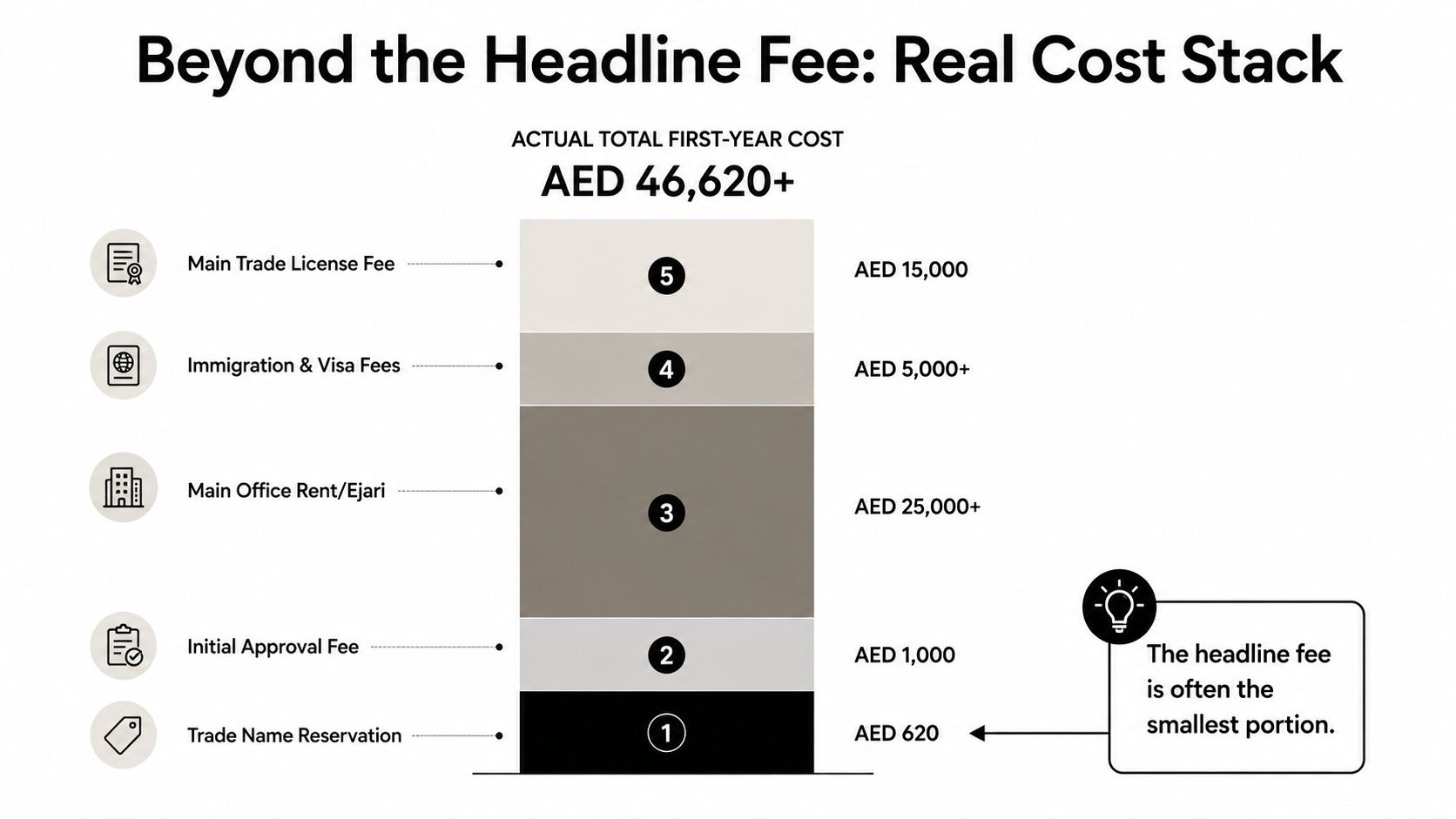
A quote showing only the licence charge can leave a founder short of cash before the company starts trading. Dubai setup budgets are fee-stack driven. Activity, premises, legal documents, immigration, market fees, and optional services all affect the first-year total.
Official licensing records establish the licence as a formal business milestone, while the operating budget extends beyond that displayed charge. Market guidance lists an AED 1,370 annual DED or e-trader package, made up of AED 1,070 for the licence and AED 300 for mandatory Dubai Chamber membership. It also places typical first-year mainland LLC setups around AED 15,000 to AED 25,000, increasing to AED 40,000 to AED 90,000 when office space and an investor visa are included (Dubai trader licence cost guidance). For another practical view of Dubai setup expenses, compare this trade licence cost breakdown from Smart Classic Business Hub.
Model the stack, not the advertisement
Build the budget line by line:
- Licence and chamber charges: Issuance or renewal costs vary by authority and activity.
- Trade name and initial approval: Treat these as separate application-stage charges where applicable.
- MOA and notarisation: Legal drafting and notarisation sit outside the headline licence fee.
- Tenancy and market fees: Mainland premises can bring Ejari registration and market-fee obligations. The cited guidance identifies 5% market fees on annual office rent as a material cost.
- Immigration and visas: Investor and employee applications add medical, Emirates ID, and immigration charges.
- External approvals: Industrial, tourism, food, health, and other regulated activities may require approval from another authority.
Free zone packages often look cheaper because they use shared offices or flexi-desk arrangements. Check visa quotas, establishment-card charges, activity tiers, and renewal terms before accepting the package. Offshore structures can reduce operating costs, but they do not provide the normal UAE operating platform. Compare them only when that limitation fits the business model.
Commercial licensing demand also creates a recurring cost issue. Dubai recorded 231,989 commercial licence issuance and renewal transactions in the first half of 2026, including 58,337 new licences and 173,652 renewals, according to Dubai business licensing reporting (Dubai commercial licence activity report). Renewal volume matters because staying operational requires repeated payments, not just an initial registration.
Prepare a full-year cash-flow model before signing a lease. Ask for every government charge, premises cost, visa item, and renewal assumption in writing. The cheapest quote usually excludes a cost you still have to pay.
Renewal, Verification, and Ongoing Compliance
Getting the licence is the midpoint, not the finish line. A Dubai business licence is a living compliance obligation, and the company must keep its activity, premises, ownership records, visas, and government registrations aligned.
Start with verification. Use official Dubai and UAE government services to search the business name, licence information, trade-name requests, and public registration details. The Dubai Land Department's trade licence search service can expose fields such as company name, licence number, issue date, expiry date, phone number, and email (Dubai Land Department trade licence search).
Audit the licence before renewal
Read the licence line by line. Don't rely on the trade name alone.
- Activity check: Confirm every activity matches current invoices and contracts.
- Expiry check: Record the exact expiry date in more than one calendar.
- Premises check: Make sure the tenancy or Ejari record remains active and linked correctly.
- Ownership check: Update shareholder, manager, and constitutional records when changes occur.
- Public-data check: Compare the official search result with the licence copy held by the bank, accountant, and company administrator.
The renewal file may require an active tenancy, paid government charges, updated constitutional documents, and any activity-specific approvals. A mismatch can block bank work, immigration transactions, or contract onboarding even when the business owner believes the licence is “basically valid”.
Treat compliance as an operating calendar
Depending on the company and activity, ongoing obligations can include commercial compliance and consumer-protection requirements, beneficial-owner reporting, anti-money-laundering records, tax registrations, accounting records, and filings under applicable UAE economic-substance rules. The correct obligations depend on the entity's activities and structure, so the company should maintain a written compliance calendar rather than rely on renewal reminders alone.
A useful operating habit is to start the renewal review well before expiry. Check the lease, activity list, shareholder details, bank records, visas, and required filings together. Renewal guidance for Dubai DED companies can be found through this trade licence renewal service guide.
Set a 60-day pre-renewal reminder. That gives you time to correct an activity mismatch, renew the tenancy, obtain an approval, or resolve a portal issue before the licence becomes a business interruption.
A lapsed licence can affect partner and employee visas, banking access, contracts, and account reactivation. Don't wait for a bank or government portal to expose the problem. Verify the record yourself, keep the official licence copy organised, and budget renewal as a recurring operating expense.
Smart Classic Business Hub helps founders compare mainland, free zone, and offshore structures, prepare licence applications, and manage Dubai licence renewals and related compliance work. Visit Smart Classic Business Hub to discuss your activity, premises, visa requirements, and full setup budget before you submit an application.