
A UAE trade licence is the official permission issued by the relevant economic authority that allows a company to carry out a specific business activity in a specific jurisdiction. The UAE recognises six licence categories, industrial, commercial, crafts, tourism, agricultural, and professional, so the correct licence depends on what you plan to do and where you plan to operate.
You might be looking at three setup quotes right now. One agent has suggested a Dubai mainland commercial licence, another has offered a free-zone professional package, and a third has recommended an offshore structure. The prices differ, but the more important difference is what each licence allows you to do.
That document affects your approved activity, legal form, trade name, ownership structure, office requirements, visa eligibility, banking process, and market access. It also creates continuing obligations after incorporation. A founder who chooses the wrong activity or assumes that a free-zone licence automatically permits mainland sales can face delays, amendments, or penalties later.
Why Every UAE Founder Ends Up Asking the Same Question
The confusion usually starts with language. Setup agents often use “trade licence” as a broad phrase, while they're discussing different licence categories, jurisdictions, and company structures. Mainland, free zone, and offshore aren't competing versions of the same product. They're separate legal environments with different operating rules.
A consultancy may receive a professional licence, while a retailer may need a commercial licence. A company manufacturing products may require an industrial licence, and a hospitality business may fall under tourism licensing. The activity determines the route, not the founder's preferred label.
The document behind the other decisions
Your licence becomes the reference point for several practical arrangements:
- Ownership: The jurisdiction and activity influence how the company can be owned and structured.
- Visas: The approved office arrangement and licence package affect the company's ability to sponsor resident employees or shareholders.
- Premises: The authority may require an Ejari, office lease, flexi-desk, or another approved address arrangement.
- Banking: Banks review the company's licence, activity, ownership, and supporting documents when assessing a corporate account.
- Sales territory: A licence issued in a free zone may not give the same direct mainland access as a mainland licence.
Practical rule: Never compare setup quotes by price alone. Compare the legal activity, issuing authority, premises requirement, visa allocation, renewal terms, and permitted market access.
Understanding the licence early gives you a more realistic budget and reduces the risk of operating beyond your approved scope. It also helps you ask an agent a better question than “How much is a licence?” Ask, “What commercial rights does this licence give my company?”
What a Trade License Actually Is
A UAE trade licence is a jurisdiction-specific legal authorisation. The relevant economic authority issues it to permit a company to conduct named activities within an approved legal and geographic framework. The Ministry of Economy and Tourism identifies six categories nationwide, while emirate and free-zone authorities manage much of the practical licensing process. The Ministry's business establishment guidance explains the national classification of industrial, commercial, crafts, tourism, agricultural, and professional licences.
In Dubai mainland, the Department of Economy and Tourism, commonly referred to as DET, issues the licence. A free-zone company receives its licence from the relevant free-zone authority. The licence normally records the company's trade name, legal form, approved activities, jurisdiction, and validity information. It works alongside the company's commercial registration or equivalent corporate record.
What the licence permits
The licence authorises the company to perform the activities listed on it. If your company is licensed for management consultancy, that doesn't automatically authorise it to sell physical products, provide regulated financial services, or operate a training centre. You may need an amendment or additional approval before adding those activities.
The licence also doesn't provide unlimited access to every UAE market. A free-zone licence may allow the company to operate within its zone and serve international clients, but direct mainland activity can require additional permissions, a mainland branch, a distributor, or another approved structure. Sector regulators can impose further conditions even when the company already holds a trade licence.
Consider two businesses offering design work. A designer operating as an individual or professional firm may need a professional licence based on skills and services. A company importing branded design products for resale may need a commercial licence. The word “design” appears in both business plans, but the underlying commercial activity is different.
A licence also isn't the same as a franchise right. If you're comparing permission to operate with rights granted by a brand owner, this franchise analysis from Coto & Waddington offers useful legal context. In practical terms, the trade licence comes from the authority, while a franchise arrangement comes from a private commercial agreement.
The Six License Categories and How to Pick Yours
The UAE's licensing framework separates businesses by their principal economic activity. The category is not a preference you select because it sounds suitable. The authority assesses the activity code, business model, documents, premises, and any required external approvals.
| License Category | Typical Activity Example | Common Mismatch to Avoid |
|---|---|---|
| Professional | Management consultancy, design services, or technical advisory work | Applying for commercial licensing when the company sells expertise rather than goods |
| Commercial | Importing, distributing, or reselling products | Assuming a trading licence covers every product or regulated item |
| Industrial | Manufacturing, processing, or production | Treating light assembly as industrial without confirming the authority's activity code |
| Tourism | Travel services, hospitality, or tourism-related operations | Starting tourism activity without the required sector approvals |
| Agricultural | Farming, cultivation, or related agricultural activity | Ignoring land, environmental, or operational permissions |
| Crafts | Skilled workshop or small craft activity | Using a professional classification for physical workshop work |
Match the activity to the invoice
A professional licence generally fits work sold through skill, expertise, or qualifications. A commercial licence fits the buying and selling of goods. Industrial licensing applies when the company manufactures or processes products, while tourism and agricultural activities can bring additional authority requirements.
The same founder can need different permissions for connected activities. For example, a company that advises restaurants on operations may be a professional service business. If it also imports kitchen equipment for resale, that trading activity may need commercial approval.
Before signing: Write down exactly what you'll invoice for, what you'll advertise, and what your customers will receive. Then match those actions to the proposed activity code.
Adding an activity later usually requires an amendment, supporting documents, and sometimes external approval. Don't choose a vague category to save time at incorporation. A narrower but accurate licence is safer than a broad-sounding licence that doesn't cover your actual work.
Mainland, Free Zone, and Offshore Compared
The jurisdiction determines the practical rights attached to the licence. Mainland companies generally have the broadest route to local UAE trading, free zones can offer focused packages and zone-based benefits, and offshore structures are designed mainly for international holding or commercial purposes rather than UAE operating activity.
| Factor | Mainland | Free Zone | Offshore |
|---|---|---|---|
| Ownership | Foreign ownership is available for most mainland activities, subject to the applicable rules | Ownership follows the chosen free-zone framework and activity requirements | May involve nominee or holding arrangements, with limited UAE operating rights |
| Market access | Generally supports direct trading across the UAE, subject to activity approvals | Direct mainland sales may need additional permission or an approved route | Usually limited to international operations and holding purposes |
| Office and visas | Premises requirements depend on the activity and authority | Packages may include flexi-desk options and visa allocations | Doesn't normally create a residency or office entitlement |
| Regulator | Relevant emirate economic authority, such as Dubai DET | The selected free-zone authority | Offshore authority such as JAFZA Offshore or RAK ICC |
| Customs and tax | Goods and tax treatment depend on the transaction and applicable rules | Customs movement and mainland sales require careful planning | Not designed as a normal UAE trading operation |
| Renewal | Renew through the issuing mainland authority | Renew through the free-zone authority | Renew through the offshore registrar or agent |
A mainland licence is often the clearer choice when your customers, staff, premises, and daily operations are mainly in the UAE. A free-zone structure may suit a founder serving overseas clients, operating within a zone, or seeking a packaged formation route. Offshore licensing is a different tool and shouldn't be presented as a substitute for an operating company.
The choice also affects ownership arrangements, office costs, bank onboarding, customs steps, and future expansion. Use this mainland versus free-zone Dubai comparison to examine the jurisdiction decision alongside your activity and customer location.
Free-zone-to-mainland access deserves special attention in 2026. A 2025 Baker McKenzie guide describes a more lenient framework introduced in September 2025 for free-zone companies seeking to conduct business onshore in Dubai. That doesn't mean every free-zone licence grants automatic mainland rights. Confirm the specific permission, registration, and activity conditions before signing a lease or marketing to mainland customers.
How to Apply for a Trade License
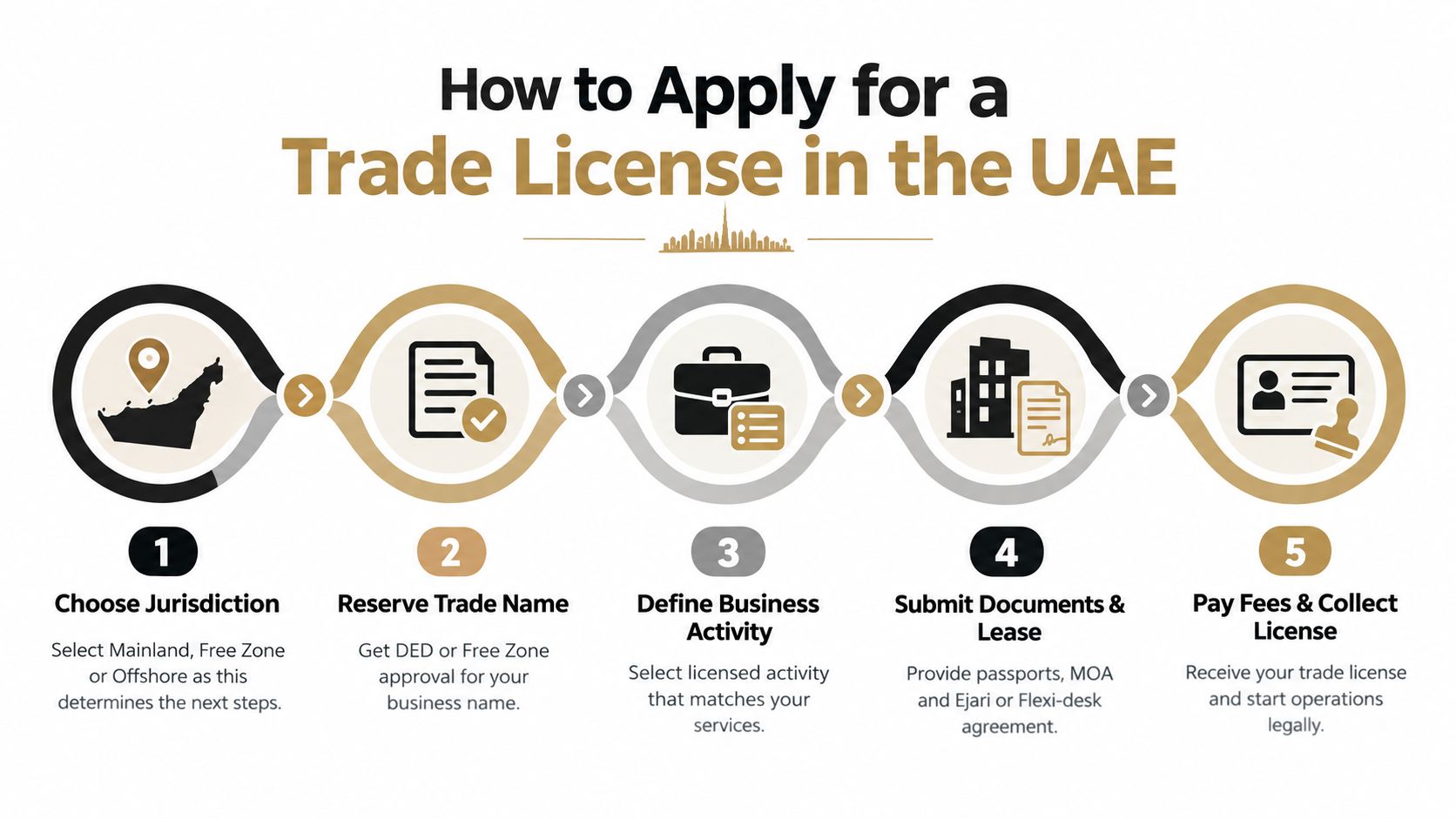
The application starts with a decision, not a form. Choose the jurisdiction and activity first, because the authority, legal form, documents, office requirement, and approval pathway all depend on those choices.
You'll usually reserve a trade name through the relevant portal, such as the Dubai economic authority's platform for mainland applications or the chosen free-zone authority's system. The authority then reviews the proposed activity and issues initial approval where applicable. At this point, confirm whether the name, legal form, and activity description accurately reflect the business you intend to run.
Prepare the corporate file
The exact document list varies, but founders commonly need passport copies, entry permit or Emirates ID information where relevant, and no-objection letters for certain UAE residents. Mainland LLC structures may require an attested memorandum of association, while free-zone shareholders complete the forms required by their authority.
External approvals can determine the timeline. Depending on the activity, you may need clearances or permissions involving Dubai Municipality, the Roads and Transport Authority, the Telecommunications and Digital Government Regulatory Authority, the Dubai Health Authority, the Dubai Financial Services Authority, or the Securities and Commodities Authority.
Once the authority accepts the file, you pay the licence and establishment-related charges. The company then completes the premises requirement, which may involve an Ejari, flexi-desk, or office agreement. Shareholder and employee immigration steps follow where visas are included, and the authority issues the final licence document after the required conditions are met.
Free-zone applications can often move faster when the activity is straightforward and the documents are ready. Mainland applications may take longer if premises, legal documents, or external approvals need review. Offshore incorporation follows a separate registrar process and can involve additional corporate documentation. Treat any quoted timeline as conditional on document quality and approval requirements, not as a guaranteed delivery date.
For a practical process reference, review this guide on how to get a business licence in the UAE.
Fees Timelines and the Cost Drivers Most Quotes Miss
A setup quote rarely represents the complete cost of operating a company. The headline licence charge is only one component, and authorities calculate fees according to the jurisdiction, activity, legal form, premises, and services selected.
Verified market guidance places commercial mainland licences at roughly AED 7,500, plus a 10% innovation fee, while professional licences may start at about AED 5,000. Free-zone packages can range from AED 5,750 to AED 26,000, and offshore incorporation can range from AED 3,000 to AED 7,000, as outlined in this Dubai trade licence cost guide. These are reference figures, not universal quotations.
| Cost Item | Mainland (AED) | Free Zone (AED) | Offshore (AED) |
|---|---|---|---|
| Licence or incorporation | From roughly 7,500 for commercial licensing | About 5,750 to 26,000 for packages | About 3,000 to 7,000 for incorporation |
| Trade name reservation | About 200 to 750 | Authority-dependent | Registrar or agent-dependent |
| Office or address | May include Ejari and office costs | May include flexi-desk or office package | Usually no operating office entitlement |
| Establishment card | Often a separate cost | Often package-dependent | Structure-dependent |
| Visas and identity costs | Depend on visa count and approvals | Depend on package and visa allocation | Normally no residency link |
| External approvals | Activity-dependent | Activity-dependent | Structure and purpose dependent |
The first estimate may omit name reservation, initial approval, memorandum attestation, establishment card, premises, visa deposits, medical examinations, Emirates ID, accounting, and PRO support. Ask the agent for a line-by-line quotation and identify which charges recur at renewal.
For a broader planning view, use this UAE business setup cost guide before committing funds. The most important cost drivers are your activity, chosen jurisdiction, office size, and visa count.
Officially cited Dubai guidance discussed in recent coverage points to a 30-day grace period after expiry and a late penalty of AED 200 or AED 250 per month, depending on the applicable rule or authority. The same guidance warns that ignoring renewal can create trade-name deregistration risk. Confirm the current amount with the issuing authority before relying on a budget.
Staying Compliant After the License Is Issued
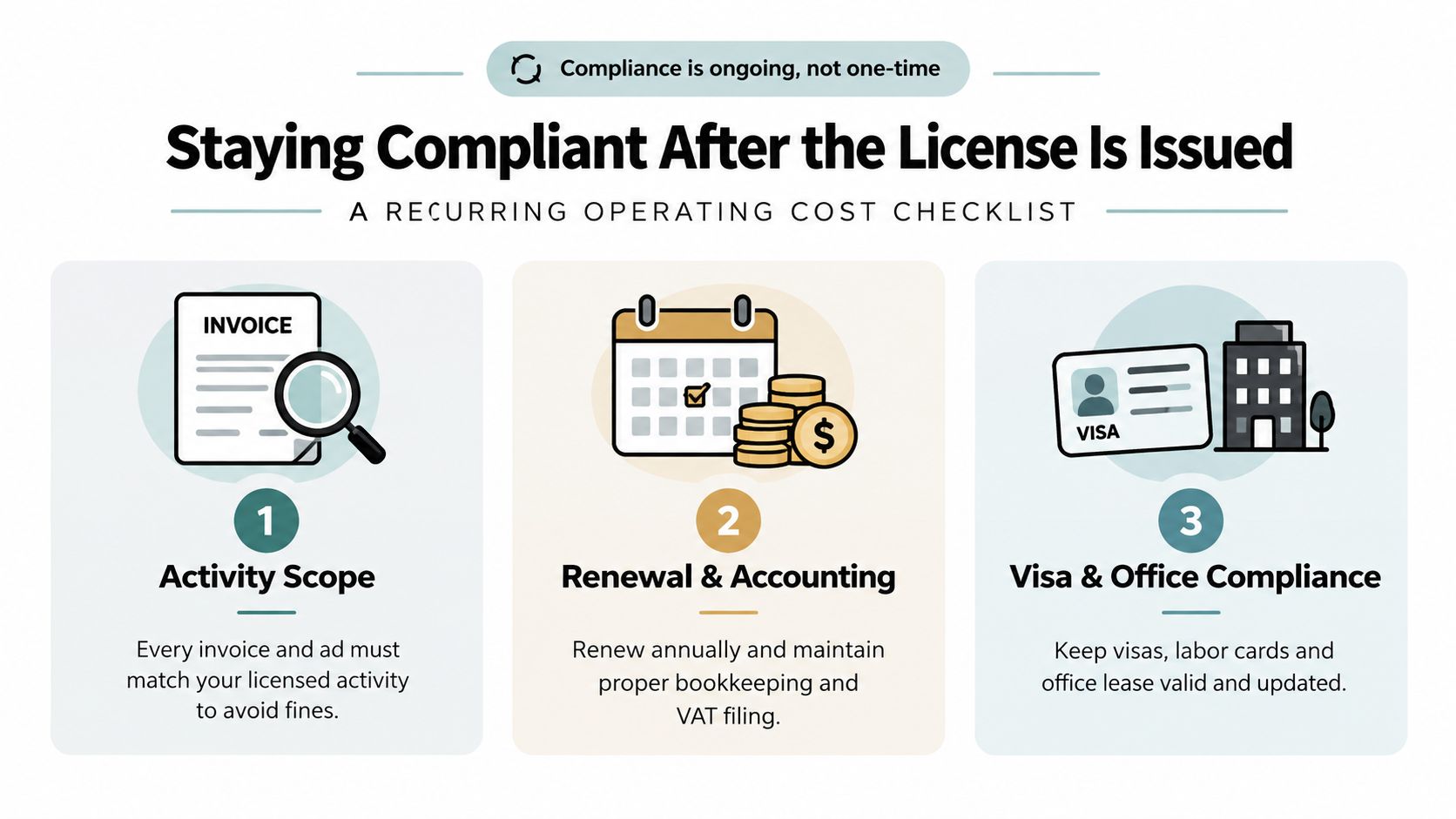
Receiving the certificate doesn't finish compliance. It starts a recurring operating cycle in which the business must keep its activity, premises, corporate records, immigration file, and regulatory filings aligned.
Keep the activity within scope
Your invoices, website, advertising, contracts, and customer deliverables should reflect the licensed activity. If a consultancy begins selling goods, or a software company starts providing regulated financial services, the founder should check whether an amendment or external approval is required before accepting that work.
The licence also connects to practical company administration. A business may need to maintain its trade name, keep its office or Ejari documentation current, manage establishment records, and complete applicable economic substance, beneficial ownership, VAT, accounting, and tax obligations. The precise filings depend on the company's activities and structure.
Treat renewal as an operating deadline
A late renewal can lead to fines and administrative restrictions. It can also disrupt visa processing, banking administration, signatory access, and employee arrangements. Abu Dhabi's compliance data shows how central licence continuity has become. In reported 2025 figures, new economic licences increased 29% year on year, active mainland licences rose 9% compared with 2023, and renewed licences grew 27%. Authorities also waived AED 11.6 million in renewal fines for 7,823 businesses, according to this UAE trade licence compliance overview.
The lesson isn't just to remember an expiry date. Build a renewal calendar, review the activity before renewal, confirm the lease, and check whether the company's visa and accounting records remain consistent. This practical explanation of why compliance matters for business is useful for founders who still see compliance as paperwork rather than an operating control.
Free-zone companies also need to verify any new mainland access permission separately. A licence category alone doesn't answer where the company may sell.
Quick Checklist and FAQs for First-Time Founders
Use this checklist before you sign an agent agreement or submit an application:
- Select the jurisdiction: Decide whether your customers and operations require mainland, free-zone, or offshore treatment.
- Confirm the activity code: Match the code to what you'll invoice, advertise, manufacture, sell, or deliver.
- Reserve the trade name: Check name rules with the issuing authority before printing materials or signing contracts.
- Prepare documents: Organise passports, identity documents, letters, shareholder forms, and any required attestation.
- Confirm premises: Check whether the authority requires Ejari, a flexi-desk, or a dedicated office.
- Pay and collect documents: Obtain the licence, establishment card, and related corporate records.
- Set the renewal date: Add the expiry and an earlier internal reminder to your calendar.
| Question | Short Answer |
|---|---|
| Can a foreigner own 100% of a mainland company in 2026? | Foreign ownership is available for most mainland activities, but confirm the exact activity and any sector-specific conditions with the issuing authority. |
| What happens if the licence expires? | Late renewal can trigger monthly penalties and may affect visas, banking administration, and other company services. |
| Is a virtual office acceptable? | It depends on the authority, activity, and package. Some structures accept flexi-desk arrangements, while regulated or premises-based activities may require a physical site. |
| How long does a free-zone licence last? | The validity depends on the authority and package. Check the certificate and renewal terms rather than assuming every zone follows the same cycle. |
| Can one licence cover multiple activities? | It can cover multiple approved activities where the authority permits them, but each activity must be recorded and compatible with the selected licence category. |
| What's the difference between a trade licence and commercial registration? | The licence authorises approved business activity. Commercial registration records the company in the relevant corporate system. They work together but serve different functions. |
| Are professional fees tax-deductible? | Deductibility depends on the nature of the expense, business records, and applicable UAE tax rules. Keep proper invoices and obtain tax advice for your structure. |
| Which authority handles complaints against a licensed company? | Start with the authority that issued the licence, then use the relevant sector regulator or consumer channel if the matter falls within its jurisdiction. |
Smart Classic Business Hub helps founders with UAE company formation, trade licence applications, mainland, free-zone and offshore structures, renewals, PRO coordination, VAT-compliant accounting, and related compliance administration. Visit Smart Classic Business Hub to discuss your activity, jurisdiction, documents, and ongoing obligations before you submit the application.