
You've just opened your company's first full set of accounts and your accountant asks a question that changes the mood in the room: “Are we ready for corporate tax?” The books may be up to date, invoices may be filed, and the bank may be reconciled, but that doesn't automatically mean the business can support its tax position.
For a Dubai founder, corporate tax compliance is no longer a question reserved for large groups. It affects how you register, calculate taxable income, file, pay, and preserve evidence. The difficult part often isn't remembering the headline rate. It's connecting sales records, expenses, contracts, payroll information, ownership details, and related-party transactions into one reliable record.
This guide treats compliance as an operational data problem. You'll start with the legal foundation, then follow the registration and filing process, understand deadlines and penalties, and build towards audit-ready records. The same approach also helps sole proprietors, freelancers, free zone companies, and international investors avoid the gaps that appear when tax work is left until the end of the financial year.
Introduction to Corporate Tax Compliance in the UAE
The UAE introduced federal corporate tax through Federal Decree-Law No. 47 of 2022, applying the regime to financial years beginning on or after 1 June 2023. For a founder, the practical starting point is the relevant financial year and the evidence the business must keep. The amount eventually payable comes later. The UAE government's corporate tax guidance sets out the basic framework.
Consider a company entering its first relevant tax period while invoices, supplier payments, employee costs, and shareholder expenses sit in separate spreadsheets. The return may not be due yet, but the evidence is being created now. If those records cannot be matched, preparing the return becomes a reconstruction exercise.
Compliance is more than payment
Corporate tax compliance links five tasks:
- Registration: Establish whether the business or individual must register and obtain the required tax identification details.
- Tax computation: Convert accounting results into taxable income, applying relevant rules, adjustments, exemptions, and reliefs.
- Return filing: Submit the corporate tax return or required declaration through the relevant process.
- Payment: Settle any amount due within the permitted period.
- Record defence: Keep transaction, ownership, accounting, and supporting records that explain the filed position.
Completing the first four tasks does not make a return defensible by itself. An unexplained shareholder payment, an unreconciled customer balance, or a missing contract can prevent the business from supporting its figures when questioned.
Practical rule: Treat every transaction as something that may need an explanation later, not merely as an entry in the bookkeeping system.
Good preparation starts with records that agree across the business. Operations may hold customer contracts, HR may hold employee cost information, and finance may hold the ledger. Each file should describe the same transaction, ownership detail, or expense.
That alignment matters for small businesses and individuals carrying on business activities. Their tax information may be spread across personal accounts, informal approvals, and operational files instead of one finance system. A founder who focuses only on the tax rate can therefore miss the larger task: connecting the evidence behind each figure. Corporate tax compliance is an operational data task. Align the records first, then calculate and report from evidence that agrees.
How UAE Corporate Tax Works and Who It Covers
A founder checks the bank balance and sees a modest profit. The tax question still requires more than looking for a payment due. UAE corporate tax compliance starts by separating scope, rate, and process. A business can fall within the system even when its taxable income produces no tax payment. Registration, calculation, filing, and payment are connected steps, but they are not the same obligation.
The headline calculation uses a threshold. The first AED 375,000 of taxable income is subject to a 0% rate, while taxable income above AED 375,000 is subject to a 9% rate. The full figure must still be measured accurately, using records that support revenue, expenses, and adjustments. Knowing the rate is only the final part of the task. The harder operational question is whether the figures in finance, sales, operations, and ownership records agree.

Registration isn't the same as tax payable
A company may need to register and file even when its calculation results in no tax payment. “We are below the threshold” therefore does not establish that the business has no compliance obligation.
The regime can cover incorporated businesses, including companies operating from free zones, depending on their facts and applicable conditions. It also covers natural persons conducting a business in the UAE when the relevant requirements are met. The Federal Tax Authority states that a natural person conducting business with turnover above AED 1 million in a calendar year must register by 31 March of the following year, according to its guidance for natural persons.
That rule can affect sole proprietors, freelancers, and owner-managers. A personal licence or small operation does not by itself settle the tax position. Review the business activity, turnover, registration status, records, and filing position together.
Build a clear mental model
Use this sequence:
- Identify the person or entity carrying on the activity.
- Determine whether the relevant tax rules bring it into scope.
- Identify the financial year and tax period.
- Calculate taxable income from reliable accounting records.
- File and pay, or submit the required declaration, within the deadline.
Free zone status requires an examination of the conditions attached to available relief. A 0% band still requires an accurate calculation. The practical test is whether the business can show how it reached its answer, with data that matches across departments and records that remain audit-ready.
Registration and Filing Steps You Must Follow
Corporate tax compliance is easier to manage as a timeline than as a year-end scramble. The sequence is practical: establish who is carrying on the business, confirm the registration position, organise the tax period, align the records, prepare the calculation, submit the return, and settle any amount due.
Step one, establish the registration position
Start with the legal entity or natural person conducting the activity. Gather the licence, incorporation documents, ownership details, financial year information, and accounting records needed for the application. A natural person should assess business turnover separately, then confirm whether the applicable registration threshold and FTA milestone have been reached.
The FTA reported that corporate tax registrants exceeded 640,000 by October 2025, as stated in its corporate tax compliance announcement. For founders, the practical lesson is simple: registration belongs in ordinary business administration. It is not a task reserved for multinational groups.
Step two, identify the tax period and prepare the records
Confirm the financial year that forms the tax period. Then collect records supporting revenue, expenses, assets, liabilities, ownership, and related-party dealings. Treat these records like connected parts of one map. The sales system, general ledger, bank records, payroll data, and contracts should point to the same transactions.
A return form cannot fix missing source data. If the sales report does not agree with the ledger, investigate the difference before calculating taxable income. Assign responsibility for resolving gaps across finance, sales, procurement, payroll, and operations, because corporate tax accuracy depends on their data matching.
Step three, calculate and file
Begin the taxable income calculation with organised accounting data, then apply the relevant tax treatment. Keep working papers explaining adjustments, exclusions, relief claims, and unusual transactions. A second reviewer should understand both the figures and the business activity behind them.
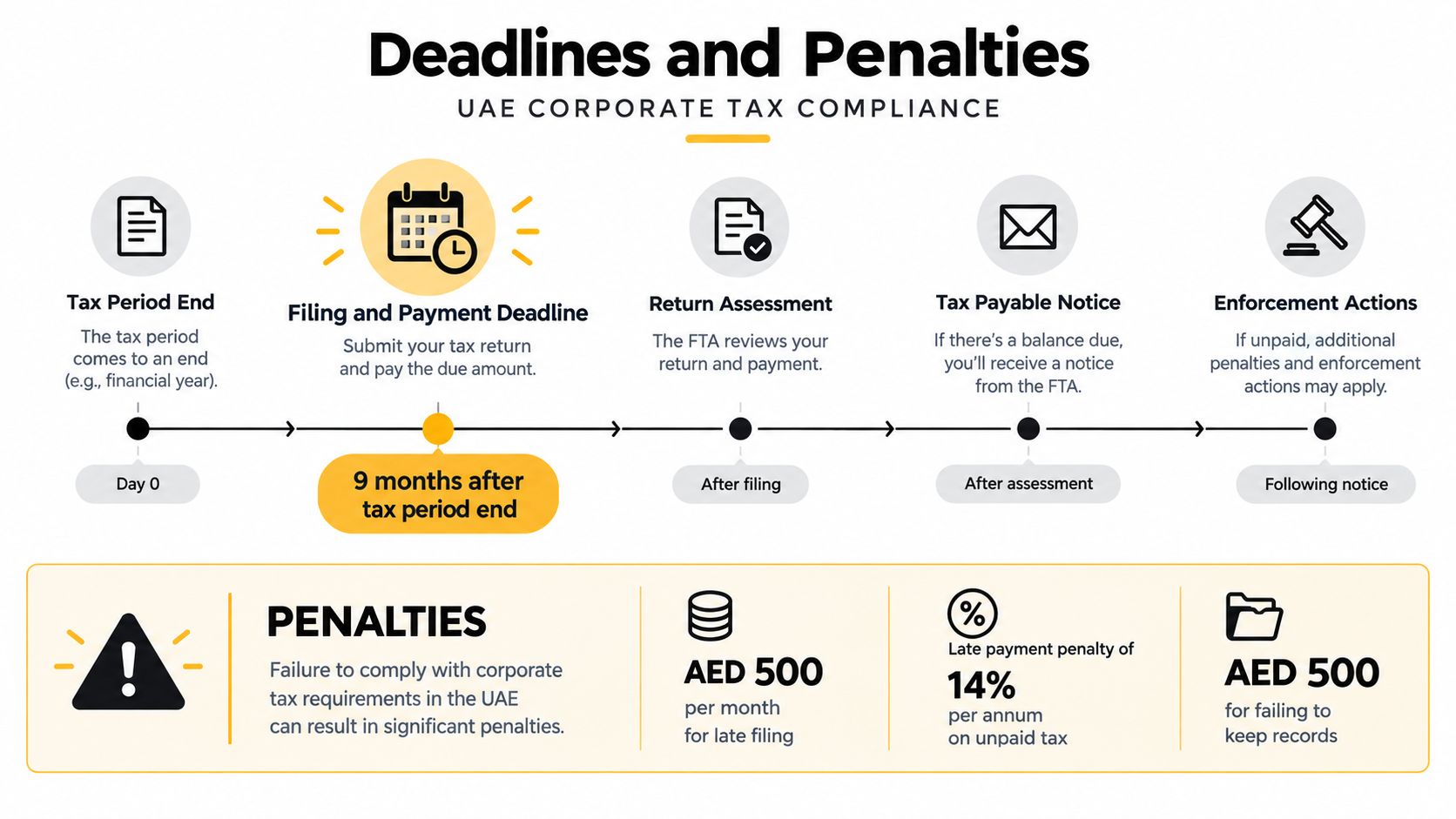
The FTA states that taxable persons must submit their corporate tax return and settle corporate tax within nine months from the end of each tax period, according to its deadline and penalty notice. Exempt persons who must register must file an annual declaration within the same nine-month window.
Use this internal checklist:
- Registration: Confirm the entity or person's position and required application.
- Period: Record the tax period end date and calculate the filing and payment deadline.
- Evidence: Assemble ledgers, invoices, contracts, reconciliations, and ownership records.
- Review: Check unusual transactions and related-party dealings.
- Submission: File the return or declaration.
- Settlement: Pay any amount due by the same deadline.
Deadlines Penalties and What Happens If You Miss Them
A nine-month statutory window can disappear quickly. A Dubai company with a December year-end may spend the first months closing accounts, chasing customer balances, gathering documents, and checking tax adjustments. If reconciliation starts only near the deadline, there may be no time to correct missing or inconsistent data.
As noted in the filing steps, the statutory window is nine months from the end of the tax period. The practical risk is not only submitting late. Late preparation can expose errors that affect the return, payment amount, or supporting explanation.
Why waiting creates more than a deadline problem
Common warning signs include:
- Sales reports do not reconcile with the general ledger.
- Supplier invoices are missing or recorded in the wrong period.
- Shareholder and company expenses are mixed.
- Payroll records do not match accounting entries.
- Intercompany balances lack a written agreement.
- Free zone income has not been separated from other activities.
These are operational data-control failures. The deadline exposes them, but the cause usually sits earlier in the process. Finance may hold the ledger, while operations hold delivery evidence, HR holds payroll data, and founders hold shareholder records. If those records do not align, the return can become an estimate rather than an audit-ready position.
A return prepared from incomplete records is not a finished compliance process. It is an estimate waiting for a challenge.
Late payment can create a separate cash-flow problem. A business may have calculated its liability but still miss settlement because approval, banking access, or cash forecasting was handled too late. The FTA's guidance confirms that tax payable must be settled within the applicable deadline, so payment should be tracked as its own control, not treated as an automatic result of filing. Review the FTA's deadline guidance when confirming the consequences that apply.
Natural persons and small businesses can also fall into a registration gap. A founder may assume that a trade licence, VAT registration, or personal bookkeeping already covers corporate tax obligations. It does not necessarily do so. The relevant registration and first-period rules should be checked before relying on a general deadline, as explained in the FTA's natural-person registration notice.
Build controls around the calendar
Set an internal close date well before the statutory deadline. Assign owners for bank reconciliations, customer and supplier balances, payroll, fixed assets, shareholder records, related-party documents, and payment approval. A simple tracker should show what has been received, reviewed, corrected, and approved.
Monthly or quarterly reviews keep the information current. They also give finance time to ask business owners what a transaction means while the details are still available.
Accounting Records Transfer Pricing and Audit Readiness
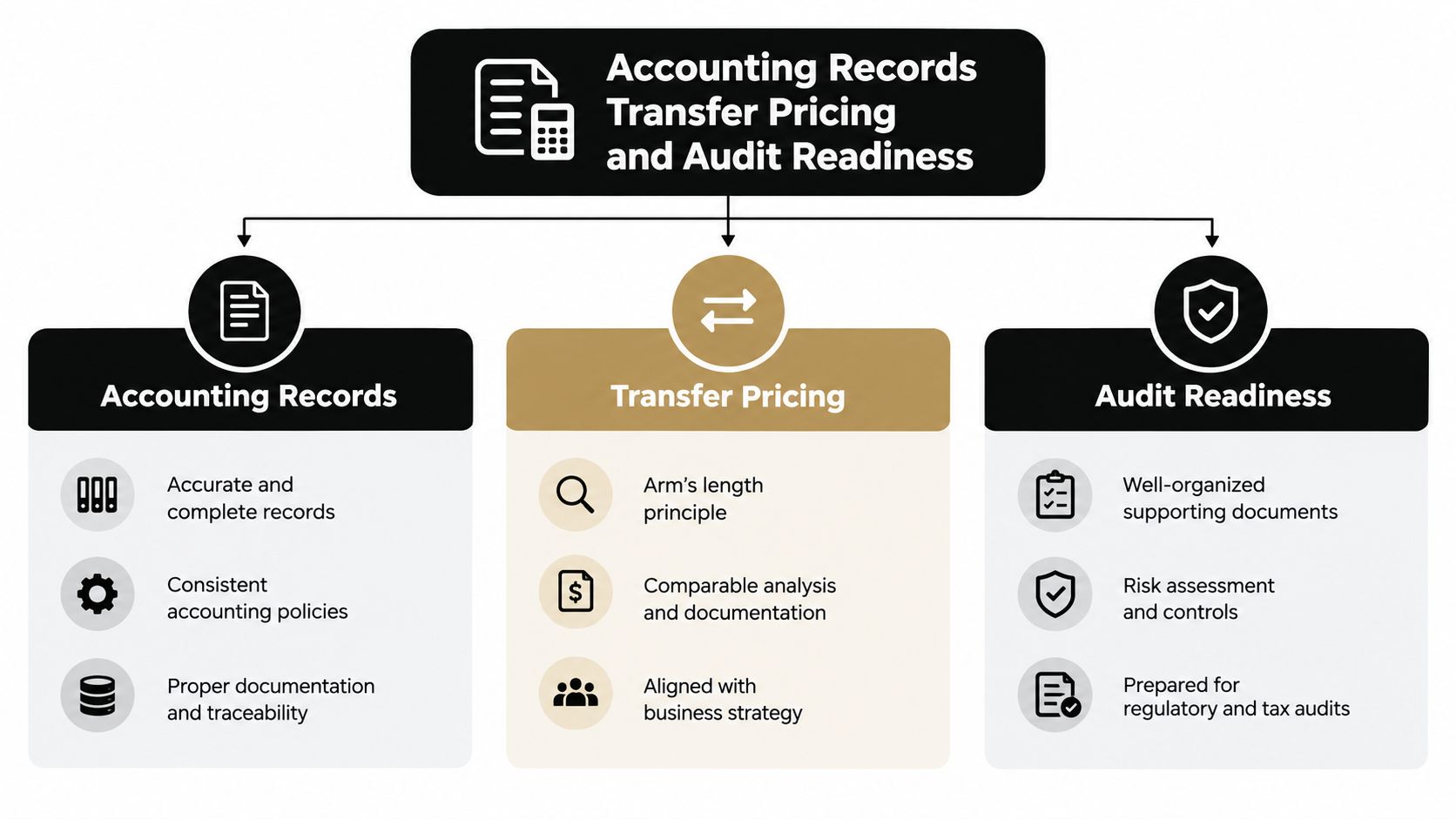
A founder may know the 9% rate and still struggle during a tax review. The problem is often operational: sales records sit in one system, payroll in another, ownership documents with the company secretary, and intercompany agreements in an email folder. An audit-ready file brings those pieces together so the filed position can be explained.
The FTA has emphasised retaining transaction records, asset and liability records, and shareholding records. Its August 2025 recordkeeping communication also highlighted document retention for corporate tax returns. Keep the evidence and reasoning behind the return, not only the final form.
The record layers should agree
Transaction records show what the company bought and sold. Invoices, receipts, contracts, delivery evidence, and payment records should support the same story as the ledger.
Asset and liability records explain what the business owns and owes. Maintain schedules for fixed assets, loans, receivables, payables, and other balances. Each accounting entry should lead back to a supporting document.
Shareholding records identify the owners and record changes in ownership. They also support related-party analysis, so they should be available to the finance team rather than kept in a separate administrative file.
Reconciliations connect the systems. Bank, payroll, sales, and intercompany reconciliations each test whether the accounting entry matches its underlying source. A mismatch is a question to resolve before filing, not a detail to explain later.
Transfer pricing has threshold effects
The UAE uses an OECD-style three-tier transfer pricing documentation model. For financial years starting on or after 1 June 2023, taxpayers may need a disclosure form, master file, and local file when consolidated group revenue reaches AED 3.15 billion or the UAE entity's own revenue reaches AED 200 million, as described in the UAE transfer pricing guidance.
The practical work starts before the year-end close. Map related-party transactions, record the functions and risks involved, retain agreements, and prepare benchmarking support where required. Smaller businesses and natural persons can also face gaps when personal bookkeeping, licence records, or finance data do not clearly explain the business position.
The strongest control is shared ownership of the data. Finance can reconcile the numbers, while operations confirms what was delivered, HR supports payroll information, and shareholders provide ownership records. The main risk isn't ignorance of the 9% rate. It's disconnected data that can't defend the filed position.
How Corporate Tax Interacts With VAT ESR and Free Zones
A founder may have a VAT registration, an Economic Substance Regulations record, and a Free Zone licence, yet still lack the evidence needed for corporate tax. These regimes can use the same invoices, contracts, and accounting data, but each asks a different question about the business.
| Regime | Who It Applies To | Filing Trigger | Key Evidence Required |
|---|---|---|---|
| Corporate Tax | Taxable persons and other persons required to register under the regime | Relevant tax period and applicable registration position | Tax computation, return or declaration, ledgers, transaction records, ownership records |
| VAT | Businesses within the VAT system based on the applicable rules | VAT registration and return obligations | Tax invoices, VAT ledgers, supply records, tax return workings |
| ESR | Relevant businesses carrying on activities covered by the regulations | Relevant activity and reporting requirements | Activity records, people and premises evidence, expenditure and governance records |
| Free Zone Relief | Qualifying Free Zone persons meeting the applicable conditions | Qualifying income and continuing conditions | Income classification, contracts, substance, accounting records, supporting operational evidence |
VAT records can support sales and purchase figures, but they do not by themselves establish taxable income. Corporate tax may also require a clear view of ownership, assets, liabilities, related-party dealings, and the basis for any relief. A VAT return is like a receipt log for supplies. A corporate tax file is the wider business story, including how transactions connect to profit and ownership.
SME checklist
A small business should:
- Keep sales and purchase records that agree with the accounting system.
- Separate owner, employee, and company spending.
- Reconcile banks, receivables, payables, payroll, and fixed assets.
- Maintain a clear ownership and related-party file.
- Track Free Zone income and the conditions attached to any relief position.
- Keep supporting evidence throughout the year, rather than collecting it only during return preparation.
These controls matter because smaller businesses often spread information across bank accounts, spreadsheets, payroll files, and licence records. If those sources do not agree, the issue is operational data quality, not tax-rate knowledge.
Foreign investor checklist
A foreign investor should add:
- A clear map of UAE and overseas entities.
- Agreements covering management, services, loans, licensing, and group transactions.
- A review of where functions, people, assets, and decision-making sit.
- Consistent records for ownership and intercompany balances.
- Coordination between UAE finance staff, overseas advisers, and group tax teams.
Free Zone relief is a maintained position, not a permanent label. The company must continue showing how its income qualifies and how its operations support that position. If contracts describe one arrangement while accounting records or operational evidence show another, the headline benefit may not be defensible. The same alignment matters for natural persons carrying on business, where personal and business records can otherwise become difficult to separate.
Practical Checklists and When to Get Expert Support
A founder can manage parts of corporate tax compliance internally, especially where the business has one entity, straightforward activity, clean records, and no complex related-party arrangements. The risk rises when the company's legal structure, transactions, and operational reality no longer fit neatly into one spreadsheet.
For SMEs and startups
- Registration: Confirm the entity's status and keep the tax registration information organised.
- Bookkeeping: Record sales, purchases, payroll, assets, liabilities, and shareholder transactions consistently.
- Reconciliations: Review bank, customer, supplier, payroll, and intercompany balances before year-end.
- Evidence: Store invoices, contracts, payment records, ownership documents, and tax workings together.
- Calendar control: Set internal review dates before the statutory filing and payment deadline.
- Free zone review: Check qualifying conditions continuously if relief is relevant.
For natural persons and foreign investors
- Scope assessment: Review whether business activity and turnover create registration duties.
- Structure map: Document the relationship between UAE entities, overseas companies, shareholders, and related parties.
- Transfer pricing: Identify intercompany transactions early and assess documentation needs.
- Cross-border records: Keep agreements, invoices, payment evidence, and explanations for group charges.
- Professional review: Obtain help when the position depends on several jurisdictions, relief conditions, or complex ownership.
Expert support becomes sensible when reconciliations remain unresolved, related-party transactions lack agreements, a free zone position depends on detailed conditions, or a natural person isn't sure whether business activity falls within the regime. Smart Classic Business Hub can support corporate tax registration and filing, VAT-compliant accounting, record organisation, audit coordination, and transfer pricing documentation while the founder remains focused on operating the business.
Visit Smart Classic Business Hub to discuss corporate tax registration, filing support, audit-ready recordkeeping, and transfer pricing documentation for your UAE business. Their Dubai-based consultants can also help align accounting, VAT, audit, company formation, and wider compliance work into a practical plan.