
Trade licence cancellation in the UAE is a structured legal exit, not a single form submission. In Dubai, the official fee base starts at AED 3,540 where licence cancellation and company dissolution with liquidation are both required, while allowing the licence to expire can expose a business to recurring penalties ranging from AED 500 to AED 2,000 per item or in combined charges.
The founder usually reaches this point after a quiet decision: stop trading, keep costs under control, and close the company before another renewal cycle creates more expense. Then the practical questions arrive. Are employee visas still active? Has the labour file been closed? Are there unpaid fines, a corporate bank account, a tenancy contract, a PO box, or VAT registration left behind?
Those obligations explain why a smooth closure depends on sequence rather than one final application. Dubai's framework connects the licence to government clearances, employee and investor exits, creditor protection, liquidation where applicable, and tax deregistration. The authority and exact route also depend on whether the business is a mainland company or a free zone entity.
Why Cancelling Your Trade Licence Feels Harder Than Setting It Up
A founder can establish a company through a relatively clear sequence. Select the activity, reserve the name, obtain approvals, issue the licence, and begin operating. Closure feels different because the business has accumulated relationships and registrations that don't disappear when trading stops.
Consider a small Dubai company whose owner has stopped accepting work. The office is empty, no invoices are being raised, and the founder assumes the licence can be cancelled online. During the first attempt, the authority asks about employee visas, labour records, outstanding fines, and other clearances. The bank account remains open, the tenancy is unresolved, and the business is still registered for VAT. The owner hasn't submitted one missing form. The owner has an unfinished exit chain.
Closure is a legal event
Dubai treats trade licence cancellation as a regulated process through the Dubai Department of Economy and Tourism, rather than as a simple surrender of a document. The government workflow includes document submission, clearance checks, and a formal cancellation certificate. For entities that require liquidation, creditor protection also becomes part of the legal route, as described in this Dubai business closure guidance.
That structure protects more than the authority. Creditors need an opportunity to submit claims, employees need their immigration and labour records settled, and tax authorities need a clear record of the business's status. A company that stops operating may still have legal and financial obligations until the relevant registrations are closed.
Practical rule: Treat the licence as the centre of a compliance chain, not as the whole chain.
The first decision is jurisdiction
Before collecting documents, identify who issued the licence. A Dubai mainland company normally deals with DET, while a free zone company follows the regulations and portal of its own operator. A free zone entity under the Dubai Development Authority, for example, follows that authority's de-registration and cancellation requirements rather than the mainland workflow.
This distinction matters because the application route, approvals, notices, and certificate may differ. It also prevents a common error: following a mainland checklist for a free zone company, or assuming that a free zone portal removes the need to settle visas, tax, banking, or employment obligations.
The right mental model is straightforward. Stopping business activity is an operational decision. Cancelling the licence is a regulated legal exit. The work between those two points determines whether closure is orderly or expensive.
Mainland Versus Free Zone Closure Paths
The issuing authority decides the primary cancellation route. Mainland and free zone businesses may face similar downstream tasks, but they don't use identical portals, forms, or company regulations.
| Business structure | Primary authority | Main closure characteristic | Final evidence |
|---|---|---|---|
| Dubai mainland company | Dubai Department of Economy and Tourism | DET cancellation workflow, with liquidation and public notice where required | Formal cancellation certificate |
| Dubai Development Authority or another free zone entity | Relevant free zone authority | Operator-specific de-registration and private company regulations | De-registration or cancellation certificate |
Mainland companies
For a mainland company, the process usually runs through DET. A straightforward licence cancellation still depends on clearing linked obligations, while an LLC or similar structure that requires liquidation may need a liquidation application, public notice, and a creditor-claim period before final approval.
The public notice isn't a cosmetic step. It gives creditors a defined opportunity to raise claims before the company is finally dissolved. Dubai-focused guidance describes a 45-day notice period, published in two Arabic newspapers, for mainland companies undergoing liquidation. Those requirements make the mainland route more than an online request followed by immediate closure.
The final certificate matters because it proves that the authority has completed the legal cancellation. Keep it with the company's corporate records and use it when dealing with tax deregistration, banks, counterparties, and any later compliance query.
Free zone entities
A free zone company follows the regulations of the free zone that issued its licence. The Dubai Development Authority provides its own cancellation and de-registration workflow, and other operators may impose their own document, approval, and service-centre requirements. The mainland and free zone comparison can help founders identify the structural differences before they begin.
Free zone administration can feel more direct because the operator often manages several connected services through its own portal. That doesn't mean the business can ignore employee visas, establishment records, tax registration, banking, or contractual obligations. A free zone certificate confirms the operator's de-registration, but it doesn't automatically settle every external relationship.
A simple decision frame
Check the licence itself, not the business address or the founder's nationality. If DET issued it, follow the mainland route. If a free zone issued it, start with that operator's de-registration rules and ask which outside clearances it expects before issuing the final certificate.
The practical overlap is substantial. Both routes require organised records, settled immigration and labour obligations, attention to tax status, and proof of final cancellation. The difference is who controls the primary file and which legal milestones must be satisfied before the certificate is released.
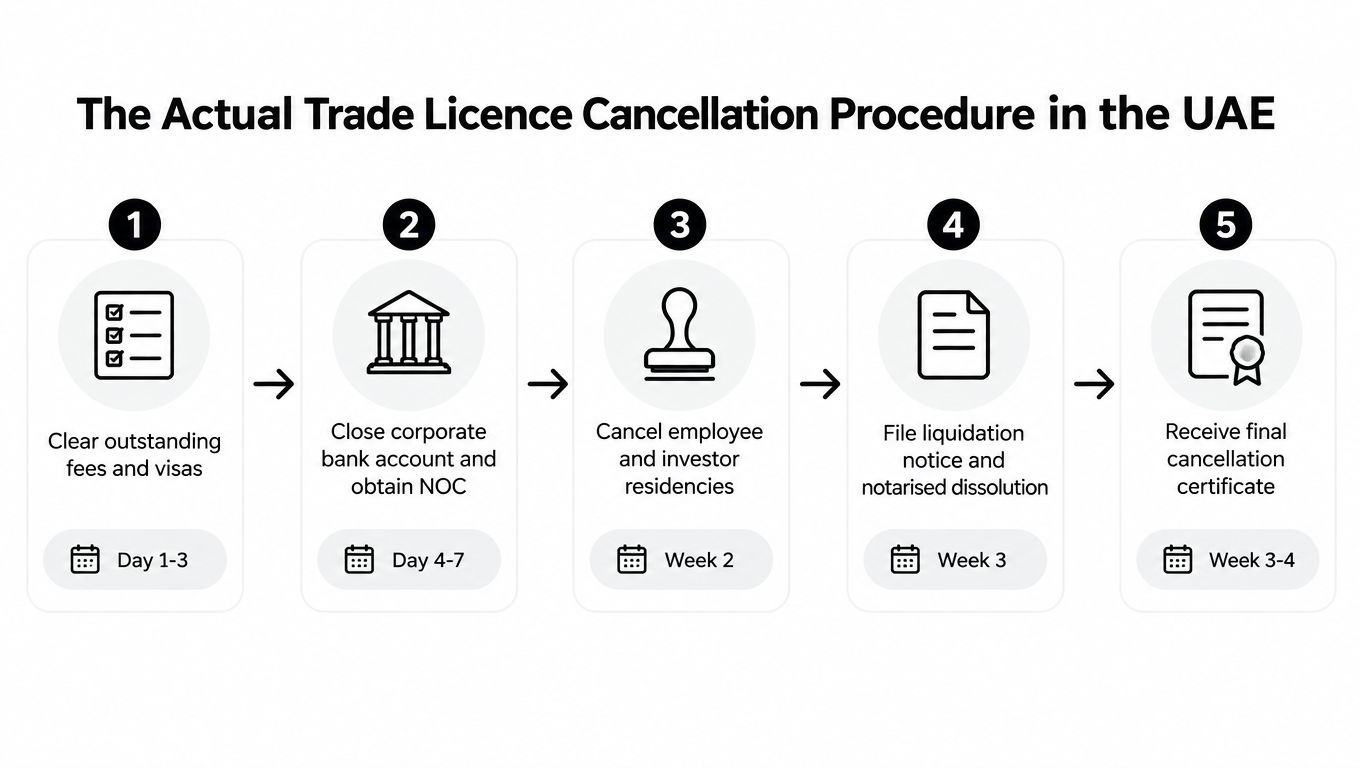
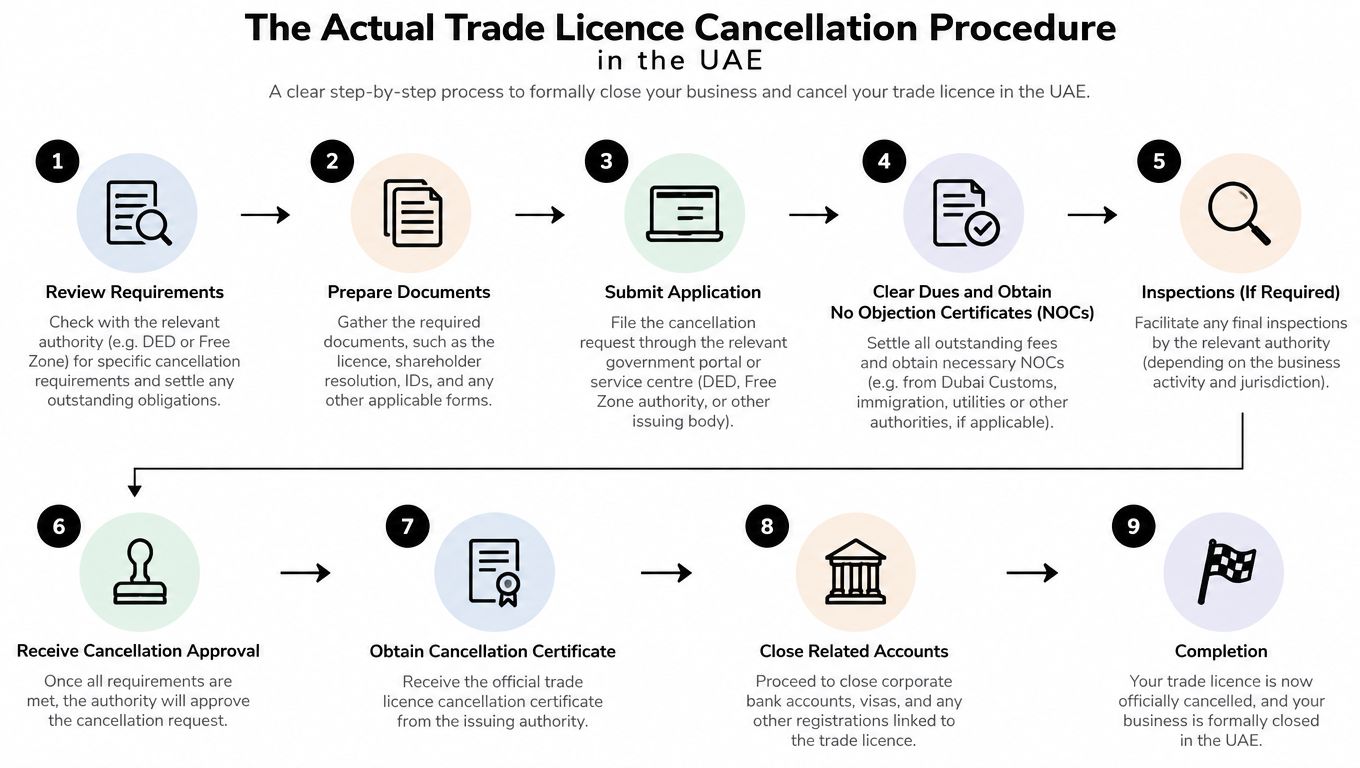
The Actual Trade Licence Cancellation Procedure in the UAE
A professional closure starts with an audit of the company, not with the cancellation button. Pull the licence, establishment details, visa records, labour information, tax registration, lease documents, bank details, and outstanding government notices into one working file. That file shows which obligations must be cleared before the authority will accept the final request.
The order below reflects how closures are handled in practice. Exact documents vary by structure and authority, so the issuing authority's current checklist remains decisive.
Clear the obligations connected to the company
Start with government fines and penalties. An unpaid amount can stop the cancellation request or keep the company exposed after the owner believes the business has closed.
Then settle the employment and immigration side. Employee visas, investor or partner residencies, labour cards, and labour files need to be cancelled or otherwise closed through the relevant channels. A founder who leaves these records active may face further administrative work even after the commercial file is submitted.
Close or resolve the supporting commercial commitments as well:
- Banking: Close the corporate bank account and obtain any required closure confirmation or no-objection evidence.
- Premises: Settle the tenancy, obtain the relevant confirmation, and recover any deposit that remains due.
- Postal records: Close the company PO box where one exists.
- Commercial relationships: Resolve unpaid invoices, supplier balances, customer claims, and employee dues before liquidation moves to its final stage.
The objective is to remove the liabilities that sit around the licence. The authority can't treat the company as cleanly exited while linked records remain active or unresolved.
Submit the application and complete liquidation where required
Once the clearances are ready, submit the cancellation request through the relevant DET portal or service centre for a mainland company, or through the free zone's own system for a free zone entity. Some workflows require service-centre confirmation or additional document checks.
For an LLC or similar company that must be liquidated, prepare the corporate approvals and liquidation documents, including the board or shareholder resolution where applicable. The company may also need to appoint or document a liquidator under the applicable procedure.
Public notice follows where required. In Dubai mainland liquidation cases, the creditor-notice period described in the available guidance is 45 days, with publication in two Arabic newspapers. Final approval should not be treated as imminent until that milestone and any creditor claims have been addressed. Founders who need a fuller explanation of the legal sequence can review this guide to the UAE liquidation process.
Finish with the certificate and tax file
After the authority verifies the clearances and required liquidation steps, it issues the final cancellation or de-registration certificate. Save the certificate with the resolutions, notices, closure confirmations, and financial records. Don't rely on a portal status alone when another authority may ask for documentary proof.
VAT deregistration is a separate compliance task. The Federal Tax Authority identifies a trade licence cancellation certificate, liquidation letter, and board resolution among the documents required when a business deregisters because it no longer makes taxable supplies. The FTA VAT deregistration service should therefore be built into the closure plan rather than left until after every other record is forgotten.
A clean file has a visible beginning, middle, and end: obligations cleared, cancellation or liquidation completed, and tax status closed with supporting evidence.
Fees, Penalties, and Hidden Costs That Increase Closure Expenses
The official fee is only the first line in a closure budget. In Dubai, the standard government charges cited for mainland closure are AED 1,020 for licence cancellation and AED 2,520 for company dissolution when liquidation is required, producing an official base of AED 3,540 before external costs, outstanding obligations, or visa clearances are added. These figures are set out in Dubai business closure fee guidance.
That baseline helps, but it doesn't answer the question founders ask: what will it cost to make the company ready for cancellation? The answer depends on the condition of the file.
Where the budget expands
Outstanding government fines are the first variable. A company that has kept every registration current may have a cleaner file than one that stopped monitoring its obligations after trading ended. Visa and labour closures can create further costs, particularly where several employee or investor records remain active.
Liquidation also introduces work beyond the authority's standard cancellation charge. Public notice publication, document preparation, notarisation where required, liquidator involvement, and professional coordination can all affect the final invoice. A founder who compares only the government fee may select an apparently cheap route that excludes the work needed to reach the certificate.
Other cost areas deserve a written check:
- Immigration and labour: Confirm the fees and status of every visa, labour card, and establishment record.
- Banking: Ask the bank whether outstanding charges, account restrictions, or pending transactions must be resolved before closure.
- Tenancy: Check rent, early termination terms, utility balances, and deposit recovery.
- Professional support: Separate authority charges from PRO, accounting, legal, liquidator, translation, and notarisation fees.
- Tax administration: Keep funds and records available for VAT deregistration, final returns, and any required supporting documents.
The cost of delay
A licence that remains open can keep generating obligations. Expired licences and establishment cards can attract recurring monthly penalties in Dubai-adjacent free zones, with cited examples ranging from AED 500 to AED 1,000 per month per item, or up to AED 2,000 per month combined, as noted in Dubai trade licence cancellation guidance.
Those figures aren't a universal tariff for every UAE jurisdiction. They are a warning to check the issuing authority's schedule before deciding that non-renewal is harmless. The longer a founder waits, the more likely the file is to contain stale visas, unpaid fees, expired establishment records, or documents that must be reissued.
Budget by clearance, not by form
Ask for a closure quote that separates official charges, liquidation work, public notice, visa and labour cancellations, tax support, and unresolved penalties. This structure makes trade-offs visible. Handling document collection internally may reduce professional time, but it won't remove authority fees or cure an incomplete file.
The most reliable saving is early preparation. It prevents avoidable renewals and allows the founder to resolve obligations while records, signatories, bank access, and counterparties are still available.
The Biggest Risk Is Doing Nothing Until the Licence Expires
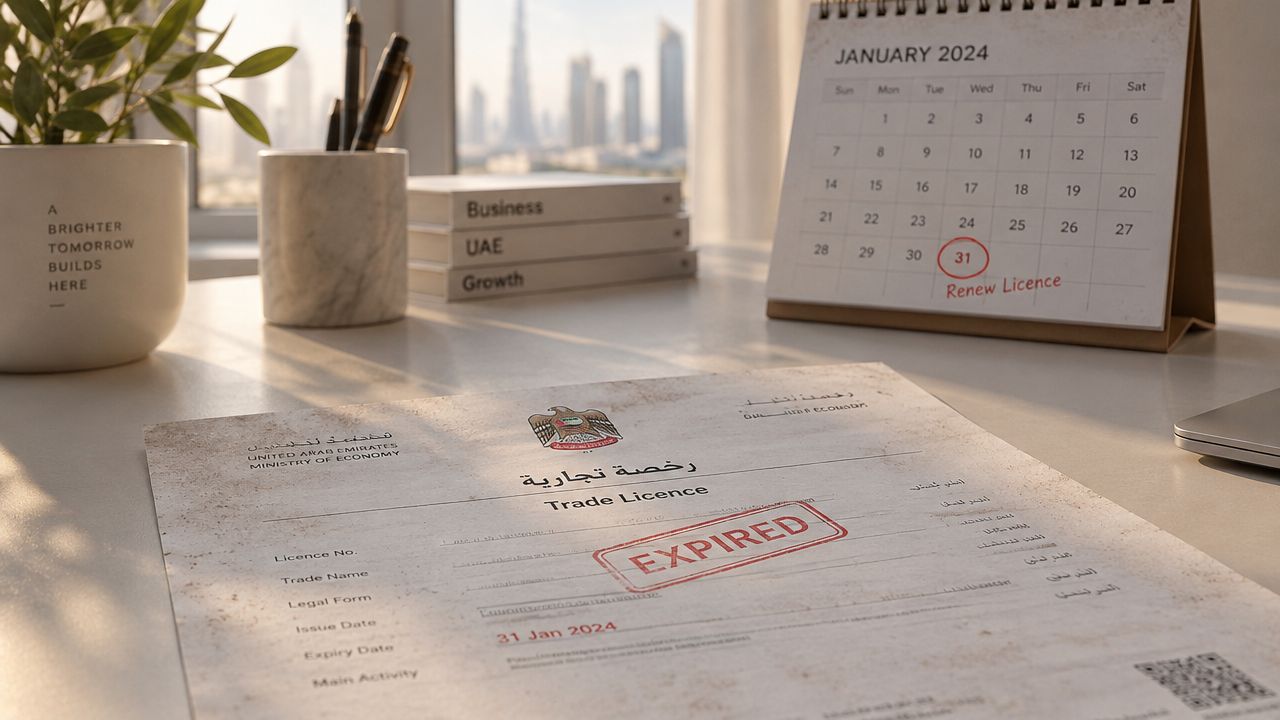
A founder closes the office, releases staff, and stops trading. Months later, the company still appears active in government records because an expired licence is not a completed cancellation. The legal and administrative file remains open until the owner follows the issuing authority's de-registration or liquidation route.
That gap creates risk. Notifications may go unchecked, renewal-related charges may remain unpaid, and connected records can become stale. By the time the founder requests a cancellation certificate, the file may require more clearances, updated documents, or professional work than it would have required at the original exit decision.
Why passive expiration creates exposure
Penalty schedules differ between mainland authorities and free zones. As covered in the cost section, recurring penalties can accumulate monthly against open records. The practical consequence is that the file becomes harder to close the longer it sits, because stale visas, expired establishment records, and unpaid charges may need attention before cancellation can proceed.
Confirm the issuing authority's rules as soon as trading stops. Then choose deliberately between temporary renewal, immediate cancellation, or a formal liquidation process. Renewal can preserve operating time during an orderly transition, while cancellation may be the cleaner route once the business has genuinely stopped. Waiting without a documented plan leaves the timeline controlled by unresolved obligations.
Expiry also leaves other records behind
The licence is only one part of the company's identity. Employee and investor visas, labour files, tax registration, bank accounts, leases, and PO boxes can remain open after expiry. Those unresolved records can delay bank closure, deposit recovery, VAT deregistration, and proof that the company no longer operates.
The effect may extend to the owner. Depending on the record and authority, unresolved obligations can complicate later dealings with government departments, immigration applications, new company formations, or banking relationships. These outcomes are not automatic, but they justify checking the file promptly instead of assuming inactivity has ended the company's responsibilities.
An expired licence is an unfinished exit, not a completed closure.
Use renewal only when the company needs time to trade or complete an orderly transition. The guidance on trade licence renewal in the UAE is relevant when continuation is intentional. It should not replace a cancellation plan after trading has stopped.
How to Approve Closure With Confidence Before You Submit
Before filing, ask whether someone can produce evidence for each open item, not merely confirm that it was “handled”. A practical readiness check includes:
- Authority status: Fines and government charges are cleared.
- People records: Employee, investor, and partner visas, labour cards, and labour files are settled.
- Commercial commitments: Bank, PO box, tenancy, utilities, suppliers, and customer claims are resolved.
- Corporate approvals: Liquidation documents, resolutions, notices, and supporting letters are ready where required.
- Tax file: The cancellation certificate and other documents needed for FTA VAT deregistration are planned.
If you appoint a PRO or consultancy, ask whether the quoted service includes creditor notices, newspaper publication, liquidation coordination, visa and labour clearances, and final certificate collection. Also request a written split between government charges and professional costs. Founders comparing professional support may find this overview of small business legal counsel costs useful when assessing the wider closure budget.
Trade licence cancellation is manageable when the company treats it as a controlled legal exit. Start with the issuing authority, map every connected record, clear obligations in sequence, and retain the certificates that prove the process is finished.
Smart Classic Business Hub supports Dubai business liquidation with document review, clearance coordination, cancellation, and deregistration assistance. If you're ready to close a mainland or free zone company, visit Smart Classic Business Hub to discuss the current status of your file and the next practical steps.