
A founder usually reaches this point with a spreadsheet open, a trade licence renewal approaching, and the uncomfortable realisation that continuing to trade no longer makes commercial sense. The first instinct is often to cancel the licence and move on. In the UAE, that shortcut can leave visas active, tax registrations open, bank accounts unresolved, and creditors without a formal route to submit claims.
The liquidation process in the UAE is a legal winding-up procedure, not an informal stop to business activity. The company enters liquidation once it has been dissolved, and a liquidator must be appointed through a shareholder or general assembly resolution under the UAE Commercial Companies framework. The law distinguishes voluntary liquidation from liquidation conducted through bankruptcy procedures, as outlined in the UAE Central Bank legal framework.
Before anyone prepares paperwork, make three decisions. Is the company solvent? Are creditors likely to object or are liabilities disputed? Which authority governs the entity, mainland, a free zone, DIFC, ADGM, or another structure? Those answers determine the route, the level of creditor involvement, and the documents required.
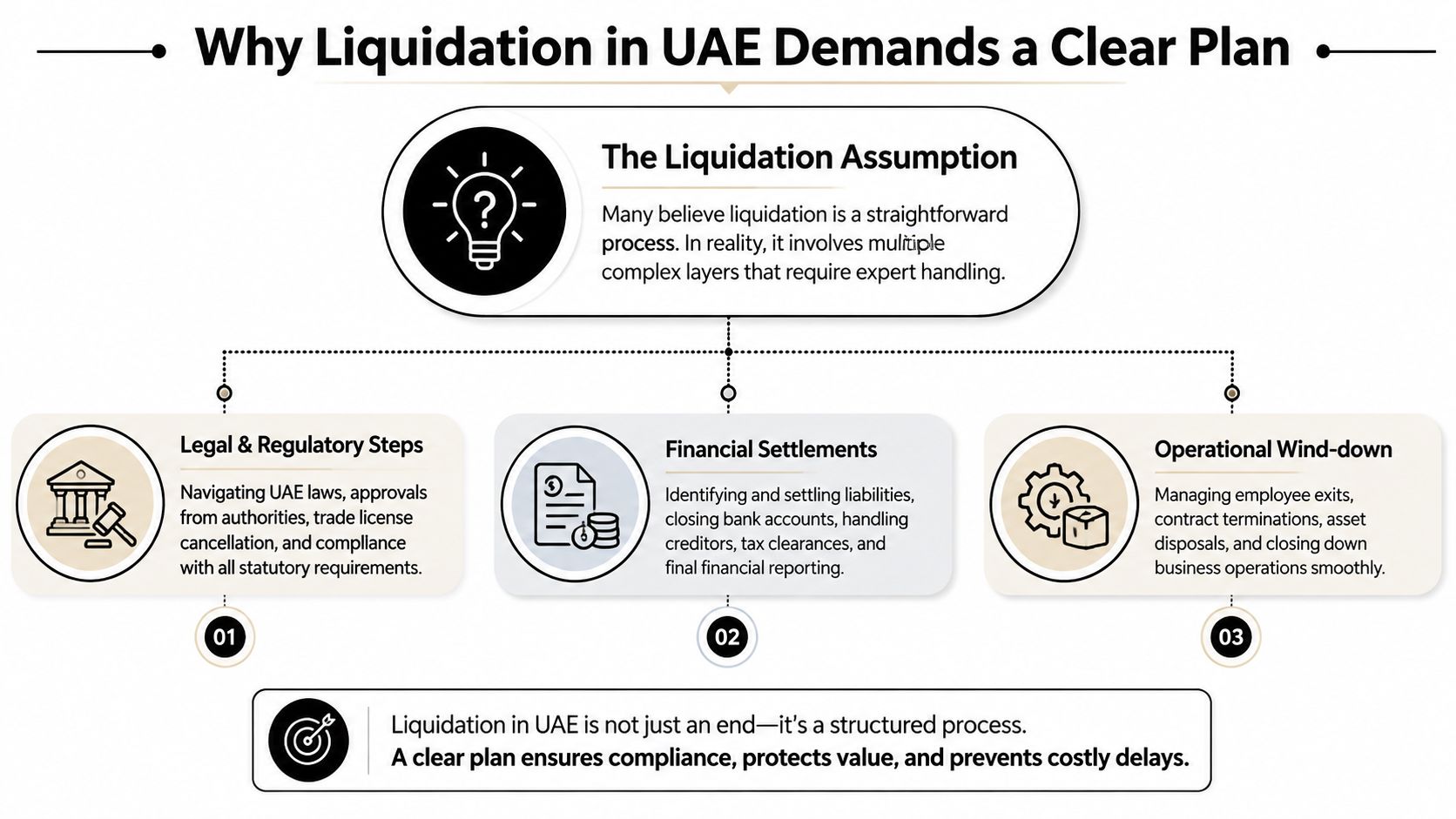
Why the Liquidation Process in UAE Demands a Clear Plan
The licence is only one part of the exit
A trade licence cancellation doesn't automatically settle the company's wider obligations. The founder still has to address employees, immigration files, utilities, leases, tax registrations, banking arrangements, and any claims from suppliers or customers. A company can stop operating while its legal and administrative obligations remain active.
That creates practical exposure. A bank may keep the corporate account restricted while it waits for liquidation documents. An employee visa that hasn't been cancelled can block the surrender of the establishment file. A director may also face personal consequences if the company distributes assets while liabilities remain unpaid or if the liquidation process is handled without proper records.
Practical rule: Treat closure as a controlled project with one owner, one document register, and a written record of every clearance.
Federal Decree-Law No. 32 of 2021 on Commercial Companies replaced the earlier 2015 regime and became the central legal basis for dissolution and liquidation of mainland companies, according to this UAE liquidation legal guide. The legal foundation is federal, but the operating steps still depend heavily on the licensing authority and the company's financial condition.
Start with the financial condition
A solvent company with settled or manageable liabilities may be suitable for voluntary liquidation. Shareholders approve dissolution, appoint a licensed liquidator, and allow the liquidator to settle claims and complete the closure. An insolvent company, or one that cannot meet its debts as they fall due, may need a formal insolvency or court-supervised route instead.
Creditor behaviour matters just as much. A creditor claim during the public notice period doesn't automatically mean the company has failed, but it can stop a clean administrative finish until the claim is investigated and resolved. If the dispute is substantial, the founders may lose control over the timing and move into a more formal creditor-led process.
The jurisdiction adds another layer. Mainland procedures don't operate identically to those of DMCC, JAFZA, DIFC, or ADGM. A resolution format accepted by one authority may be rejected by another, while auditor, attestation, lease, and publication requirements can vary.
The most reliable approach is to map the company's solvency, creditors, staff, tax status, assets, and authority before filing anything. That early assessment prevents the common mistake of beginning with licence cancellation and discovering later that tax deregistration, employee liabilities, or an unresolved creditor has become the critical path.
Choosing the Right Liquidation Path for Your Company
The correct route depends less on the founder's preference than on the company's financial condition and the likelihood of creditor intervention. UAE legal coverage distinguishes court-supervised processes for distressed debtors from deregistration-style closures for non-distressed entities, as explained in the UAE insolvency practice guide.
The three routes at a glance
| Criteria | Voluntary Liquidation | Compulsory Liquidation | Administrative Strike-Off |
|---|---|---|---|
| Trigger | Shareholder or general assembly resolution, usually where the company can meet its obligations | Creditor action, insolvency, or a court order | Prolonged inactivity or failure to renew, subject to authority rules |
| Creditor role | Creditors can submit claims during the notice period | Creditors and the court have a stronger role in the process | Creditors may still object or pursue liabilities |
| Director control | Shareholders retain meaningful control through the appointed liquidator | Control is reduced and the court process governs key decisions | Administrative control is limited and may not resolve underlying liabilities |
| Best suited to | Solvent companies with an organised exit plan | Companies unable to settle debts or facing serious disputes | Dormant entities that meet the authority's strike-off conditions |
| Main risk | Hidden liabilities or a late objection | Greater procedural complexity and loss of timing control | Treating strike-off as a substitute for proper debt settlement |
Voluntary liquidation is normally the cleanest option for a solvent company. Shareholders pass a notarised resolution, appoint a licensed liquidator, and authorise the winding-up. The liquidator then settles liabilities, realises assets where necessary, and submits the final report.
Compulsory liquidation is different. A creditor petition, insolvency, or court direction can shift the matter into a supervised process. The company shouldn't use voluntary liquidation to delay action where it clearly can't pay creditors. That decision can increase personal and regulatory risk for those responsible for the company's affairs.
Administrative strike-off may appear attractive because it can look simpler, especially for an inactive entity. It doesn't necessarily resolve unpaid taxes, employee claims, landlord disputes, or supplier debts. Allowing a licence to expire without confirming the authority's formal strike-off process can leave the company exposed rather than closed.
A company should choose the route that matches its balance sheet, not the route that appears shortest on a checklist.
DIFC and ADGM operate under separate financial centre regimes, with formal insolvency frameworks that differ from onshore federal procedures. Founders should therefore confirm the governing rules before adopting a mainland process. For a broader explanation of the practical differences between licensing environments, review this guide to mainland and free zone companies in Dubai.
Use this decision matrix before preparing documents:
- Solvent with settled liabilities: Consider voluntary liquidation.
- Solvent but exposed to a disputed or likely creditor claim: Obtain legal advice before filing and prepare a claims strategy.
- Unable to pay debts: Assess formal insolvency or compulsory liquidation options.
- Inactive with no known liabilities: Check whether the authority permits administrative strike-off and confirm that tax and employment records are complete.
- Registered in DIFC or ADGM: Use the relevant financial centre insolvency and companies procedures rather than assuming mainland rules apply.
Mainland Company Liquidation Steps and Timeline
Mainland liquidation follows a milestone sequence. The exact administrative experience can vary, but the core process is rigid enough that founders should plan around the statutory creditor notice rather than promise a closure in a few days.
Four milestones control the process
1. Approve dissolution and appoint the liquidator. Shareholders pass a notarised resolution confirming dissolution and appointing a licensed liquidator. The resolution should give the liquidator authority to deal with assets, liabilities, government departments, banks, employees, and final filings.
2. Submit the opening file to the licensing authority. The company submits the resolution and supporting documents to the relevant Dubai economic authority. Once accepted, the authority issues the initial or provisional liquidation approval, allowing the company to move into the public notice stage.
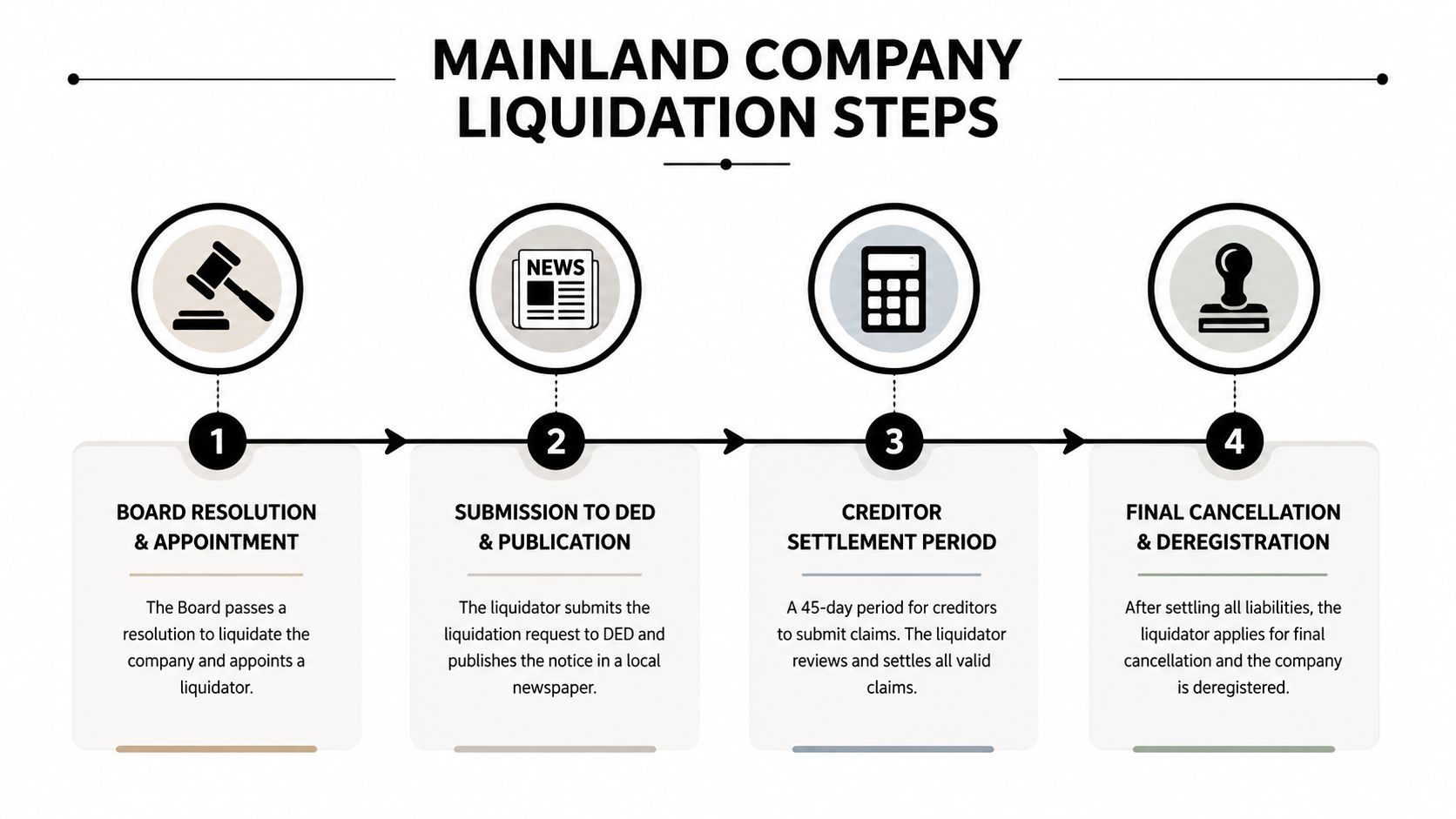
3. Publish the creditor notice. For mainland closures in Dubai, the liquidation notice is published in two Arabic local newspapers, and creditors receive a 45-day claim period before final closure steps can proceed, according to Dubai liquidation guidance. This is the principal timeline floor. The liquidator can't bypass it because the company has no known debts.
4. Complete the final report and cancellation file. After the notice period, the liquidator investigates any claims and prepares the final report. The company then submits the clearance package, which can include labour and immigration cancellations, tax evidence, utility and telecom closures, landlord documentation, bank clearance, and the liquidator's final report.
What a clean file looks like
A straightforward solvent mainland closure commonly takes about 2–4 months, while complex matters can extend to 6–12 months or longer, according to this UAE liquidation timeline guide. The 45-day notice period sits inside that broader timetable, while document preparation, authority reviews, claims, and tax work determine how much time surrounds it.
The usual delay points aren't dramatic legal events. They're missed publication requirements, rejected or incomplete forms, unresponsive portals, a late employee cancellation, or a creditor who appears after the founders assumed the file was finished.
Government charges and liquidator fees depend on the authority, company structure, documentation, audit requirements, and complexity of outstanding work. Because the verified material doesn't establish a universal fee schedule, any fixed quote should be treated cautiously. Request a written breakdown that separates authority charges, newspaper publication, audit work, tax support, liquidator fees, translation, attestation, and clearance work.
For administrative guidance on Dubai economic services, founders can also consult Goodhand for entrepreneurs. The useful question isn't only “What does closure cost?” It's “Which tasks are included, and who remains responsible if an authority rejects the file?”
Free Zone and Financial Centre Closure Variations
The phrase “UAE liquidation” covers several administrative environments. A mainland company, a DMCC entity, a JAFZA company, a DIFC business, and an ADGM entity don't necessarily submit the same forms or obtain the same clearances.
Free zones set their own procedural requirements for resolutions, liquidator appointments, auditor involvement, office termination, and authority approvals. The federal tax position still matters, but the licensing authority controls the corporate registry and may impose its own document sequence.
The authority determines the document stack
DMCC, JAFZA, and Dubai South can require authority-specific forms and clearance steps. The company may need an original licence, constitutional documents, a shareholder resolution, liquidator acceptance, financial statements or an audit report, lease evidence, and proof that employees and operational accounts have been cleared. The exact combination must be confirmed with the relevant portal before signatures are arranged.
DIFC and ADGM require special care because their company and insolvency regimes operate within financial centre frameworks influenced by common-law principles. A voluntary closure for a solvent company shouldn't be confused with a formal insolvency appointment where creditors or the court have a stronger role. That distinction affects who controls the process, which practitioner is required, and how claims are handled.
Offshore structures may have a more limited operational footprint, but “simple” doesn't mean liability-free. The registered agent or authority may still require evidence that there are no outstanding debts, fees, tax obligations, or claims before accepting deregistration.
| Jurisdiction | Typical Timeline | Auditor Required | Publication Required | Estimated Cost Range (AED) |
|---|---|---|---|---|
| Mainland Dubai | Often anchored by the 45-day creditor notice | Depends on authority and company requirements | Two local Arabic newspapers for mainland closures | Varies by file and authority |
| DMCC | Authority-dependent, commonly requiring a managed voluntary closure | Authority-dependent | Authority-dependent | Varies by documents and professional work |
| JAFZA and Dubai South | Authority-dependent | Authority-dependent | Authority-dependent | Varies by structure and clearances |
| DIFC | Can extend where creditor or asset issues remain | Depends on route | Formal requirements depend on the process | Varies by practitioner and proceedings |
| ADGM | Can extend where creditor notification or disputes arise | Depends on route | Formal requirements depend on the process | Varies by practitioner and proceedings |
| Offshore entities | Often simpler where liabilities and records are clear | Authority or agent-dependent | Authority or agent-dependent | Varies by agent and authority |
The table deliberately avoids invented fee ranges and universal timelines. Authorities change their forms and charges, and a company with employees, leased premises, customs activity, or tax disputes will not follow the same path as a dormant entity. Confirm the portal, attestation rules, auditor position, and publication requirement before committing to a closure date.
Tax Deregistration and Compliance Bottlenecks
Many founders still treat liquidation as a licensing exercise. That approach fails when the Federal Tax Authority profile remains open, filings are incomplete, or the company has unresolved VAT, corporate tax, or customs records.
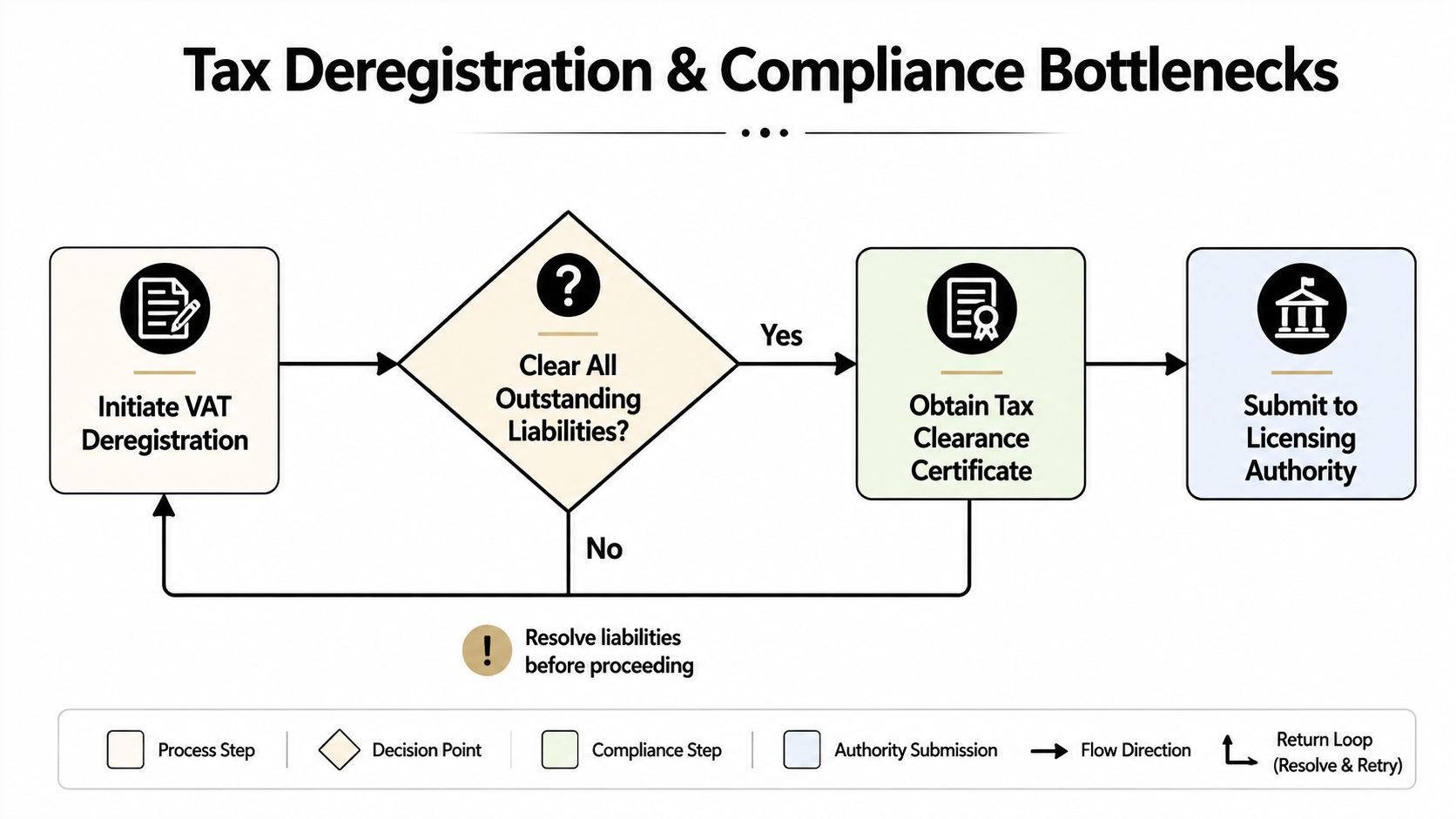
Tax deregistration must be planned alongside the corporate closure, not after it. UAE-focused guidance emphasises that companies must deregister with the Federal Tax Authority and settle final filings before closure is finalised, as discussed in this UAE liquidation compliance analysis.
“No activity” doesn't mean “no filing”
A dormant company may still have filing obligations, retained stock, bank movements, employee payments, or historic transactions requiring explanation. A VAT refund claim under review can keep the tax file open. Unreconciled import records can also require clarification before the authority accepts deregistration.
The practical sequence is to reconcile the accounting records, identify the final taxable activity, submit outstanding returns, apply for VAT deregistration through the EmaraTax portal where applicable, respond to FTA information requests, and preserve evidence of final settlement. Companies registered for corporate tax must also address the relevant final filings and liabilities before the closure file is treated as complete.
Build the tax file before the notice period ends
The tax team should prepare:
- Return history: Confirm that every required VAT and corporate tax filing has been submitted.
- Transaction reconciliation: Match bank, sales, purchase, payroll, customs, and inventory records.
- Asset position: Identify assets to be sold, transferred, written off, or distributed.
- Authority responses: Keep copies of FTA submissions, requests, explanations, and approvals.
- Final evidence: Obtain the tax deregistration evidence required by the licensing authority.
The timing depends on the condition of the records and whether the FTA raises questions. A company with clean books can progress while the creditor notice runs. A company with missing returns or disputed transactions may face a materially longer closure.
Founders who need to understand the underlying VAT registration and deregistration obligations can review this VAT registration guide. The important operational point is simple: don't wait for the final licence cancellation request to discover that the tax profile has become the blocking item.
Employee Visas and Final Operational Clearances
A company isn't operationally closed when staff can still use company-sponsored visas, the establishment card remains active, or the office lease continues to generate obligations. The final clearances should run as a coordinated workstream, because one unresolved item can prevent the licensing authority from issuing the cancellation certificate.
Close people matters first
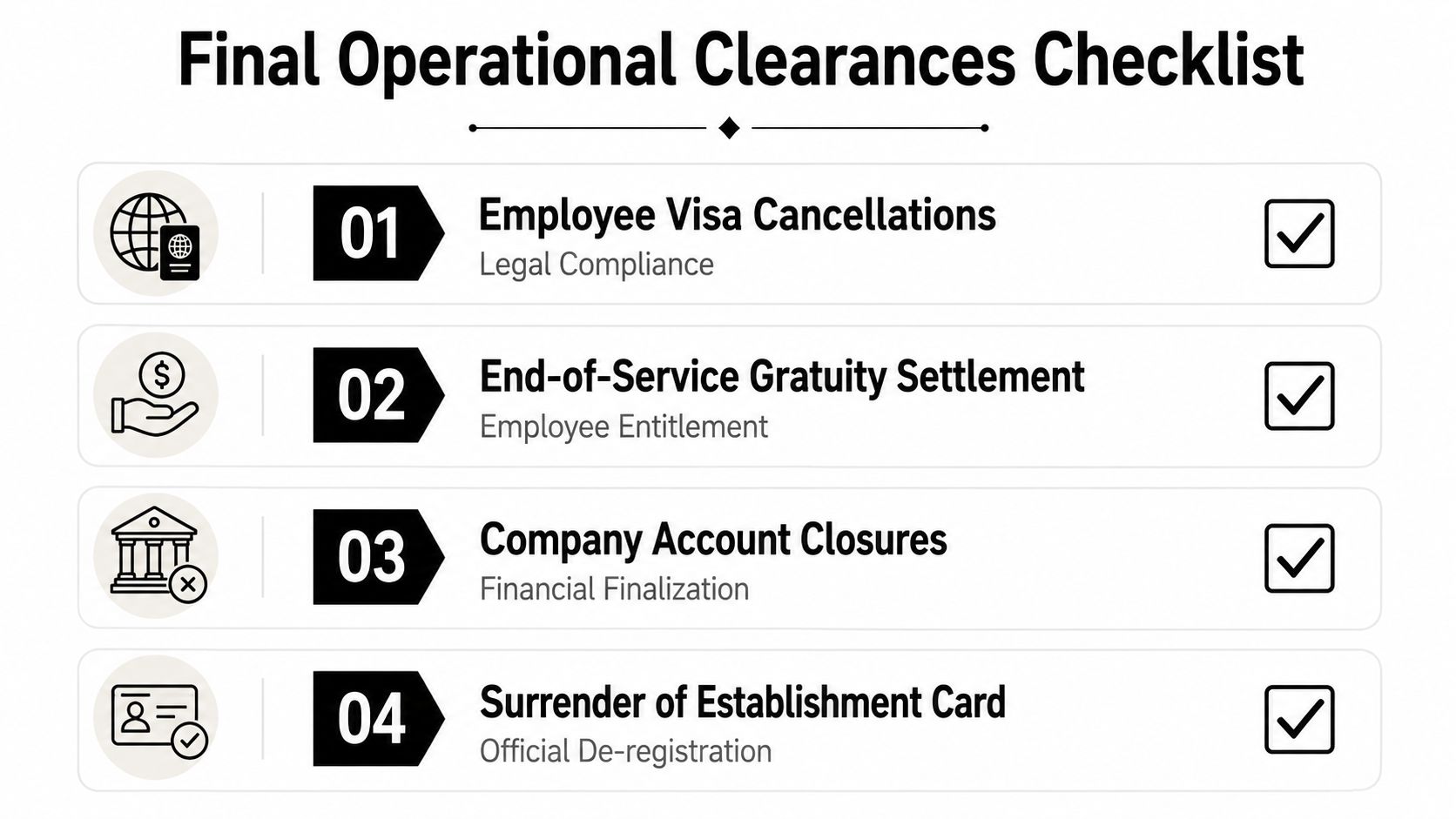
Process employee visa and labour file cancellations through the relevant employment and immigration channels. Settle salaries, leave balances, and end-of-service benefits, and document each payment or agreed settlement. A labour complaint or disagreement can interrupt the closure and create a separate dispute that the liquidator must address.
Use a written checklist for every employee:
- Employment settlement: Calculate and document final dues.
- Labour cancellation: Close the relevant employment record.
- Immigration cancellation: Cancel the sponsored visa through the applicable authority.
- Evidence pack: Store signed settlements, cancellation confirmations, and correspondence.
The company should also confirm the establishment card position before final filing. Founders often cancel the trade licence first in their planning, then discover that an uncancelled employee file or immigration record is still attached to the business.
Close the accounts that keep generating risk
Request bank closure evidence after facilities, cards, guarantees, and outstanding charges have been addressed. Terminate the office lease and complete any Ejari-related closure required for the premises. Obtain utility and telecom disconnection or clearance evidence, then check whether the landlord, bank, or service provider has issued a written no-objection document.
A managed process can coordinate these tasks while the liquidator handles the formal winding-up. Smart Classic Business Hub provides liquidation and related compliance support, including coordination of administrative clearances. For the employee benefits calculation itself, finance teams can use this practical end-of-service benefits resource, then have the figures reviewed against the employee records and applicable requirements.
Your Liquidation Checklist and Next Steps
A printable checklist should be organised by dependency, not by whichever form appears first on the authority portal.
Before filing
- Assess solvency: Confirm whether the company can meet known liabilities.
- Map creditors: List suppliers, landlords, banks, employees, tax authorities, and disputed claims.
- Approve dissolution: Prepare and notarise the shareholder or general assembly resolution.
- Appoint the liquidator: Obtain the liquidator's acceptance and authority documents.
- Reconcile records: Bring accounting, VAT, corporate tax, payroll, customs, and bank records up to date.
During liquidation
- Obtain initial approval: Submit the opening file to the correct authority.
- Publish notice: Complete the required creditor announcement and track the notice period.
- Settle staff obligations: Cancel labour files and visas, and document final payments.
- Close operations: Address the lease, utilities, telecom accounts, bank facilities, and establishment records.
- Complete tax work: Submit final returns, respond to FTA requests, and secure deregistration evidence.
After approval
- File the final report: Give the authority the liquidator's report and clearance package.
- Archive evidence: Retain resolutions, returns, settlements, clearances, and correspondence.
- Confirm cancellation: Obtain the final cancellation certificate and preserve the registry record.
- Review residual risk: Check for unresolved creditor, tax, banking, customs, or employment matters.
The most common failure points are missed tax filings, uncancelled visas, landlord disputes, dormant bank accounts that require additional review, and incomplete customs closures for trading businesses. Founders who are also disposing of office equipment may find liquidation advice from Cubicle By Design useful when planning asset removal alongside the legal closure.
Smart Classic Business Hub can support the sequence from initial solvency assessment and authority-specific document preparation through liaison with economic departments, free zones, and the FTA. Don't wait until the licence expiry or a creditor notice forces the decision. Book a liquidation readiness consultation while the company records, staff files, and tax accounts are still accessible.
Smart Classic Business Hub offers practical support for UAE company liquidation, including document preparation, authority coordination, tax and compliance follow-up, and final deregistration administration. Visit Smart Classic Business Hub to request a liquidation readiness consultation and establish the correct route before you file.