
A valuation usually becomes urgent at the worst possible moment. An investor asks what equity they'll receive for their capital. A partner wants to exit. A buyer approaches with an offer that sounds attractive until you realise you have no defensible basis to accept or reject it.
That's when many owners discover the gap between accounting records and economic value.
A set of financial statements tells you what the business has done. Business valuation services help determine what the business is worth in a real decision context. In the UAE, that context matters more than many founders expect. A mainland trading company, a DIFC advisory firm, and a free zone software business can all generate healthy revenue and still require very different valuation logic.
The practical question isn't “What is the formula?” It's “What value conclusion will stand up to scrutiny from investors, counterparties, auditors, regulators, or the Federal Tax Authority?” A good valuation answers that with evidence, method, and judgement. A poor one gives you a number that looks precise but fails the first serious challenge.
Beyond the Balance Sheet What Is Your Business Really Worth
Business owners often start with the wrong reference point. They look at paid-up capital, net assets, or last year's profit and assume one of those figures should anchor value. Sometimes that works for a dormant company or a business headed for liquidation. For an operating company with growth prospects, contracts, systems, and market position, it usually doesn't.
Why book value rarely tells the full story
A buyer doesn't acquire only desks, fit-out, stock, or bank balances. They acquire earning power. They assess whether your company can keep generating cash, retain clients, scale operations, and defend its position.
That matters even more in sectors where value sits in assets that don't appear clearly on the balance sheet. In the UAE technology and digital services sector, intangible assets can account for over 65% of total enterprise value, according to this UAE business valuation analysis. That changes the job completely. A valuation that focuses mainly on tangible assets will understate what many modern UAE businesses are actually worth.
Examples of intangible value include:
- Customer relationships: repeat revenue, low churn, contract visibility
- Proprietary systems: internal software, workflow tools, algorithms, data structures
- Brand position: pricing power, reputation, market trust
- Commercial know-how: licences, supplier terms, operating processes, local execution capability
What a professional valuation actually does
A proper valuation isn't a certificate with a single headline figure. It's a structured opinion built for a purpose. That purpose could be fundraising, shareholder restructuring, M&A, tax compliance, financial reporting, or dispute support.
Practical rule: The “right” valuation depends on why you need it. The same business can be viewed differently for a sale negotiation, a transfer pricing file, or an internal share transfer.
Experienced advisers save clients from expensive mistakes. They don't start with the number you want. They start with the question the valuation must answer. Then they choose the method, assumptions, and level of documentation that match that purpose.
The real benefit
A credible valuation strengthens your position. It lets you negotiate with support instead of instinct. It helps you test whether a term sheet is reasonable. It exposes weak assumptions in your own planning before an investor does.
That's why business valuation services are strategic, not administrative. They give decision-makers a defensible basis for action in a market where regulation, tax treatment, and entity structure can materially affect value.
The Three Lenses of Valuation Common Methods Explained
Most valuations rely on three broad approaches. The technical language can sound more complex than it is, so it helps to think of them as three lenses applied to the same business.
Asset-based approach
This approach asks a simple question. If you listed the company's assets and liabilities, what would remain?
It's similar to valuing a car by pricing each component separately. You total what the business owns, subtract what it owes, and arrive at net asset value. That can be useful where the business is asset-heavy, underperforming, or heading towards liquidation.
What it doesn't do well is capture future earning power. A profitable services company can be worth far more than its net assets. A digital business may own little physical equipment and still be highly valuable.
Market approach
This method works like pricing a property by looking at comparable sales nearby. The valuer looks for similar companies or transaction benchmarks and derives a value by comparison.
In practice, the challenge is comparability. Few private companies are identical. Differences in size, margins, tax profile, management dependence, and customer concentration can distort a simplistic comparison. Used well, though, the market approach is a powerful reality check because it reflects how actual buyers and investors price similar businesses.
A market multiple can look persuasive and still be wrong if the peer group doesn't reflect your sector, jurisdiction, risk profile, or ownership structure.
Income approach
This is the approach many operating businesses ultimately come back to. It values the business based on expected future economic benefit, usually through a Discounted Cash Flow (DCF) model or related income-based analysis.
The rental property analogy is useful here. If a property will generate rental income over time, its value depends on those future cash flows and the risk attached to receiving them. A business works the same way. Forecasts, margins, reinvestment needs, tax impact, and risk all shape value.
This approach is often best for growing businesses because it captures what a buyer is really paying for. Not history alone, but future returns.
Comparison of Business Valuation Methods
| Valuation Method | Best For | Pros | Cons |
|---|---|---|---|
| Asset-Based Approach | Asset-heavy companies, distressed entities, liquidation scenarios | Straightforward, grounded in identifiable assets and liabilities | Often misses goodwill, growth potential, and intangible value |
| Market Approach | Businesses with credible comparables or active transaction benchmarks | Reflects observable market behaviour, useful as a reality check | Comparables may be weak, adjustments require judgement |
| Income Approach | Going concerns, growth businesses, investor-led valuations | Captures future cash generation and business-specific economics | Sensitive to assumptions, requires reliable forecasting |
What works and what doesn't
In practice, strong valuations rarely rely on one method blindly.
- What works: matching the method to the business model and valuation purpose
- What fails: forcing an asset method onto a service firm, or relying on a market multiple with poor comparables
- What experienced valuers do: use one method as primary and others as cross-checks, then reconcile the result with commercial reality
A founder should be cautious when a provider offers a valuation too quickly without discussing business model, reporting quality, tax profile, or transaction purpose. That usually means they are fitting the company into a template instead of analysing it properly.
When Do You Need a Business Valuation Key Use Cases
A formal valuation usually appears when ownership, tax, or capital is about to move. The timing matters because the valuation shapes negotiations before documents are signed.

Fundraising and investor entry
A founder preparing for a seed or growth round needs more than confidence in the pitch deck. If the valuation is too high, serious investors push back quickly. If it's too low, the founder gives away more equity than necessary.
A defensible valuation helps frame dilution, explain assumptions, and show that management understands its own economics. It also forces discipline around forecasts, customer concentration, and profitability paths.
Mergers and acquisitions
A seller wants the highest credible price. A buyer wants downside protection. Business valuation services create the middle ground where both sides can discuss value using a reasoned framework instead of headline expectations.
For sellers, valuation highlights value drivers before going to market. For buyers, it identifies where the price depends on assumptions that need deeper due diligence.
Shareholder exits and disputes
This is one of the most common and most sensitive triggers. A partner wants out. A family business is being restructured. A minority shareholder challenges a transfer price.
The earlier parties agree on valuation mechanics, the less likely a commercial disagreement turns into a legal one.
An independent valuation can reduce emotion by shifting the discussion away from personal views and towards method, assumptions, and evidence.
Tax and regulatory filings
Some valuations are not optional. They are part of broader compliance work, especially where related-party transactions, restructurings, or fair value questions arise.
In those cases, the valuation has to do more than make commercial sense. It has to survive review by auditors or tax authorities. That changes the standard of documentation and support.
Liquidation and closure
Not every valuation is growth-oriented. When a company is winding down, owners need clarity on what assets can realistically be realised, how liabilities affect recoveries, and whether there is residual value after settlement.
That's a different exercise from investor valuation. The point isn't upside. The point is orderly decision-making under practical constraints.
The Valuation Process and What You Get
Clients often expect a valuer to ask for financial statements, run a model, and issue a number. The actual process is more structured than that. That's a good thing. Structure is what makes the final report defensible.
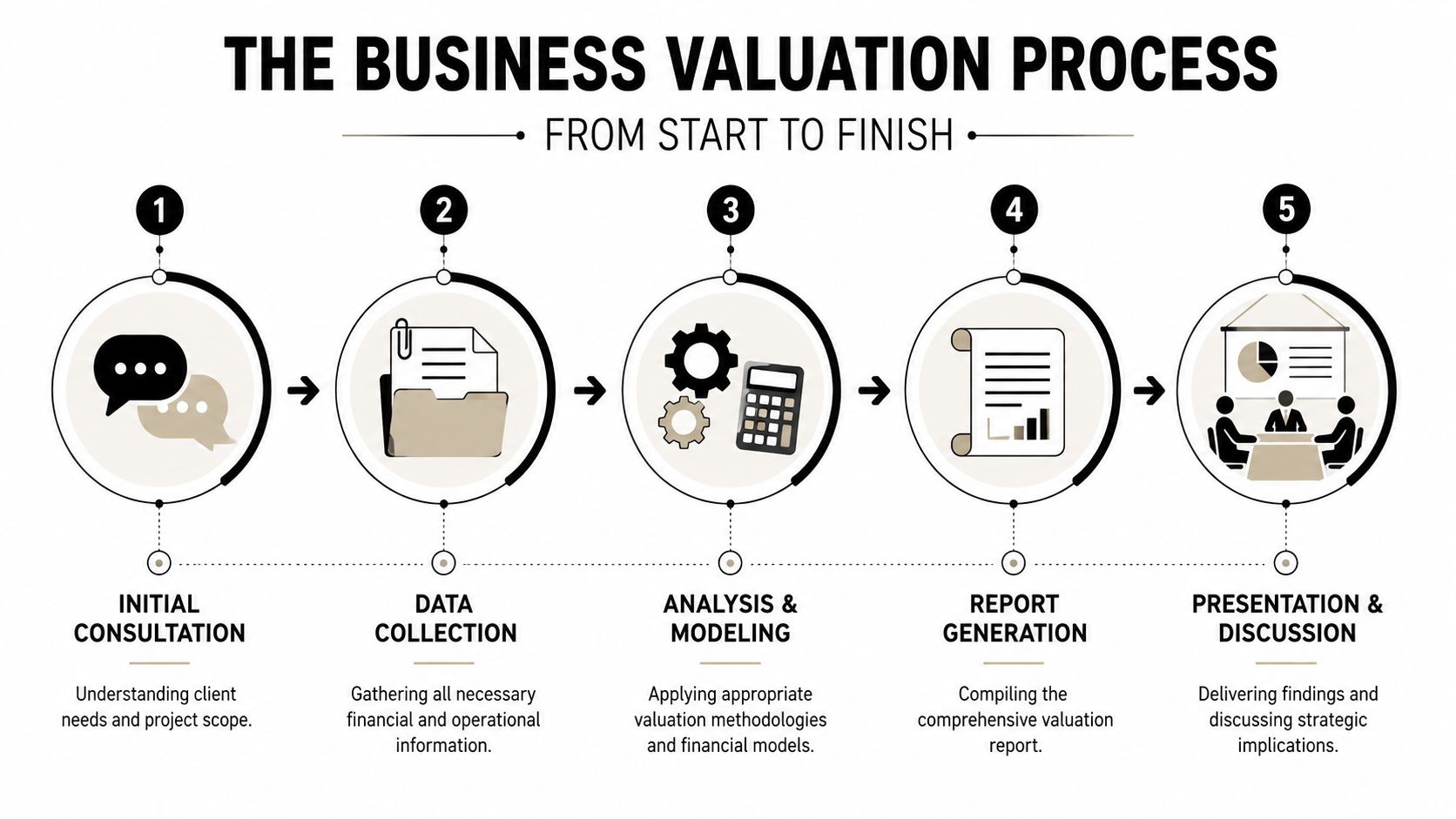
Step one and two define the scope and gather evidence
The first conversation should establish purpose, valuation date, ownership interest, industry context, and any regulatory angle. A valuation for a fundraising discussion is not built exactly like one for tax or shareholder litigation.
After scope comes data collection. In the UAE, valuation work typically requires 3–5 years of historical financial data, including audited statements, business plans, forecasts, asset registers, and records of recent transactions, as outlined by this UAE valuation services overview. If that information is incomplete, the valuer can still proceed in some cases, but the report may become more conservative or carry heavier assumptions.
Step three tests the business, not just the numbers
In the actual analysis, the valuer normalises earnings, reviews margins, checks for non-recurring items, analyses working capital patterns, and tests management forecasts against historical performance.
A sound process also asks operational questions:
- Revenue quality: Is income recurring, project-based, or dependent on a few clients?
- Management depth: Does the business depend heavily on one founder?
- Commercial concentration: Are supplier or customer risks material?
- Forecast credibility: Do projected results align with historical behaviour and market conditions?
Common mistake: Owners submit optimistic forecasts without support. A valuer won't ignore them, but they won't accept them at face value either.
Step four and five turn analysis into a usable report
Once the methodology is selected and applied, the valuer prepares a draft report. This usually goes through a factual review with management. That review is not for negotiating the number. It's for correcting factual errors, clarifying business context, and confirming assumptions.
The final deliverable is typically a detailed valuation report containing:
| Report Component | What it covers |
|---|---|
| Executive summary | Purpose, scope, valuation date, conclusion |
| Business overview | Operations, ownership, products or services, market position |
| Economic and industry context | Relevant market conditions affecting the business |
| Financial analysis | Historical performance, adjustments, trend review |
| Valuation methodology | Methods considered, methods selected, rationale |
| Conclusion | Final value indication and supporting commentary |
A useful report should let a third party follow the logic from inputs to conclusion. If the report gives only a number with minimal reasoning, it won't carry much weight when challenged.
Valuation in the UAE Special Regulatory and Market Factors
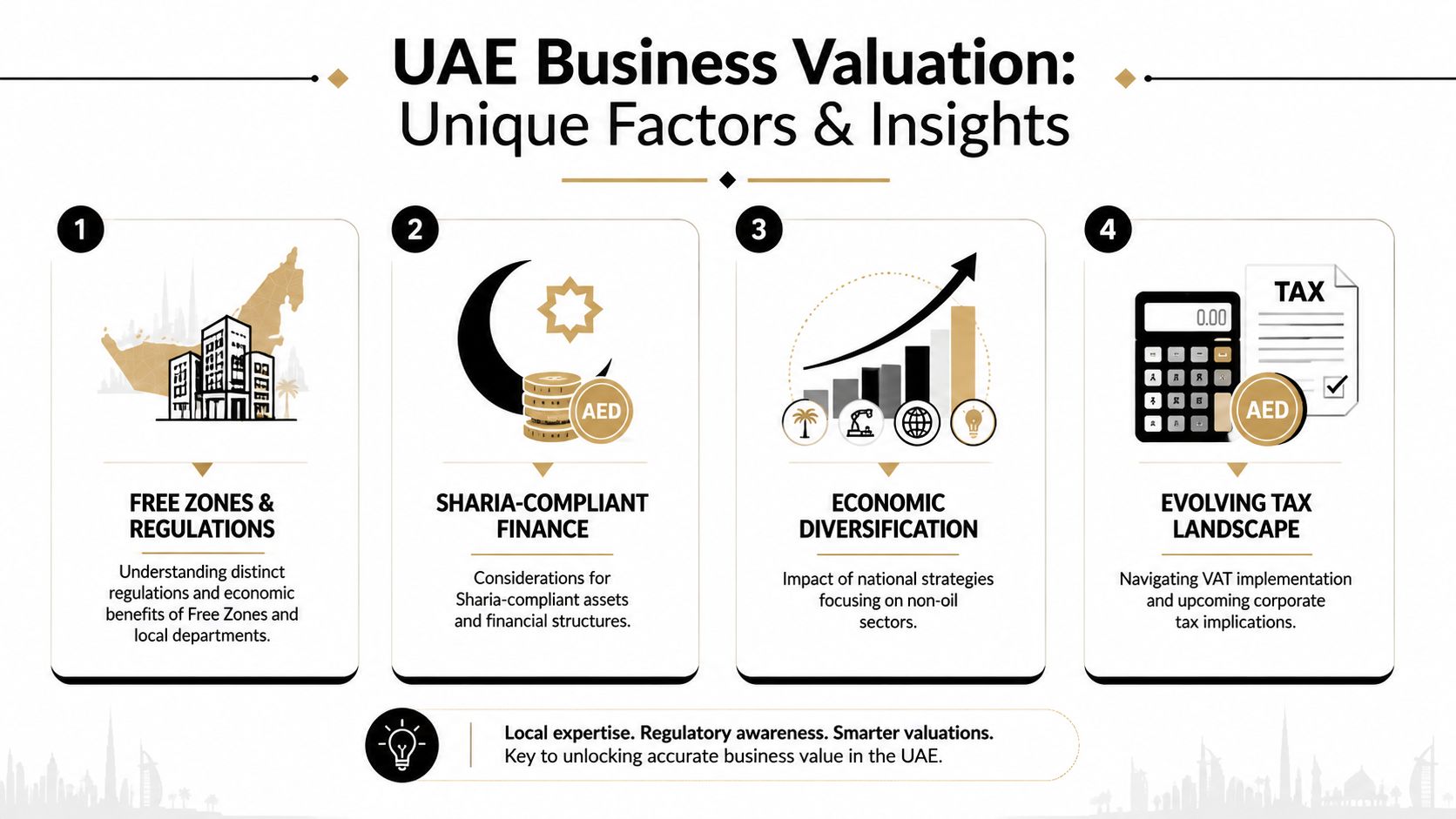
Generic valuation guidance breaks down quickly in the UAE. Local tax rules, entity structures, market comparables, and regulatory expectations can materially change the result. Consequently, many imported templates fail.
Corporate tax and FTA scrutiny
For Corporate Tax and Transfer Pricing compliance in the UAE, valuations must adhere to IFRS 13, and the Market Approach using localised peer data from DFM or Nasdaq Dubai is required in situations where a DCF alone lacks region-specific risk support, according to this UAE Corporate Tax valuation guide.
That point deserves attention. Many business owners assume a DCF is always enough because it is detailed and company-specific. For internal planning, it may be. For FTA-facing work, a DCF without locally grounded assumptions can be vulnerable. The issue isn't whether the spreadsheet is complex. The issue is whether the assumptions reflect UAE market reality and comply with the reporting framework.
Mainland and free zone valuations are not interchangeable
One of the most overlooked issues in UAE business valuation services is the difference between Mainland and Free Zone entities. Too many valuations treat them as if they operate under one uniform tax and regulatory environment.
They don't.
Free Zone status can alter expected post-tax cash flows, investor perception, operating flexibility, and strategic attractiveness. The source material provided for this article notes that a 10–15% valuation discrepancy can occur when international benchmarks are applied without proper adjustment for UAE regulatory factors and Free Zone incentives, based on this discussion of UAE valuation methodology gaps.
That doesn't mean every free zone business is worth more. It means the valuer has to analyse how the entity's licensing regime, qualifying income profile, and operating constraints affect value. In some cases, Free Zone benefits improve projected cash flow. In others, mainland access, sector approvals, or contractability may support stronger value.
Tax regime impact on SME value
The UAE Corporate Tax framework also affects assumptions around net cash flow and investor returns. The source material indicates that the 9% Corporate Tax on profits above AED 375,000 has depressed SME valuations by 12–15% compared to pre-2023 baselines in some contexts, according to this Dubai valuation market commentary.
The practical takeaway is not that every SME automatically loses value. It's that post-tax forecasting now matters more. Owners who still present pre-tax style thinking in investor or restructuring discussions often overstate maintainable value.
Special cases involving assets and startup structures
Some UAE mandates become more specific when the valuation includes tangible property or startup-style capital structures.
- Property-linked valuations: Where tangible assets such as freehold property are included in M&A or dispute work, the same source notes the need for RICS regulation and RERA accreditation in relevant contexts.
- Startup valuations: The same market commentary also notes increased use of the Option Pricing Model for startup cases involving intangible assets and complex upside scenarios.
A valuation that ignores UAE-specific regulation may still look polished. That doesn't make it defensible.
The strongest UAE valuations aren't just mathematically neat. They reflect entity type, tax position, local market data, and the purpose of the report.
How to Choose the Right Business Valuation Provider in the UAE
A weak provider can create more risk than no valuation at all. The issue isn't only technical quality. It's whether the firm understands how UAE commercial reality, tax compliance, and entity structure affect the result.

What to screen for before you appoint anyone
Start with capability, not price. A cheap report that fails investor due diligence or FTA review is expensive in practice.
Use this checklist:
- UAE-specific technical depth: Ask how the firm handles mainland versus free zone assumptions, local market comparables, and Corporate Tax implications.
- Standards and defensibility: Confirm whether their work aligns with accepted valuation and reporting standards relevant to the engagement.
- Industry familiarity: A hospitality operator, a software business, and a logistics company should not be modelled the same way.
- Purpose-fit reporting: Check whether they've handled valuations for fundraising, M&A, internal restructurings, or tax compliance similar to yours.
- Clear process: A serious provider can explain what they need, how they analyse it, and what the report will contain.
Questions worth asking in the first meeting
The right questions expose whether the provider is thinking or templating.
Ask things like:
- How would you reflect Free Zone status in your valuation model?
- When do you rely primarily on market evidence versus income-based modelling?
- How do you treat owner-related adjustments or non-recurring expenses?
- What support do you need from management to test forecasts properly?
- If this report is reviewed by tax advisers, auditors, or counterparties, how will your assumptions hold up?
A good adviser will answer directly. A weak one usually responds with vague reassurance.
Choose the firm that explains trade-offs clearly. Valuation is rarely about one perfect answer. It's about a well-supported range, a justified conclusion, and assumptions you can defend.
A note on fees
Providers may charge fixed fees, staged fees, or time-based fees depending on scope. The right model depends on the engagement. A narrow internal valuation and a complex tax-facing valuation are not equivalent assignments.
What matters most is transparency. You should know what work is included, what may trigger additional fees, and whether meetings, revisions, or management presentations form part of the engagement.
Conclusion Turning Valuation Into Strategic Value
A valuation becomes useful when it helps you make a decision with confidence. That could mean negotiating a sale, raising capital, resolving a shareholder issue, supporting a tax position, or planning your next move as an owner.
The mechanics matter. So do the UAE-specific details. Method selection, report quality, Free Zone versus Mainland treatment, Corporate Tax impact, and regulatory defensibility all influence whether the valuation stands up when someone serious reviews it.
The strongest business valuation services do more than produce a number. They translate your company's economics into a conclusion that investors, buyers, regulators, and counterparties can understand and challenge without it falling apart.
If you need clarity on what your UAE business is really worth, treat valuation as a strategic exercise, not an administrative task. The quality of that work can affect equity, tax exposure, deal outcomes, and negotiating strength long after the report is issued.
If you're preparing for fundraising, restructuring, a transaction, or tax-sensitive decision-making, Smart Classic Business Hub can help you approach valuation with the right commercial and regulatory perspective. Their Dubai-based team supports UAE businesses with company structuring, accounting, audit coordination, corporate finance advisory, and practical guidance that helps owners turn valuation work into better decisions.