
Feasibility Study Template: Sections, Prompts and Checks


Most founders who download a feasibility study template fill it with the exact wrong material. Standard advice tells you to write a polished executive summary, paste in a SWOT grid, and claim a tiny slice of a billion-dirham market to prove your venture will thrive. That approach produces persuasive prose that collapses the moment real invoices, licence renewals, and payroll hit your bank account.
Strong macroeconomic headlines make this trap even easier to fall into. In Q1 2025, UAE real GDP reached AED 455 billion after growing 3.9% year over year, while non-oil GDP rose 5.3% to AED 352 billion, according to the UAE Ministry of Economy and Tourism. Healthy national expansion does not guarantee that a specific clinic, trading desk, or consultancy will survive its first six months of cash outflows.
A working feasibility study template is not a narrative pitch deck. It's a seven-section decision tool where every section ends in a verifiable number or a binding verdict, built around UAE cash timing, Value Added Tax (VAT) thresholds, and corporate tax obligations.
Feasibility Study Template Sections at a Glance
Before you draft a single projection, your template needs to reflect the actual scale of businesses operating across the Emirates. Generic corporate frameworks assume deep capital reserves and dedicated finance departments, which rarely match how local ventures launch.
Sizing the Template for Lean UAE Ventures
The UAE Ministry of Economy reported 558,000 companies in 2022, made up of roughly 395,000 micro-enterprises (70.9%), 150,000 small enterprises (26.8%), and 13,000 medium enterprises (2.3%). The same government data showed that SMEs contributed 63.5% of non-oil GDP in 2020.
Because micro and small businesses form the vast majority of the market, your template must test lean operating realities rather than corporate averages. Early-stage ventures here face tight initial capital, small teams, and heavy sensitivity to licence fees, commercial rent, employee visas, accounting retainers, and delayed customer payments. Building separate micro, small, and medium model tabs forces you to see how fixed compliance costs behave at your true launch scale, and clarifies how your revenue ties into diversified non-oil sectors like trade, technology, logistics, tourism, or professional services.
Turning the Outline into an Action Sheet
A template only earns its keep when every section produces a hard output instead of descriptive paragraphs. Use the seven-section map below as your master structure.
| Section | Reader question | Core output |
|---|---|---|
| Project summary | What is being built, for whom, and what decision is requested? | One-page summary with the decision asked |
| Market and demand | Is there real demand in this emirate and sales channel? | Demand validation matrix and a sized customer segment |
| Operations and staffing | What must run every day to deliver the product or service? | Staffing plan, premises, and supplier list |
| Financial model | Does cash flow turn positive, and when? | 24-month monthly cash flow and break-even month |
| Tax and compliance | What do VAT and corporate tax change in the cash flow? | Tax-adjusted cash flow and licence and renewal costs |
| Scenarios and risk | What happens if sales are slower or customers pay late? | Base, upside, downside and stress cases |
| Go or no-go decision | Should the project proceed, pause or stop? | Scored verdict with conditions and owners |
Copy this table directly into a shared working document or spreadsheet today. Assign one named owner and a firm due date to each row before you gather a single quote or interview a customer, so the study stays a live decision gate rather than an abandoned draft.
How to Work Through the Template in Order
Sequence matters because every downstream financial calculation depends on upstream evidence. If you jump straight into spreadsheet formulas before verifying customer willingness to pay or delivery capacity, you automate wishful thinking.
The visual workflow below maps out the exact sequence to follow when populating your template.
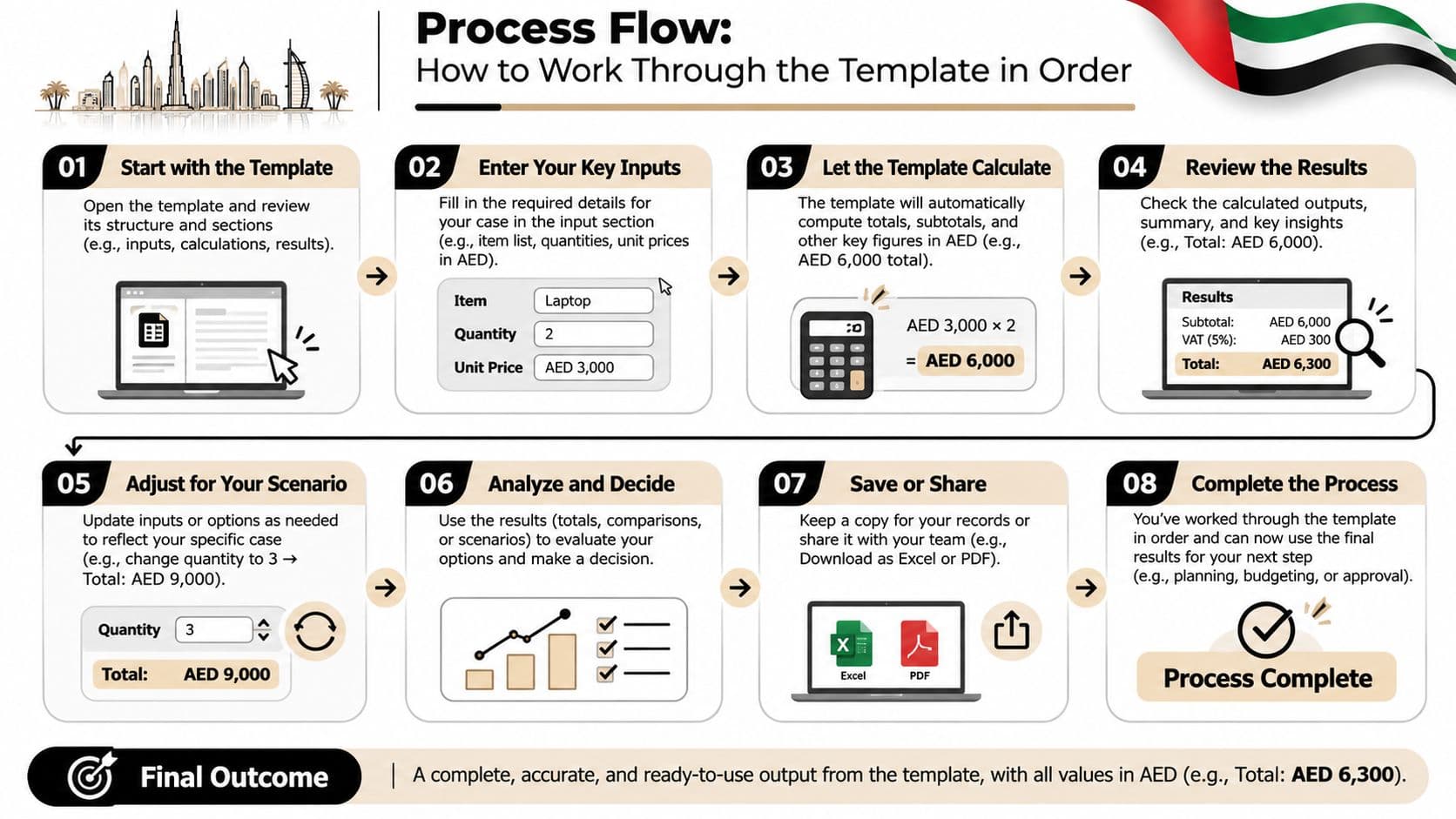
Six Sequential Steps from Idea to Verdict
Work through these six steps without skipping ahead, keeping your assumptions linked inside one master workbook so a change in hiring dates or prices automatically updates your cash position. Seeing how founders unified 50+ models shows why consolidating scattered sheets into one structured system prevents hidden version errors when decisions get tight.
- Draft the one-paragraph project summary and decision request. Start by stating exactly what you're launching and what approval you need (such as releasing setup capital or signing a lease), so every subsequent test answers that specific question. The common slip is writing a grand vision statement that never defines the decision on the table.
- Size demand from primary local evidence. Replace broad market estimates with real signals like customer interviews, signed expressions of interest, and channel pricing tests. Founders routinely slip here by forecasting monthly sales first and hunting for justifications afterward.
- Map the full cost base with setup separated from recurring lines. Itemise every one-time launch cost apart from ongoing monthly overhead so you can see both your entry ticket and your monthly burn rate. The classic error is lumping trade licence fees, security deposits, and fit-out expenses into annual averages that hide month-one cash shock.
- Construct a 24-month monthly cash flow including tax and collections. Plot when cash lands in your bank account alongside rent, payroll, VAT remittances, and corporate tax accruals rather than relying on an accrual profit-and-loss statement. Treating accounting profit as spendable cash is the single fastest way to misjudge survival.
- Run base, upside, downside, and stress scenarios. Adjust sales velocity, gross margins, and customer payment timing to record the exact minimum cash buffer each case requires. Most drafts skip downside testing entirely, leaving founders blind to a slow launch quarter.
- Score the project and attach conditions to approval. Measure your findings against pre-set go or no-go thresholds, documenting the exact milestones that must hold if you proceed. Teams often slip by letting enthusiasm override a weak score instead of pausing to fix the gap.
Practical rule: If cash turns negative in your downside case, the template hasn't failed. It has just uncovered a concrete funding requirement that you can solve before committing to a lease or trade licence.
Market and Demand Validation Prompts
Start with the buyer, not the total addressable market. Before you estimate a single dirham of revenue, answer four blunt prompts in your working file: who writes the cheque, which emirate they operate in, which commercial channel they buy through, and what licence category that channel legally requires.
Testing Demand Across Five UAE Channels
Buying behaviour varies sharply between a walk-in retail shopper in Jumeirah, a free zone B2B client, and a government procurement portal. If you're still weighing sectors or evaluating business opportunities in Dubai, test each target channel independently instead of blending them into one generic customer persona.
| Channel | Evidence to collect | Validation test |
|---|---|---|
| Mainland consumer | Customer interviews and survey responses | Pricing test with target customers in the chosen emirate |
| Free zone B2B | Signed expressions of interest from buyers | Pilot order or letter of intent before the licence is bought |
| Government procurement | Tender notices and past awards in the sector | Eligibility check and bid pipeline review |
| Expatriate consumer segment | Competitor mapping by emirate and neighbourhood | Sign-up or footfall test in the chosen location |
| Corporate and B2B buyers | Interviews with procurement managers | Conversion rate from pipeline to paid order |
For every row you plan to pursue, add columns in your own spreadsheet for licensing constraint, minimum sample size, conversion assumption, and decision threshold. A channel backed only by desk research gets zero revenue in your base case until a live test proves buyers will pay your stated price.
Why Macro Momentum Does Not Prove Local Demand
A favourable national business climate is a double-edged sword for new entrants. The UAE ranked first globally in the Global Entrepreneurship Monitor 2024-2025 assessment and stood as the leading destination for entrepreneurship and SMEs among 56 economies. The same 2025 UAE profile scored market dynamics at 7.6 and commercial infrastructure at 7.2.
Low friction to incorporate means your competitors can launch just as easily as you can. High ease of entry drives up competitor density across popular emirates and squeezes margins when founders rely on optimistic top-down market share figures.
To separate genuine project demand from macro noise, rank your proof strictly by commitment level:
- Strongest evidence: Signed pilot orders, refundable deposits, paid pre-orders, or written letters of intent from named local buyers.
- Acceptable early signals: Structured pricing interviews with target procurement managers or verified local sign-up tests in your chosen neighbourhood.
- Weakest claims: Taking a tiny percentage of a national industry report without mapping existing competitors by emirate and checking whether their current capacity is already full.
Map direct rivals by emirate and district, noting their published pricing, service turnaround, and obvious capacity bottlenecks. Only translate a channel into your financial forecast once your validation test clears the conversion threshold you set in advance.
Operations and Staffing Prompts
An ambitious sales curve means nothing if your team, premises, and suppliers cannot fulfil the orders on time. This section translates your daily delivery workflow into concrete headcount, space, and vendor commitments that feed directly into your cost base.
Daily Delivery and Payroll Worksheet
Answer these six operational prompts in writing before opening your financial tab:
- Core versus outsourced functions: Which daily tasks create your competitive edge in-house, and which support activities (such as bookkeeping, IT maintenance, or courier delivery) should go to local service providers?
- Phased headcount milestones: How many full-time and part-time staff do you need in month one, month six, and month twelve, and which key roles must be hired and onboarded before your first sale?
- Full UAE employment cost: Beyond base monthly salary, what are the housing or transport allowances, residency visa fees, Emirates ID charges, medical insurance premiums, and labour-contract costs for each hire?
- Premises and licence alignment: Do you need a mainland commercial office, a free zone flexi-desk, warehousing, or an approved residential workspace, and does your chosen licensing authority permit that exact activity at that address?
- Supplier terms and upfront cash: Who are your primary and backup vendors, what credit terms do they offer new companies, and which ones demand security deposits or advance cash before releasing stock?
- Monthly delivery ceiling: How many units, client engagements, or billable hours can your initial team and space handle each month before quality slips or expansion becomes mandatory?
Every answer here converts directly into a line item. Record each operational expense with its unit price, billing frequency, start month, and payment trigger (such as upfront deposit versus monthly arrears).
Linking Capacity Caps to Your Sales Ramp
Once you establish your monthly delivery ceiling, wire that ceiling directly into your revenue spreadsheet as a hard cap. If two consultants can deliver a fixed number of client audits per month, your revenue formula must never project sales above that output until a third hire appears on the payroll schedule, complete with onboarding lead time.
Two operational oversights derail early-stage studies more than almost anything else. First, founders frequently assume they can recruit, secure visas, and onboard specialist staff instantaneously the week sales spike. Second, they overlook upfront supplier deposits, Ejari or tenancy cheque structures, and utility connection deposits that pull cash out of the account weeks before the first customer invoice is ever issued.
Close this section with three tangible files attached to your workbook: a phased staffing plan, a premises and licence compatibility record, and a supplier register listing credit terms and deposit requirements.
Cash Runway and Scenario Model
Profitability on paper tells you whether a business model works in theory. Cash runway tells you whether the business stays solvent long enough to reach that point.
Separating Setup Outlays from Recurring Costs
Build your financial workbook by cleanly dividing one-time launch outlays from ongoing monthly obligations. One-time items include trade licence registration, tenancy deposits, office fit-out, equipment, software onboarding, and opening inventory. Recurring items cover commercial rent, salaries, visa amortisation, accounting retainers, insurance, marketing spend, and annual licence renewals.
For every single line, log the unit cost, payment frequency, start month, and whether the outflow hits in advance or in arrears. Then construct your monthly revenue engine from the bottom up: validated customers per month multiplied by average transaction value, paced strictly to your licensing completion date and hiring timeline. Layer working-capital schedules directly beneath revenue to track inventory holding days, supplier payable days, and customer receivable days.
Track three distinct milestones rather than relying on a single break-even figure:
- Operating break-even month: The first calendar month in which gross contribution covers your recurring fixed costs.
- Cumulative break-even month: The later month in which cumulative cash inflows finally pay back all initial setup outlays and early operating losses.
- Cash runway: The exact number of months your opening capital can fund planned outflows before the bank balance hits zero.
Using a dedicated UAE cash flow statement template helps structure operating, investing, and financing lines clearly, while learning how to build bulletproof startup financial projections ensures your formulas stay dynamic when you test assumptions.
Stress-Testing Collections and Financing Limits
Anchor your long-term growth assumptions to official macroeconomic data as an upper ceiling, never as an automatic baseline for a brand-new company. Data from the Federal Competitiveness and Statistics Centre put UAE 2024 GDP at AED 1.78 trillion at current prices, with constant-price GDP growth of 4% and non-oil GDP growth of 5%. Meanwhile, the Ministry of Economy Q1 2024 review recorded more than 788,000 companies registered in the UAE by the end of 2023 alongside a national objective of reaching one million companies by 2031, and cited Central Bank projections of 4.5% overall GDP growth and 5.0% non-hydrocarbon growth for 2025 alongside a non-oil private-sector Purchasing Managers' Index of 54.1 in October 2024. Treat those macro benchmarks as context, then select a realistic, tighter sector proxy for your own emirate and niche.
Just as critical, never assume a bank line will automatically rescue a tight quarter. The Central Bank of the UAE Financial Stability Report showed that while SME lending recovered, it grew only 8.8% during 2025. That same report highlights local late-payment conditions tracked in the 2025 Atradius UAE payment-practices survey alongside Deloitte's 2025 Middle East restructuring analysis, which identifies strained cash flow, unpaid VAT and corporate-tax liabilities, and unsustainable debt servicing as primary triggers for formal restructuring.
A venture can look profitable on an income statement and still collapse in month five because customer invoices sit unpaid while rent, visas, and tax remittances clear on schedule.
Test your model across four structured cases in the same workbook so you can compare the peak cash deficit side by side.
| Scenario | Demand and price assumption | Collection days | Decision it informs |
|---|---|---|---|
| Base | Market-share ramp from validated channel evidence | Terms agreed with customers | Expected cash runway and break-even month |
| Upside | Faster ramp with higher average transaction value | Same as base | Staffing and premises capacity needed |
| Downside | Slower customer acquisition and lower gross margin | 30, 60 or 90 day delay | Minimum cash buffer and financing need |
| Stress | Demand well below base with a 90 day delay | 90 days plus tax reserve | Whether the project should be paused or stopped |
Record the lowest cash point in each scenario. That figure, not your year-one accounting profit, dictates how much capital you need to launch safely.
UAE Tax and VAT Checks to Build In
Treating taxation as a footnote at the bottom of an annual income statement creates dangerous blind spots in a UAE feasibility study. Both VAT and corporate tax alter your pricing competitiveness and create lump-sum cash outflows that can collide with slow receivable cycles.
Rolling Thresholds and Tax Cash Timing
Under rules published on the official UAE government VAT portal, businesses must generally register for VAT when taxable supplies and imports exceed AED 375,000 over a 12-month period, while voluntary registration opens above AED 187,500. For corporate tax, the UAE levies a 0% rate on taxable income up to AED 375,000 and a 9% rate on taxable income above that threshold.
Build all five checks below directly into your 24-month monthly spreadsheet rather than waiting for year-end reconciliations.
| Rule | Threshold or rate | What to test in the model |
|---|---|---|
| VAT mandatory registration | Taxable supplies and imports above AED 375,000 in 12 months | Rolling 12-month threshold test each month |
| VAT voluntary registration | Available above AED 187,500 | Sensitivity case with and without registration |
| Recoverable input VAT | Recoverable on eligible business purchases | Timing of VAT refunds in working capital |
| Corporate tax, lower band | 0% on taxable income up to AED 375,000 | Post-tax profit for the first band |
| Corporate tax, standard rate | 9% on taxable income above AED 375,000 | Tax payment date in the monthly cash flow |
Notice the rolling nature of the VAT trigger. Your spreadsheet needs a monthly formula that sums the trailing twelve months of taxable supplies and imports (plus upcoming 30-day projections) every single month. Checking only at calendar year-end risks missing a mid-year registration deadline and absorbing unbilled VAT directly out of your gross margin. Reviewing a detailed UAE VAT registration threshold guide alongside your spreadsheet ensures you capture taxable imports and exempt supplies accurately.
Forecast output VAT collected, recoverable input VAT on eligible business purchases, and exact remittance dates on separate rows. Do the same for corporate tax: accrue the liability monthly whenever projected taxable income clears the zero-rated band, then place the actual cash payment in the exact settlement month so you see whether it overlaps with a rent cheque or seasonal sales dip.
Pricing and Registration Prompts to Answer First
Run two parallel model switches (registered versus unregistered) and answer three practical prompts before locking your pricing:
- Are your quoted prices VAT-inclusive or VAT-exclusive? Consumer-facing brands often have to absorb VAT inside shelf prices to stay competitive, compressing net margin, whereas B2B contracts typically quote prices plus VAT.
- Can your target customers recover input VAT? If you sell primarily to VAT-registered corporate buyers, voluntary registration above the lower threshold lets you recover input VAT on your own setup and operating costs without making your service more expensive for clients.
- Will your growth curve cross the mandatory threshold inside year one? If your base case crosses in month nine, budget for accounting software configuration, tax filing fees, and a ring-fenced VAT reserve from month one.
Because tax regulations, free zone qualifying rules, and filing schedules evolve, confirm all assumptions and thresholds with a qualified UAE tax adviser before finalising your investment decision.
Worked Cash Buffer Example
Abstract percentages hide how fast delayed B2B invoices drain a new bank account. Running a simple, hypothetical mainland consulting venture through six months of arithmetic shows exactly how to calculate a survival buffer you can replicate with your own numbers.
Calculating the Downside and Stress Buffers
Say a founder launches a mainland advisory practice with the following hypothetical assumptions:
- One-time setup outlays: AED 60,000 paid in month 1 (covering licensing, deposits, and basic equipment).
- Recurring operating costs: AED 40,000 per month from month 1 through month 6.
- Total cash outflows by month 6: AED 300,000 (AED 60,000 setup plus six months of operating costs).
- Invoiced sales: AED 0 in months 1 to 3 during licensing and business development, followed by AED 50,000 per month in months 4, 5, and 6 (AED 150,000 total invoiced).
Now apply real-world collection timing and an illustrative 5% VAT reserve on those AED 150,000 of invoiced sales (AED 7,500) across two delayed-payment cases:
- Downside case (60-day collection delay): Invoices raised in month 4 (AED 50,000) arrive in month 6, while month 5 and month 6 invoices land after month 6. Total cash collected through month 6 is only AED 50,000. Subtracting AED 50,000 from AED 300,000 in outflows creates a peak operating cash deficit of AED 250,000. Adding the AED 7,500 VAT reserve yields a downside cash buffer of AED 257,500.
- Stress case (90-day collection delay): Month 4 invoices do not clear until month 7, leaving AED 0 collected by the end of month 6. All AED 300,000 in outflows must be funded out of pocket, plus the AED 7,500 VAT reserve, pushing the required stress cash buffer to AED 307,500.
Compare that required buffer directly against committed capital in the bank. If your dedicated funding covers the downside buffer, the 60-day case is secure, though a 90-day payment stretch would still break the business unless you trim monthly overhead or delay launch until stronger deposits are secured.
The most common mistake analysts catch in founder models is sizing opening capital from cumulative accounting losses or from the base case where every client pays on day one. Repeat this exact six-month ledger with your own setup quotes, monthly burn, and realistic collection lags before committing a dirham.
Red Flags and Go or No-Go Verdict
Most founders treat a feasibility review as a green-lighting ritual rather than a stress test. Challenge your own draft ruthlessly before any investor, bank manager, or business partner ever sees it.
Eight Red Flags That Invalidate a Draft
Audit your completed workbook against these eight failure points, fixing the underlying assumption immediately rather than polishing the narrative:
- Demand rests on a top-down market share with zero customer proof: Run a live pricing test or collect signed expressions of interest in your target emirate before writing another line of the study.
- The revenue ramp outruns your hiring or licensing schedule: Re-scope your launch timeline so first revenue starts only after trade licences, visas, and delivery staff are active.
- Your monthly cash flow omits VAT and corporate tax lines: Insert rolling threshold tests, tax accruals, and a ring-fenced tax reserve immediately.
- Cumulative break-even sits beyond your funded cash runway: Delay the launch, trim fixed scope, or secure committed capital to close the exact shortfall before signing a lease.
- One anchor client supplies the majority of projected revenue: Validate and win a second commercial channel so a single delayed invoice cannot halt operations.
- Customer payment terms are guessed rather than confirmed: Obtain written credit terms from target buyers and test 60-day and 90-day delays in your cash ledger.
- Annual licence renewals and visa cycles are missing from year two: Add every recurring government, PRO, and compliance renewal fee in the exact calendar month it falls due.
- The venture only survives under the upside scenario: Cut fixed overhead and premises commitments until the project clears break-even on validated base-case demand.
Setting Your Go or No-Go Rules
End your study with a documented scoring gate rather than an open-ended opinion. Applying a structured opportunity assessment scoring framework helps you weight demand proof, operational readiness, and capital cushion objectively across competing ideas.
Decision gate: Never approve a launch on an upside scenario. If the numbers only survive when everything goes right, you're looking at a wish list, not a viable project.
Apply three rigid verdict rules to close the document:
- Proceed: Base-case break-even falls comfortably inside your cash runway, the downside case stays positive (or is fully covered by committed buffer capital), and verified buyer evidence exists in at least one target channel.
- Pause and test: The unit economics look workable, but local demand proof or written supplier terms remain thin. Set a 30-day validation sprint with a named owner and specific evidence targets.
- Stop: Even after trimming fixed costs, the stress case creates a cash shortfall you cannot credibly fund. Walk away with your capital intact.
Write down the verdict, list every attached condition, and assign an owner to verify each milestone before launch. To lock down realistic one-time setup lines before running your final scenario test, you can estimate registration outlays using our Business Setup Cost Calculator tool. When you bring an existing business into a formal review, prepare your recent financial statements and a letter of intent alongside your completed template. From there, our first step is an initial consultation and assessment, where our specialists review your requirements and objectives and map out which PRO services you need, including company registration, visa processing, or government approvals.
Smart Classic Business Hub helps founders, SMEs, and international investors across Dubai and the wider UAE turn draft assumptions into auditable feasibility studies, VAT-compliant financial models, and compliant company setups. Whether you need an independent review of your cash runway and tax scenarios or end-to-end support with mainland and free zone registration, accounting, and PRO services, our consultants guide every stage from assessment to launch. Explore our full advisory and setup services at Smart Classic Business Hub.