
UAE businesses must register for VAT once taxable supplies and imports exceed AED 375,000 over a rolling 12 months, or when they're expected to cross that line within the next 30 days. Voluntary registration becomes available when taxable supplies and imports reach AED 187,500.
A Dubai founder can reach that point without a dramatic warning. One month, she's sending invoices, paying suppliers and reinvesting every dirham into the business. The next, her bookkeeping shows that taxable activity has moved beyond the vat registration threshold UAE businesses need to monitor, yet no VAT application has been submitted.
That's where the confusion usually begins. The threshold isn't an annual sales target, and it isn't measured only by the cash currently sitting in a bank account. The Federal Tax Authority, or FTA, applies specific tests to taxable supplies and imports, using both past activity and a forward-looking expectation.
Why the VAT Registration Threshold Matters for UAE Businesses
A Dubai consultancy owner has just completed a strong quarter and sees AED 400,000 in revenue. She celebrates the milestone, then realises that she may already have crossed the VAT registration line without applying to the FTA. The problem isn't that the business grew. The problem is that growth wasn't connected to a working VAT monitoring process.
The threshold gives smaller businesses room to operate without immediately taking on VAT administration. At the same time, it gives the FTA a clear compliance point for businesses whose taxable activity has reached a meaningful level. The Federal Tax Authority explains the UAE VAT registration thresholds, including the mandatory and voluntary tests that resident businesses need to assess.
The FTA administers the UAE's federal tax system. It receives registration applications, manages VAT returns, handles tax correspondence and enforces obligations. Registration isn't the end of the process. Once a business becomes registered, its invoices, accounting records, VAT calculations and return submissions need to support the figures reported to the authority.
Who needs to pay attention
This rule matters to more than established trading companies. It's relevant to:
- Mainland SMEs: A consultancy, agency or retailer can approach the threshold as its client base expands.
- Free zone businesses: A free zone licence doesn't automatically remove the business from the UAE VAT system.
- Freelancers and sole traders: The legal structure doesn't replace the need to assess taxable activity.
- E-commerce sellers: Imported stock and taxable UAE activity can create obligations that aren't obvious from local sales alone.
- International investors: A new UAE entity needs a clear process for separating its activity from related businesses and owners.
Non-resident businesses can face different questions around UAE taxable activity and registration. For cross-border situations, a practical overview of VAT compliance for non-residents can help identify issues that aren't covered by a resident business's ordinary turnover review.
Practical rule: Treat the threshold as a control inside your bookkeeping, not as a figure you check after the year has finished.
Mandatory and Voluntary Registration Thresholds Explained
The UAE has two central registration points. Mandatory registration applies at AED 375,000, while voluntary registration begins at AED 187,500, subject to the relevant taxable supplies and imports test. Both figures are set out by the FTA and the UAE's official government platform.
In simple terms, mandatory registration removes the choice. If the business exceeds the applicable threshold, or expects to exceed it under the forward-looking test, it needs to apply. Voluntary registration gives an eligible business below the mandatory point the option to enter the VAT system earlier.
The calculation focuses on taxable activity, not every amount that appears in the accounts. Taxable supplies generally include standard-rated sales, qualifying zero-rated sales and relevant imports. Exempt activity, such as certain financial services, and out-of-scope supplies don't automatically form part of the same taxable turnover calculation.
The two thresholds at a glance
| Criterion | Mandatory Registration | Voluntary Registration |
|---|---|---|
| Threshold | AED 375,000 in taxable supplies and imports | AED 187,500 in taxable supplies and imports |
| Business choice | Registration is required when the applicable test is met | Registration is optional when the eligibility test is met |
| Measurement | Rolling 12-month review and the next 30-day expectation | Based on the qualifying taxable activity and eligibility evidence |
| Main implication | The business must enter the VAT system | The business may choose to enter earlier |
| Typical decision | Compliance obligation | Commercial and administrative decision |
The voluntary figure sits at half the mandatory threshold, which creates a useful early-warning point. Reaching AED 187,500 doesn't mean that registration is compulsory. It does mean that the founder should stop treating VAT as a distant issue and model whether early registration would help or create unnecessary work.
Remember: A business can be below the mandatory point and still need to make a deliberate VAT decision once it enters the voluntary registration band.
How the Look-Back and Forecast Tests Actually Work
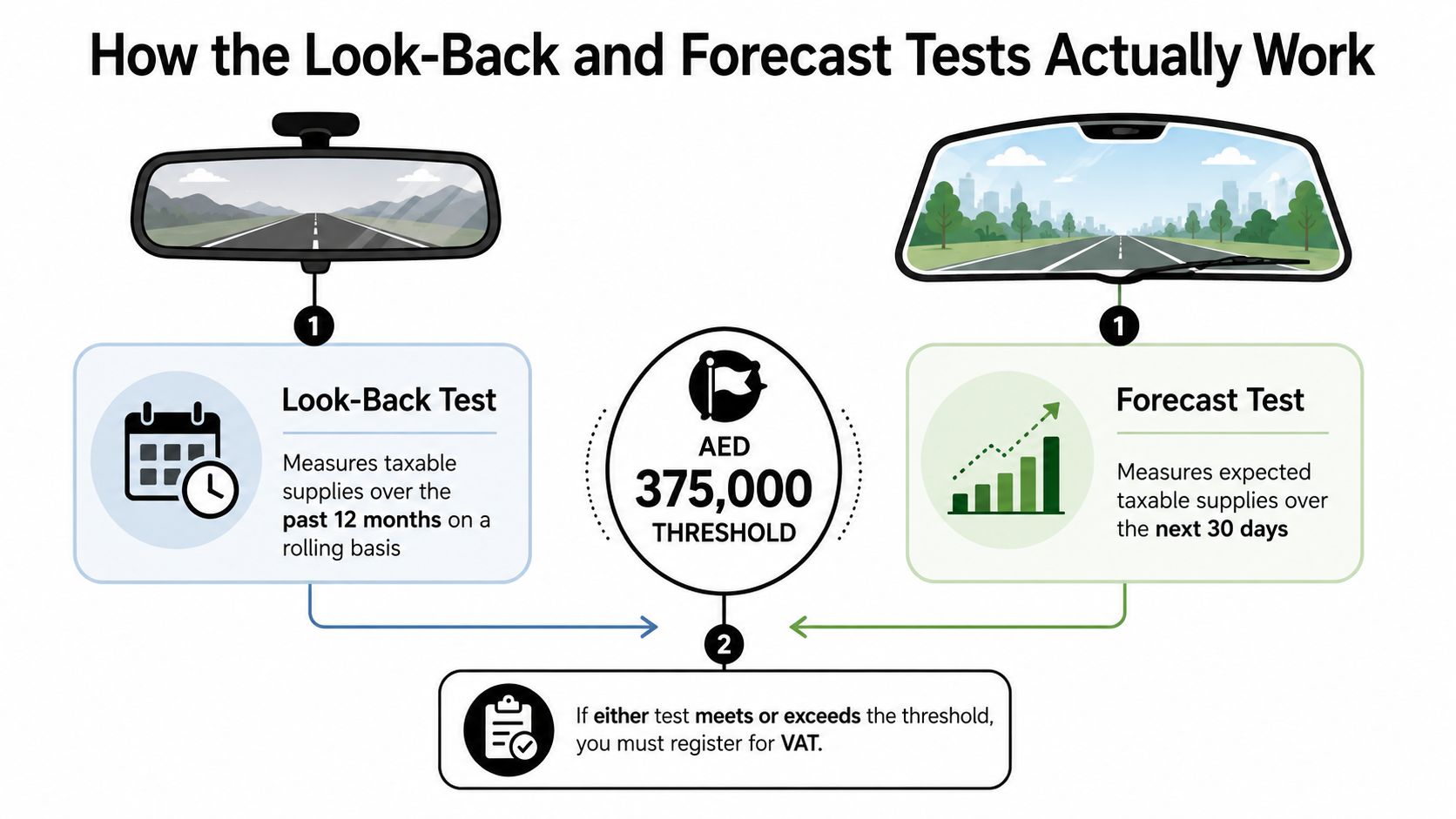
A founder reviewing VAT exposure at month-end needs two views of the business. The look-back test works like a rear-view mirror, while the forecast test works like a windscreen. Together, they show both the taxable activity already completed and the activity the business is about to undertake.
“Rolling 12 months” does not mean the company's financial year. On each review date, add the relevant taxable supplies and imports from the previous rolling 12-month period. The FTA's VAT registration guidance explains how this retrospective measurement fits within the UAE registration rules.
The forecast test asks a different question: does the business expect taxable supplies and imports to exceed AED 375,000 during the next 30 days? That expectation may arise from signed work, committed orders or other reliable evidence. A business may therefore have a registration obligation before its historical figures visibly exceed the threshold.
If the retrospective test is breached, the registration application is due within 30 days of the breach, in line with the authority's published registration timing rules. A founder should record the breach date rather than waiting for the next year-end review.
A worked example
A design studio reviews its taxable activity at the end of each month. Its bookkeeper adds taxable supplies and relevant imports across the latest rolling 12-month window, instead of comparing January with December.
If the total remains below AED 375,000, the studio then examines the next 30 days. Signed projects and committed orders could take expected activity beyond the mandatory threshold, so the studio should address registration before waiting for customers to pay invoices.
A practical review should document:
- The review date, identifying the rolling period assessed.
- Taxable supplies, separated from exempt and out-of-scope income.
- Relevant imports, including transactions requiring VAT treatment under the applicable mechanism.
- The forward expectation, supported by contracts, purchase orders or other business records.
- The action date, if either test creates a registration obligation.
The review also depends on reliable records. Smart Classic's guidance on accounting and record-keeping requirements can help founders organise the evidence behind each calculation. For international context, Tax Compass on the £90k VAT limit offers a comparison with the UK system, although UAE businesses must apply the UAE rules.
Choosing Between Mandatory and Voluntary Registration
Once taxable supplies and imports pass AED 375,000, the decision is no longer commercial. The business has a legal registration obligation if it has crossed the rolling test or expects to cross the line under the 30-day forecast test.
The harder decision belongs to a business between AED 187,500 and AED 375,000. Voluntary registration can make sense for a growing B2B consultancy with significant taxable costs, but it isn't automatically the right move for every freelancer or small retailer.
Compare the trade-offs
| Factor | Mandatory Registration | Voluntary Registration |
|---|---|---|
| Timing | Required when the applicable mandatory test is met | Chosen by an eligible business |
| Input VAT | Recovery may be available on eligible business costs, subject to the rules | Early registration can allow eligible setup and operating costs to be considered |
| Customer pricing | VAT needs to be handled on taxable sales from the effective date | The business must decide how VAT affects quoted prices |
| Administration | Registration and ongoing compliance are unavoidable | The business takes on compliance before mandatory registration |
| Commercial fit | A legal requirement | Stronger where B2B customers and recoverable costs justify the work |
A company preparing an office, purchasing professional services or paying for a fit-out may value the ability to recover eligible input VAT. A B2B customer may also prefer dealing with a VAT-registered supplier because the customer's own VAT treatment is easier to document.
The downside is operational. A lean founder must maintain tax codes, issue suitable invoices, separate output and input VAT, and prepare returns. If prices were agreed without considering VAT, charging it later can put pressure on margins or force an uncomfortable renegotiation.
Decision rule: Voluntary registration deserves serious consideration when expected B2B sales and recoverable input VAT clearly outweigh the cost of compliance, or when delaying registration would make later pricing difficult.
The FTA Registration Process Step by Step
Registration works best when the founder prepares the evidence before opening the application. The FTA needs a coherent picture of the legal entity, ownership, activities and taxable turnover. A rushed application can create clarification requests and delay the point at which the business can operate confidently inside the VAT system.
Prepare the application file
Collect the trade licence, Memorandum of Association where relevant, passport and Emirates ID copies for the owner or authorised signatory, business contact details, bank information and a clear explanation of the taxable activities. The turnover analysis should match the figures in the accounting records and explain how the business reached its registration conclusion.
Submit through the FTA portal
Create or access the account on the FTA's online services platform and start the VAT application. The form asks for information about the business profile, ownership, banking arrangements, activities and expected financial position.
A founder should review every uploaded document before submission. The trade licence name, legal entity details and authorised signatory information should tell the same story across the application.
Handle review and approval
After submission, the FTA may ask for additional information through the portal. Responding with clear documents and a concise explanation is more useful than uploading unrelated material. Once approved, the business receives its Tax Registration Number, or TRN, and the approval letter states the effective registration date.
The business should then configure its invoicing and accounting process before issuing taxable invoices from that effective date. Smart Classic's guide to registering for VAT in the UAE can help founders organise the application process and supporting paperwork.
Edge Cases That Often Catch Founders Off Guard
A founder may monitor local invoices carefully and still miss part of the threshold calculation. The difficult cases usually involve the relationship between entities, the location of goods, or the difference between taxable and exempt activity.
One owner, several entities
Two UAE businesses under common control may need to be assessed together for VAT purposes where the FTA considers them a tax group or otherwise treats their activities as connected. Each company can appear small on its own, while the combined picture creates a registration issue.
That means founders shouldn't review each licence in isolation. Ownership, control, business activities, contracts and movement of funds all deserve attention before deciding that every entity sits safely below the threshold.
Imports can change the result
An e-commerce founder may import inventory from outside the UAE and assume that only UAE customer invoices matter. Relevant imports can enter the threshold analysis, including transactions dealt with through the reverse-charge mechanism. The founder's dashboard may show modest local sales while customs and purchase records tell a different story.
Zero-rated isn't exempt
A zero-rated supply carries a VAT rate of zero, but it remains part of taxable activity for threshold purposes. Exempt supplies are treated differently. Certain financial services and bare land transactions may fall outside the taxable calculation, depending on the exact nature of the supply.
Classification matters: “No VAT charged” doesn't tell you whether a transaction is zero-rated, exempt or out of scope.
The contract can be the trigger
A design studio that has been below the threshold signs a large contract scheduled for invoicing next month. The forward-looking test may become relevant immediately. Waiting until the invoice is issued can leave the founder reacting after the registration obligation has already arisen.
The same caution applies when a founder changes from a freelance permit to a company structure. The legal entity and its taxable activity need to be analysed carefully. A new licence doesn't justify ignoring the business history and transactions connected to the activity.
Common Misconceptions and Penalty Risks
A free zone licence does not by itself remove a business from UAE VAT registration. The company still needs to review its taxable supplies, relevant imports and actual activities. Special treatment may apply to particular transactions or zones, but the licence location alone is not a blanket exemption.
Voluntary registration also requires a commercial decision. The business may recover eligible input VAT on costs, while taking on extra record-keeping, customer pricing questions and possible cash-flow pressure. A founder selling mainly to consumers may have less room to add VAT than a B2B consultancy. The right choice therefore depends on the customer base, costs and operating model.
Penalty exposure is practical, not theoretical. The figures below come from the supplied brief and should be checked against current FTA rules before the business relies on them.
| Violation | Penalty Amount | Trigger |
|---|---|---|
| Failure to register on time | AED 10,000 | Mandatory registration is required but the business doesn't register on time |
| Late VAT return filing | AED 5,000 | A VAT return is filed after the applicable deadline |
| Unpaid tax | 5% monthly penalties | VAT remains unpaid after the relevant due date |
Use the FTA's published registration guidance to confirm when the registration obligation begins. For the practical controls that follow, Smart Classic's VAT compliance checklist helps organise registration, invoicing, bookkeeping and filing tasks.
Records protect the explanation
A final turnover figure is not enough. Keep invoices, contracts, import records, customer classifications and calculation worksheets showing how the threshold was assessed. If the FTA asks why the business registered on a particular date, the founder should be able to reconstruct the decision from records made at the time.
A simple monthly review works like a dashboard warning light. It shows whether sales are approaching the threshold before the issue becomes a missed obligation. Assign one person to review the figures and retain the supporting evidence with the calculation.
Banks, licensing authorities and commercial partners may also question a tax profile that does not match the entity's reported activity. Correct registration therefore supports the credibility of the wider compliance file, not only the VAT return.
Practical Next Steps and How Smart Classic Can Help
The threshold becomes manageable when the founder turns it into a recurring workflow. Don't wait for an accountant to discover the issue during year-end work. Put the review into the monthly close, assign responsibility and keep the evidence with the calculation.
Start with the two tests
First, calculate taxable supplies and relevant imports over the latest rolling 12-month period. Then assess the next 30 days using signed contracts, confirmed orders and other reliable commitments. Keep exempt and out-of-scope supplies separate so the result isn't distorted by income that doesn't belong in the threshold calculation.
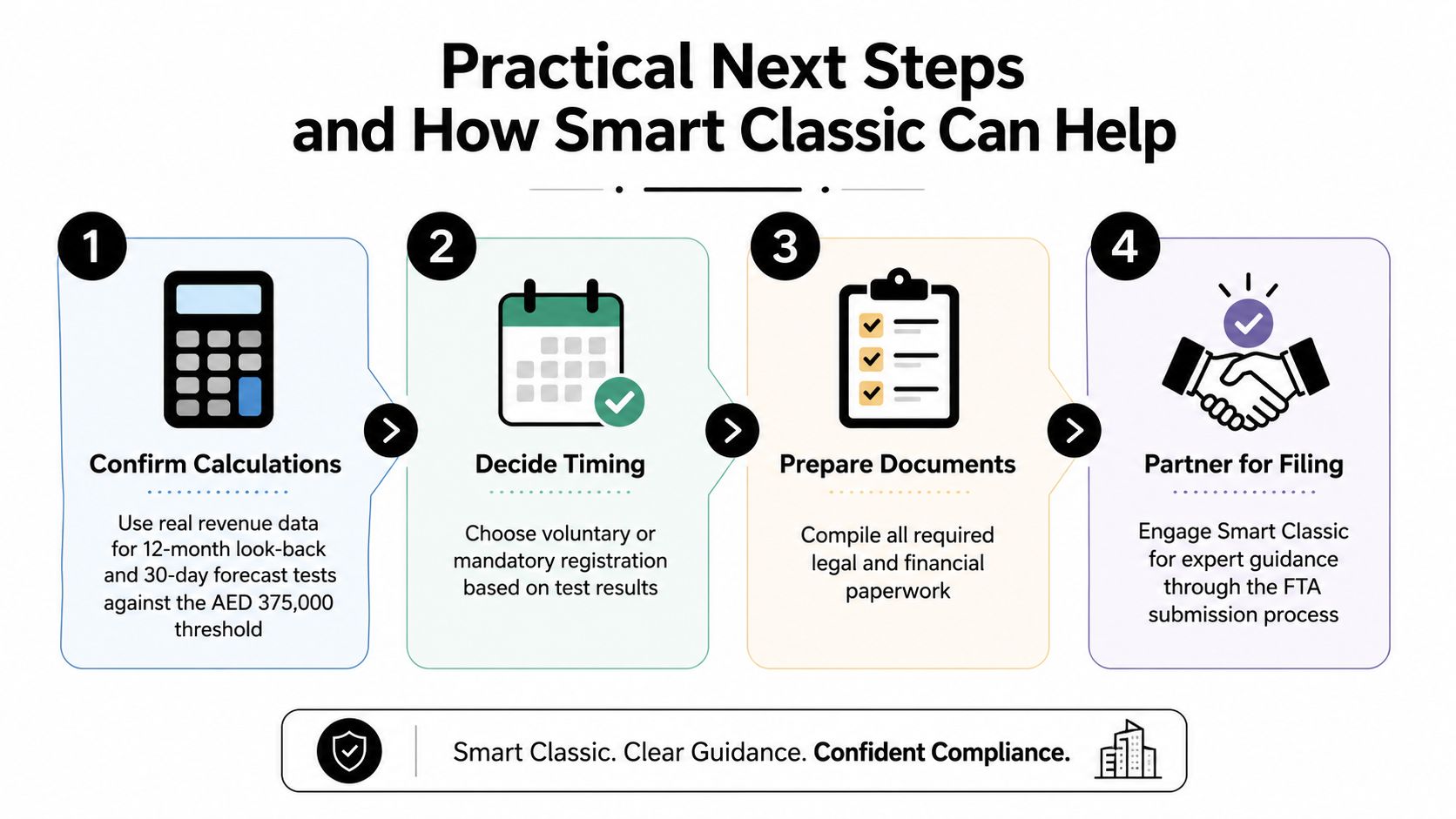
Choose the timing
If the mandatory test applies, prepare the registration application within the required 30-day period. If the business falls within the voluntary band, compare the expected recoverable input VAT and B2B pricing position with the work involved in maintaining VAT records and filing returns.
The decision should reflect the business's next stage, not only its last invoice. A founder expecting rapid contract growth may prefer an organised early setup, while a small consumer-facing operation may need to protect its pricing and cash flow.
Build the supporting file
Prepare the trade licence, ownership documents, authorised signatory identification, bank details and turnover analysis. Make sure the documents use consistent legal names and that the figures can be traced back to invoices, bank entries and accounting records.
Smart Classic can support threshold modelling, prepare the FTA submission and help configure VAT treatment in tools such as Zoho Books or QuickBooks. Its Dubai-based consultancy workflow can also cover ongoing VAT-compliant accounting, FTA correspondence and voluntary disclosure support where required. The business should still retain ownership of the underlying records and review the advice against its exact transactions.
Keep compliance running
Registration is only the entry point. Each month, review taxable turnover, imports, customer invoices, input VAT and unusual transactions. Each filing period, reconcile the accounting system to the return before submission.
The practical objective is simple: make the threshold review routine enough that a registration deadline never arrives as a surprise.
Smart Classic Business Hub offers UAE VAT registration guidance, threshold modelling, FTA application support and VAT-compliant accounting for founders and growing businesses. Visit Smart Classic Business Hub to discuss your taxable activity, registration timing and the accounting workflow needed after approval.