
What Is Offshore Company Formation? a UAE Guide for 2026


An offshore company in the UAE is a legal entity set up in a designated jurisdiction to hold assets, own shares, handle international transactions or structure cross-border investments, not to trade from UAE mainland premises. Offshore registration doesn't create an automatic tax exemption, because only qualifying income earned by a qualifying free zone entity receives a 0% corporate tax rate while non-qualifying taxable profits above AED 375,000 fall under the standard 9% rate.
Most popular advice online sells the exact opposite story. Promotional brochures frame an offshore company as an effortless shortcut to zero tax, invisible ownership, zero paperwork and instant international banking. Founders who buy into that sales pitch often discover too late that they've built a company that can't invoice local clients, can't sponsor their own residence visa and still triggers reporting duties.
Global capital keeps flowing into the Emirates for good reason. The UAE Government Media Office reported that the UAE ranked 10th globally for inward foreign direct investment in 2024, attracting AED 167.6 billion (USD 45.6 billion) in inflows. That scale brings varied corporate options, yet it also comes with clear federal tax, ownership and economic substance rules. Understanding what is offshore company formation in the UAE starts with treating it as a precise legal structuring choice rather than a loophole.
What an Offshore Company Actually Is
A European software founder holds minority stakes in three overseas startups. The founder needs one vehicle to own those shares, collect dividends and sign cross-border shareholder agreements. A retail shop in Dubai, local sales staff and a commercial lease would add cost without solving the ownership problem. An offshore company works like a holding vault for assets, shares and international arrangements, rather than a storefront for local trade.
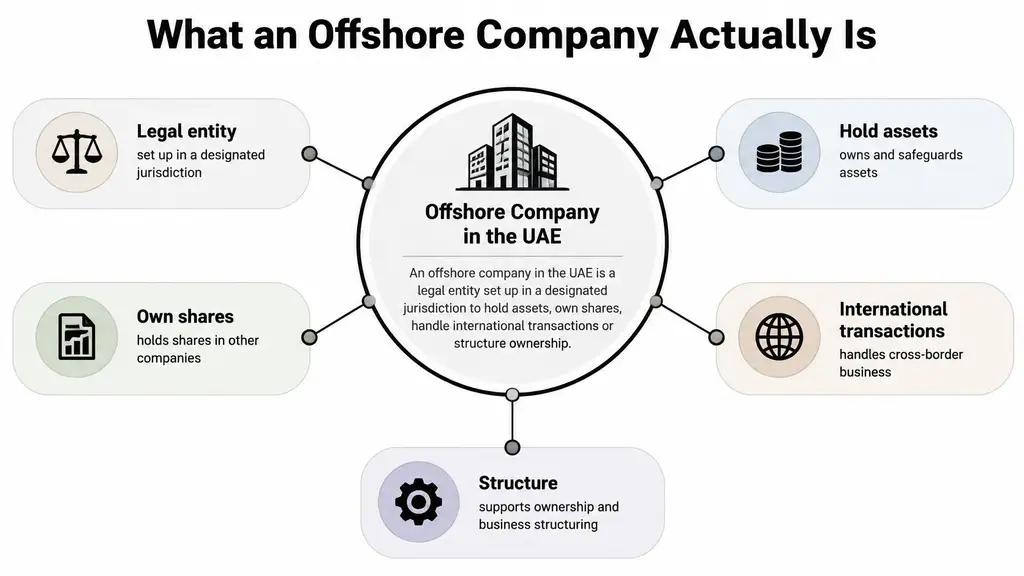
Much of the confusion around offshore company formation comes from treating three UAE corporate regimes as interchangeable. Each one has a different job, just as a safe, an office and a shop window each serve a different purpose.
- Offshore company: A non-mainland juridical entity registered in a designated UAE jurisdiction, such as RAK ICC or JAFZA Offshore, built for holding assets, owning shares, facilitating international transactions or structuring cross-border investments.
- Free zone company: An operating business licensed inside a specific UAE economic zone, authorised to carry out the commercial, consulting, technology or logistics activities printed on its zone licence.
- Mainland company: A locally licensed UAE business that can lease offices in the emirate, hire local teams and trade directly with UAE residents and government bodies.
Founders usually consider an offshore vehicle for three core purposes: asset holding, such as international investments or approved property structures; international shareholding, which pools stakes in foreign subsidiaries under one parent entity; and cross-border deal structuring, which separates a joint venture or financing arrangement from an operating business. Choosing any entity type involves balancing liability separation against administrative duties, much like setup and compliance trade-offs explained for traditional business forms. That general idea still applies, but UAE offshore, free zone and mainland entities each follow their own rules.
The scenario decides whether offshore registration makes sense. A consultant who signs contracts with clients abroad and needs a stable holding or contracting layer may find it useful. A founder planning to invoice UAE customers, sponsor visas or lease a local office needs a structure that permits those activities. An offshore company can hold shares while saying little about daily operations, ownership transparency or tax treatment. Those points require separate review.
Why Registration Does Not Equal Tax Exemption
One misconception catches new founders more than any other: assuming that a UAE offshore or free zone certificate places the company outside the tax system. According to the UAE Federal Tax Authority free-zone guidance issued on 26 May 2024, entities established in free zones are treated as taxable persons under the federal corporate tax framework.
To benefit from the 0% corporate tax rate on qualifying income, a free zone entity must meet strict statutory conditions rather than relying on its certificate of incorporation. Those requirements include maintaining adequate UAE substance, earning qualifying income, complying with transfer-pricing rules, retaining required documentation and meeting applicable conditions for audited financial statements. Non-qualifying taxable income is subject to the standard 9% rate, and founders must also review tax rules in any foreign country where the owners live or manage the business.
Practical rule: Before choosing any UAE vehicle, write down clear answers to three questions: what the company will actually do, who will own and control it, and where its income will originate.
Offshore, Free Zone and Mainland Compared
The right UAE entity is less like picking a shopfront and more like choosing the correct key for a door. A key may look impressive, yet it still has to open the specific door you need: local customers, owner visas, staff sponsorship, asset holding or cross-border contracting.
| Criterion | Offshore company | Free zone company | Mainland company |
|---|---|---|---|
| Trade directly with UAE mainland customers | No, not by default | Only if the free zone licence allows it | Yes, with a mainland trade licence |
| Employ staff under the company | No, not by default | Yes, within the zone licence | Yes |
| Residence visas for owners or staff | No, not by default | Yes, subject to the specific zone licence and quota | Yes, subject to licence |
| Typical use | Holding assets, owning shares, cross-border deals | Specialised trade, logistics, consulting, technology | Serving UAE customers locally |
| Corporate tax starting point | Taxable person; preferential treatment depends on qualifying status and income | Taxable person; 0% only if a qualifying free zone person with qualifying income | Taxable person; tax depends on taxable income and applicable rules |
Free zone regulations aren't uniform across the Emirates. Always inspect the exact activity list on the zone licence and the authority's published rules before assuming a free zone entity can invoice local buyers or sponsor a particular headcount.
Reading the Limits Behind Each Column
Treat the table as a map of legal boundaries, not a quality ranking. Under the official UAE Government business regulations portal, an offshore corporate vehicle doesn't automatically grant the right to trade from UAE mainland premises, employ staff under the company or obtain residence visas. Free zone entities operate under a separate regulatory framework tied to their licensing authority, whereas a mainland entity is the standard route when your revenue comes from UAE customers walking into local premises or signing domestic contracts.
The practical question is simple: where does the money come from, and who needs to deal with the company inside the UAE? If clients are in Dubai, mainland customers usually need a mainland supplier with a mainland trade licence. If the work is specialised and tied to a particular zone, a free zone licence may fit. If the company mainly holds shares or supports cross-border arrangements, offshore may be the cleaner container.
If you're weighing whether your operations belong outside the domestic market or inside it, reviewing how onshore and offshore company structures differ makes those licensing boundaries much clearer before you spend money on registration fees.
The tax row carries an equally sharp distinction. Incorporation changes the legal wrapper; it does not switch off tax analysis. Under the official UAE corporate tax regime, businesses within scope face standard corporate tax on taxable income, while a qualifying free zone person may qualify for preferential treatment on qualifying income. A mainland company is also within the corporate tax framework, with the result depending on taxable income and the rules that apply to its activities.
Founders often confuse two separate questions here: "Which licence do I need?" and "What tax position follows?" Those questions connect, but they are not identical. A licence defines what the company may do. Tax treatment depends on income, qualifying conditions, management and control, permanent establishment questions, transfer pricing and documentation. A company can hold a valid licence and still have a tax position that needs proper analysis.
Corporate-tax and tax-residency analysis should therefore follow the structure decision, not replace it. The review needs to examine where income arises, where management and control sit, whether activities create a permanent establishment, how related-party transactions are priced and whether the entity is carrying on business in the UAE. That is why offshore registration should be treated as one structure among several, not as a blanket tax exemption or a no-substance shortcut.
Match the corporate structure to the commercial activity first, then confirm the tax position. Reversing that order leads to licences you can't legally use.
Purposes and Tax Position by Business Scenario
The same offshore entity can work smoothly for one founder and collapse under compliance friction for another. Purpose decides everything. The UAE Ministry of Economy notes that more than 40 UAE free zones permit foreign investors 100% ownership alongside tax-related incentives, which historically attracted founders building holding groups, technology ventures, logistics hubs and cross-border trading desks. Today, however, ownership flexibility sits side by side with measurable economic presence and activity tests.
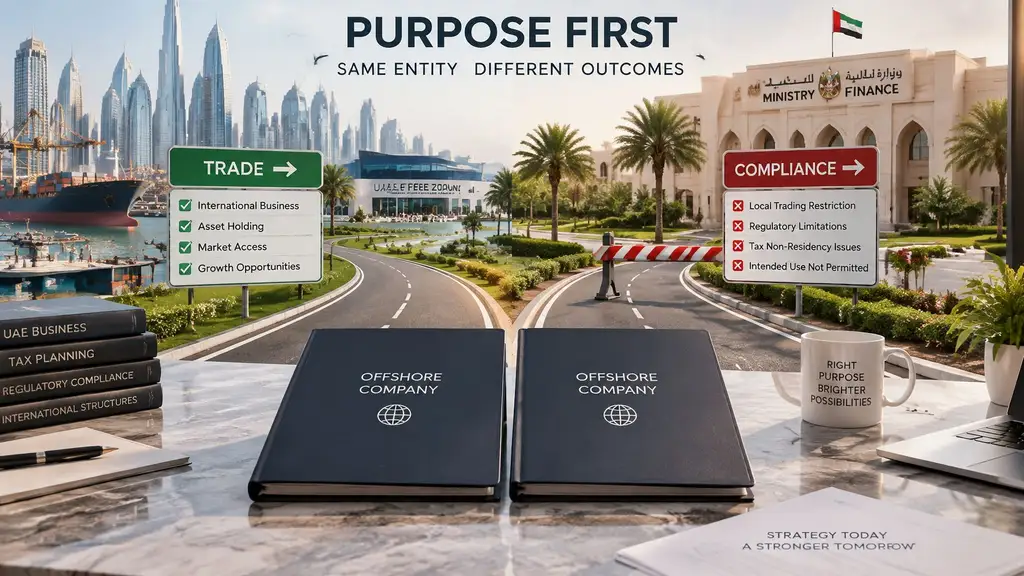
Three Worked Scenarios Where Structure Meets Reality
Looking at concrete business models shows where an offshore company holds together and where obligations tighten.
Case 1 is a passive overseas investment holder. Say a founder places shareholdings in four foreign private companies inside a UAE offshore vehicle. The company doesn't sell products, hire staff or invoice UAE clients; it owns equity and receives occasional dividends. For this structure to stay clean, the founder must keep an accurate share register, properly signed board resolutions approving each investment and clear records proving the company isn't running an unlicensed operating business.
Case 2 involves licensing intellectual property. Suppose an entrepreneur develops proprietary software or brand trademarks and places ownership inside a UAE entity that licenses those rights to related operating companies abroad. This vehicle isn't passive at all. It collects royalty streams from connected parties, which means it needs genuine management oversight, documented board decisions and transfer-pricing documentation demonstrating that royalty fees match arm's-length market terms. Without real decision-making records and substance, both UAE authorities and the licensees' home tax offices can challenge the arrangement.
Case 3 is a cross-border corporate group holding entity. Imagine an industrial group using a UAE holding company to own operating subsidiaries in three countries and consolidate group governance. The holding company doesn't manufacture goods or serve retail buyers, yet it sits at the top of an active group. Its governance records, director appointments and financial statements must show clearly where strategic control happens so the group avoids accidental tax residency disputes in other countries.
Matching Business Scenarios to Tax and Compliance Rules
Every business model triggers a different mix of corporate tax exposure, VAT review and accounting duties. Use the table below as a starting point for structured analysis, not a formal tax opinion for a specific transaction.
| Scenario | Corporate tax position | Records and reporting | Usual fit |
|---|---|---|---|
| Passive foreign holding company | Taxable person; 0% only if it meets the qualifying conditions for its income | Ownership records, board records, substance evidence where a Relevant Activity applies | Holding shares or assets abroad |
| UAE-facing consultancy | Income from UAE customers generally falls outside the preferential 0% route; standard 9% above AED 375,000 | Full bookkeeping; VAT registration if thresholds are met | Mainland or free zone operating licence |
| Intellectual property owner | Taxable person; 0% only if the income qualifies, otherwise the standard 9% rate applies | Transfer-pricing documentation for related-party licences; substance for IP activities | Holding IP with real management and decision-making |
| Trading company | Standard rules apply unless the income qualifies; 0% unlikely for UAE trade | Full accounting, VAT and transfer-pricing records where related parties trade | Free zone or mainland operating licence |
Breaking the Automatic 0% Corporate Tax Myth
Many promotional websites still equate "offshore" or "free zone" with "tax-free." Official UAE Ministry of Finance corporate tax guidance confirms that juridical persons established in a free zone fall squarely within the scope of UAE Corporate Tax as taxable persons. Only a Qualifying Free Zone Person earning Qualifying Income can access the 0% preferential rate.
Under Cabinet Decision No. 100 of 2023, meeting qualifying status requires tangible local roots, not just a registration certificate. A qualifying free zone person must conduct its core income-generating activities inside the relevant free or designated zone and maintain adequate assets, qualified full-time employees and operating expenditure proportionate to those activities. If an offshore or free zone vehicle earns revenue from UAE mainland customers, operates through a mainland presence or derives income outside qualifying categories, that preferential treatment breaks down.
Banking and personal tax assumptions deserve the same realism. Registering an offshore company doesn't automatically hand you personal tax residency, double-taxation treaty benefits, commercial credibility with enterprise buyers or guaranteed corporate banking. Financial institutions scrutinise ownership layers, source of funds and transaction counterparties closely, so planning your offshore bank account opening requirements alongside your legal structure prevents stalls after incorporation.
Substance Rules and Where Offshore Stops Helping
A stubborn myth surrounds what is offshore company formation in the Emirates: the belief that an offshore vehicle means no office, no people and no annual reporting. That assumption fails the moment the company conducts a regulated activity under federal substance rules.
The UAE Ministry of Finance Economic Substance Regulations FAQ states explicitly that an offshore company can fall within the Economic Substance Regulations if it carries out a defined "Relevant Activity." For substance compliance, UAE authorities treat offshore entities in the exact same way as regular free zone companies or mainland businesses. Where a Relevant Activity applies, the company must maintain adequate economic presence in the UAE relative to the scale of its income and file both its required notification and report on time.
Activities That Trigger Substance Review
Not every offshore company carries identical compliance weight, yet five common cross-border activities demand close scrutiny before you incorporate:
- Passive holding company business: A pure equity holding company faces a reduced substance test compared with operating businesses, yet it must still hold accurate statutory registers, comply with registrar filings and show it holds adequate arrangements to maintain its equity participations.
- Intellectual property holding: IP businesses attract the heaviest scrutiny because intangible rights can easily be shifted on paper. Evidence of adequate presence includes local strategic decision-making, documented oversight of development or exploitation, and qualified personnel managing the IP risks in the UAE.
- Financing and leasing: Lending money to group subsidiaries or third parties for interest triggers substance obligations. Expect to demonstrate that lending terms are agreed by directors with genuine authority, board meetings are documented and local operating expenditure reflects the financing workload.
- Headquarters functions: If the entity provides senior management, risk control or group-wide administrative services to foreign affiliates, it must show real executive direction happening locally rather than rubber-stamping decisions made elsewhere.
- Distribution and service centre operations: Buying goods from foreign related parties for resale or providing cross-border administrative services requires verifiable UAE operational capacity, including qualified people, local records and expenditure matching the transaction volume.
What if the company sits completely dormant or acts purely as a passive asset holder with no Relevant Activity income? Document that position every year rather than ignoring compliance calendars. Keep dated board minutes confirming zero trading or Relevant Activity revenue, maintain clean financial records showing no qualifying commercial inflows and retain written confirmation of your annual filing assessment. Separating corporate registration from ongoing compliance, banking due diligence and immigration plans keeps a simple holding structure from turning into an expensive penalty notice. Staying aligned with UAE corporate tax compliance standards protects good standing across both tax and substance filings.
Four Situations Where Offshore Stops Helping
An offshore company is a poor tool whenever your commercial plan needs local operational roots. Walk away from an offshore structure if you require any of the following:
- UAE residence visas for founders, directors or employees, because offshore vehicles don't come with visa quotas.
- Physical UAE office premises or warehousing to host staff, store inventory or meet walk-in clients.
- Local trading rights to invoice UAE mainland buyers or bid on domestic contracts directly.
- A UAE tax residency certificate to claim treaty relief abroad, which typically requires genuine local residency, substance and an appropriate onshore or free zone presence.
Offshore registration is a legal wrapper for cross-border ownership, never a substitute for an operating licence, a local team or personal residency.
How to Set Up an Offshore Company in the UAE
A small sequencing error can turn a simple offshore registration into banking delays or a later restructuring exercise. The paperwork looks simple when viewed one document at a time. The decisive test is whether the ownership chain, activity description, records and decision trail all tell the same story. Think of the file as a mirror: if the corporate documents say one thing and the commercial plan implies another, banks and regulators will notice the gap.
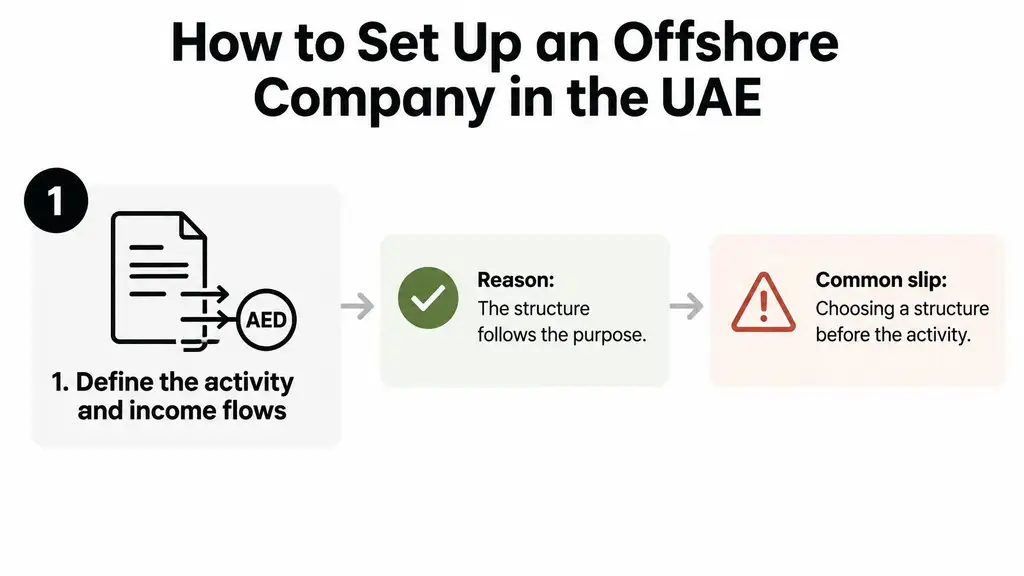
Define the activity and income flows first. Write down every asset the company will own, every party that will pay it and where those counterparties sit, because the structure must follow the commercial purpose. The common mistake is choosing an offshore package by price before clarifying whether UAE customers or local visas form part of the plan. An offshore vehicle works best as a clean holding or cross-border ownership wrapper, so the activity description should stay consistent with that role.
Book an initial consultation and assessment. Smart Classic Business Hub starts with an initial consultation and assessment, where specialists learn the client's business requirements and objectives and assess which PRO services are needed, such as company registration, visa processing or government approvals. A structured review catches mismatches early, before fees are paid for a structure that cannot support the intended activity.
Confirm the jurisdiction and legal structure. Decide with certainty whether an offshore registry such as RAK ICC or JAFZA Offshore, a specialised free zone or a mainland company fits the activity. The team guides clients through each step, from advising on the right jurisdiction and company legal structure to obtaining an investment licence where operating permissions are required. Do not assume every UAE offshore registry allows identical asset classes, particularly if UAE real estate ownership is part of the plan.
Prepare complete ultimate-beneficial-owner details. Offshore structures in the UAE operate under beneficial-ownership transparency, so the file should show who ultimately controls the company. Under published UAE free-zone regulatory rules, companies must submit accurate ultimate-beneficial-owner (UBO) records covering each owner's full name, residential address, nationality, birth details, occupation, ownership percentage and whether ownership runs through a nominee, trust or similar arrangement. Incomplete ownership disclosures slow down incorporation, renewals and bank approvals, and they can trigger enhanced due-diligence reviews under the UAE's anti-money-laundering framework.
Submit incorporation documents and complete registration. Assemble valid passport copies, recent proof of residential address, proposed company names, constitutional documents and a written summary of the commercial rationale, ownership chain and expected transaction flows. Where a corporate shareholder sits above the new entity, prepare legalised corporate certificates and board resolutions in advance so the registrar does not pause the file midway. Clean sequencing here also makes later accounting and audit work easier.
Set up banking and accounting records from day one. Incorporation does not guarantee a corporate bank account. Banks assess source of funds, counterparties and governance records independently, so prepare the business rationale pack early. Establish proper accounting records immediately for corporate tax tracking, even if transaction volume is low. Offshore companies are often misunderstood: registration creates the legal entity, while banks and tax obligations depend on the activity and records behind it.
Diarise every ongoing statutory deadline. Regulatory compliance starts when the certificate of incorporation is issued. Beneficial-ownership changes should be reported to the registrar as required, and entities conducting specified Relevant Activities may need to submit annual Economic Substance notifications and, where applicable, file an Economic Substance Report after the financial year-end. Missing a quiet filing window creates avoidable administrative fines.
A Quick Readiness Check Before Filing
Before signing any incorporation form, verify that the paperwork answers three plain questions cleanly: who ultimately owns the company, what specific commercial or holding activity it performs and where strategic decisions and accounting records are maintained. If any answer looks vague on paper, tighten the structure before submitting the application.
Confirm the Right Structure Before You Incorporate
Before paying a single registration fee, test your business plan against four quick diagnostic checks. Each test gives a clear green light or red flag.
- Asset holding and cross-border deals: Your goal is strictly holding shares in foreign companies, owning approved investments or structuring cross-border transactions without hiring local staff. An offshore company is a strong candidate.
- Visas, offices or residency certificates: You need a UAE residence visa, a physical local office, domestic trading rights or a UAE tax residency certificate. Stop looking at offshore vehicles and evaluate a mainland or appropriately licensed free zone operating company instead.
- UAE customer revenue: Your clients sit inside the Emirates and expect local invoicing or on-the-ground service delivery. A mainland trade licence or an eligible free zone operating licence is normally required.
- IP ownership or group financing: You intend to hold intellectual property rights or lend capital across related companies. Confirm that you can meet local economic substance and transfer-pricing documentation standards before selecting an offshore route.
Putting Your Plan Against the Four Core Models
Every founder's situation leans toward one of four archetypes: a passive foreign holding company, a UAE-facing consultancy, an intellectual property owner or an active trading company. Each archetype produces a different answer on corporate tax registration, VAT exposure, bookkeeping depth and licensing. A passive foreign holding vehicle can often function cleanly offshore with disciplined governance records, whereas a UAE-facing consultancy or active trading desk almost always belongs under a mainland or free zone operating licence.
Incorporate offshore only when your commercial purpose, ownership chain and income flows all point to the same structure.
Your Next Practical Step
Before filing with any UAE authority, assemble a concise pre-incorporation pack containing four items:
- Plain-English activity description: One page explaining what the company will own, contract for or receive, and what it will never do.
- Mapped income sources: A list of expected revenue types (dividends, royalties, consulting fees or trading margin) and the countries where payers sit.
- Complete ownership chain: Every individual beneficial owner down to exact percentages, plus details of any corporate parents, trusts or directors.
- Expected transaction flows: Anticipated banking currencies, counterparty jurisdictions and rough annual volumes to test banking feasibility early.
Hand that pack to a qualified UAE corporate adviser and request a written structural assessment covering licensing, corporate tax scope, substance exposure and banking readiness before submitting any registry application. Taking an extra week to validate the blueprint costs far less than unwinding the wrong entity a year later.
Smart Classic Business Hub provides company formation, offshore registration, PRO services, tax residency certificates, VAT-compliant accounting, audit and liquidation services across Dubai mainland, free zones and offshore jurisdictions. Our Company Pro Services Package can be customised to your specific business requirements and objectives, whether you need targeted registration support or full ongoing governance and tax compliance. Visit Smart Classic Business Hub to arrange an initial assessment and confirm the right UAE corporate structure before you incorporate.