
The advice that still gets repeated is to register offshore, keep the quote low, and treat 100% foreign ownership as the whole decision. That advice falls apart the first time a UAE customer wants an invoice, a landlord wants a trade license, or a bank asks who runs the company and where.
Onshore vs offshore in the UAE is a test of what the company is allowed to do. I would score invoicing, premises, hiring, visas, and banking before I looked at an incorporation fee. Ownership percentage is no longer the split that matters.
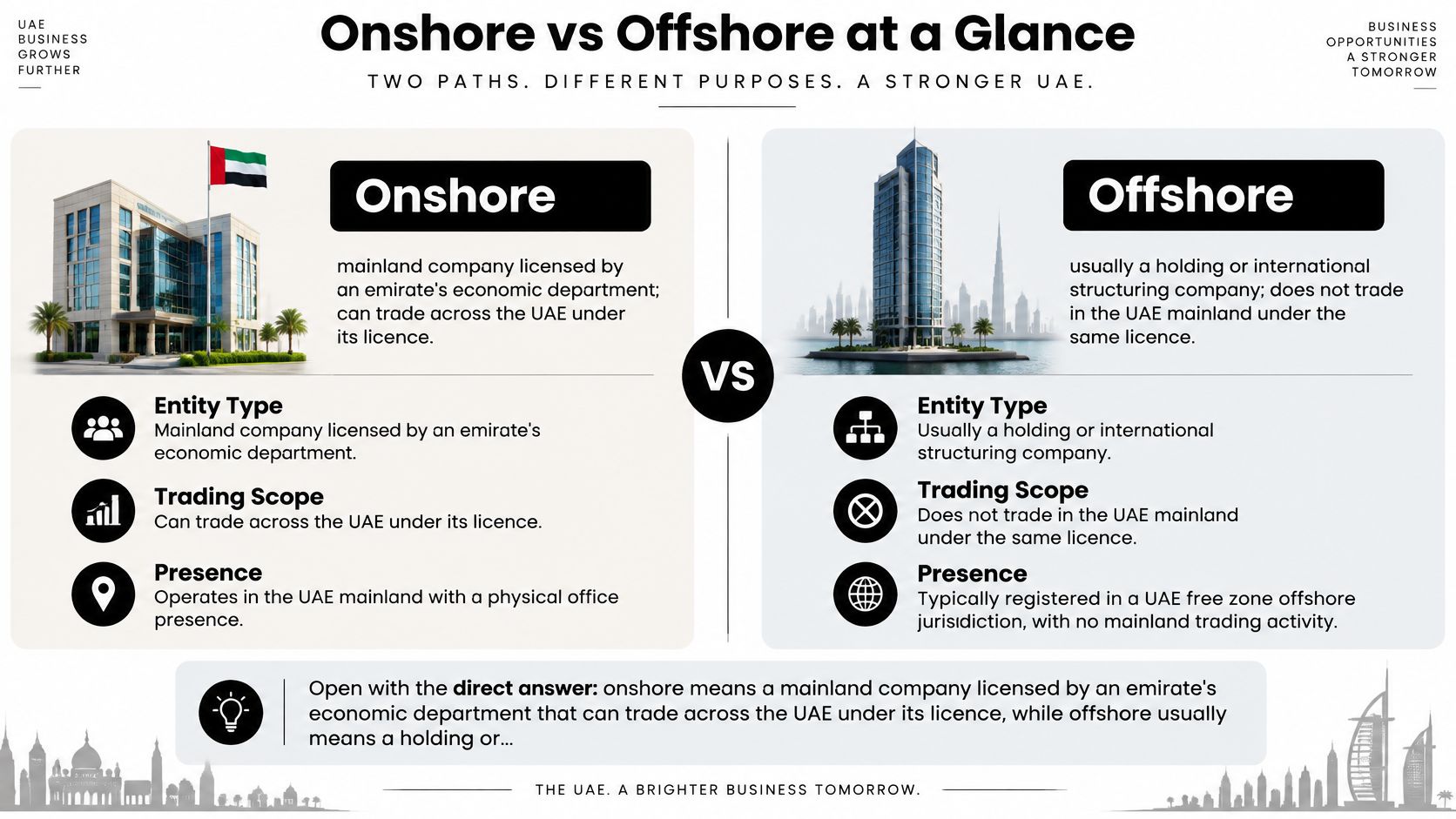
Onshore vs Offshore at a Glance
A free zone company is neither onshore nor offshore in the way those labels are usually sold. It sits between a mainland license and a pure holding vehicle, and that middle position explains most of the confusion in UAE incorporation.
Onshore means a mainland company licensed by an emirate's economic department. It can trade across the UAE under the activities on its license. Offshore usually means a holding or cross-border vehicle. It generally lacks the right to trade inside the UAE. A free zone company is the third route. The Ministry of Economy and Tourism states that the country has more than 40 free zones, many of which permit 100% foreign ownership and offer tax-related incentives. Those zones sit across the seven emirates and cover a wide range of activities, so location and permitted activity decide as much as legal form.
Mainland licenses list the activities the company may perform and allow business across the UAE within those rules. Offshore registration is commonly used for holding assets, international transactions or corporate structuring. It does not give the same right to trade, tender or contract locally.
The practical test is five yes or no questions. Can the entity invoice UAE customers? Can it lease premises? Can it hire staff? Can it sponsor visas? Can it open a UAE bank account without a long fight? A mainland company answers yes to each if the license activity matches the work. An offshore vehicle answers no to most, and banks treat it as a cross-border holding client. A free zone company varies by zone, activity and permit, which is why license scope matters before the fee.
Ownership no longer separates the structures
Federal Decree-Law No. 26 of 2020 enabled full foreign ownership for many mainland commercial companies and removed the general requirement for an Emirati shareholder in numerous activities. Offshore or free zone registration is no longer the only route to 100% foreign ownership. The strategic difference is operational. Mainland entities are typically better placed for direct UAE-market activity, government tenders and local contracting.
Dubai has also loosened the rule for free zone companies that want to operate on the mainland, subject to permits from the Department of Economy and Tourism. That narrows the operational gap without turning a free zone license into a mainland license. Permit conditions, activity scope and premises still decide whether the company can invoice the customer in front of it. The UAE government's foreign direct investment guidance tracks inbound capital and the rules that apply to foreign investors. The function test remains the same: a permit to operate onshore depends on the emirate and the license.
A Dubai design agency that serves local clients, signs retainers and needs an office needs a mainland license or a free zone license with permits that let it work onshore. A holding company that only owns shares in an operating group does not trade in the UAE, so an offshore vehicle can be the closer fit, provided later tax and substance tests are met.
| Criterion | Onshore (mainland) | Offshore |
|---|---|---|
| Legal basis | Licensed by the emirate's economic department | Offshore registration; no general right to trade in the UAE |
| Ownership | Foreign ownership allowed for many activities since Decree-Law No. 26 of 2020 | Typically 100% foreign-owned holding vehicle |
| Trading inside the UAE | Permitted within the license activity | Generally not permitted |
| Government tenders and local contracting | Well suited | Limited |
| Premises and staff | Can lease premises and employ UAE staff directly | Small operating footprint, which weakens substance |
| Corporate tax position | In scope under a UAE commercial license | Not an automatic exemption; residence, permanent establishment and income decide |
| Substance expectation | Operational substance is easier to evidence | Must show genuine management and control if in scope |
| Best fit | Direct UAE sales, staffing and leasing | Holding, investment and cross-border structuring |
If the company must sell, hire or lease inside the UAE, read the mainland column. If it only holds assets or contracts across borders, the offshore column may fit, subject to tax, banking and substance tests. License scope, physical presence and the customer base decide more than the ownership line.
Trading Rights, Licences and Contracts Compared
Start with the activity printed on the license. A mainland license lists what the company may perform, and that activity has to match what the business will invoice. Check the wording before you sign a lease or a customer contract. A mismatch is how a setup that looked valid at incorporation fails at the first invoice.
An offshore vehicle generally cannot invoice UAE customers or trade inside the UAE. That makes it a poor vehicle for a retailer, a clinic, or a consultancy whose buyers sit in Dubai, Abu Dhabi, or another emirate. Government tenders and contracts with UAE public entities usually expect a mainland license. An offshore registration will not clear that eligibility screen.
Premises and people follow the same split. A mainland company can lease an office or a warehouse and employ staff in the UAE directly. An offshore vehicle is built for a small local footprint. That footprint is an advantage only when the company is not pretending to operate locally.
Three businesses, three answers
An online seller shipping goods to UAE customers is trading in the market those customers live in. Invoicing them from an offshore company is the wrong tool. The seller needs a mainland license, or a free zone license whose scope and permits cover that trade. Activity codes, customs treatment, and the warehouse lease should be agreed before stock arrives. The practical route is a Dubai trade license whose activity matches the goods and the sales channel.
A consultancy with a UAE client base has the same problem in a lighter form. Proposals, statements of work, and monthly invoices are local trade. Mainland licensing is the straightforward fit. A free zone license can work when the permitted activity covers the advice and any mainland permits required for onshore clients are in place. An offshore company that "just invoices" those clients is the structure I would not use.
A holding company that owns intellectual property and licenses it to operating group companies is different. It is not selling to UAE consumers, bidding for public work, or hiring a local team. Offshore or a free zone holding vehicle can match that purpose. The license, if any, should describe holding and licensing, not retail or professional services the group does not intend to perform from that entity.
Answer these in writing before you compare quotes:
- Invoice UAE customers: Will UAE persons or companies pay this entity for goods or services?
- Bid for public work: Will we enter government tenders or contract with UAE public bodies?
- Lease or hire here: Will we take premises or employ staff in the UAE?
Each yes points to a mainland license or a permitted free zone license. A clean set of nos is the only pattern where offshore stays in the conversation.
The license scope, not the ownership percentage, decides what the company may do.
How Corporate Tax Treats Each Structure
The tax gap between a mainland company and an offshore company is narrower than formation marketing suggests. UAE corporate tax applies to businesses and individuals conducting business under a UAE commercial license, with 0% on taxable income up to AED 375,000 and 9% above that threshold, according to official UAE corporate tax guidance. A mainland company with a commercial license generally sits inside that regime from the start.
The offshore test is not a label
An offshore company is not an automatic exemption. Test whether it is incorporated or resident in the UAE, whether it has a UAE permanent establishment, and whether it earns UAE-connected business income. The Federal Tax Authority states that UAE corporate tax applies irrespective of the nationality or residence of founders or ultimate owners. A foreign passport on the shareholder register does not switch the tax off.
Four variables decide the outcome in practice. Management and control asks where key decisions are made. Permanent-establishment exposure asks whether people, contracts, or a fixed place of business create a taxable presence. The source and nature of income asks whether receipts are holding returns or trading profits tied to the UAE. Applicable tax treaties can change which country taxes a given stream, but a treaty is not a substitute for reading the UAE rules first. Registration and filing have to be tested. They should not be assumed away because the word offshore appears on the certificate.
Mainland is the cleaner operating choice when the business sells to UAE customers, employs people here, leases premises, or needs a visible local presence. Offshore is more defensible for holding, investment, or cross-border work where local trading stays limited. Choosing on the incorporation invoice alone skips the analysis that the tax authority will apply.
| Item | Rule | Applies to |
|---|---|---|
| Taxable income up to AED 375,000 | 0% | Businesses under a UAE commercial license |
| Taxable income above AED 375,000 | 9% | Businesses under a UAE commercial license |
| Corporate tax return | Due within 9 months after the relevant tax period | Mainland and offshore entities in scope |
| Qualifying free zone income | May be taxed at 0% if conditions are met | Qualifying free zone persons only |
| Economic Substance Report | Due within 12 months after the financial year end | In-scope entities conducting relevant activities |
A qualifying free zone person may access 0% on qualifying income, and only when the conditions are met. The free zone label by itself does not create that rate. Free zone companies remain taxable persons and have to comply with the law.
Document transfer pricing, the beneficial owner, and the substance analysis next to the structure you pick. Groups that bill between a holding company and a UAE operating company should record how prices were set before the first intercompany invoice, not during an inquiry. The same discipline shows up in cross-border formations elsewhere. The EU Inc. by renn registration guide is a useful parallel on how a rushed filing creates cleanup work that costs more than the original setup. For the UAE numbers, model the 0% band, the 9% band, and the filing calendar inside a proper corporate tax planning review before you lock the entity.
Banking, Substance and Residency Consequences
Neither structure is compliance-free. The UAE Economic Substance Regulations cover mainland, free zone, and other entities that conduct specified Relevant Activities. The Ministry of Finance requires in-scope entities to submit an annual notification and, where applicable, an Economic Substance Report. The test is adequate UAE economic presence for the activity claimed: the people, premises, expenditure, and decision-making the work needs.
Claim UAE-based activity without that presence and you create a documentation and governance problem, not a clever saving. Mainland usually lines up with the test because the company can contract, hire, lease, and carry on the licensed activity in its own name. Offshore can shrink the local footprint. That shrinkage becomes a weakness the moment the entity must show genuine management, control, and a commercial reason for existing.
What banks and visa files actually ask
Banks look at business purpose, UAE presence, source of funds, and the flows they should expect. An operating company with UAE invoices, a lease, and payroll is easier to explain than a holding vehicle with no local activity and a vague description of "international investments." Prepare a short narrative of who the customers are, which currencies will move, and which entity earns the margin. A UAE business bank account application goes faster when that pack matches the license, not a pitch deck from a different business.
Residency follows presence. A residence visa is usually tied to a licensed UAE setup and to physical presence, so confirm the route with the authority that issues it before you pay for a structure that cannot sponsor anyone. For founders who need to live and work here, our Investor Visa Package gives clients a physical presence in the UAE and allows unrestricted business activities. That is an operating outcome. It is not something an offshore certificate produces on its own.
Free zone juridical persons stay inside the corporate tax system even where qualifying income can be taxed at a preferential rate. Build the cost comparison around expected UAE revenue, staffing, office needs, audit and accounting workload, return deadlines, substance evidence, and banking. Annual license price is the smallest line in that list.
Keep UAE and non-UAE activity in separate files:
- UAE invoices and contracts. The documents that show who was billed and under which license.
- Payroll and visa files. Employment contracts, visa copies, and who is on the ground.
- Premises leases. The address you will cite as the place of business.
- Bank statements by transaction flow. UAE collections separated from holding or foreign flows.
- Tax return and substance evidence. The notification, the report where required, and the decision records.
A small footprint is only an advantage when nobody has to prove the company is really managed in the UAE.
Matching Your Business Purpose to a Structure
The cheapest certificate is usually the wrong answer. A structure is a set of permissions, and those permissions either cover the work or they do not. Sort the plan by function before you sort it by price. Holding shares or intellectual property, selling to UAE customers, hiring staff, leasing or warehousing, bidding for government work, and trading across borders from a UAE base are different jobs. Each job pulls a license, a banking story, a substance file, a tax filing, and often an immigration step.
| Purpose | Usual fit | Main consequence to test |
|---|---|---|
| Holding shares or intellectual property | Offshore or free zone holding vehicle | Substance and tax residence of the holding entity |
| Selling to UAE customers | Mainland or permitted free zone license | License activity must match what is invoiced |
| Hiring UAE staff | Mainland or free zone with UAE presence | Visa and employment setup tied to licensed presence |
| Leasing premises or warehousing | Mainland or free zone | Lease requires licensed activity and physical premises |
| Bidding for government work | Mainland license | Tender eligibility depends on the license |
| Trading across borders with a UAE base | Operating structure with a UAE license | Corporate tax on UAE-connected income |
Score the shortlist against the functions the business must perform. A no in a row that matters removes the option, whatever the license fee.
| Function the business must perform | Offshore | Free zone | Mainland |
|---|---|---|---|
| Invoice UAE customers directly | No | Yes, if the activity is licensed | Yes |
| Lease premises or warehouse in the UAE | No | Yes, within the zone | Yes |
| Hire staff and sponsor UAE visas | No | Yes, against the license quota | Yes |
| Open and run a UAE bank account | No, expect heavy scrutiny | Yes, with substance evidence | Yes |
| Bid for government or mainland contracts | No | Limited by zone and activity | Yes |
Offshore suits a narrowly defined holding objective. It is a poor substitute for an operating company, and comparing it with mainland or free zone entities on the setup fee alone hides the key constraint: the structure cannot invoice UAE customers, lease operating premises, or sponsor staff. Qualifying treatment depends on conditions and on qualifying income, not on the zone's name. Test the tax position against the activity and the income, not against the label on the certificate.
For an operating business, the choice between free zone and mainland turns on where the customers are and what the license activity says. Selling, hiring, leasing, and tendering belong on an operating license. A mainland license is the usual answer for public tenders. A free zone license remains a strong operating choice when the activity, the premises, and any mainland permits line up with the customers. Cross-border trade with a UAE base is still an operating structure. The UAE license, the people, and the contracts create the tax and banking picture. Treating that business as a passive offshore file because the buyers are abroad is the mistake that shows up later in rejected invoices and unanswered bank queries.
The same function-first habit helps outside the UAE. Founders comparing US forms can compare LLCs, S Corps, and C Corps on liability, tax, and who can own the company, instead of on the filing fee. Bring that habit here. If the plan needs UAE customers, staff, or premises, start from mainland or free zone. If it needs holding only, test offshore against substance and tax before anyone submits a form.
Smart Classic Business Hub handles company formation, PRO services, offshore registration, tax residency certificates, VAT-compliant accounting, audit, and liquidation. Its PRO team works across Dubai mainland, offshore, and free zones, so the structure is matched to the functions above rather than to a single package name.
Confirm Your Structure Before You Register
Write four answers before you choose a form. Who pays this company, and from which country? Which country do the staff work in? Who makes management decisions, and where are they when they make them? What will the bank ask to see in the first compliance review? If those answers describe a UAE trading business, do not register a holding vehicle and hope the license can be fixed later.
- Write the purpose in one sentence. "We hold shares in two operating companies" is a different business from "We invoice UAE retailers."
- Match that sentence to a license activity. Use the yes-or-no checklist on invoicing, tenders, premises, and staff, then the purpose table. The activity wording has to survive the first contract.
- Model the operating load. Put expected UAE revenue, headcount, premises, audit, and tax-return work next to each other. The cheaper certificate often adds cost in banking delays and rejected contracts.
- Fix the substance evidence before incorporation. Decide who decides, where they sit, and which premises and spend will exist in year one. Building that story after the company exists is slower and less credible.
- Take the pack to a licensed adviser. The first step is an initial consultation and assessment. We learn the business requirements and objectives and assess which PRO services are needed, such as company registration, visa processing, or government approvals, then give a cost and a timeline.
Groups with foreign shareholders should also settle who is disclosed as the owner. A clear note on ownership transparency when incorporating abroad is worth reading before beneficiary forms are signed in a hurry. The right test is simple. Can this structure perform the functions the business depends on? If it cannot invoice, hire, lease, or bank for the work you described, it is the wrong structure, however low the formation fee looks.
Smart Classic Business Hub helps founders compare mainland, free zone, and offshore setups against the work the company must do, from licensing and PRO through tax, accounting, and visas. If you are deciding whether an onshore license or an offshore holding vehicle fits your customers, staff, and banking needs, bring that one-sentence purpose to a consultation. Visit Smart Classic Business Hub to start with an assessment of the structure, the permits, and the timeline.