Industrial Licence Dubai: Requirements and Costs Explained
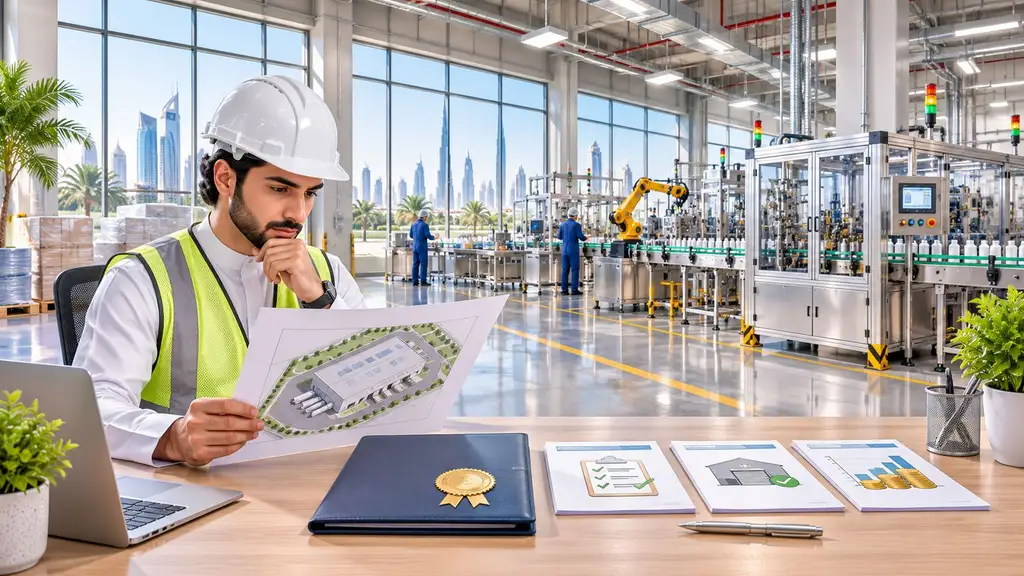

The popular advice for getting an industrial licence in Dubai sounds simple: choose a company structure, reserve a name and pay the fees. That leaves out the decisions most likely to delay production, whether the activity classification matches your process, whether the premises can accommodate it and which technical authorities must approve the operation.
A company licence isn't the same as permission to switch on a production line. Start with an approval map and a workable site, then compare mainland and free zone routes. Only after those decisions should you treat a licence quotation as a meaningful project cost.
What an Industrial Licence Covers and Who Needs One
An industrial licence authorises a named production activity at a specific premises, separately from a general trading licence. Manufacturing, processing, assembly and qualifying packaging activities connect the company to physical production, rather than to buying and reselling goods.
The distinction becomes clearer when you describe what happens inside the building. A business that buys finished chairs and resells them has a different operating model from one that cuts timber, applies finishes and assembles furniture. Likewise, importing completed electrical equipment isn't the same activity as assembling components into finished units.
Industrial licence activity by sector
The Ministry of Economy's industrial licensing records on the UAE's official open-data portal provide the following 2013 UAE sector benchmarks, useful for understanding historical scale rather than current Dubai totals.
| Sector | Licences | Employees | Revenue (AED) |
|---|---|---|---|
| Furniture | 418 | 13,661 | 533,560,018 |
| Machinery and electrical kits | 210 | 9,425 | 912,986,410 |
| Transport equipment | 82 | 14,221 | 3,048,554,286 |
| Vehicle and truck manufacturing | 64 | 2,740 | 388,980,272 |
The useful lesson isn't that a new factory should resemble these established sectors. It's that industrial licensing records sit alongside employment and revenue because they concern operating production businesses. A feasibility study therefore needs to connect the licensed activity with machinery, staffing, premises and expected output.
Company size alone doesn't settle the licence category. A small workshop assembling goods still needs its process classified correctly, while a large distributor doesn't become a manufacturer merely because it occupies a warehouse.
A practical self-check
- You make or transform goods: Describe the inputs, production method and finished product to the licensing authority.
- You assemble or package goods: Confirm the exact activity classification rather than assuming these are trading functions.
- You only resell finished products: Check the commercial route instead of paying for an industrial structure you don't need.
- You outsource production: Separate your own activities from those performed by the contracted manufacturer.
If goods are made, assembled, processed or packaged on your site, investigate the industrial route before choosing a standard trading licence. The authority needs the actual process description, not just a broad label such as furniture or electronics.
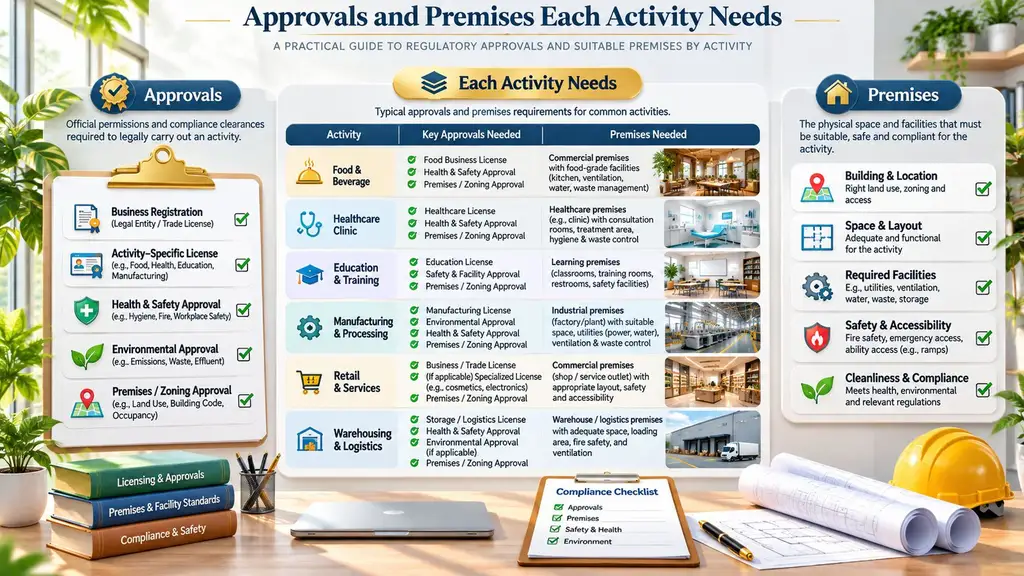
Approvals and Premises Each Activity Needs
| Activity | Extra approvals usually needed | Premises consequence |
|---|---|---|
| Food processing | Dubai Municipality food safety approval | Suitable waste handling and hygiene zoning |
| Chemicals | Civil Defence review and environmental permit | Separated storage and ventilation |
| Medical products | Health authority registration | Controlled, secure storage |
| Waste recycling | Environmental permit | Drainage and emissions controls |
| Machinery and electrical assembly | Civil Defence inspection | Checked power capacity and ventilation |
| Furniture manufacturing | Civil Defence fire-safety review | Dust and spray controls |
Treat this as a typical approval map, not an exhaustive or binding list. Confirm the responsible authority, applicable permit and submission order for your specific process before committing to a property.
A warehouse advertised as industrial isn't automatically suitable for every manufacturing activity. Under Dubai's law regulating economic activities%20of%202011%20Regulating%20Economic%20Activites_English%2020012016.pdf), applicants must identify suitable premises, meet the requirements of the licensing authority and competent entities, and avoid using the premises for activities outside the licence.
This approval guide helps connect the process to the facility requirements.
Test the process against the building
Consider furniture manufacturing. Cutting and assembling purchased boards creates a different facility brief from cutting, sanding and spray-finishing them on site. The latter introduces questions about dust extraction, finishing materials, ventilation and fire separation that a basic storage layout won't answer.
Food processing creates a different set of design questions. Your layout should show how incoming ingredients, production, cleaning, waste and finished products move through the unit without inappropriate overlap. Don't submit a generic warehouse drawing when the reviewer needs to understand the production flow.
Premises rule: Assess the building against your most demanding production step, not just the finished product you intend to sell.
Questions to settle before committing
- Production zoning: Is the proposed manufacturing process permitted at this location?
- Power and water: Can the existing supply support the machinery, cooling, washing and other process loads?
- Waste and emissions: Can you install the required extraction, drainage, treatment or collection arrangements?
- Storage separation: Is there room to separate raw materials, finished goods and hazardous or controlled substances?
- Landlord consent: Does the proposed lease expressly permit the activity and necessary alterations?
- Shared-unit suitability: Can your operation meet access, safety and segregation requirements independently of neighbouring users?
Ask for the answers against an actual layout and machinery schedule. A verbal assurance that similar businesses operate nearby doesn't establish that your proposed unit can obtain approval.
Mainland or Free Zone for Industrial Activity
| Criterion | Mainland Dubai | Free zone |
|---|---|---|
| Local licence issuer | Department of Economy and Tourism | The free zone authority |
| Premises | Specific premises suitable for the activity and compliant with competent-authority rules | Zone-provided or zone-approved industrial unit; confirm permitted activities and unit size |
| Ownership rules | Current UAE company law and activity controls apply | Zone-specific framework; confirm before forming the company |
| Importing raw materials | Standard customs entry and duty treatment for the goods | Zone customs procedures; confirm treatment of goods moving in and out |
| Selling into the mainland | Direct sales within the licence scope | Confirm the permitted distributor, mainland-entity or other authorised arrangement |
| Federal industrial registration | MoIAT Industrial Production Licence registers the factory | Ask the zone and MoIAT whether federal registration is also required |
Choose the route around the operation, not the company package. A free zone may offer an industrial unit that reduces your search and fit-out work, but the zone must accept your activity and the unit must accommodate your process. A mainland address may suit your customers while still requiring substantial facility modifications.
Match the route to your supply chain
For a manufacturer selling mainly within Dubai, mainland licensing may provide a more straightforward direct-sales structure. Check that the licence scope covers how you intend to manufacture, store and sell the goods, rather than treating production and distribution as interchangeable.
For an exporter importing raw materials and shipping finished products overseas, a free zone deserves close examination. Map the physical movement of the materials and ask how customs procedures apply at each boundary, particularly when some finished goods will enter the mainland.
An investor testing a product can investigate an approved shared industrial unit on either route. A shared production facility isn't the same as a co-working desk: confirm which processes you can carry out, what equipment you can install and which approvals attach to your business rather than the building operator.
The better route is the one that accommodates the complete production and sales plan, not the one that issues incorporation documents fastest.
Check beyond the finished product
Give the authority a process list covering receiving, preparation, processing, assembly, packaging and storage. A zone's acceptance of the finished product category doesn't automatically answer whether every intermediate operation is permitted.
Then ask the zone authority and MoIAT whether your activity requires federal industrial registration alongside the zone licence. Settle ownership eligibility, customer access and customs arrangements in writing before comparing company formation prices.
How to Apply for an Industrial Licence Step by Step
The MoIAT Industrial Production Licence service describes a pathway beginning with activity selection, trade-name and security approvals, factory location and local initial approval before the federal production licence application. The local industrial licence authorises the business activity; the MoIAT licence registers the factory and permits production under federal industrial controls.
The sequence below is a planning framework. Obtain the authority-specific order because technical submissions, installation permissions and final inspections can involve linked or overlapping stages.
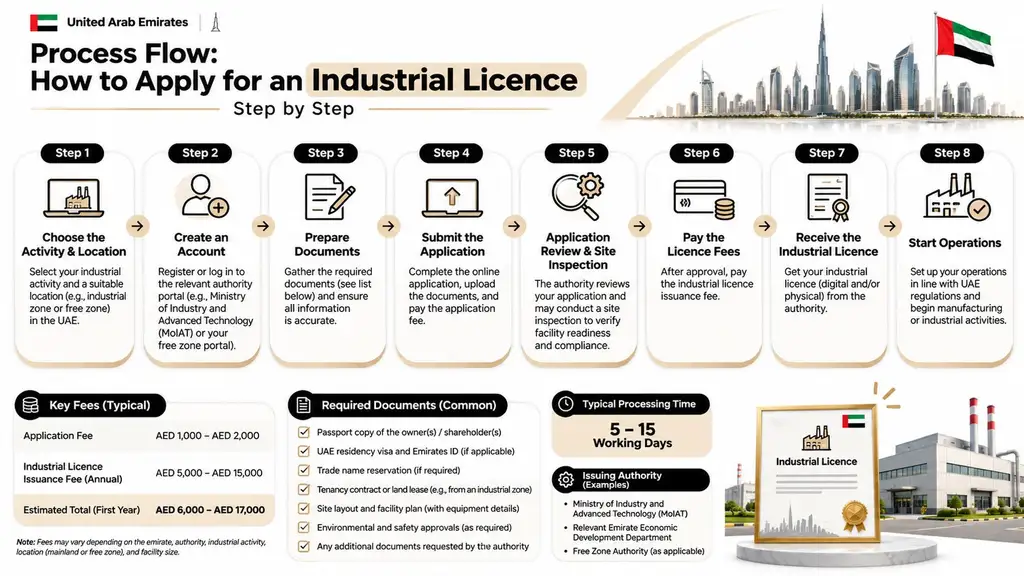
Build the application around approval gates
Select the precise industrial activity.
Prepare a process description showing raw materials, machinery, production steps and outputs. This allows the authority to classify the operation and identify external regulators, but it doesn't establish that a particular building is acceptable.Obtain trade-name and security approvals.
Prepare shareholder and manager identification, proposed company details and the supporting corporate documents requested for your legal form. These approvals progress company formation, not factory readiness.Confirm the factory location.
Submit the proposed location, layout and facility information required by the relevant reviewers. Validate utility loads and obtain conditional regulatory feedback before making non-refundable machinery commitments; a landlord's acceptance isn't technical approval.Secure local initial approval.
For a mainland application, progress through Dubai's Department of Economy and Tourism; for a free zone, follow that authority's procedure. Initial approval allows the application to advance, but outstanding premises and technical conditions still need to be closed.Apply for the MoIAT Industrial Production Licence.
Assemble the local approval and factory information required by the federal application. Keep the process description, machinery schedule and premises details consistent across submissions so reviewers aren't assessing different versions of the project.Complete activity-specific technical approvals.
Obtain the Civil Defence, environmental and other sector approvals applicable to the operation. Some design or conditional approvals may be needed earlier, while final clearance may require installed equipment, so record the dependency for each permit rather than treating this as an isolated paperwork stage.Complete authorised installation, inspections and production clearance.
Distinguish permission to install machinery from permission to commission or run it. Schedule inspections at the required point, close corrective actions and hold the applicable production authorisations before commencing manufacturing.
Separate registration speed from production timing
The UAE Commercial Companies Law%20of%202021%20ON%20COMMERCIAL%20COMPANIES.pdf) provides for commercial licence issuance within three working days after complete documents and payment, but that isn't an end-to-end industrial project timetable. It doesn't remove outstanding premises, safety, environmental or sector approvals.
Build your schedule around deliverables instead of a formation headline.
| Project stage | Evidence needed to move forward |
|---|---|
| Incorporation | Accepted company structure, name and corporate documents |
| Local industrial licence and premises approval | Accepted activity and site documentation |
| Facility approval and MoIAT licensing | Technical submissions and applicable federal licensing requirements satisfied |
| Installation and inspection | Authorised installation completed and required inspection findings closed |
| Production and first sales | Production clearance and applicable product, customs and sales permissions in place |
Ask each authority for its current processing window, including what starts the clock. A submission awaiting revised drawings or an external approval isn't equivalent to a complete application ready for decision.
Prepare a coordinated document pack: identity and corporate records, a process-flow description, factory layout, machinery list, raw-material details, utility loads and waste-handling arrangements. Confirm which documents need translation, attestation or a particular technical signatory before arranging them.
Finally, record each licence's validity period and renewal requirements. Ask which changes to the activity, premises, equipment or capacity need prior approval or an amendment, so a later production expansion doesn't proceed on an outdated approval file.
Costs and Fees to Budget Before You Apply
The licence price is only one budget line. A meaningful industrial licence Dubai cost comparison must include the facility, technical work and equipment needed to reach production, not just the documents needed to form the company.
Request written, activity-specific quotations rather than relying on a generic all-in figure. Fees can change, and a quotation that excludes facility work isn't comparable with one that includes it.
First-year budget lines for an industrial licence in Dubai
| Cost line | When it appears | What drives the amount | Where to confirm |
|---|---|---|---|
| Government licensing fees | At application and local initial approval stages | Applicable activity, legal form and premises-related fee rules | Licensing authority fee schedule |
| MoIAT Industrial Production Licence fee | Following local initial approval | Applicable service and production classification | MoIAT |
| Industrial premises rent | Before signing the lease | Location, unit size, condition and power capacity | Landlord and lease terms |
| Civil Defence and environmental approvals | During facility approval | Activity risk, site design and required submissions | Civil Defence and environmental authority |
| Equipment and utility connections | After premises validation and relevant approvals | Process line, power load and installation scope | Suppliers and utility provider |
| Inspection and technical testing | Before production starts | Required inspections, tests and repeat visits | Each approving authority |
| Consultancy and document translation | Alongside application stages | Agreed work and document volume | Written scope and fee quotation |
| Renewal and amendment fees | At expiry or when approved details change | Renewal terms, type of change and repeat inspections | Licensing authority |
Compare complete project scopes
For a small assembly business, don't assume official fees will be the largest expense. Price the benches, machinery, electrical distribution, ventilation, storage and installation before deciding whether the premises are affordable.
Power availability deserves its own check. A unit with attractive rent may require connection work or internal electrical upgrades that make a better-equipped building more economical overall.
Budget discipline: Compare the cost of reaching an approved, operating facility, not merely the cost of receiving a licence.
Keep recurring costs separate from setup expenditure. Rent, utilities, maintenance and renewal obligations affect the operating budget, while machinery installation and initial fit-out affect the cash needed before sales begin.
For every quotation, establish which fees are fixed, which are calculated from activity or facility details, and which arise only after inspection. Ask whether drawings, resubmissions, testing, utility deposits and amendment work are included, and require exclusions to appear in writing before signing.
Confirm Your Approvals Before You Sign a Lease
The immediate decision isn't which licence package to buy. It's whether your proposed route and premises can support the complete manufacturing operation without an unresolved approval dependency.
Create a pre-commitment file
- Define the operation: Write down each production step, the materials used and the goods produced.
- Shortlist workable sites: Test layouts and utility capacity, and obtain the landlord's written consent for the activity and alterations.
- Obtain the current application requirements: Request the document list and fee schedule for your exact activity from the licensing authority.
- Set the approval sequence: Identify technical reviewers, required submissions and conditions that must be satisfied before installation or operation.
- Control commitments: Delay irreversible equipment orders and unconditional lease commitments until the relevant feasibility checks are complete.
Where an application requires a lease before final approval, clarify that dependency early. Seek appropriate advice on approval conditions in the lease rather than assuming every authorisation can be obtained before signing.
Keep an approval map with the project file
Use a single-page register with a line for each authority. Record the document it needs, who prepares it, whether it is required before or after lease signing, its prerequisite approval and the evidence that closes the requirement.
Mark the mainland or free zone route against every line. Give each outstanding action an owner, so the landlord, engineer, equipment supplier and company representative aren't relying on one another to resolve it.
At Smart Classic Business Hub, we offer UAE trade licence services, government approvals and renewals, with company formation guidance through each step. Compare us with other advisers and request a written scope before engaging; professional support should make responsibilities and exclusions clearer, not replace authority confirmation.
Does the chosen premises support every approval the activity needs? If not, resolve that before committing to the production plan.
Smart Classic Business Hub offers company formation guidance, UAE trade licence services, government approvals and licence renewals. Visit Smart Classic Business Hub to discuss your proposed industrial activity, premises and mainland or free zone route, and request a written scope for application support.