
VAT Compliant Accounting Software in the UAE 2026


The UAE's VAT rate is 5%. The bookkeeping obligation that came with it is much larger than the number suggests.
When VAT began on 1 January 2018 at a standard rate of 5%, the Ministry of Finance made accurate financial records a statutory requirement for every business, not only the ones that registered. Companies below the mandatory registration threshold still have to keep orderly records so their turnover can be assessed if they cross it. Registered companies face a higher bar: their records must let the Federal Tax Authority verify individual transactions and reconcile VAT charged to customers with VAT paid on purchases.
That reconciliation is where software choices go wrong. A tool that prints an invoice and adds 5% is an invoicing tool. VAT-compliant accounting software classifies each transaction, separates output VAT from input VAT, keeps the source document attached to the posting, and produces return figures a reviewer can trace back to a document.
Judge every candidate against the eight capabilities below, then against the e-invoicing dates that decide whether you migrate once or twice.
Features a UAE VAT-Compliant Accounting System Must Have
A compliant system does eight specific things. Miss one and the gap surfaces during a review rather than during invoicing, which is the worst possible moment to find it.
Run every candidate product against this table before you sign anything.
| Requirement | What the software must do | Why it matters |
|---|---|---|
| VAT coding per line | Apply standard rate, zero-rated, exempt and out-of-scope codes | Output and input VAT must reconcile to the return |
| Tax Registration Number | Print the TRN on tax invoices and e-invoices | Identifies the taxable person on every document |
| Transaction-level VAT fields | Store the VAT code and amount on each ledger line | Lets the FTA trace each return figure to source |
| Document attachment and linking | Link invoices, credit notes and receipts to postings | Substantiates recoverable input tax |
| Period locking and audit log | Lock closed VAT periods and record every change | Prevents silent edits after filing |
| Retention and archive | Keep records searchable for five years, fifteen for real estate | Matches FTA retention rules |
| FTA Audit File export | Generate the FAF from ledger data | Supports audit requests |
| E-invoicing connection | Connect to an Accredited Service Provider and send structured data | Required on the 2026-2027 timeline |
Where mid-market packages quietly fail
Three rows break most otherwise decent products. Coding: many systems let you set one VAT treatment per customer or per invoice, so a mixed invoice with zero-rated freight and standard-rated goods posts the wrong tax on half its lines. Registration details: the TRN gets printed on tax invoices but vanishes from credit notes and simplified invoices. Line-level fields: the software posts a single monthly VAT journal and loses the transaction detail behind it.
Confusion usually starts with the return itself. The VAT return isn't the compliance record, it's a summary of postings, and every posting needs a document behind it.
The reconciliation the FTA performs
Say a trader books AED 200,000 of taxable sales and AED 10,000 of output VAT for a quarter. On the purchase side the same trader claims input VAT on stock, rent, utilities and freight. Each claim sits on a supplier invoice naming the supplier's TRN, the date, the goods or service and the VAT amount. When the FTA reconciles VAT charged to customers against VAT paid on purchases, it works from those documents line by line, not from a quarterly total.
If the software can't reproduce that pairing on demand, the return is a number with no story behind it.
Deal-breaker rule: if a vendor can't show you a locked period and a document attached to a posting during the trial, walk away. That gap never gets fixed after go-live.
A product that clears all eight rows is ready for a proper trial on your own data. Anything less is a data migration waiting to happen.
How Long VAT Records Must Be Kept
The default answer to how long VAT records must be kept in the UAE is at least five years after the end of the tax period, and the clock doesn't always stop there. The Federal Tax Authority's guide for taxable persons sets that baseline, then extends it in specific circumstances.
| Record type | Minimum retention | Software requirement |
|---|---|---|
| Standard VAT records (sales, purchases, expenses) | At least 5 years after the tax period | Searchable electronic archive that stays legible |
| Disputed liability, ongoing audit or notified audit | 5 years plus up to 4 more years | Retention lock that overrides automatic deletion |
| Real estate records | 15 years after the tax period | Long-term storage with rapid retrieval |
| Balance sheets and profit-and-loss accounts | At least 5 years after the tax period | Exportable financial statements for each period |
| Payroll, fixed-asset and inventory records | At least 5 years after the tax period | Linked registers that remain readable |
When five years becomes nine
The retention period can be extended by up to four additional years when a VAT liability is disputed, when a tax audit is ongoing, or when the FTA has notified the business of an intended audit before the original five years expire. Real-estate records follow their own rule at fifteen years after the end of the tax period.
That extension is a software problem, not a filing-cabinet problem. Most cloud tools run a retention setting that deletes or cold-stores documents on a schedule. You need a legal-hold flag that suspends deletion the day a dispute or audit notice arrives, plus an administrator who knows where that flag lives.
Format is your choice, legibility is not
The FTA doesn't prescribe one mandatory storage format. Records may be kept electronically or on paper, provided they stay legible and readily available when requested. What must survive is the substance: balance sheets, profit-and-loss accounts, payroll records, fixed-asset records, inventory records, plus evidence of payments, receipts, purchases, sales, revenue and expenses.
Paper passes the rule. It just fails the next test.
The one-minute retrieval
Ask a simple question of any shortlisted system: return a supplier invoice from the earliest year you're still required to keep, in a readable format, with its VAT code, and time how long it takes.
Practical rule: a record you can't produce in about a minute isn't retained, it's rumoured. The FTA asks for documents, not for a promise that someone will search the archive next week.
Retention is a feature you configure and test, not a habit you trust a bookkeeper to remember. For the fuller document set that sits behind this, our guide to accounting record keeping requirements maps each record to the period it must survive.
Audit Trails, Invoices and Credit Notes Explained
A system can calculate VAT perfectly and still fail, because the FTA doesn't audit your arithmetic first. It audits your evidence. The FTA's guidance on tax obligations requires records covering payments, receipts, purchases, sales, profits, expenses, supplies and imports, alongside issued and received tax invoices, credit notes, inventory records, balance sheets and profit-and-loss statements, with records generally available for at least five years after the relevant tax period and longer for real estate.
That requirement describes a chain of documents. The difference between a system that calculates VAT and one that leaves a trail is easiest to see as a sequence.
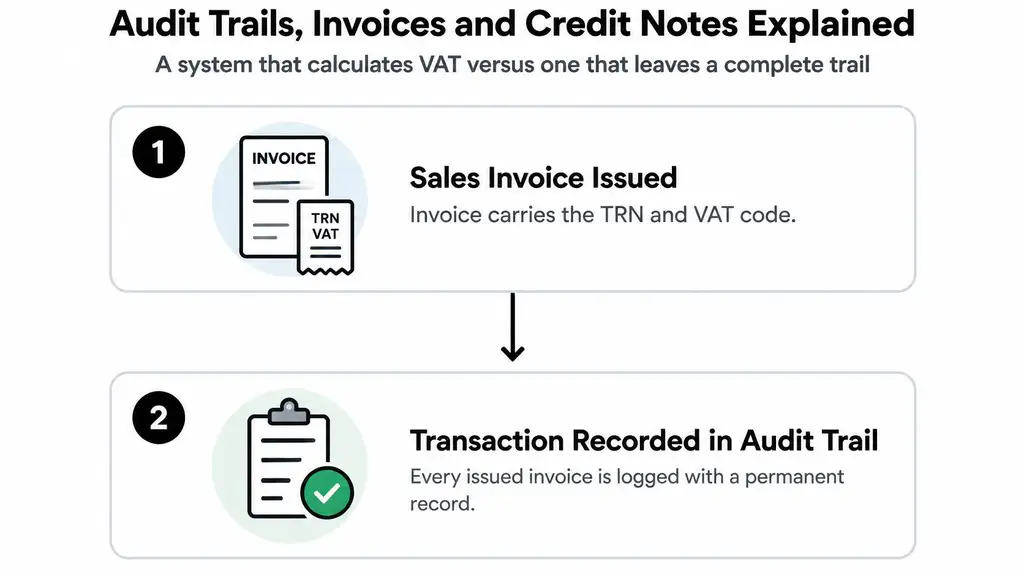
The five steps that build the trail
- Issue the sales invoice with the TRN and the right VAT code on each line.
- Post it to the ledger so the output VAT is stored at line level, not lumped into one tax account entry.
- Attach the source file and link it to that posting, so the document and the number never drift apart.
- Close and lock the VAT period once the return is filed, recording who locked it and when.
- Correct later mistakes through a credit note, never by editing the original invoice.
Steps one to three are what most buyers check. Steps four and five are what separates a compliant system from a tidy one.
A credit note, followed to the dirham
Say you invoice a customer AED 10,000 plus AED 500 VAT for consultancy work. Two weeks later, part of the scope is cancelled and you agree a return of AED 2,000. The correct response is a credit note for AED 2,000 plus AED 100 VAT, referencing the original invoice number and date. The original stays untouched. The net output VAT on that pair of documents is AED 400, and the return shows both figures with both documents attached.
Now compare that with a business whose ledger shows only a period total of AED 52,000 output VAT. The total may be correct. The business still can't demonstrate which invoices produced it, which credit notes reduced it, or which customer received what.
The principle behind it: corrections add a document. They never erase one.
Deleting an original entry after a return is filed is the failure mode the FTA would question first, and it's the one no amount of backup will explain away. Role-based controls, period locking, an audit log and automated retention all exist to make that deletion impossible rather than merely discouraged.
The FTA Audit File and Data Integrity Requirements
The FTA's tax accounting software requirements cover more than invoicing. They identify capabilities for preparing VAT-return information, generating an FTA Audit File (FAF), backing up and restoring data, archiving and restoring it after extended periods, and maintaining controls over accounts payable, accounts receivable, the general ledger and fixed assets. The FTA's guidance on tax accounting software and e-invoicing sets that scope.
Read those as four control areas plus one export. Each translates into something you can test in a trial rather than accept on a datasheet.
Four control areas, four questions
- Accounts payable: does the system flag a duplicate supplier invoice number from the same supplier before it posts, or does it accept the second copy without warning?
- Accounts receivable: can it show gaps in invoice numbering, and does it stop staff from back-dating an invoice into a locked period?
- General ledger: does it refuse to post an unbalanced journal, and can every line carry a VAT code and a source document?
- Fixed assets: are acquisitions, disposals and depreciation entries kept as linked records rather than one spreadsheet file on a laptop?
Those controls matter because the FAF is generated from the same ledger. If the underlying data is incomplete, the export shows it.
Field-level validation in practice
Structured data means the software checks values before it accepts them. A supplier's TRN follows a fixed format. A tax invoice needs a date, a description, a VAT amount and a currency. Under the e-invoicing framework, VAT-registered businesses must capture the Tax Registration Number (TRN) on the e-invoice, and service providers validate the required fields against the UAE data dictionary before the document is exchanged.
Editable spreadsheets do none of this. Image-only invoices do less: nothing in a scanned PDF can be validated or exported in structured form, so a system built on attachments alone fails the moment the FTA asks for machine-readable data.
Practical rule: during the trial, ask the vendor to generate an FAF from test data and then restore the system from a backup. Time both. Encryption you haven't restored from is a setting, not a guarantee.
Ask for the restore to happen on a schedule, not as a one-off favour. Recovery that's assumed rather than tested tends to be discovered as broken at the worst moment. Our VAT audit checklist for UAE businesses turns these checks into the questions a reviewer will ask.
E-Invoicing Deadlines and Choosing a Future-Ready Platform
An e-invoice isn't a PDF. The Ministry of Finance defines e-invoices as structured invoice data exchanged electronically and reported to the Federal Tax Authority, and it has published a timetable that turns the definition into a software decision (UAE Ministry of Finance e-invoicing initiative).
| Business group | Accredited Service Provider appointment | E-invoicing go-live |
|---|---|---|
| Revenue of AED 50 million or more | By 31 July 2026 | By 1 January 2027 |
| Revenue below AED 50 million | Before the 1 July 2027 go-live | 1 July 2027 |
| Any business adopting early | From 1 July 2026 (voluntary) | Voluntary, before the legal date |
Below the AED 50 million revenue line, the go-live lands on 1 July 2027. Across both groups, all persons may adopt e-invoicing voluntarily from 1 July 2026, which makes early adoption a business choice rather than a legal obligation.
The cheapest tool is the one you buy twice
Plenty of guides still define a VAT-compliant product as software that calculates the standard rate, stores a TRN and generates a VAT report. That benchmark is now incomplete, and the gap has a price.
Here's the contrarian conclusion. A basic invoicing tool lowers this year's cost and raises next year's, because it can't connect to an Accredited Service Provider, so the business runs a second migration before the SME deadline arrives.
- A basic invoicing tool passes today's VAT review. It calculates tax, stores a registration number and produces a report.
- A platform built for the 2026-2027 regime passes the same review and also sends structured data through an accredited provider, handles credit notes as structured documents, and keeps retention intact through the changeover.
The checklist to apply is short and unglamorous. One: a documented connection to an Accredited Service Provider, confirmed in writing. Two: an API or connector path that your accountant or integrator can use. Three: Arabic and UAE tax-field support, including the fields the data dictionary requires. Four: audit trails and offline controls that survive an internet outage. Five: support for tax invoices, simplified invoices, debit notes and credit notes as structured data, not as attachments.

The runway looks generous on a calendar. The actual work sits in the months before go-live, when supplier records, TRNs and invoice templates get cleaned up.
Migration is where most of that work hides. If your historical data lives in statement PDFs, top PDF statement converters for 2026 turn those statements into structured transactions, so nobody retypes a year of bank lines into the new ledger. On the regulatory side, our summary of UAE e-invoicing requirements covers the field-level expectations. Smart Classic Business Hub handles this configuration as part of its financial management advisory, corporate finance, business consultancy, feasibility study, business plan, company formation, PRO services, offshore registration, tax residency certificates, VAT compliant accounting, audit and liquidation services, so the tax codes, invoice sequencing, supplier TRN details and place-of-supply fields get aligned before the first live document goes out.
Confirm Your Software Fits Before the 2027 Deadline
Five actions settle the question, and all of them fit into a month.
- Find your revenue group and put both e-invoicing dates, the Accredited Service Provider appointment and the go-live, into your compliance calendar with owners assigned.
- Retrieve an old record from the edge of your retention period and confirm its VAT code, attached document and audit log still open in under a minute.
- Ask for a credit note against a test invoice and check that the original stays unchanged in the ledger.
- Request an FTA Audit File export and a backup restore during the trial, and time both with a stopwatch rather than a promise.
- Get written confirmation of the Accredited Service Provider connection and the document types it supports, including simplified invoices and debit notes.
Then repeat the review each year, because the obligations attached to a UAE company move. We tell clients about upcoming yearly compliances that every company must follow if it operates in the UAE, and our support and advisory services include updates on regulatory changes, advice on best practices, and help with additional requirements that may arise.
One recommendation, and it's the whole argument in a sentence: choose the platform that passes the checklist and the e-invoicing test, not the one with the lowest monthly fee. The fee is a line item. The migration is a year.
Choosing accounting software for a UAE business is a compliance decision before it's a software decision, and that's where Smart Classic Business Hub does the work alongside you. We configure VAT-compliant accounting setups, align tax codes and invoice sequencing, support FTA audit queries and prepare businesses for e-invoicing deadlines. Visit Smart Classic Business Hub to talk through your setup before the next deadline lands.