
UAE E-Invoicing Requirements for 2026: Deadlines and Scope


A PDF invoice that looks perfect on screen won't count as an e-invoice in the UAE. Neither will a scan, a Word file or a neatly formatted email attachment. The new system cares about structured, machine-readable data that another system can validate and process without anyone retyping it.
That's the counterintuitive shift behind the UAE e-invoicing requirements. Most businesses already invoice electronically in the everyday sense, so the work isn't learning to send a file faster. It's cleaning customer records, fixing tax codes and connecting your accounting data to an Accredited Service Provider before a revenue-based deadline arrives. For the largest businesses, one of those deadlines has already passed.
Deadlines by Annual Revenue Band
The private-sector schedule sets provider appointment and implementation deadlines by annual revenue. The two stages require separate planning: appointing a provider starts the process, while implementation requires invoices to be ready for live exchange.
E-invoicing deadlines by annual revenue band
| Business group | Provider appointment | Implementation |
|---|---|---|
| Annual revenue AED 50 million or more | 30 October 2026 | 1 January 2027 |
| Annual revenue below AED 50 million | 31 March 2027 | 1 July 2027 |
| All businesses, pilot phase | Pilot opened 1 July 2026 | End-to-end exchange testing before mandatory adoption |
| Government entities | Separate phase timetable | Separate phase timetable |
The UAE Electronic Invoicing Guidelines set the private-sector thresholds and deadlines shown above. They also describe a pilot phase and a separate timetable for government entities.
The revenue bands set the order of implementation work, but data quality often determines whether a business can go live on time. Customer records, tax codes and invoice totals need to be consistent enough to pass through the exchange process. Starting provider onboarding close to the deadline leaves less time to find and fix errors.
How the revenue test works
Use annual revenue for the most recent completed financial year to identify the applicable band. A current forecast or partial-year figure does not establish that result. If revenue is close to the threshold, confirm the figure with your accountant before setting the compliance timetable.
Practical rule: Record the revenue figure, the applicable band and both deadlines. If finance cannot provide those three items, confirm the revenue basis first.
The pilot phase gives businesses an opportunity to test invoice exchange before mandatory adoption. Check whether customer identifiers, totals and tax codes remain accurate through the process, then resolve any data issues before live invoicing begins.
A newly incorporated company should include provider onboarding in its launch planning if it falls within scope. Its incorporation date alone does not determine the applicable requirements.
What Makes an Invoice a Legal E-Invoice
A PDF invoice is like a photograph of a paper bill. A person can read it, but a computer has to guess where the total, tax amount and customer number sit. An e-invoice is closer to a completed database record, where each value sits in a named field that software can read without interpretation.
That analogy explains why changing your invoice template won't help. You're not redesigning a document. You're changing how invoice data is created and moved.
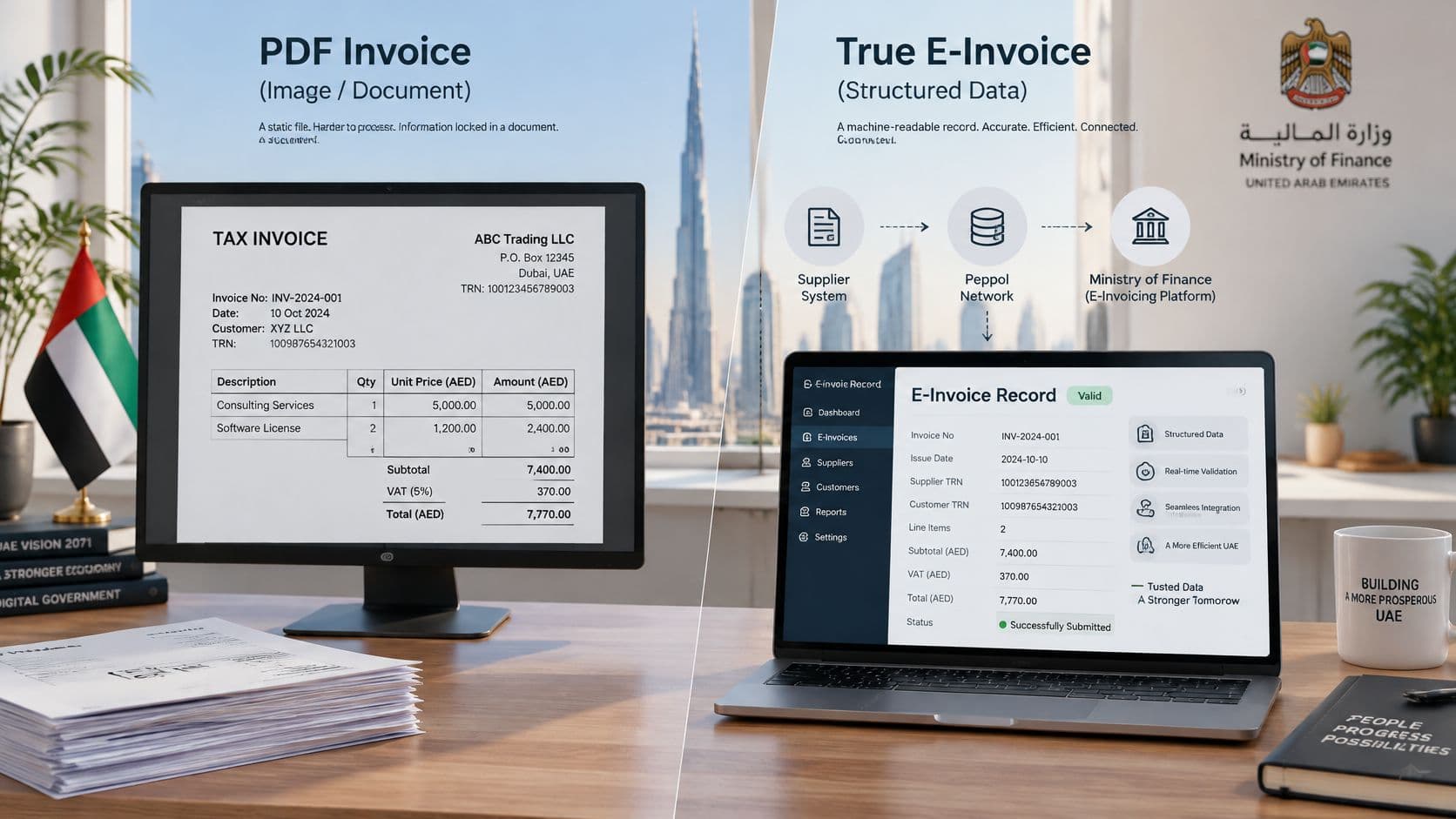
The Ministry of Finance eInvoicing initiative describes an eInvoice as issued, transmitted, received and reported electronically through the UAE's Accredited Service Provider network, with invoice data ultimately connected to the Federal Tax Authority. It also states that this applies to any person conducting business in the UAE regardless of VAT registration, unless a specific exclusion applies under Ministerial Decision No. 243 of 2025 and its amendments.
Read that scope line carefully. A business that isn't VAT registered may still need to prepare, which makes e-invoicing wider than VAT invoicing alone.
The four stages of a compliant flow
First, your accounting or ERP system creates structured data for the sale. Second, it sends that data to your Accredited Service Provider instead of emailing a file to the customer. Third, the provider validates the payload and converts it into the required XML format where needed. Fourth, the data is exchanged with the buyer and reported onwards, so the transaction leaves a consistent trail.
Each stage can break for a mundane reason. A missing buyer identifier, an inconsistent tax code or a credit note that doesn't reference its original invoice can stop the flow. None of those faults shows up when you're only eyeballing a PDF.
- PDFs and scans: Human-readable images, not compliant structured data.
- Word files and invoice emails: Editable documents without validated fields.
- Structured e-invoices: Field-level data exchanged and reported through an accredited channel.
The benefit, if your data is clean, is less manual tax work. Automatic transmission can support pre-population of selected VAT return fields and may speed up refund processing. The prerequisite is procedural readiness, not a new logo on your invoice. Treat invoicing as a data process from this point on.
Which Transactions Fall In and Out of Scope
Scope isn't one rule that says every sale is treated identically. It's a sequence of decisions you make transaction by transaction, and getting one decision wrong can send the wrong document through the wrong channel.
Start with the table, then test each transaction type you handle against it.
| Transaction | E-invoicing requirement | What to do |
|---|---|---|
| Domestic supply to a UAE business buyer | In scope | Issue a structured e-invoice through an Accredited Service Provider |
| Export to an overseas buyer | Depends on the buyer's own obligations | Confirm whether the buyer must register with a UAE provider and what endpoint data is needed |
| Import of Concerned Goods or Concerned Services | Outside the requirement | Follow the standard import documentation process |
| Exempt supply | Excluded only if a specific exclusion applies | Confirm the exemption classification and map it to the correct tax code |
| Credit note or correction of an issued invoice | In scope | Issue a credit note through the FTA correction process, not an edited invoice |
The first question is whether you're making a domestic supply to a business buyer in the UAE. If the answer is yes, work on the basis that a structured e-invoice through an accredited provider is required. That's the clearest category and the one your system must handle flawlessly from day one.
Cross-border sales need more care. The Federal Tax Authority e-invoicing guidance states that imports of "Concerned Goods" and "Concerned Services" are outside the e-invoicing requirements, while an overseas buyer does not need to register with a UAE Accredited Service Provider when the buyer is not otherwise obligated under UAE VAT or Corporate Tax law.
That doesn't end the exporter's work. You still need to confirm your own reporting duty and what buyer endpoint information you must hold. Don't assume that because the overseas buyer sits outside the UAE network, your side of the transaction has no requirements attached to it.
A free-zone example with two customers
Say a free-zone company sells consulting work to a client in Dubai and to a customer in Germany. The Dubai sale is a domestic business supply, so it follows the structured route through the provider. The German sale triggers a different check, because the overseas buyer may have no UAE registration obligation, and the exporter must confirm what's reportable and what endpoint data it needs before issuing anything.
Same service, same week, two different classifications. Staff who only know that e-invoicing is now mandatory will process both the same way.
Don't silently edit an issued invoice to fix an error. Use the standard correction process, including a credit note where appropriate.
That correction rule catches teams used to opening last month's PDF and reissuing a corrected version. Once an invoice has been issued through the system, the audit trail matters. Finish this exercise today by writing a one-line decision for each transaction type you handle, including domestic supplies, exports, imports, exempt supplies and credit notes.
Mandatory Invoice Data and Format Requirements
The system depends on clean data, not on a new look for your invoice. A beautifully formatted document built on inconsistent customer records will fail validation. A plain record with every field mapped correctly will pass.
Your supplier system sends data in the UAE PINT AE format to an Accredited Service Provider, which validates the payload and converts it to the UAE-standard e-invoice XML where necessary before onward exchange and reporting to the Federal Tax Authority, according to the Ministry of Finance eInvoicing page. That page also confirms the framework is XML-based and does not require a QR code or barcode.
So an existing QR-enabled VAT invoice isn't evidence of readiness. It may look modern and still contain none of the structured data this system needs.
Data groups your system must produce
- Supplier and buyer identifiers: Tax registration identifiers for both parties, recorded consistently.
- Buyer electronic address: The endpoint your provider uses to deliver the invoice.
- Invoice basics: Number, date and currency on every document.
- Line-level detail: Tax codes and taxable amounts for each line, not just the invoice total.
- VAT totals: Amounts that reconcile with the line data beneath them.
- Exemption classifications: The correct treatment where a supply isn't standard-rated.
- Credit-note links: A clear reference back to the original invoice being corrected.
Validation failures can interrupt issuance or reporting. That means a field that's optional in your current workflow, such as a customer tax number your sales team sometimes skips, becomes a blocker. Your finance team will feel that as invoices stuck in a queue while someone chases a customer for a number that should have been captured at onboarding.
The master-data work behind the format
Start by cleaning customer records. Remove duplicates, fill in missing identifiers and check that every active customer has the details the buyer side needs to receive an invoice. Then align tax codes across your products and services, so the same item isn't coded one way by sales and another way by accounts.
This work is unglamorous and it's where go-live dates slip. Providers can connect your system quickly, but they can't invent missing customer data for you.
Finish with a practical test before you choose a provider. Export a sample of recent invoices and credit notes, check every field against the list above and record your failure rate. That number tells you whether you need a light tidy-up or a serious data project, and it gives providers something concrete to quote against.
Choosing and Onboarding an Accredited Service Provider
The provider you appoint is a deadline decision as much as a software decision. A business whose records are still incomplete will spend the onboarding window fixing data, not exchanging invoices. That lag hits the higher revenue band first, because its appointment date has already passed.
Three routes are available. A business with a capable ERP can connect through an API for automated exchange. A smaller business may prefer a provider's portal, where staff send and receive invoices in a browser. A business already on accounting software with a ready connector can use that path and skip custom development. Invoice volume, how clean the data already is, and how much manual work the team can absorb each month decide which route fits.

Shortlisting criteria that matter
- Accreditation status: Confirm the provider is approved, not merely planning to apply.
- Sending and receiving: One provider for both directions keeps reconciliation simple because sent and received invoices share a single data trail.
- Onboarding timeline: Ask for a firm date in writing, not an estimate.
- Credit notes and corrections: Check these are supported, not treated as an afterthought.
- Exit cost: Ask what changing provider later would involve before you sign.
If you are in the higher revenue band, set each provider's written onboarding date against your January implementation start. A lower fee that misses that start is not a saving. Smaller businesses should lock internal milestones well before their appointment deadline. Onboarding queues lengthen near the end of a phase, and gaps in customer or tax data stretch the same queue, because a provider cannot supply records your system does not hold.
Smart Classic Business Hub informs clients about upcoming yearly compliances that every company must follow if it operates in the UAE, so a band deadline should not arrive as a surprise. Whichever route you choose, appointment and onboarding have to be finished before the first invoice leaves through the new system.
Penalties and Mistakes That Trigger Them
For businesses with annual revenue below AED 50 million, delaying provider appointment can trigger an administrative penalty of AED 5,000 per month or part thereof. The Federal Tax Authority's e-invoicing page sets out the appointment deadline of 31 March 2027 and the implementation deadline of 1 July 2027 for this revenue band.
A delay can therefore cost more than the software a business postponed selecting. Other mistakes may not carry a stated penalty in the available guidance, but they can still disrupt invoice corrections, reconciliation, or processing.
Common e-invoicing mistakes, consequences and fixes
| Mistake | Consequence | Fix |
|---|---|---|
| Delaying the provider appointment | AED 5,000 per month or part thereof | Appoint and onboard before the band deadline |
| Sending PDF invoices by email | Does not meet the UAE definition of an eInvoice | Issue structured data through an Accredited Service Provider |
| Editing an issued invoice | Breaks the correction trail and can leave invoice records inconsistent | Issue a credit note through the standard correction process |
| Assuming a QR code makes an invoice compliant | The framework requires XML-based structured data; a QR code alone does not meet that requirement | Generate the UAE PINT AE structured data and XML |
| Using different providers to send and receive | Sent and received records may not reconcile across systems | Use one Accredited Service Provider for both |
An issued invoice should be corrected through the prescribed process, rather than overwritten. That preserves a traceable link between the original invoice and its correction. Using separate providers can also leave the finance team matching two incomplete records instead of one connected transaction trail.
PDFs fail for a different reason: they do not provide the structured data required for an eInvoice, regardless of how professional they look. A QR code does not resolve that gap. The required format is structured XML data, so checking sample invoices and correction records before go-live can expose data and process failures early.
Start Your Readiness Checklist Before Go-Live
You don't need to replace your accounting system to start. You need eight actions completed in the right order.
- Confirm your band: Establish your most recent full-year revenue and the deadline that applies. If you're in the higher band, your appointment deadline has passed, so appoint immediately.
- Shortlist and appoint: Choose one accredited provider for sending and receiving, and get its onboarding timeline in writing.
- Sign and connect: Complete onboarding, then connect your accounting data to the provider.
- Audit master data: Check supplier and customer records, including tax registration numbers and buyer electronic addresses.
- Map tax codes: Align every tax code and exemption classification in your accounting system.
- Test a sample: Export recent invoices and credit notes, check each field against the required data list and record the failure rate.
- Run integration tests: Use the pilot window where available and reconcile outputs against your VAT return.
- Go live and monitor: Meet your band's implementation date and watch rejections closely for the first month.
We inform clients about upcoming yearly compliances that every company must follow if it operates in the UAE, and this checklist belongs on that calendar now. Steps four to six will take longer than you expect, so don't leave them until after you've signed with a provider. Book the provider appointment now, because the first deadline has already passed and every week of delay adds risk.
If you'd like help confirming your revenue band, cleaning your invoice data and preparing your VAT-compliant accounting for structured e-invoicing, our Dubai-based consultants can guide you from readiness checks through to ongoing compliance. Visit Smart Classic Business Hub to book a consultation and put your appointment and go-live dates in place.