
Power of Attorney UAE: Types, Steps and Risks


You're outside the UAE when a buyer is ready to complete your property purchase, your company needs a signature, or a bank asks you to attend in person. Someone you trust can help, but they need more than your permission by email. They need authority that the organisation handling the transaction will recognise.
A power of attorney in the UAE can provide that authority. The challenge isn't just choosing a general or special document. It's making sure the wording authorises the exact task, while meeting the bank's, registry's or court's submission requirements.
What a Power of Attorney Means in the UAE
A power of attorney is like a key card programmed for specific doors, not a master key to the entire building. You decide which actions another person may take on your behalf, and the document records those permissions.
The arrangement involves three terms:
- Principal: The person or company granting authority.
- Agent or attorney-in-fact: The person authorised to act. This title doesn't automatically mean they're a lawyer.
- Instrument: The legal document recording the appointment, its scope and its restrictions.
Under the Civil Transactions Law, Federal Law No. 5 of 1985, a person may contract through an agent unless personal action is legally required, and Article 150 requires an agreement-based power of attorney to specify the extent of the agent's authority.

Authority follows the task
The distinction between tasks matters. An agent appointed to receive property generally cannot initiate legal proceedings. Conversely, an agent appointed to conduct litigation generally cannot receive property without special permission from the principal.
For example, authorising someone to collect documents relating to your apartment doesn't necessarily authorise them to sell it. Appointing someone to handle a dispute doesn't automatically let them collect money or property connected with that dispute.
Practical rule: Ask what the agent must actually sign, submit, receive or agree to, rather than whether the document sounds sufficiently broad.
A POA is a controlled delegation of legal capacity, not a transfer of ownership. Your agent acts within the authority you grant; they don't become the owner of your assets because you appoint them.
Before signing, identify the transaction, the powers needed to complete it, the intended duration and any restrictions. That gives both the agent and the receiving organisation a clearer basis for deciding what the agent can do.
General, Special and Durable Power of Attorney Compared
| Type | Scope | Typical use | Main risk |
|---|---|---|---|
| General | Broad authority over the matters listed in the document | Routine administration, bank servicing, government forms | Vague or broad wording can be refused by banks and authorities |
| Special or limited | A named transaction or proceeding | Selling a specified property, signing a particular contract, attending a hearing | An expiry date may arrive before a delayed transaction finishes |
| Durable | Intended to continue after loss of capacity, only if legally effective under the applicable rules | Continuity planning during long absences, health planning, ongoing company management | An explicit continuation clause alone may not establish enforceability in the UAE |
UAE power of attorney types compared
Choose a general POA for a defined group of ongoing administrative matters. Choose a special POA when you can identify a particular deal or proceeding. Treat durable authority as a legal-planning question requiring advice, not as a standard document label that guarantees continuity.
General doesn't mean unrestricted
A general POA may be useful when an owner wants a representative to submit government forms, collect correspondence and manage specified company administration. Those functions should still be listed.
Bank servicing deserves particular care. Permission to request statements is different from permission to transfer funds, borrow money or close an account. Don't assume a bank will interpret an administrative appointment as authority for every financial action.
A special POA narrows the appointment to a particular purpose, such as signing the documents needed to sell an identified property. Its duration should allow for realistic completion delays, but it needn't leave the agent with unrelated powers afterward.
Absence and incapacity aren't the same
Being abroad doesn't mean you've lost legal capacity. A principal who remains capable of making decisions may need an ordinary POA with an appropriate duration, rather than a document described as durable.
If your objective is continued representation after loss of capacity, obtain UAE legal advice on whether that arrangement is available and effective for your circumstances. Don't assume importing durable wording from another country makes it enforceable locally.
The label helps organise the document. It doesn't replace a review of what the agent can actually do.
Consider a founder living overseas. They might appoint someone for listed company-administration tasks, while using a separate special POA for an intended share transfer. This separates routine work from a transaction that changes ownership.
The useful test is whether you can describe the appointment clearly. If you need representation for a single transaction, a special POA is usually the more focused drafting starting point. If you need several ongoing functions, list each function rather than relying on a general label.
Legal Requirements for Principals and Agents
Start with the principal. They need legal capacity, including the required legal age and ability to understand the appointment, and authority over the matter being delegated. A shareholder's personal authority, for example, shouldn't be confused with authority to act for the company itself.
The agent must be legally eligible for the role, and the delegated matter must be identifiable and capable of delegation. Trust is important, but it doesn't replace eligibility or the receiving organisation's identity checks.
Court representation needs particular care
Under Federal Decree-Law No. 42 of 2022 on Civil Procedure, a company employee representing a company needs a POA issued by its legal representative, stating the representative's job capacity and duly attested by the Notary Public for each relevant proceeding. The law also allows authority to be recorded through a statement entered in the court-hearing minutes.
That isn't the same as sending an employee with a company letter. Court representation has procedural requirements, so confirm the representative's eligibility and the required form of appointment before the hearing.
Prepare documents for the particular appointment
Use the following as a preparation checklist, not a universal submission list. Ask the notary and receiving authority which originals, copies and supporting records they require.
| Case | What to prepare | Watch-out |
|---|---|---|
| UAE resident principal | Emirates ID, passport copy, draft for review and formal signing | Name the transaction and receiving authority |
| Foreign principal | Passport; home-country POA if using a foreign-issued route; Arabic translation where required | Foreign-issued POAs may need UAE embassy and Ministry of Foreign Affairs attestation |
| Company as principal | Trade licence copy, proof of signatory authority, company stamp details | The signatory must be authorised to delegate on the company's behalf |
| Company employee in court | POA issued by the legal representative, stating job capacity | Must be notarised for each relevant proceeding |
| Agent eligibility | Agent identity documents and confirmation of willingness to act | Check eligibility for the specific role and whether formal acceptance is required |
Requirements by principal and agent case
Check names against identity and corporate records before arranging formal signing. A mismatch in a company name, passport spelling or signatory capacity can create an avoidable query.
The receiving authority checks whether the appointment satisfies its transaction procedures. Its acceptance requirements don't expand the powers granted by the principal, but they can determine whether the document is usable for the intended submission.
Drafting and Checking a Power of Attorney Before Signing
More powers can mean more risk, not more convenience. Combining shares, real estate, banking, litigation, immigration and liquidation in a single appointment may give an agent permissions you never intended to use.
The UAE civil-transactions provisions on agency tie an agent's capacity to the matters expressly specified and their necessary related acts, while requiring authority over the subject matter, an eligible agent and an identifiable matter capable of delegation. A document called general therefore isn't automatically sufficient for every transaction.
Build the draft around actions
Name each transaction and its required powers.
Replace a broad instruction to handle a sale with the actions the representative must perform: sign the sale agreement, submit transfer documents and attend the transfer appointment. Ask separately whether they need authority to negotiate terms or amend an agreement.Identify the asset, company or account.
Use the relevant title deed reference, unit details, trade licence information or account reference. Check those identifiers against the underlying records rather than copying them from an old draft.Set an expiry date with a completion buffer.
Allow for document queries, financing delays and rescheduled appointments. Decide whether authority should end on completion, on a stated date, or on whichever event happens first, subject to legal review.Consider joint approval for significant transactions.
If you want joint agents or dual signatures, confirm that the receiving organisation can implement the arrangement. An internal instruction to seek your approval isn't necessarily a control the bank or registry will enforce.Exclude powers you don't intend to grant.
Address borrowing, gifts, guarantees, delegation to another person and transactions involving the agent's own interests where relevant. A representative appointed for administration shouldn't receive ownership-changing powers by accident.Plan how authority will be withdrawn.
Identify who must receive notice, where copies are held and how the agent will return documents. Broad appointments are harder to manage operationally when several institutions have accepted them.Resolve language requirements before signing.
Confirm whether an Arabic version or legal translation is needed. Have discrepancies between language versions resolved, and obtain advice on any governing-language clause rather than assuming it overrides procedural requirements.
Compare vague and transaction-specific wording
A vague instruction might read:
Manage my property affairs.
A more useful drafting instruction would be:
Authorise the agent to sign the sale and transfer documents for the property identified by its title deed and unit details, subject to the principal's stated minimum sale price and specified expiry date.
These are illustrations, not ready-to-sign clauses. A complete instrument must identify the people, asset, permissions and restrictions, and fit the receiving authority's requirements.
The difference is practical. The first instruction leaves unanswered whether the agent may lease, mortgage, sell or merely maintain the property. The second directs the drafter toward a defined sale and gives the principal clear decisions to make.
Run a pre-signing acceptance check
Send the proposed wording to the intended bank, property authority, registrar or other recipient where a draft-check process is available. Ask whether the representative can complete the named task using that wording and what supporting documents must accompany it.
Check the document type, translation and attestation route, expiry provisions and withdrawal arrangements together. Seek legal review for cross-border appointments and any proposed continuation after incapacity.
We provide personalised consultation to understand the client's requirements and objectives, explain the available POA types and their implications, and guide the process. Our UAE POA process is completed online without physical visits, and we handle notarisation and attestation through the appropriate UAE authorities.
Notarisation isn't a cure for vague drafting. A formally authenticated document can still leave a bank or land department unable to identify the power needed for the requested transaction.
How to Notarise and Attest a Power of Attorney
Treat notarisation, translation and attestation as distinct tasks. Their sequence should follow the route agreed with the notary and the organisation that will receive the POA.
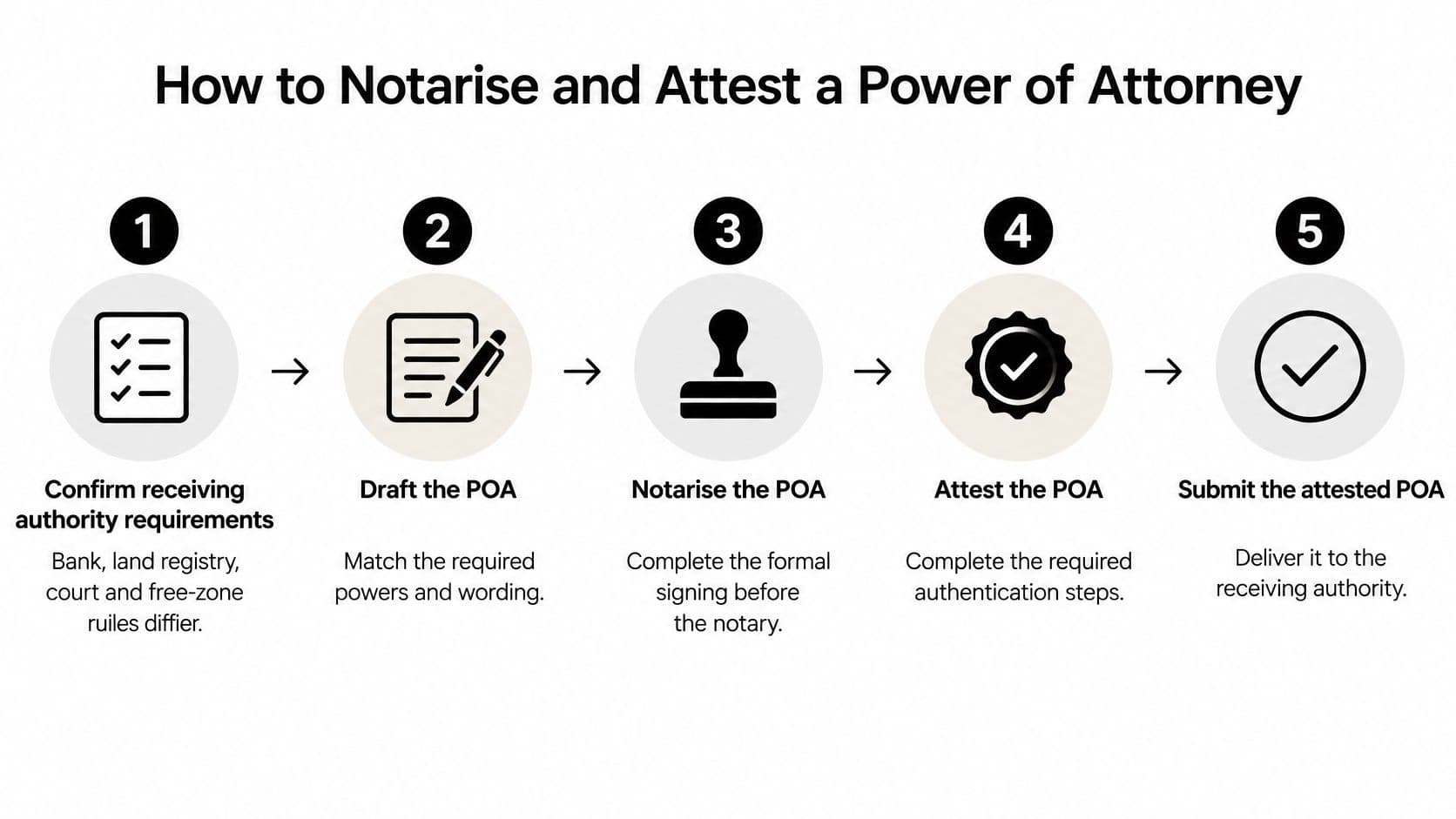
Complete the formalities in the right order
Confirm the recipient's requirements before execution.
Tell the bank, land registry, court or free-zone authority who is appointing whom, where the principal will sign and what the agent must do. Request its document-format, identity, language and authentication requirements.Finalise the transaction-specific draft.
Resolve missing powers and incorrect identifiers before signing. Confirm the expiry provisions and ensure any bilingual versions reflect the same intended appointment.Complete the notarial signing process.
Follow the notary's instructions for identity verification and signing, whether through an available remote route or an attendance-based process. Have original identity documents and evidence of corporate signing authority ready when required.Confirm the applicable charge and separate service costs.
The federal public-notary fee schedule lists AED 100 per party for execution or notarisation of a general or special POA. Don't treat that listed charge as a quotation for translation, overseas authentication or the entire preparation process.Arrange the required Arabic translation.
Confirm whether translation is needed before notarisation, for submission afterward, or as part of a foreign-document route. Use the translation format the recipient accepts and check names and asset references carefully.Complete foreign-document authentication where applicable.
A POA executed abroad may require UAE embassy and UAE Ministry of Foreign Affairs attestation. Establish the required chain before execution, including any preliminary authentication in the country of origin.Retain the right version and submit it.
Obtain the issued notarised instrument or the appropriate certified copy, and keep its reference details securely. Where the notary retains an original, clarify what document or electronic record you'll receive for use.
Faster processing doesn't mean automatic acceptance
The Ministry of Justice's Digital Agencies initiative launched in 2024 reduced POA processing time from two working days to approximately 10 minutes, according to the initiative record published by the International Telecommunication Union. That describes the initiative's processing improvement, not a guaranteed end-to-end timeline for every POA or foreign attestation chain.
Notaries can authenticate signatures, notarise instruments, retain originals and issue corresponding certificates. They don't turn an omitted permission into an express power.
Before submission: Check that you have the usable issued document, any required translation and the completed authentication chain, not merely confirmation that a signing appointment took place.
The common slip is treating notarisation as the finish line. The process is complete for your purpose only when the receiving organisation accepts the document for the intended transaction.
Power of Attorney Use Cases for Individuals and Companies
An owner abroad agrees to sell an apartment in Dubai. A relative can attend locally, but the owner wants to retain control over the price and avoid giving the relative authority over other assets.
A special property-sale POA provides a focused starting point. The drafting instructions should identify the apartment, the sale documents the relative may sign and the owner's commercial restrictions. Payment arrangements should be checked directly with the relevant transaction participants rather than assuming authority to sell also permits receipt of the proceeds.

An overseas founder appointing a local representative
Consider a founder who wants someone in the UAE to handle incorporation and subsequent company administration. The representative needs a task list, not permission to manage all business affairs.
Separate licence applications, government submissions and collection of corporate documents from banking activities. Bank account opening, account operation and borrowing should be considered individually, with the bank confirming its own requirements.
If the founder doesn't intend to sell shares or close the business, those powers shouldn't appear merely because they were included in a template. Also check who grants the authority: the founder personally or the company through an authorised signatory.
A company sending an employee to court
A company may want an employee familiar with the dispute to represent it. The appointment needs to identify the employee's job capacity and come from the company's legal representative, with the proceeding-specific notarisation formalities addressed.
The employee's familiarity with invoices or contracts doesn't itself establish court authority. The company should also decide which procedural decisions the representative may make and obtain legal advice on powers requiring specific authorisation.
Other common situations need similarly focused instructions:
- Family banking assistance: Identify whether the relative may obtain information, submit requests or conduct permitted transactions.
- Government submissions: Name the application and whether the agent may sign declarations or only deliver documents.
- Property registration: Specify the property and registration actions, rather than borrowing wording intended for a sale.
Use the transaction as the drafting starting point. Reusing another person's POA can import permissions you don't need while omitting the action your representative must perform.
Registration, Remote Signing and Common Legal Risks
A property transaction or corporate filing may require the POA to be presented, verified or recorded with the relevant authority. Don't assume notarisation automatically registers the appointment wherever it might later be used.
Ask the recipient whether it needs an original, a certified copy, an electronic instrument or verification through a particular system. Also establish whether the POA must be recorded before the transaction appointment.
Remote signing and practical acceptance
The UAE federal notary legislation allows information-technology tools for notarial transactions, including completion without physical appearance where permitted, and gives electronic signatures and notarised electronic instruments the corresponding evidentiary value.
That legal recognition doesn't eliminate transaction checks. Identity verification, language requirements and cross-border authentication can still affect whether a particular bank, registrar, court or embassy accepts the document in the form submitted.
| Risk | Usual cause | Prevention |
|---|---|---|
| Rejected by bank or registry | Vague or generic powers | Name each power and the transaction it serves |
| Unauthorised actions by agent | Overly broad scope | Limit scope, set an expiry date and confirm workable dual-signature controls for large deals |
| Old POA still in use | No written revocation sent | Issue written revocation and notify the agent, banks and authorities |
| Foreign POA refused | Missing attestation or translation | Confirm requirements with the receiving authority before signing |
| Unclear end of authority | No expiry or continuation terms | Write the end conditions and check them with a lawyer |
Common POA risks and how to prevent them
Make revocation operational
A principal who is of sound mind and legal age can revoke or amend a POA at any time by executing a new POA document or giving written notification to the attorney-in-fact and relevant authorities. Obtain legal advice where the appointment includes third-party rights or other potentially restrictive arrangements.
Don't assume issuing a replacement document alerts everyone who holds the old one. Identify the banks, registries, companies and other recipients that have relied on it, then follow their procedures for recording the change.
- Notify the agent: Give clear written notice and retain evidence of delivery.
- Contact affected institutions: Ask how they record revocation or replacement and obtain acknowledgement where available.
- Control circulating copies: Request their return and preserve a record identifying the withdrawn instrument.
An old POA left in circulation creates a practical risk even after you've decided to end the appointment. Clear notices, institutional updates and retained records help prevent further reliance on it.
We offer personalised POA consultation, document preparation, and notarisation and attestation through the appropriate UAE authorities, with an online process that doesn't require physical visits. Visit Smart Classic Business Hub to discuss the transaction you need completed, who will act for you and where the document will be submitted.