
Business Setup in Dubai: Start Your UAE Company


You’re probably in the same position as many founders who contact a Dubai consultancy for the first time. You’ve decided the UAE makes sense. You like the tax position, the geography, the credibility that comes with a Dubai address, and the access to regional and international markets. Then the questions start piling up.
Should you go mainland or free zone. Do you need office space right away. Which licence fits your activity. How long does setup really take once banks, visas, and compliance are involved. And why do some offers look cheap until you ask what’s included.
That confusion is normal. Business setup in dubai is straightforward only after the structure is chosen correctly. Most problems don’t come from the government process itself. They come from founders choosing the wrong jurisdiction, the wrong activity code, or an unrealistically low budget before they understand how the pieces fit together.
Your Gateway to Business Success in Dubai
A founder lands in Dubai on Sunday, takes three meetings on Monday, and wants a company live by Friday. On paper, that can sound reasonable. In practice, the answer depends on what the business needs to do on day one, who needs a visa, which clients will pay the company, and whether a bank will be comfortable with the activity and ownership structure.
Dubai attracts serious entrepreneurs for good reason. It gives founders a credible base for regional trade, international services, asset holding, and expansion into the Gulf. The appeal is not just tax. It is speed, market access, infrastructure, and the ability to build a company around a clear commercial objective instead of forcing everything into one rigid model.
That is the point many first-time founders underestimate. Company formation in Dubai is not only an administrative task. It is an operating decision with consequences for sales, visas, banking, compliance, and cost.
I usually tell clients to start with a harder question than "How much is the licence?" Ask what the company needs to achieve in the first 12 months. A consultancy selling to UAE clients has a different setup logic from an e-commerce importer, a holding company, or a solo founder who mainly wants residency and a clean invoicing structure. If that commercial goal is unclear, the setup often goes wrong before the application is even filed.
Practical rule: A low entry price can become an expensive mistake if it limits client access, complicates banking, or forces a restructure within the first year.
The strongest setups are built backwards from operations. Can you bill local clients directly. Do you need employee visas now or later. Will you need warehouse space, a flexi-desk, or no office at all. Are you trying to keep overhead low for year one, or build a structure that can absorb staff, investors, and larger contracts without amendments every few months.
Jurisdiction choice sits at the center of that planning. Founders comparing mainland and free zone company setup options in Dubai often focus on brochure-level selling points and miss the practical trade-offs. The better approach is to compare licensing scope, visa capacity, office requirements, approval complexity, and how each option will affect banking and growth.
Dubai can be efficient. It can also become expensive very quickly when the structure is chosen for headline price instead of fit. I have seen founders pay once for a low-cost licence, then pay again for activity changes, additional approvals, new office arrangements, or a full migration into a better jurisdiction after the business starts trading.
That is why a realistic setup plan matters more than a fast quote. Clear activity selection, a workable visa strategy, enough budget for the full process, and honest timelines will do more for your launch than any glossy package promise.
Choosing Your Business Jurisdiction in Dubai
Your first major decision is jurisdiction. In most cases, that means choosing between mainland, free zone, and offshore. Founders often ask which one is best. That’s the wrong question. The useful question is which one matches your revenue model, client base, staffing plan, and risk profile.
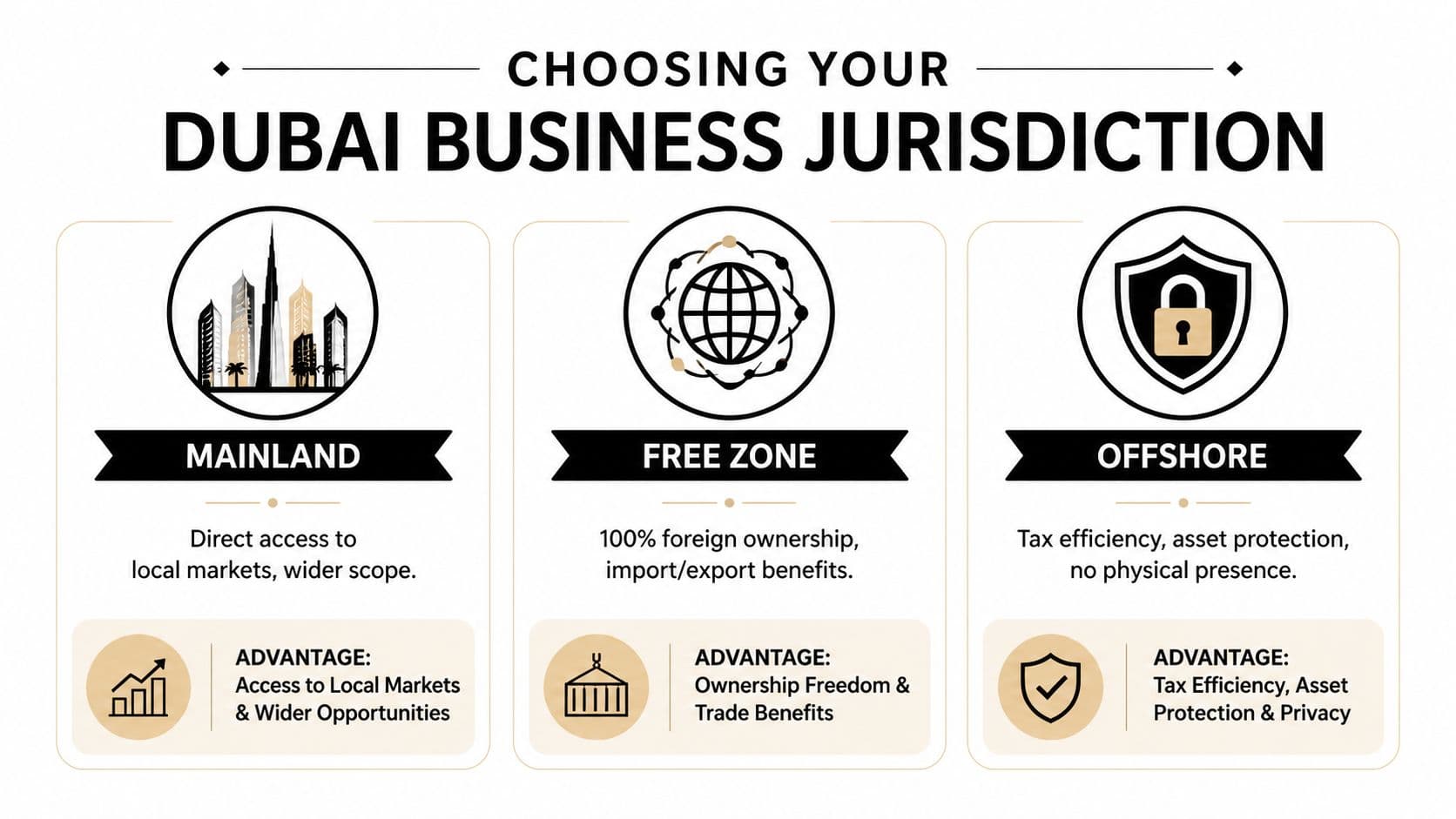
Mainland for local market access
Choose mainland if you want to operate directly in the UAE market without building around jurisdiction limitations. This suits businesses that expect onshore clients, physical operations, broader commercial scope, or activity types that don’t sit neatly inside a free zone model.
Mainland also tends to make sense when your company needs credibility with certain counterparties, wants wider flexibility on where it leases space, or expects to grow a team that works across the local market. The trade-off is that setup usually involves more moving parts. Activity classification matters, approvals can be stricter, and the total cost can climb if the structure wasn’t designed carefully.
Free zone for international and owner-led models
Free zones are often the right fit for international consultants, digital businesses, trading companies with an external focus, and founders who prioritise 100% foreign ownership. They can be more efficient at the licensing stage, especially for relatively clean service activities and lean startup structures.
That doesn’t mean every free zone setup is automatically simple. Some founders choose a free zone because the headline entry cost looks low, then realise later that client access, visa quotas, or bank onboarding don’t match the business they intend to run.
Offshore for holding and structuring purposes
Offshore is usually not the answer for someone who wants an operating business on the ground in Dubai. It is more relevant when the goal is international structuring, asset holding, or ownership efficiency. If you need a physical operating presence, staff visas, and direct commercial activity in the UAE, offshore is generally not the primary route.
Mainland vs. Free Zone vs. Offshore at a Glance
| Feature | Mainland | Free Zone | Offshore |
|---|---|---|---|
| Primary use case | Local UAE trading and service delivery | International business, export-import, remote services | Holding, asset protection, international structuring |
| Market access | Direct access to UAE market | Often strongest for free zone and cross-border operations | Not usually designed for operational UAE trading |
| Foreign ownership | Depends on activity and structure | Commonly suited to full foreign ownership models | Used for ownership structuring |
| Office expectation | Often tied to tenancy and operational footprint | Can be lighter depending on package and zone | No physical operating presence model |
| Visas | Linked to structure, space, and approvals | Linked to package, licence type, and quota rules | Not typically used for operational staffing |
| Best for | Firms building local sales and execution | Founders wanting lean international setup | Investors and holding structures |
| Typical challenge | More approvals and setup complexity | Mismatch between brochure promises and real operations | Limited use for active operating businesses |
Pick jurisdiction based on where your customers are, where your staff will sit, and how banks will read your business. Not on whichever brochure says “fastest”.
One helpful comparison is this deeper look at mainland vs freezone setup in Dubai. It’s worth reviewing before you lock yourself into a licence that feels affordable now but awkward six months later.
What usually works and what usually fails
A few patterns show up repeatedly in practice:
- A mainland setup works well when the founder already knows they need UAE market access, local contracts, broader execution rights, or a more conventional operating footprint.
- A free zone setup works well when the business is service-led, internationally oriented, lean on staffing at the start, and realistic about later visa and banking requirements.
- An offshore setup works well when the objective is ownership or asset planning rather than day-to-day operations in Dubai.
Where founders get into trouble is trying to force a model into the wrong box.
- A consultant fails with the wrong free zone when the licence allows the company to exist, but the bank, the client, or the visa quota doesn’t support growth.
- A trader fails with the wrong mainland activity when approvals and compliance become more complex than expected.
- An investor fails with offshore when they later realise they need operational substance, not just a legal vehicle.
Securing Your Dubai Trade License and Legal Form
A founder picks a jurisdiction on Monday, submits papers on Tuesday, and expects a licence by the end of the week. Then the file stalls because the activity is too broad, the legal form does not match the shareholder structure, or an approval was missed. That is a normal Dubai setup problem, and it is usually preventable.
Start with the activity, not the company name
Founders often fixate on the brand name first. The licensing authorities care more about what the company will do.
Your business activity drives the licence category, the approvals you may need, the documents the bank will later ask for, and in some cases the office requirement. If the activity is loosely described at the start, the company can still be formed, but the trouble usually shows up later during invoicing, contract review, VAT registration, or account opening.
A simple example. "Management consultancy" sounds broad enough to cover many service businesses. In practice, a founder may also want to offer training, software implementation, or marketing support. If those services are not aligned with the approved activity set, amendments follow. That adds time, paperwork, and cost that could have been avoided with better planning on day one.
Licence categories and legal forms
Most applications fall into three familiar licence categories:
- Commercial licence for trading, resale, import, export, and general commercial activity
- Professional licence for consultancy, advisory, technical, and service-based work
- Industrial licence for manufacturing, assembly, or industrial processing
The legal form is a separate decision. It affects liability, shareholding, constitutional documents, and how future changes are handled.
Common structures include an LLC for businesses with multiple shareholders and a sole establishment for some owner-led professional activities. A single-founder consultancy may prefer a leaner structure at launch. A business expecting outside investors usually benefits from setting up in a form that will be easier to amend later. I have seen founders save a little on initial paperwork, then spend far more restructuring once a partner or investor enters the picture.
Choose the legal form that fits ownership, liability, and growth plans. Do not choose the one that simply gets approved fastest.
What the licensing process looks like in practice
For a standard mainland file, the order is usually straightforward if the planning is sound:
- Select the correct activity or activity set
- Reserve an acceptable trade name
- Get initial approval
- Prepare the MOA or constitutional documents
- Arrange the tenancy document and Ejari, if required
- Complete KYC, notarisation, and identity checks
- Obtain any extra authority approvals linked to the activity
- Receive the trade licence
The advertised timeline can look quick. However, the actual timeline depends on whether the file is clean, whether all shareholders are available for signing, and whether the activity triggers outside approvals. For a straightforward consultancy, the process can move fast. For regulated sectors, trading businesses, or companies with multiple foreign shareholders, the timeline often stretches because one missing document creates a chain of delays.
That is why founders should review the full cost of starting a business in Dubai alongside the licensing path. The licence fee is only one part of becoming operational.
How free zone licensing differs
Free zones usually offer a lighter process on paper, but the planning standard should be higher, not lower.
The main trap is under-scoping the licence. A founder chooses one narrow activity to reduce cost, then finds that a client proposal, bank compliance review, or visa plan no longer fits the licence. Amending a free zone licence later is possible, but it is rarely the cheapest or fastest route.
Another practical difference is document scrutiny. Free zones can be efficient, but they still expect a clear business description, shareholder documents, and a credible explanation of how the company will operate. If the file says one thing, the website says another, and the bank application says something else, questions follow.
A clean application is consistent across all three.
Document checklist founders should prepare early
Prepare the file before you pay for anything non-refundable:
- Passport copies for all shareholders and managers
- Several trade name options
- A precise business activity description
- Shareholding breakdown
- MOA or incorporation drafts, where applicable
- Tenancy and address documents, if the authority requires them
- KYC support documents covering identity, business purpose, and source of funds
At this stage, founders also need to think about cash timing. Licence costs, deposits, visa charges, office commitments, and banking delays can hit before revenue starts. If that gap is tight, plan for securing initial business capital before the company is formed, not after the invoices start piling up.
A setup partner can help if the role is practical rather than promotional. Smart Classic Business Hub handles company formation, PRO services, visas, VAT-aligned support, and related paperwork under one workflow. That matters because licensing problems in Dubai rarely come from one big mistake. They come from three small ones that were handled by three different parties.
Budgeting for Your Dubai Company Formation
A founder sees a package advertised at a low entry price, assumes that is the setup budget, then gets hit with visa fees, medicals, Emirates ID costs, document attestation, office upgrades, and renewal charges that were never built into the first calculation. That is how a Dubai setup goes off track before trading even starts.
The package price and the real startup cost are different numbers
“Starting from” usually means the narrowest version of a licence package. It rarely means the cost of becoming operational.
Some low-cost structures do suit a single founder who needs a licence first and can add pieces later. The problem is that many founders compare packages without checking what sits outside the quote. A candid review from this analysis of low-cost setup claims points out the same pattern seen on the ground. Promotional pricing often excludes expenses that show up soon after approval, and real operating timelines can stretch well beyond the sales pitch.
That trade-off matters. A cheap package can still be the right choice for a solo consultant testing a market. It is often the wrong choice for a business that needs two visas, client meetings, a bank account quickly, and room to hire within the first year.
Build the budget in layers, not as one licence fee
A practical Dubai setup budget usually has four layers:
- Formation costs such as licence fees, registration charges, initial approvals, and legal documents
- Activation costs such as establishment card, visas, medical tests, Emirates ID, document attestation, and bank application support
- Operating costs such as flexi-desk or office rent, phone, insurance, software, staff, and founder living expenses during the pre-revenue period
- Ongoing compliance costs such as renewals, bookkeeping, VAT work where applicable, audit requirements in some jurisdictions, and licence amendments
Early realism helps founders save money. If the business needs three people on visas, an office that satisfies quota rules, and enough cash to cover the first few months, the budget should reflect that on day one. If the plan is to start alone, invoice remotely, and keep fixed costs light, a leaner structure may be justified.
If cash flow is tight before launch, review options for securing initial business capital. Many founders do not fail on business model alone. They run short between incorporation and actual trading.
Timelines belong in the budget
Time costs money in Dubai. If a founder expects to invoice in two weeks but banking, visa processing, or document corrections push the operating date out by a month or more, rent and personal expenses continue while revenue does not.
I usually tell clients to budget for the gap between licence issuance and full usability, not just for the licence itself. A company is only commercially ready when it can sign contracts, receive payments, sponsor the right people, and meet basic compliance requirements without scrambling for extra cash.
A more realistic way to compare options is to review a detailed cost of starting a business in Dubai breakdown and check what is included, what is deferred, and what becomes payable only after the licence is issued. That is the difference between a setup that looks cheap on paper and one that works in practice.
Establishing Your Presence with Visas and Banking
A founder gets the licence on Monday, expects to open the bank account by Friday, and plans to bring in a first employee next week. Then the bank asks for clearer proof of business activity, the visa quota does not match the hiring plan, and the launch slips by a month. That happens often in Dubai, especially when visas and banking are treated as admin tasks instead of operating decisions.
Visa planning should happen before licence issuance
Visa capacity should be part of the setup decision from the start. Jurisdiction, office type, business activity, and the number of people you expect to sponsor all affect what happens after incorporation.
A solo consultant and a trading company with three planned hires should not buy the same package just because the headline price looks attractive. I have seen founders choose a low-cost free zone option, only to find that adding staff later is slower or more expensive than they expected. By that point, changing the structure can cost more than choosing correctly on day one.
The practical question is simple. Who needs a visa in the first 12 months? That includes the owner, employees, and sometimes dependants if long-term residency is part of the plan.
Residency strategy should match the business plan
Dubai offers several residency routes, but the useful question is not whether a visa is available. The useful question is whether the company structure supports the way you plan to live and operate.
For example, a founder building a small remote consultancy may only need one residence visa and a clean renewal path. A founder planning to relocate family, hire locally, and stay in the UAE for the long term should test those goals against the chosen licence, office solution, and expected investment level before the company is formed.
That early check avoids expensive corrections later.
Banking depends on credibility
Corporate banking in Dubai is rarely blocked by paperwork alone. Banks want a business story that makes sense. If the licence says one thing, the website says another, and the expected transactions do not match either, the file gets delayed or rejected.
Founders improve approval odds when they prepare a bank-ready file with:
- A business activity description that matches the licence
- A website, profile, or pitch deck that accurately reflects the service or product
- Shareholder and source-of-funds documents that are clear and consistent
- Sample invoices, contracts, or supplier discussions if the business is already in motion
- A realistic explanation of incoming and outgoing payments
This is one of the biggest gaps between brochure pricing and real execution. A cheap setup is not cheap if the company then struggles to open an account for six weeks.
For a clearer view of documentation, review flow, and common bank questions, it helps to read this Dubai corporate bank account guide before submitting an application.
Set up the operating basics early
Once visa processing and banking are underway, the company needs a working admin base. Keep bookkeeping clean from the first invoice. Store contracts and expense records properly. Check whether VAT registration may be approaching as revenue builds, and do not wait until the threshold is behind you to ask how it works.
Communication tools belong in that same launch checklist. If the business will rely on outbound sales, customer support, or distributed staff, review this guide to VoIP for Dubai businesses early. Phone setup affects response times, recordkeeping, and daily execution.
The companies that settle in well usually handle four items together: licence, visas, banking, and operating controls. That is what turns a registered company into a usable business.
Partnering for Growth Beyond Your Business Setup
Formation is only the first milestone. The companies that settle well in Dubai usually keep the same discipline after incorporation that they used during setup. They maintain clean records, review hiring plans before they scale, and make finance decisions with local compliance in mind.
That’s where ongoing support matters. A formation agent can get papers filed. A broader advisory relationship helps with budgeting, VAT-aligned accounting, audits, tax residency certificates, feasibility reviews, recruitment coordination, and, if needed later, liquidation. Those services don’t feel urgent on day one. They become urgent the moment the company starts hiring, signing contracts, or raising capital.
Growth also changes your capital options. Founders building something venture-backable should start understanding the local funding ecosystem early. If your model fits that path, this resource to discover United Arab Emirates VCs is a useful starting point for mapping investors in the region.
The core point is simple. Business setup in dubai works best when it’s treated as the start of an operating plan, not the purchase of a licence. The right setup gives you room to sell, hire, bank, and comply without reworking the structure every few months.
Your Dubai Business Setup Questions Answered
Can I move from a visit status to an investor or employment visa after company setup
In many cases, yes, but the exact path depends on your current status, the company structure, and the immigration steps attached to your file. The practical issue isn’t only eligibility. It’s timing. Founders should align entry status, medicals, Emirates ID processing, and company documentation so the transition doesn’t interrupt travel or operations.
Do I always need a local sponsor or local service agent
Not always. It depends on the activity, legal form, and jurisdiction you choose. Some founders hear “mainland” and assume the same ownership or sponsorship rules apply in every case. They don’t. The right question is which local participation, if any, is required for your specific activity and legal form.
How long does it really take to open a business bank account
There isn’t one universal answer because banks assess risk differently and documentation quality changes outcomes. A complete file with a clear business model moves faster than a generic licence with inconsistent paperwork. Founders should assume that banking may take longer than the licence itself and budget both time and operating cash accordingly.
If you’re weighing mainland, free zone, or offshore options and want a practical view of costs, timelines, visas, and compliance, Smart Classic Business Hub can help you assess the structure before you commit. A short consultation is often enough to identify the right jurisdiction, likely documentation issues, and the hidden cost points that most setup packages leave out.