
A finance lead in the UAE often sees the same pattern at month-end. One entity in a Free Zone invoices a mainland sister company for stock, another books a management recharge, and a shareholder loan sits in the background with interest still to be posted. The numbers may look tidy in each entity's ledger, but the group view is messy. One side records revenue, the other records cost, and the tax team asks whether the price was really set as if the parties were independent.
That's where intercompany transactions stop being a bookkeeping nuisance and become a control issue. They affect cash planning, consolidated reporting, VAT handling, and transfer pricing compliance. They also expose a common weakness in growing businesses: the legal agreement exists, but the process behind it is loose, manual, and hard to defend.
Founders and SME finance teams usually need a practical starting point, not abstract theory. If you want a simple primer before going deeper, this intercompany accounting guide for startups is a useful companion for understanding how internal charges and balances work in smaller group structures.
Introduction to Intercompany Transactions
An intercompany transaction is a deal between two businesses that belong to the same group. One company may sell goods to another. A parent may lend funds to a subsidiary. One entity may recharge payroll, software, or office costs to a related company that benefited from them.
In day-to-day UAE operations, this happens constantly. A mainland trading company may buy from a Free Zone affiliate. A holding company may charge a management fee to an operating company. A group may centralise procurement in one entity and then allocate the cost across the rest.
What confuses people is that these transactions are both real and internal. They are real because each legal entity keeps its own books, files its own returns where required, and must support what it records. They are internal because, when the group prepares consolidated financial statements, those internal sales, receivables, payables, and profits usually need to be eliminated.
Internal doesn't mean informal. If two legal entities are involved, the transaction needs a commercial basis, accounting entries, and supporting evidence.
Understanding the Key Concepts
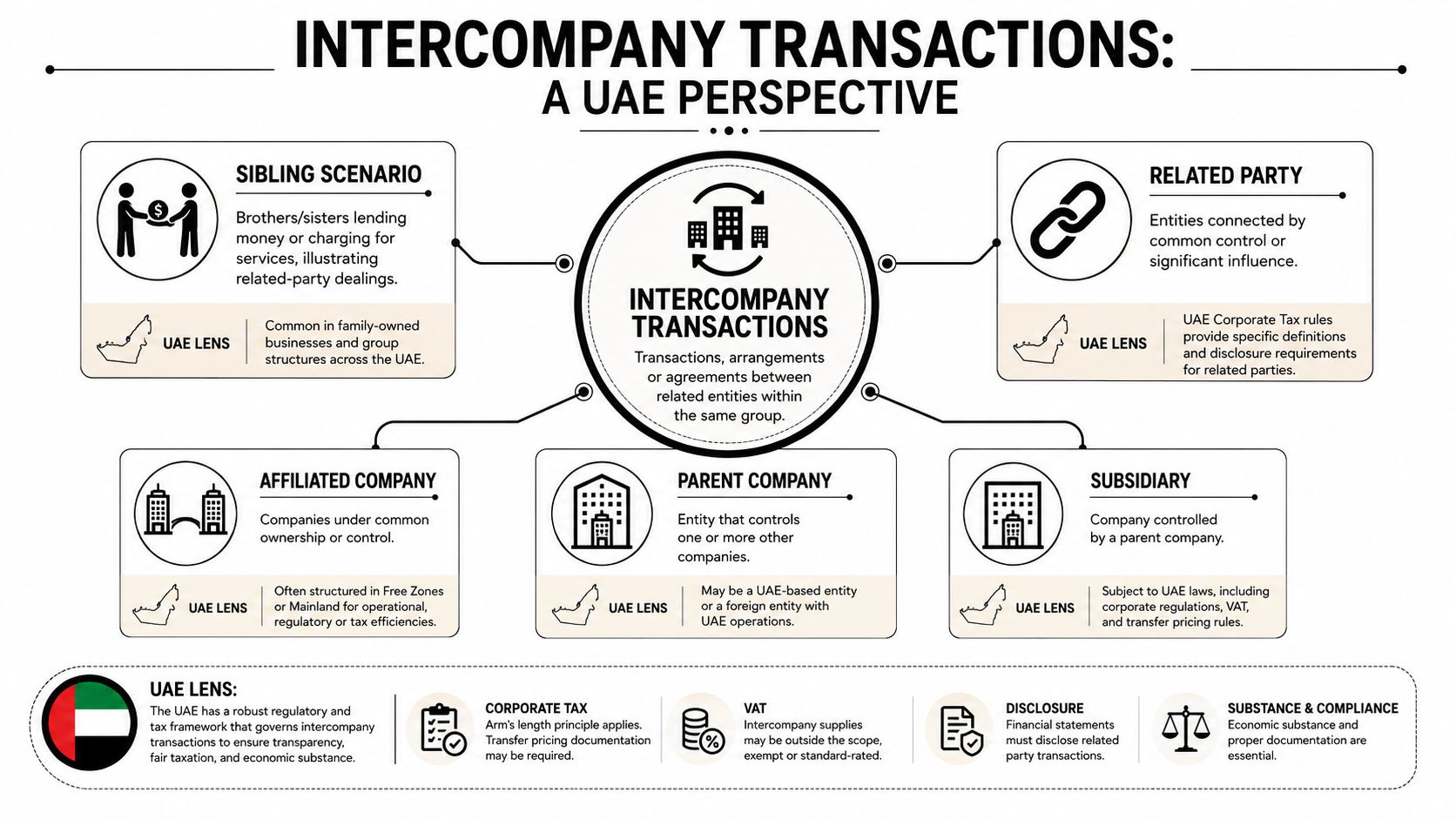
Most readers grasp intercompany transactions faster with a family analogy. Think of two siblings who each run a separate shop. One lends money to the other, or one charges the other for storage space. They know each other well, but if tax rules ask whether the price is fair, “we're family” isn't enough. They need to show that the terms make commercial sense.
That's the basic logic behind group-company dealings in the UAE.
Related parties and group relationships
A related party is a person or entity connected through ownership, control, or significant influence. In practice, that usually means a parent company, subsidiary, sister company, shareholder, or another party with a close group relationship.
You'll also hear these terms:
- Parent company means the entity that controls one or more other companies.
- Subsidiary means the company controlled by the parent.
- Affiliated company is a broader label for entities connected through common ownership or control.
These labels matter because they tell you which transactions may need special pricing support and disclosure.
The arm's length principle
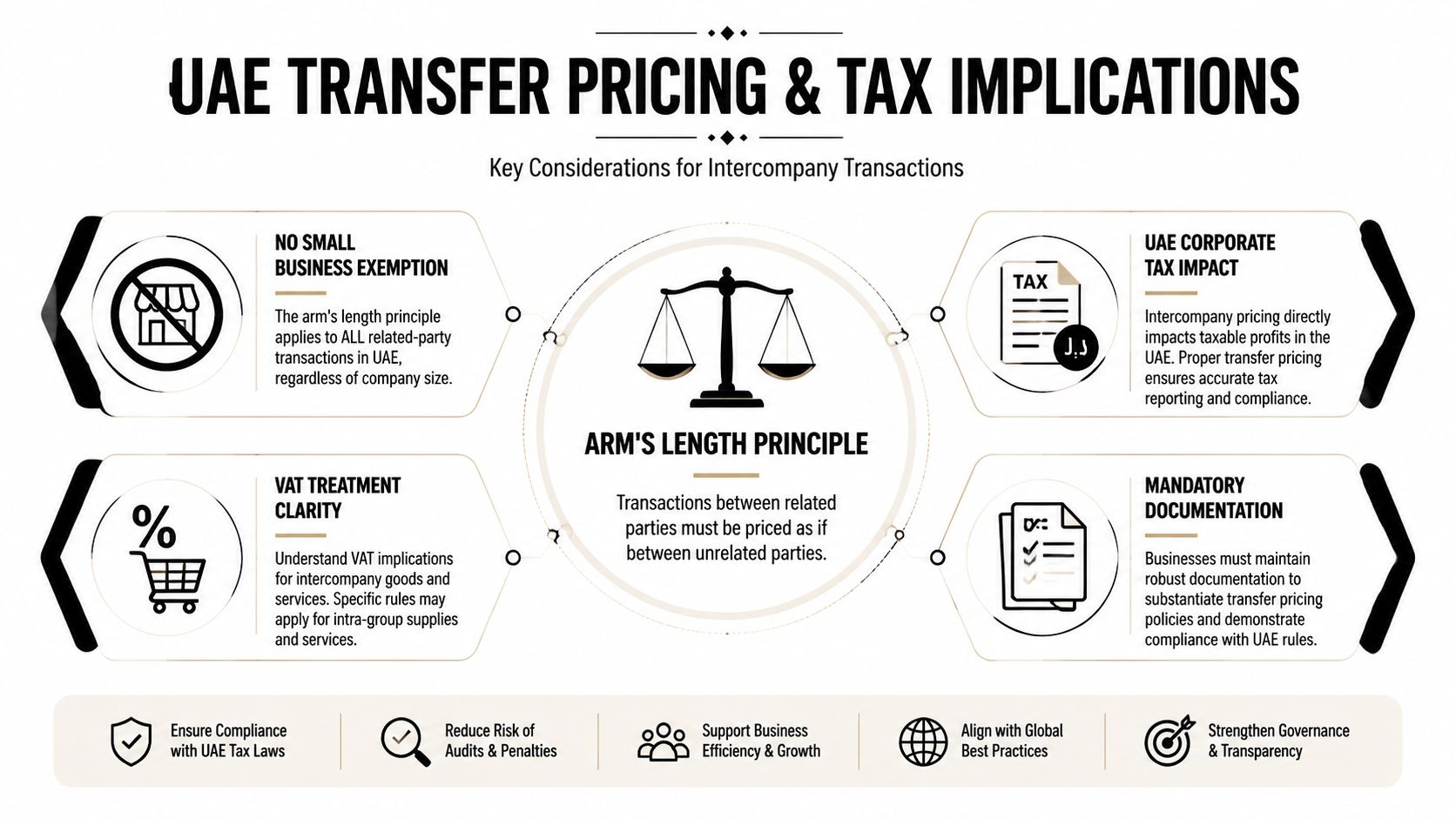
Under UAE Corporate Tax rules, related-party pricing must follow the arm's length principle. Under UAE Federal Decree-Law No. 47 of 2022, all taxable persons engaging in related-party transactions must apply that principle, with no small-business exemption for the pricing rule itself, according to this UAE transfer pricing overview.
Plainly put, if one group company charges another, the amount should reflect what independent parties would have agreed in a comparable situation.
Consolidation elimination
This is the accounting clean-up step. If Company A records intercompany revenue and Company B records intercompany expense, the group can't count both as external performance. So, during consolidation, finance removes the internal effect to avoid double-counting.
Imagine moving money from your left pocket to your right pocket. Each pocket changed, but your total cash did not.
Common Types of Intercompany Transactions
Not all intercompany transactions look the same. Some arise from normal operations, others from funding or shared support functions. The easiest way to classify them is by what is being transferred.
Comparison of common intercompany transaction types
| Type | Description | UAE Example |
|---|---|---|
| Sales of goods | One group entity sells inventory or products to another | A Free Zone entity supplies stock to a mainland trading company |
| Intra-group loans | One related company lends funds to another, often with interest | A holding company funds a newly formed operating entity |
| Management fees | One company charges for oversight, strategic, or administrative support | A head office entity recharges finance or executive support |
| Royalties | One entity charges another for using intellectual property or brand assets | A group company licences internal software or branding to another entity |
| Cost recharges | Shared costs are allocated to the entities that benefited from them | A central company recharges software subscriptions or visa-related admin support |
How these show up in practice
Sales of goods are usually the easiest to spot because they look like normal trade. One entity raises an invoice, the other records a purchase. The complexity starts when the goods are still on hand at period-end, because any internal profit in unsold inventory may need adjustment on consolidation.
Intra-group loans create accounting and tax questions at the same time. The lender records a receivable and interest income. The borrower records a payable and interest expense. The documentation should show why the loan exists, how repayment works, and why the pricing is commercially supportable.
Management fees often create confusion because teams struggle to explain what was provided. “Head office support” is too vague on its own. Finance teams usually need a service description, an allocation basis, and evidence that the receiving entity benefited.
Two transaction types people overlook
Royalties can exist even in smaller groups. If one entity owns a trademark, software, process manual, or customer-facing brand asset, another entity may be using something of value that should be documented clearly.
Cost recharges seem harmless because they often begin with a simple reimbursement. But they still need discipline. If one entity pays a supplier on behalf of another, someone should document whether that was a pass-through, a shared cost allocation, or a service with a mark-up.
A good test is simple. Ask, “What exactly moved here?” Goods, cash, services, rights, or shared cost. The accounting follows that answer.
Accounting Treatment and Consolidation Eliminations
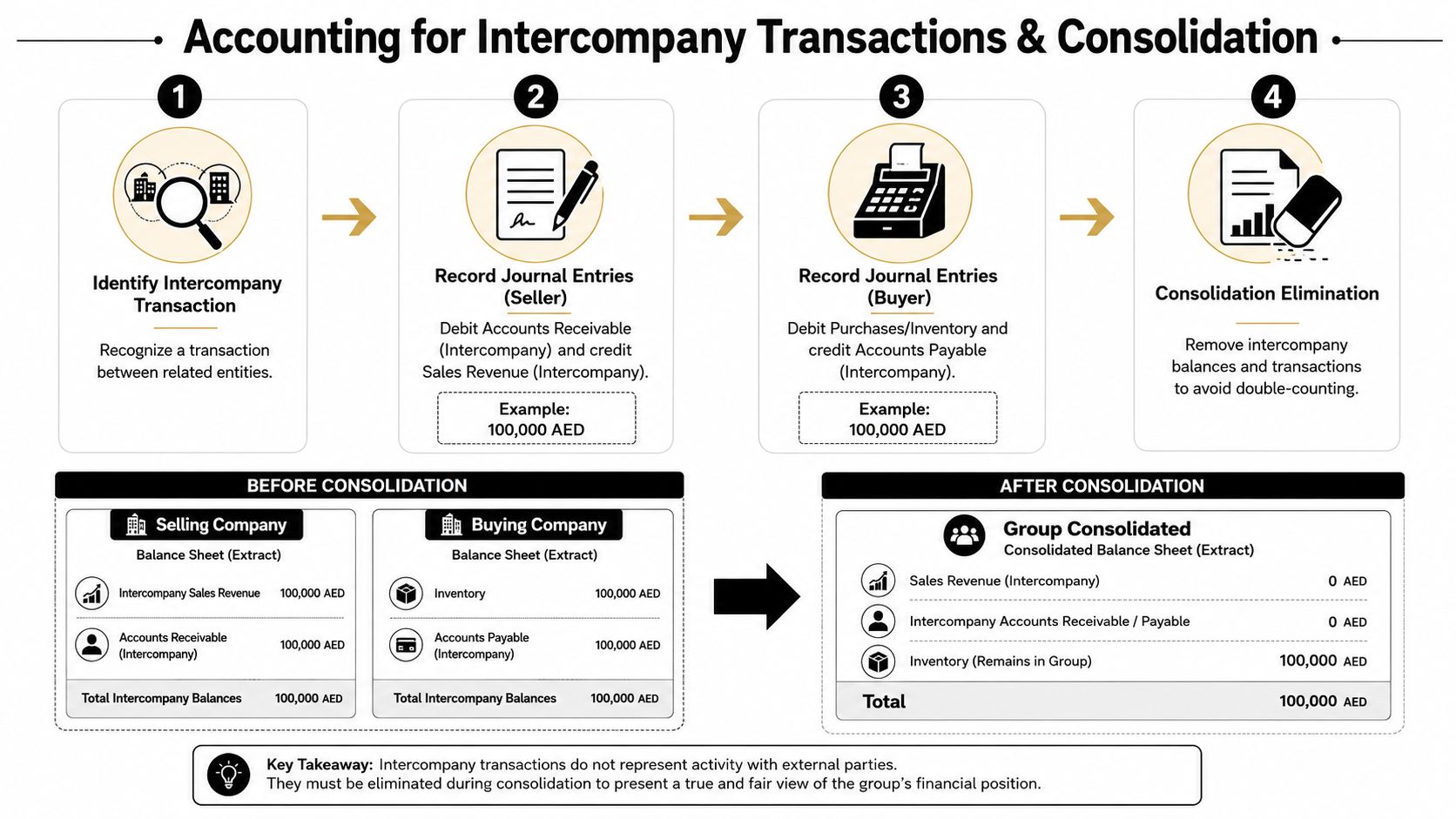
Intercompany accounting works best when finance treats it as a sequence, not a scramble. First identify the transaction. Then book both sides consistently. Then eliminate the internal effect in consolidation.
Sales between group entities
Suppose one group company sells goods to another. The selling entity typically records intercompany receivable and intercompany sales. The buying entity records inventory or purchases and intercompany payable.
At consolidation, the group removes:
- Intercompany revenue
- Intercompany cost of sales or purchases
- Intercompany receivable and payable balances
If the buying entity still holds the goods at period-end, finance may also need to remove any unrealised internal profit embedded in inventory.
Loans and interest accruals
A loan creates a balance sheet relationship first. The lender records a loan receivable. The borrower records a loan payable. As interest accrues, one entity books income and the other books expense.
On consolidation, the group generally eliminates:
- The intercompany loan balance
- Accrued interest receivable and payable
- Interest income and interest expense
The group view should show external funding costs, not internal earnings from lending money to itself.
Management fees and support recharges
Management fees often sit in overhead accounts, which makes them easy to miss during elimination. The charging entity records intercompany income. The receiving entity records expense. At consolidation, both disappear from the group profit and loss, although each entity's stand-alone books still matter for statutory and tax purposes.
For teams that want a deeper walkthrough of the mechanics, this explainer on Mastering intercompany elimination is useful because it focuses on how reciprocal balances and internal profit are removed from group reporting.
Why process discipline matters in the UAE
For intercompany billing in the UAE, all business transactions, including those with related parties, must be processed through e-invoices compliant with PINT AE specifications under the mandatory regime, as explained in this guide to UAE e-invoicing for intercompany billing.
That matters because accounting entries alone won't save a weak process. If the invoice exists but the related purchase order, goods receipt, and counterparty entry don't align, finance ends up chasing differences late in the close.
A simple monthly close routine
- Match balances early: Compare intercompany receivables and payables before month-end, not after.
- Separate intercompany accounts: Use dedicated ledger codes so internal activity doesn't get mixed into third-party balances.
- Flag timing differences: If one entity books in one period and the other books later, document it clearly.
- Review inventory positions: Unsold stock purchased from a related party may require an unrealised profit adjustment.
Transfer Pricing and UAE Tax VAT Implications
Tax is where many UAE businesses realise that intercompany transactions need more than accounting logic. A transaction can be correctly posted in the ledger and still be weak from a tax perspective if the price wasn't set on a commercial basis or if the business can't support how it arrived at that price.
The arm's length rule in practice
In the UAE, intercompany transactions between Related Parties or Connected Persons must follow the arm's length principle under Article 34 of the Corporate Tax Law. That applies to domestic arrangements such as mainland and Free Zone dealings, as well as cross-border ones, according to this analysis of UAE transfer pricing rules.
This point catches smaller groups by surprise. A one-person company with a shareholder loan can still be in scope for the pricing rule. So can a local group with no overseas parent.
Filing thresholds and documentation triggers
The disclosure thresholds are specific. Businesses with aggregate related-party transactions above AED 40 million, or AED 4 million in any single transaction category, must file a Transfer Pricing Disclosure Form with the Corporate Tax return through EmaraTax. Payments or benefits to each Connected Person above AED 500,000 trigger a separate schedule. Full Master File and Local File obligations apply to entities with revenue above AED 200 million or multinational groups with consolidated revenue above AED 3.15 billion, based on this summary of related-party transactions under UAE Corporate Tax.
For businesses below those documentation thresholds, the compliance burden doesn't disappear. They still need a written basis for how prices were set.
Practical rule: If your group can't explain the price in plain language, it probably can't defend it in an audit file either.
VAT and internal supplies
VAT adds another layer because finance teams often assume “same group” means “no tax issue”. That's not always safe. The VAT treatment of internal supplies depends on how the entities are structured and whether a VAT group exists. Routine invoicing discipline still matters, especially when goods and services move between separate legal entities.
Teams handling returns often pair transfer pricing review with a broader VAT compliance check so the invoice trail, tax treatment, and accounting records all tell the same story. If your internal processes around VAT filings need tightening, a practical reference point is this guide on VAT filing in the UAE.
A better way to think about pricing support
Rather than asking, “Do we need a long report?”, start with these questions:
- What is the transaction? Loan, goods, service, royalty, or recharge.
- Who benefits? The receiving entity should get a clear commercial benefit.
- How was the price set? Market evidence, allocation logic, or comparable commercial terms.
- What documents prove it? Agreement, invoice, calculations, approvals, and accounting entries.
That approach keeps finance and tax aligned. It also reduces the common problem where legal has a contract, accounting has a journal, but nobody has a coherent pricing story.
Documentation Controls and Reconciliations
Many UAE businesses don't fail on policy. They fail on process. The agreement says one entity sold goods to another, but the systems don't show the same event at the same time, with the same references, in both books.
That gap becomes serious when inventory moves between Free Zone and mainland entities. The lack of automated, real-time Goods Receipt visibility between buyer and supplier IT systems is identified as a key audit risk under UAE transfer pricing rules in this discussion of intercompany financial transactions and controls.
The control point most teams miss
A tax file may say the transaction was genuine. But if the buyer's ERP shows no timely goods receipt, or the supplier's system shows shipment without a matching receipt, the audit trail weakens. Finance then spends time proving commercial reality after the fact.
That's why PO-GR-invoice matching matters. Purchase order, goods receipt, and invoice should line up across both sides of the transaction, not just within one entity's system.
A workable documentation stack
Use a layered file, not a single folder of PDFs:
- Transaction register: Maintain a live schedule of all intercompany transactions by counterparty and type.
- Pricing memo: Keep a short note explaining how the price or charge was set.
- Agreement file: Store contracts, loan terms, service descriptions, and approval records.
- E-invoice evidence: Retain invoice data in the same structure used by the accounting team.
- Reconciliation support: Keep matching reports for receivable, payable, and unsettled items.
For groups refining their pricing support, this resource on benchmarking analysis in the UAE is relevant because benchmarking often sits at the centre of a defensible transfer pricing position.
Reconciliation habits that reduce friction
- Weekly matching for active entities: Don't wait until the month-end close.
- Shared reference fields: Use common PO, invoice, and shipment references across entities.
- Exception routing: Assign one owner for quantity differences, one for pricing differences, and one for timing issues.
- Cut-off review: Inspect transactions posted near period-end where one side may lag the other.
When systems don't talk to each other, accountants become messengers. That's expensive, slow, and hard to defend in an audit.
How to Implement Practical Steps and Policies
A usable intercompany policy should fit the size of the business. An SME doesn't need a bulky manual copied from a multinational. It needs a short document that tells staff what to do, who approves it, what evidence to keep, and how the accounting flows.
A practical implementation sequence
Start with the legal foundation. Put intercompany agreements in place for loans, management services, goods supply, or IP use. Then map the accounting entries for each recurring transaction type. After that, align invoicing, approvals, and reconciliation timing.
A basic roadmap looks like this:
- List every group entity and identify which ones transact with each other.
- Define transaction types so staff know whether an item is a sale, service, recharge, royalty, or loan.
- Assign approval owners for pricing, contracts, invoicing, and settlement.
- Create journal templates for recurring entries.
- Set a reconciliation calendar with clear deadlines and escalation rules.
SME checklist with relief in mind
Entities qualifying for Small Business Relief in the UAE are exempt from preparing Master File and Local File, though they must still apply the arm's length principle, according to the UAE Transfer Pricing Guide.
That's an important nuance for startups and smaller groups. It means you may not need full-scale documentation, but you still need disciplined pricing and records.
A lean SME checklist can include:
- Short-form intercompany policy: A concise document covering pricing logic, invoice flow, and approval steps.
- One-page pricing notes: Keep a practical rationale for each transaction type.
- Template agreements: Use standard wording for common loans, services, and recharges.
- Monthly counterparty confirmations: Confirm balances between entities before the close.
- VAT review step: Ensure each invoice is handled consistently with the underlying transaction.
Sample journal templates
Here are simple examples finance teams can adapt:
Goods sale
- Seller records intercompany receivable and intercompany sales
- Buyer records inventory or purchases and intercompany payable
Management fee
- Charging entity records intercompany receivable and fee income
- Receiving entity records expense and intercompany payable
Loan interest accrual
- Lender records interest receivable and interest income
- Borrower records interest expense and interest payable
If your team is formalising tax and accounting support together, this overview of VAT consultancy in Dubai is a useful reference point for joining process design with compliance review.
A good intercompany policy doesn't try to sound impressive. It gives staff a repeatable way to book, bill, match, and defend internal transactions.
If your business is setting up a UAE entity, managing mainland and Free Zone operations, or tightening VAT-compliant accounting processes, Smart Classic Business Hub can help you organise the practical side of compliance. Their Dubai-based team supports company formation, accounting, VAT, audit coordination, and business advisory so founders and SMEs can build cleaner financial processes from the start.