
You've probably done this already. You open Google Maps, shortlist Jebel Ali, Al Quoz, Dubai Industrial City, DIP, maybe Ras Al Khor, then every option starts to look “strategic” on paper. Each zone promises access, infrastructure, growth, and incentives. None of those brochures shows you where margin gets squeezed after year one.
That's the core challenge with industrial areas in dubai. The wrong choice usually doesn't fail on day one. It fails slowly through renewal costs, customs friction, utility requirements, delivery delays, unsuitable zoning, or a location that works for your first 10 staff but not your first serious production run.
The practical question isn't which zone sounds impressive. It's which location fits your customer base, your supply chain, your compliance burden, and your next phase of growth without forcing a restructure six months later.
Choosing Your Industrial Base in Dubai
A founder setting up a packaging unit or light assembly business usually starts with the same assumption. Find a warehouse, get the licence, start operations. In Dubai, that approach is too simplistic because the address affects customs treatment, transport timing, licence structure, staffing movement, and future expansion.
A business serving UAE wholesalers has very different needs from a manufacturer shipping regionally. One may need direct mainland market access and a central delivery radius. The other may need cleaner export flows and infrastructure built for industrial throughput. Those two companies should not choose the same zone just because both need “warehouse space”.
Practical rule: pick the business model first, then the zone. Never reverse that order.
Industrial areas in dubai are best treated as operating environments, not just real estate options. Some zones are flexible and central. Others are purpose-built and more efficient for manufacturing. Some are stronger for import-export. Others work better for local distribution, workshops, and hybrid industrial-commercial activity.
That distinction decides whether your setup stays efficient or becomes expensive to maintain.
Understanding Dubai's Industrial Ecosystem
Dubai didn't build industrial zones by accident. The emirate used them as part of a broader diversification strategy, and that's visible in the structure of the market today. Industrial areas in dubai aren't one uniform category. They are specialised operating clusters with different jurisdiction rules, infrastructure profiles, and commercial logic.
Why the network matters
The scale of the network shows how seriously Dubai treats industrial development. Al Quoz Industrial Area spans 1,838 hectares, while Ras Al Khor Industrial Area covers 661 hectares, Al Qusais 545 hectares, Um Ramool 391 hectares, Jebel Ali Industrial Area 84 hectares, and Al Safa 20 hectares, with Al Safa specialised for consumer food production, according to the listing of Dubai industrial areas. The same source notes that Dubai Industrial City reached 97% land occupancy in Q1 2024, up 12% year-on-year, and its customer base expanded 17% to over 1,000 companies in 2023.
Those figures tell you something practical. Good industrial stock gets absorbed quickly. If you wait until your licence is almost ready to start looking seriously at space, your shortlist may already be gone.
For businesses evaluating manufacturing specifically, it helps to understand how the broader UAE manufacturing industry is shaping location demand and sector fit.
Mainland and free zone are not interchangeable
The first filter is jurisdiction.
Mainland industrial areas are generally better suited to businesses that want direct access to the UAE domestic market. If your buyers are retailers, contractors, wholesalers, workshops, or institutional clients inside the country, mainland usually gives you cleaner commercial movement.
Free zones are built differently. They appeal to foreign investors because they offer 100% foreign ownership in zones such as Dubai Industrial City, and they are often structured for import, manufacturing, storage, and re-export. That model works well when your goods enter Dubai, get processed or stored, then leave again.
Here's the mistake many new entrants make. They hear “free zone” and assume it is automatically cheaper or better. It isn't. It's better only when your trade flows match the zone's strengths.
Think of zones as a toolkit
A simple way to assess industrial areas in dubai is to think of them as a toolkit:
- JAFZA: strongest when your business depends on port-linked trade and export movement.
- Dubai Industrial City: strongest when sector-specific manufacturing infrastructure matters.
- Al Quoz: strongest when central access and urban distribution matter more than export efficiency.
- Ras Al Khor and Um Ramool: useful when you want practical access, established industrial surroundings, and mainland functionality.
- DIP and Dubai South: attractive for firms that want a more planned environment with room to scale.
A zone should solve an operational problem. If it only solves a branding problem, it's the wrong zone.
A Profile of Key Dubai Industrial Zones
A manufacturer takes a cheaper unit because the brochure looks good. Six months later, trucks lose time on every run, approvals are slower than expected, and the power and fit-out specification no longer suits production. Zone selection usually fails at the operating model stage, not the viewing stage.
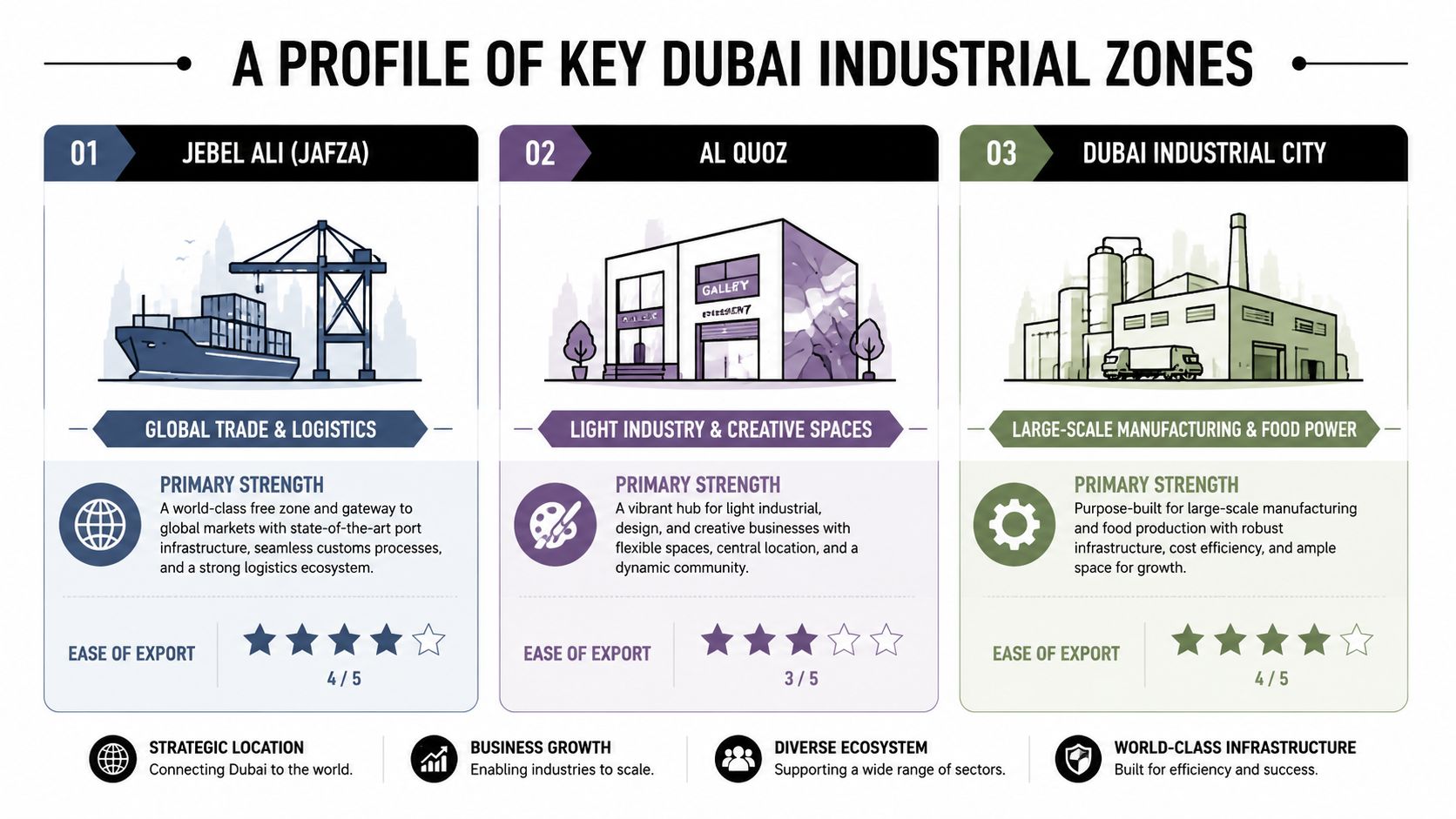
Dubai Industrial Zones At-a-Glance
| Zone | Best For | Jurisdiction | Key Advantage |
|---|---|---|---|
| JAFZA | Import-export, regional distribution, port-led operations | Free zone | Strong customs and logistics alignment |
| Dubai Industrial City | Manufacturing, sector-cluster operations, scalable industrial plots | Free zone | Purpose-built industrial ecosystem |
| Al Quoz | Light industry, workshops, urban fulfilment, mixed industrial use | Mainland | Central Dubai access |
| Ras Al Khor | Trading, workshops, practical mainland operations | Mainland | Useful access to wider Dubai road network |
| Dubai Investment Park | Mixed industrial and commercial occupiers | Mixed-use environment | Flexible business environment |
| Dubai South | Airport-oriented logistics and future-facing industrial setups | Free zone-oriented ecosystem | Proximity to major aviation and logistics infrastructure |
| Um Ramool | Airport-adjacent operations and smaller industrial users | Mainland | Good fit for time-sensitive movement |
JAFZA for port-led trade and tighter shipping control
JAFZA suits businesses that make money from import, storage, consolidation, and re-export. If container flow, customs handling, and port proximity sit at the centre of your margin, JAFZA usually stays on the shortlist.
The trade-off is straightforward. Occupancy costs and operating rules only make sense if cargo movement is the commercial priority. For a business selling heavily into the local UAE market, the wrong JAFZA setup can add handling steps, customs complexity, and delivery friction that erase the headline advantage. A clearer legal comparison sits in this guide to mainland vs free zone business setup in Dubai.
Dubai Industrial City for manufacturers planning beyond basic warehousing
Dubai Industrial City works best for businesses that need industrial logic built into the location. TECOM Group describes it as a district developed for manufacturers and industrial operators, with sector focus across food and beverage, base metals, machinery, transport, chemicals, and minerals, as noted on the Dubai Industrial City official overview.
That matters because manufacturing costs rarely sit only in rent. They sit in utility reliability, plot configuration, heavy-vehicle circulation, staff access, waste handling, and how easily a unit can be adapted as production expands. DIC usually performs better than a generic warehouse district when the business expects larger compliance demands, more technical fit-out, or phased growth from storage into full production.
Al Quoz for urban service radius and mainland practicality
Al Quoz remains one of the most usable mainland industrial districts for light industry and fast citywide access. It suits joinery, fabrication, automotive activity, repair businesses, service-linked storage, and urban distribution models where being closer to clients matters more than being closer to the port.
The downside is operational density. Access is good, but traffic, loading constraints, and mixed neighbouring uses can create friction for businesses that need a cleaner industrial environment or larger-format vehicle movement.
Dubai Investment Park and Dubai South for planned expansion
DIP tends to work well for operators who need a mixed environment rather than a pure industrial cluster. Businesses often choose it because they want warehouse space, office support, staff convenience, and room to scale without relocating too early.
Dubai South suits firms planning around aviation-linked cargo, future logistics throughput, or larger regional distribution patterns. The location can be strategically strong, but it only pays off if the transport profile matches the business. If day-to-day sales happen inside older Dubai trade corridors, distance can become a recurring cost.
Ras Al Khor and Um Ramool for function over branding
Ras Al Khor continues to attract trading companies, workshops, and practical mainland operators that want workable access without paying for a premium address. For some businesses, that is the right call. Customers do not pay extra because the warehouse sits in a better-known district.
Um Ramool serves a narrower use case. It fits airport-adjacent activity, repair operations, smaller industrial users, and firms with frequent air cargo requirements. Space can be harder to standardise there, so suitability depends heavily on the actual unit, not just the pin on the map.
Demand pressure is changing the pricing conversation
Analysts at CBRE reported in the UAE industrial market review that rental registrations increased year on year to Q3 2024, and 2023 Grade B rents rose sharply in both JAFZA and DIC.
For occupiers, the implication is practical. Good stock moves quickly, and replacement options are not always comparable once ceiling height, loading access, power capacity, licence fit, and truck circulation are reviewed properly.
A cheaper unit in the wrong zone often costs more over a two or three-year period. The extra cost shows up in transport time, retrofitting, permit work, labour inefficiency, and missed throughput. That is the true comparison to make.
Mainland vs Free Zone What to Actually Consider
Most founders get distracted by one headline: 100% foreign ownership. It's important, but it's not the decision. The primary decision is whether the jurisdiction matches the way your business earns money every day.
Start with customer flow, not ownership
If your core buyers are inside the UAE, mainland is often the cleaner operational answer. You can structure your sales, deliveries, and service relationships around local demand without building workarounds into the model.
If you are importing raw materials, manufacturing or assembling, then re-exporting, a free zone setup can be far more efficient. In that case, the customs environment and zone structure may do more for your margin than a central mainland address ever could.
For a clearer breakdown of legal and operational differences, this guide on mainland vs free zone in Dubai is worth reviewing alongside your financial model.
The hidden cost layer most proposals skip
Many businesses make the wrong call at this stage. The proposal highlights incentives, but the ongoing operating structure tells the true story. According to the review of Dubai South free zone setup considerations, SMEs need to factor in variable annual licensing fees, mandatory PRO service costs ranging from AED 2,000-5,000 annually, and differing utility deposits and infrastructure charges between zones.
That doesn't mean free zones are poor value. It means headline incentives are incomplete without full cost modelling.
A practical comparison should include:
- Annual renewals: licence renewal costs vary by zone and activity.
- PRO support: some businesses underestimate how often document handling becomes an annual operating item.
- Utility and infrastructure charges: these differ meaningfully depending on the zone and unit type.
- Sector compliance: food, chemical, and industrial processing activities can trigger extra approvals, fit-out requirements, or operational controls.
What works and what doesn't
What works is choosing a zone that matches your revenue geography.
What doesn't work is picking a free zone for prestige, then discovering your real business is local B2B supply across the UAE.
What works is comparing occupancy cost, customs treatment, approvals, and movement patterns together.
What doesn't work is comparing setup packages only.
A low first-year setup figure can hide an expensive operating model. Industrial businesses should budget for the system, not just the licence.
Navigating Logistics Warehousing and Costs
A unit can look efficient on paper and still bleed money once operations start. I see this often with industrial businesses that focus on annual rent, then discover the actual cost sits in truck waiting time, poor yard flow, customs handling, and longer daily runs between port, warehouse, and customer sites.
The value of proximity
For industrial occupiers, location affects operating cost every day. Proximity to Jebel Ali Port, Al Maktoum International Airport, and the main freight corridors changes delivery windows, fleet use, driver productivity, and how much buffer stock you need to hold.
That matters more for some models than others. A light storage business can tolerate a less efficient route if rent is lower. A manufacturer moving imported inputs and outbound pallets every day usually cannot. In those cases, a cheaper unit in the wrong area often becomes the more expensive choice within a few months.
If your team is building a cross-border distribution model, this resource on mastering international fulfillment in 2026 gives a useful external view of how fulfilment design affects international operations beyond the warehouse itself.
Rent is only one line item
Warehouse cost needs to be modelled as total occupancy cost plus movement cost. That includes transport mileage, driver hours, queueing at loading points, internal handling constraints, utility setup, and whether the unit supports your process without expensive modification.
Classification work also affects cost earlier than many founders expect. If your goods fall into multiple product categories, import, storage, and resale planning can become messy fast. This guide to the HS code process in Dubai is useful if you need to classify goods properly before committing to a warehouse, stock profile, or customs flow.
One wrong assumption here creates knock-on cost. Extra documentation, reclassification issues, or unsuitable storage conditions usually show up after lease signing, when change becomes expensive.
How to assess a unit properly
A proper site visit should test operating reality, not just the brochure.
- Check truck access: confirm approach roads, turning space, entry controls, and whether heavy vehicles can move without delay.
- Inspect loading layout: look at dock height, yard depth, loading sequence, pallet movement, and stacking practicality.
- Review power and utilities: manufacturing and processing users should confirm load capacity, water, drainage, ventilation, and any fit-out limits.
- Time the route in working hours: test realistic journeys to port, airport, suppliers, labour accommodation, and major customers.
- Ask about constraints in writing: some units have limits on operating hours, noise, hazardous materials, or vehicle parking.
- Check expansion options: growth is easier and cheaper when adjacent space or a second unit is realistically available.
A low-rent warehouse with poor access, weak utilities, or higher transport drag usually costs more to run than a better-positioned unit with a higher headline lease.
Your Location Selection Checklist
Most poor location decisions come from rushing the sequence. Businesses view one warehouse, like the price, then try to force the licence and operating model around it. The better approach is to narrow the business logic first, then test sites against it.

Internal review before you visit any site
Start with your own operation.
Define the exact activity
“Manufacturing” is too broad. You need the specific activity, product type, and whether you are assembling, processing, storing, trading, or exporting.Map the supply chain
List where inputs come from, where goods go, and whether your revenue depends more on local delivery or re-export movement.Project your real footprint
Don't size the facility only for launch. Add realistic room for inventory flow, machinery, staff movement, and near-term growth.
Shortlisting zones the right way
Once the internal review is done, shortlist only a few zones. More than that usually creates noise rather than clarity.
Use these filters:
- Jurisdiction fit: mainland for direct local market access, free zone for the right kind of import-export model.
- Operational fit: manufacturing clusters, mixed-use areas, central distribution, or airport-port alignment.
- Occupancy fit: not just base rent, but renewals, deposits, fit-out needs, and support costs.
- Labour fit: daily staff movement and practical accessibility.
Due diligence on the ground
This is the stage many founders underweight.
- Visit at working hours: traffic, loading activity, and surrounding business mix look different in the middle of the day than in a broker tour.
- Confirm zoning acceptance: never assume your activity is permitted because a nearby unit looks similar.
- Check unit condition closely: ceiling height, floor load, ventilation, fire safety configuration, and service access all matter.
- Ask expansion questions early: growth options are easier to negotiate before you sign.
- Review documents with specialists: lease terms, licence alignment, and authority approvals should all match the operating model.
Final decision test
Before signing, ask one blunt question: if the business doubles faster than expected, will this location still help, or will it force a move?
If the answer is “we'll deal with that later”, the site is probably too short-sighted.
How Smart Classic Streamlines Your Setup
Industrial setup decisions in Dubai look simple from a distance and become technical very quickly once licences, jurisdiction, premises, and approvals start overlapping. That's where execution quality matters.
Smart Classic Business Hub helps founders and investors make the location decision as a business decision, not just a paperwork exercise. That means comparing mainland and free zone options against actual customer flow, likely compliance obligations, and ongoing occupancy costs. For industrial businesses, that distinction prevents expensive mistakes that only show up after launch.
The practical value is in coordination. A proper setup requires the licence path, unit suitability, documentation, approvals, PRO support, VAT-aware structuring, and future operating needs to line up. When those pieces are handled separately, delays and mismatches become common. When they are handled together, the setup moves with fewer surprises.
This is especially useful for manufacturers, traders, warehouse operators, and import-export businesses that need more than a standard company formation package. The right support should test feasibility, flag hidden cost areas, and make sure the chosen industrial area still works when the business grows.
Frequently Asked Questions
Which industrial area is best for a manufacturing startup in Dubai
That depends on what you manufacture and where you sell. If your operation is export-oriented and needs a more purpose-built industrial setting, Dubai Industrial City often makes sense. If your business serves customers inside Dubai and needs central access, a mainland area such as Al Quoz or Ras Al Khor may be more practical.
Is a free zone always better for foreign investors
No. A free zone can be an excellent fit, especially when import-export, warehousing, or regional distribution is central to the business. But if your commercial activity is mainly inside the UAE market, a mainland setup may create fewer operational constraints.
What hidden costs should I budget for beyond the setup quote
Budget for annual licence renewals, PRO support, utility deposits, infrastructure-related charges, fit-out requirements, and activity-specific approvals. Those items affect total cost of ownership more than many first-time founders expect.
Should I lease a ready warehouse or take land for custom development
Ready units are usually faster for market entry and lower complexity. Custom land or built-to-suit options make more sense when your production line, utility needs, or compliance profile can't be handled well in standard stock.
How important is sustainability when selecting a zone
It's becoming a strategic factor, not just a compliance issue. With the UAE's Green Growth Strategy and Dubai Law No. 18 of 2024 for waste management, companies need to assess which zones have invested in wastewater treatment and waste management facilities to reduce future compliance costs and regulatory risk, as noted in the UAE clean tech and environmental technologies commercial guide.
What should I verify before signing a lease
Verify that your exact activity is approved for the premises, that the lease terms match your licence path, that the unit supports your operational load, and that the access, loading, and expansion options suit the business you expect to run after launch, not just on opening day.
If you're weighing industrial areas in dubai and want a setup plan based on operating reality rather than brochure claims, Smart Classic Business Hub can help you compare zones, model total cost of ownership, and complete the right mainland or free zone structure with less risk and less wasted time.