
You're probably doing what most new UAE founders do. You're reviewing licence costs, visas, fit-out, payroll, internet, furniture, insurance, maybe a first accountant. Then someone asks about the pantry, and the coffee machine gets treated like a minor purchase.
That's a mistake.
Office coffee makers sit in the same category as printers, routers, and meeting room screens. They look small on paper, but they affect the working day every single day. Buy the wrong machine and staff queue, supplies run out, maintenance becomes a nuisance, and the whole thing turns into a low-grade office irritation. Buy the right one and you've solved a basic operational need with very little management overhead.
Why the Right Coffee Machine is a Strategic Business Decision
In a UAE office, coffee isn't an optional extra. It's part of how the day runs. Staff arrive, clients drop in, informal chats happen between tasks, and short breaks reset attention better than forcing people to stay glued to their desks.
According to an Ifop/Nespresso study referenced here, 75% of employees drink at least one cup of coffee during their work day. That's enough to stop treating coffee provision as a lifestyle choice. It's a workplace utility.
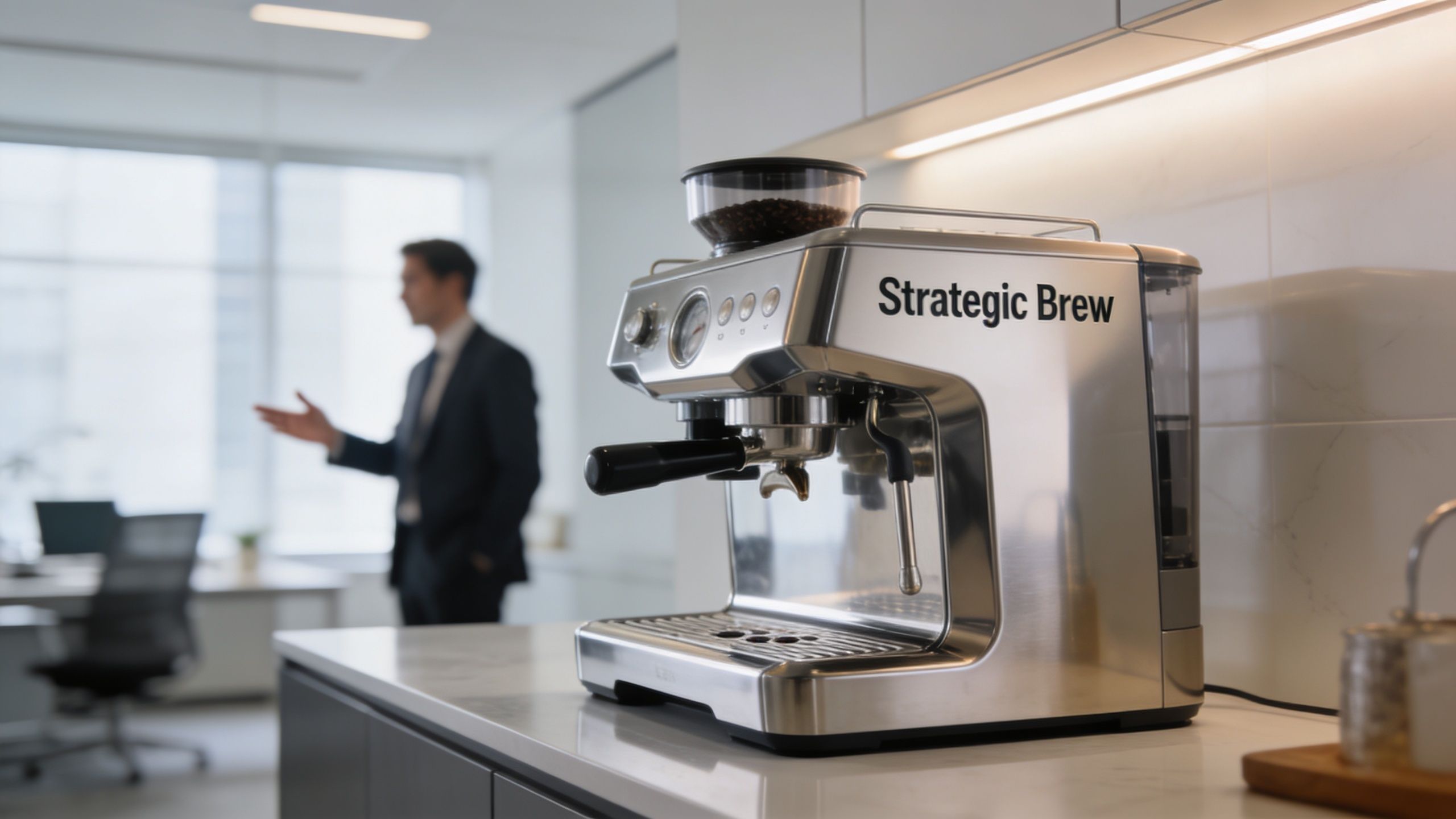
What founders usually get wrong
Most founders focus on the sticker price. They compare one machine against another as if they're buying a kettle. That's the wrong lens.
The right question is this. What machine will serve your team reliably, with acceptable running cost, without becoming an operational distraction?
That means thinking about:
- Daily use reality: Will people want quick black coffee, milk-based drinks, or both?
- Client impression: If visitors sit in your office, poor coffee sends a message.
- Maintenance burden: If no one in the office wants to clean the machine, don't buy a fussy one.
- Workflow impact: A machine that creates queues during morning arrival is a bad asset.
Practical rule: If a machine needs constant staff intervention, it's not an office solution. It's a hobby.
A useful outside perspective is this guide for office facilities managers, which aligns with what I advise clients. Match the machine to the team, not to the founder's personal coffee taste.
Why this matters in Dubai
Dubai offices are often compact, fast-moving, and client-facing. Teams are mixed. Some people want speed, some want quality, and some want both. If you ignore that reality, the office coffee setup becomes another procurement regret.
Treat office coffee makers as a small but recurring business decision. That's exactly what they are.
Choosing Your Machine Types and Technology
The market gives you four practical categories. Bean-to-cup, capsule or pod, filter drip, and percolator. Each has a place. Most businesses waste money when they buy a machine type that doesn't match their team size or maintenance tolerance.
Office coffee technology changed sharply after the 1972 introduction of the Mr. Coffee automatic drip machine, and later bean-to-cup systems pushed convenience and freshness together, as outlined in this history of coffee machines. That matters because today's office buyer isn't choosing between “coffee or no coffee”. You're choosing between automation levels.
Comparison of Office Coffee Maker Types for UAE Businesses
| Machine Type | Ideal Office Size | Upfront Cost (AED) | Avg. Cost Per Cup (AED) | Maintenance Level |
|---|---|---|---|---|
| Bean-to-cup | Medium to large offices | Higher | Lower to moderate over time | Medium to high |
| Capsule or pod | Small offices or executive rooms | Moderate | Higher | Low |
| Filter drip | Medium offices and cost-focused teams | Low to moderate | Lower | Low to medium |
| Percolator | Basic, high-volume black coffee use | Low to moderate | Lower | Low |
Bean-to-cup machines
This is my default recommendation for businesses that want a professional result without hiring a barista. You get fresh grinding, one-touch drinks, and a better impression on staff and visitors.
They're best for offices that care about coffee quality and expect regular use. They also make sense where leadership doesn't want staff spending time assembling manual brews.
The downside is obvious. More moving parts mean more cleaning and more things that can go wrong if nobody owns the process.
Capsule or pod machines
Pod machines are convenient. They're tidy, easy to operate, and good for small teams, private cabins, and boardrooms where drink variety matters more than cost discipline.
They're also the easiest system to misuse. People see the modest purchase price and ignore the recurring supply bill, storage needs, and waste. If you're running a lean SME, pods can become expensive admin disguised as convenience.
Pod systems suit low-volume, high-convenience environments. They're usually a poor main machine for a growing office.
Filter drip machines
For many UAE SMEs, this is the most sensible choice. Filter drip is simple, familiar, and economical. If your team mainly drinks standard black coffee, don't overcomplicate the decision.
A good drip machine is often better for operations than a fancy machine nobody maintains properly.
Percolators
Percolators still have a place in straightforward, high-volume environments where nobody expects speciality drinks. They're functional, not aspirational.
If your office culture is basic and practical, that's fine. Not every team needs cappuccinos.
My blunt recommendation
Pick by business reality:
- Choose bean-to-cup if your office is client-facing and coffee quality matters.
- Choose filter drip if you want dependable value.
- Choose pods only for smaller teams, executive spaces, or as a secondary machine.
- Choose percolators if speed and volume matter more than variety.
Sizing Your Solution by Staff Count and Consumption Patterns
Most companies size office coffee makers the wrong way. They ask, “How many cups do we drink in a day?” That's not the number that causes trouble.
The number that matters is peak demand.
Professional coffee planning should focus on rush periods, not daily totals. The busiest windows typically hit in the morning and again after lunch, and this office coffee maker capacity guide notes that a typical bean-to-cup machine produces 4-6 specialty drinks per hour, while a commercial drip brewer handles 12-15, with a minimum capacity of 40 cups per hour recommended for an office of 15-25 staff.
Use a simple peak-demand test
Start with this internal question: how many people are likely to want coffee within the same short window?
Don't count everyone in the company. Count the cluster. In many offices, a large share of coffee demand lands shortly after arrival, then repeats after lunch. That's where bottlenecks happen.
Use this practical formula:
- Estimate how many staff drink coffee during the same break window
- Estimate how many cups they'll want in that period
- Compare that with machine output per hour
- Add buffer for visitors, slower drink selection, and cleaning interruptions
If you're fitting out one of the smaller office spaces in Dubai, this calculation matters even more because pantry space is limited and queues become visible immediately.
What this means in practice
A bean-to-cup machine sounds premium, but if it only handles a modest number of specialty drinks per hour, it can frustrate a team during a rush. A drip brewer may feel less glamorous, yet it often performs better operationally for standard coffee service.
That's why I often recommend a mixed setup instead of a single “do everything” machine.
For example:
- Main team demand: Use drip for volume
- Leadership or guest area: Add a compact pod or bean-to-cup machine
- Small office with mixed tastes: Use one practical machine and keep the drink menu simple
If staff walk away because the queue is too long, the machine is undersized. It doesn't matter how good the coffee tastes.
The common sizing mistake
Founders often buy for current headcount only. Bad idea. If you expect hiring, buy for the near-term working pattern, not just day one occupancy.
Capacity problems don't show up on the invoice. They show up on Monday morning.
Managing the Total Cost of Ownership in the UAE
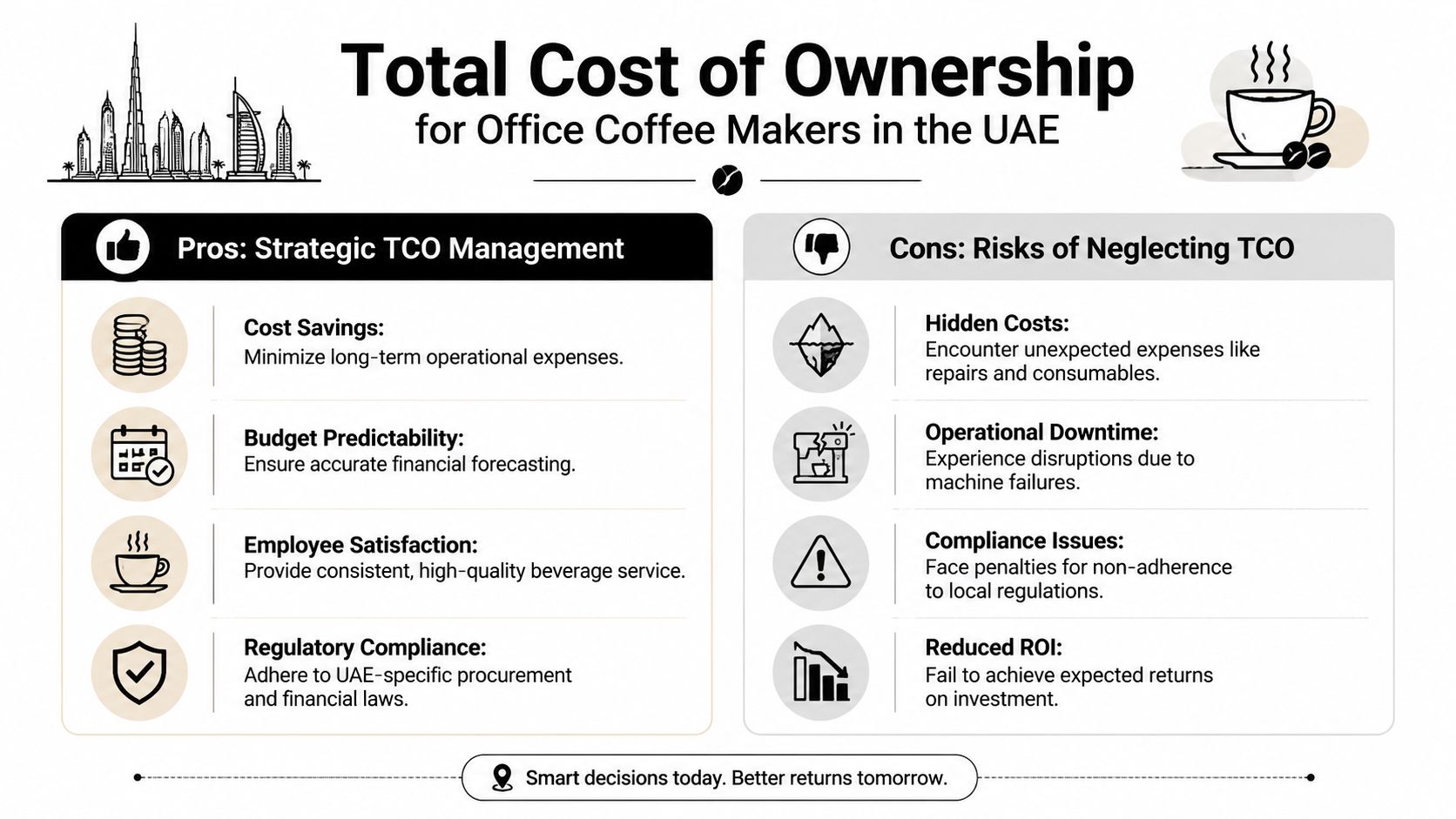
The purchase price is the least interesting number in this decision. Total cost of ownership decides whether the machine was a smart buy or a cheap mistake.
In Dubai, electricity, servicing, filters, cleaning products, spare parts, consumables, and downtime all sit inside the true cost. If you don't map those before procurement, your office coffee makers will cost more than expected and deliver less.
Start with the energy and ownership maths
This office coffee cost analysis gives a concrete UAE-specific benchmark. A 2,500-watt commercial brewer in Dubai can incur approximately AED 912-1,277 annually in electricity alone, and a full 3-year total cost of ownership typically ranges from AED 3,500 to AED 8,000.
That should reset your thinking immediately.
A proper TCO review should include:
- Machine cost: Purchase or lease amount
- Electricity: Ongoing utility impact
- Consumables: Beans, pods, filters, milk options, cleaning tablets
- Service support: Preventive maintenance and emergency repair
- Downtime risk: What happens when the machine fails on a workday
- Replacement cycle: Whether the machine remains fit for purpose as the office grows
Lease or buy
I'm opinionated here. Most small businesses should buy simple, durable machines and avoid complicated leases unless the service package is strong.
Buying works better when:
- You want asset control
- The machine is straightforward to maintain
- You don't want monthly contract friction
Leasing can work when:
- The machine is expensive and cash flow matters
- The agreement includes service, replacement support, and consumables management
- You need predictable monthly budgeting
But read the contract carefully. Some lease packages look clean until you see the supply lock-in, mandatory consumables, and response times for breakdowns.
The hidden cost nobody likes discussing
Pod waste.
If you choose capsule systems, you also choose disposal, storage, and recurring procurement discipline. For businesses that want a more sustainable setup, this practical resource on how to reduce coffee pod waste is worth reviewing before you lock yourself into a pod-based model.
Good procurement isn't finding the lowest purchase price. It's avoiding the most expensive long-term mistake.
My recommendation on cost control
For most UAE startups and SMEs:
- Buy a simple drip machine if cost control is the priority.
- Buy a bean-to-cup machine if the office is client-facing and you can support maintenance properly.
- Use pods selectively, not as the default whole-office solution.
- Demand a written breakdown of all recurring costs before approval.
If the vendor can't explain the ongoing costs clearly, don't buy from them.
Navigating UAE Sourcing and Financial Compliance
This is the part most businesses neglect. They spend too much time comparing coffee quality and too little time checking procurement structure, tax handling, import exposure, and accounting treatment.
That's backwards.
A coffee machine purchased for office use is still a business asset. In the UAE, that means the decision touches supplier documentation, VAT treatment, bookkeeping accuracy, customs if imported, and service-contract clarity. If you get those wrong, the machine becomes an accounting nuisance.
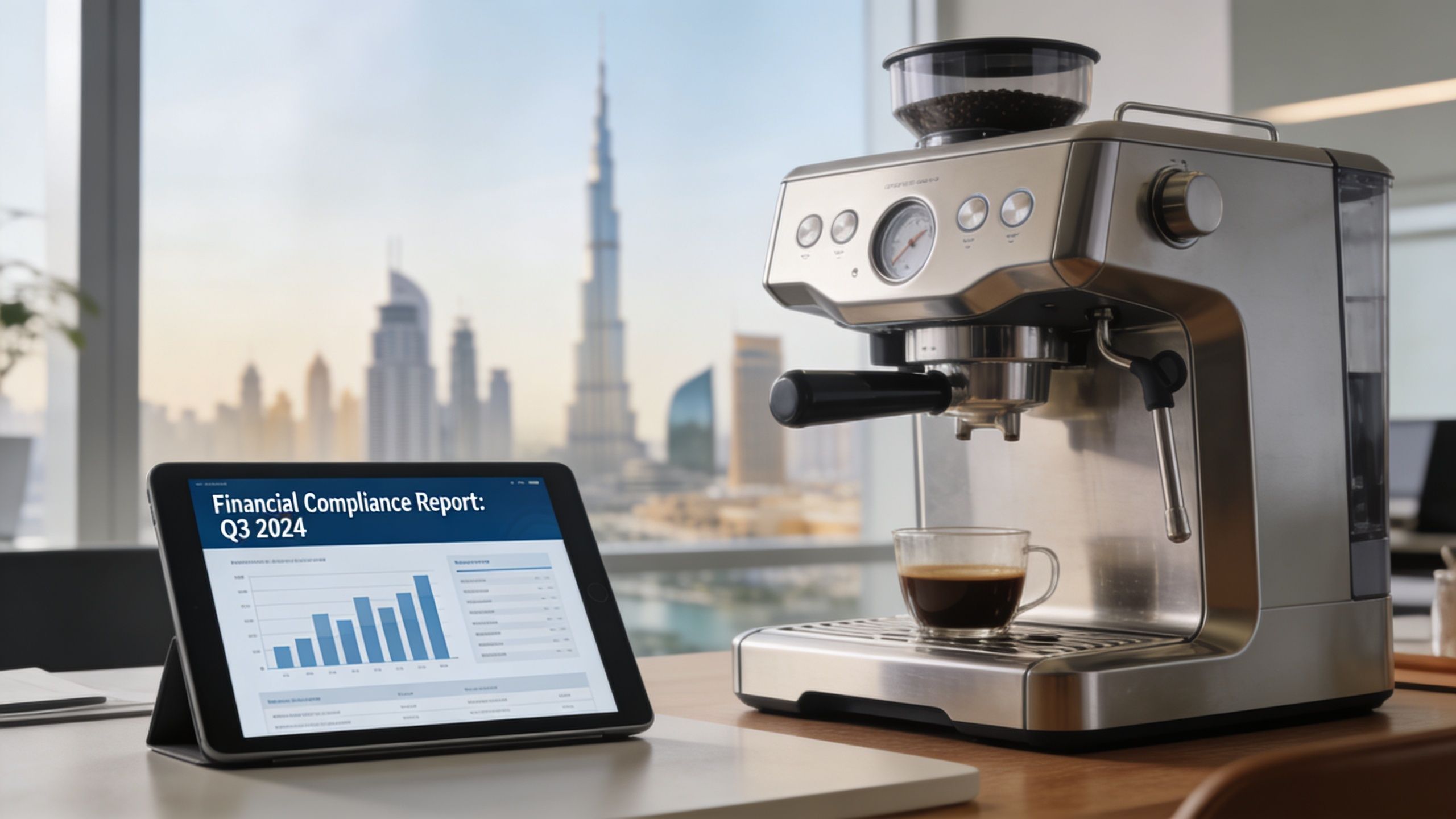
Buy from a supplier who understands business buyers
Don't buy office coffee makers the same way you'd buy a home appliance. A consumer-style seller may give you a product, but not the paperwork and support your finance team needs.
Your supplier should be able to provide:
- A proper tax invoice: Clear legal entity details, itemisation, and VAT treatment
- Warranty terms in writing: Not verbal promises from a salesperson
- Service response commitments: Especially if the machine is core to daily office use
- Spare parts access: If parts are difficult to source locally, downtime becomes your problem
- Consumables clarity: No vague lock-in arrangements
Handle VAT correctly
If your business is VAT-registered, procurement records need to be clean from day one. The machine purchase, service contract, and recurring consumables all need proper accounting support.
If your finance team is still getting organised, review the UAE process for VAT registration requirements and compliance steps before scaling operational purchases across the office.
Watch imports and customs carefully
Importing a machine from abroad can look attractive if the retail price seems lower. It often stops looking attractive once you add shipping coordination, customs handling, compatibility questions, service limitations, and replacement part delays.
For imported units, confirm:
- Commercial invoice accuracy
- Customs classification consistency
- Warranty validity inside the UAE
- Availability of local repair support
- Electrical compatibility and supplier accountability
A low purchase price doesn't help if the machine fails and no technician in Dubai wants to touch it.
Compliance is not paperwork for its own sake. It protects your tax position, your accounts, and your operational continuity.
Account for the asset properly
Your accounting team should know whether the machine is treated as a capital purchase or a smaller operational item under your internal policy. That affects how the spend is recorded and reviewed.
Just as important, separate the categories correctly:
- the machine itself
- the maintenance contract
- the consumables
- any import-related charges
Lumping all of that into a generic pantry expense creates avoidable mess later.
Beyond the Bean Coffee and Workplace Wellbeing
The smart reason to invest in office coffee makers isn't that coffee is fashionable. It's that a good office setup removes friction from the working day and supports a better employee experience.
That matters in the UAE because hiring is competitive, teams are multicultural, and workplace expectations are high. People notice the basics. They notice whether the office runs well. They notice whether management pays attention to daily working conditions.
Stop talking about morale like it's vague
Many articles claim coffee “boosts morale” and stop there. The more honest position comes from this industry discussion of office coffee solutions, which points out that many guides don't provide quantified data on productivity or retention. That gap is useful. It means founders can think more clearly instead of parroting weak clichés.
The right frame is simpler. Coffee infrastructure is part of employee experience. Not the whole thing, but part of it.
Why the coffee point matters culturally
In real offices, the coffee area does several jobs at once:
- It creates small pauses: Staff reset between tasks.
- It encourages informal interaction: Teams speak outside formal meetings.
- It improves hospitality: Visitors receive something immediate and familiar.
- It signals standards: People judge how organised an office feels.
Those outcomes don't need inflated statistics to be credible. Anyone who has managed teams knows they're real.
A practical office makes people's jobs easier. That includes the kitchen and pantry, not just the boardroom.
Treat it as a culture tool, not a gimmick
Don't oversell the machine internally. Staff can tell when management turns a basic amenity into a branding exercise.
Do this instead:
- provide a machine that works,
- stock it consistently,
- keep it clean,
- make the area presentable,
- and avoid penny-pinching that creates visible inconvenience.
That's enough.
A strong employer brand is built from repeated signals. Reliable basics matter. The office coffee setup is one of those signals.
Procurement Checklist for UAE Startups and SMEs
If you want a clean decision, use a checklist and force every supplier quote through it. That removes emotion and stops people buying a machine because it looked good in a showroom.
Pre-purchase checks
- Confirm actual use case: Is the machine for staff volume, executive use, guest service, or all three?
- Check peak demand: Base the decision on rush-hour use, not a rough daily estimate.
- Match complexity to ownership: If nobody will maintain a complicated machine, reject it early.
- Review workspace fit: Pantry size, water access, cleaning space, and waste handling matter.
Supplier and quote review
Use more than one quote. A structured office coffee vendor selection guide can help you compare providers on service terms, not just product features.
Then ask for the specifics that matter:
- Full quote detail: Machine, accessories, installation, service, VAT, and consumables
- Written warranty terms: Not sales talk
- Breakdown support: Who responds, how fast, and with what spare parts
- Consumables policy: Open supply model or restricted vendor tie-in
Finance and compliance checks
Before approval, make sure your business has its operational basics in order, especially if you're still early in your setup journey and working through wider admin tasks such as how to start a business in UAE.
Then verify:
- Invoice quality
- Correct VAT handling
- Asset recording policy
- Service contract filing
- Imported equipment documentation if relevant
Final decision rule
My advice is straightforward.
If you're a lean SME, buy the machine that your team will use easily and your accounts team can track cleanly. Don't buy the machine that makes the founder feel professional.
The best office coffee makers are the ones that fit the business, stay serviceable, and don't create admin noise.
If you are setting up or scaling in the UAE and want operational decisions handled properly from day one, Smart Classic Business Hub can help you align procurement, VAT, accounting, and business setup into one clean structure. That saves time, avoids compliance mistakes, and gives you an office that works.