
You’re ready to import. The supplier has packed the goods, the freight forwarder wants the shipment details, and then a small field on a form stops everything: HS code.
That moment catches a lot of first-time importers in Dubai. You know what you’re selling. You know your cost price, your target margin, and your launch plan. But customs doesn’t clear products based on your product name or your invoice description. Customs clears goods based on classification.
If you search hs code dubai, you’ll find plenty of basic definitions. What usually gets missed is the part that matters in real business life: how the UAE’s move to a 12-digit system changes day-to-day importing, pricing, VAT treatment, clearance speed, and risk.
Your First Step to Importing Goods into Dubai
A common first shipment looks simple on paper. A new entrepreneur orders branded drinkware, fashion accessories, spare parts, or packaged food for resale in Dubai. The supplier sends a proforma invoice. The courier or broker asks for the commodity code. Then the entrepreneur realises that “stainless steel bottle” or “phone accessory” isn’t enough.
Customs needs a recognised product identity. That identity is the HS code.

Think of it as your product’s passport. If the passport details are vague, inconsistent, or wrong, the shipment can slow down while customs asks more questions. If the code is correct from the start, the declaration, duty treatment, and compliance review become much smoother.
What new importers usually get wrong
Most beginners make one of these mistakes:
- They use a supplier’s generic description instead of checking the correct customs classification.
- They copy an old code from another country, assuming it will work in Dubai.
- They stop at a broad category and miss a more specific classification that better matches the product.
- They treat HS classification as admin work when it affects tax, timing, and landed cost.
That last point matters most. The code doesn’t just tell customs what the product is. It influences duty treatment, VAT handling, document checks, and whether the shipment attracts extra scrutiny.
Practical rule: If you can’t explain what your product is made of, what it does, and how it’s used, you’re not ready to classify it properly.
Why this matters more now
The old habit of relying on broad product labels is becoming less workable. Dubai importers now need more precision in how they describe and classify goods. That means product data, invoices, packing lists, and customs declarations all need to align.
For a startup, that can feel like red tape. In practice, it’s part of building a reliable import operation. Once you understand how the code works, you can estimate landed cost more confidently, prepare better paperwork, and avoid preventable clearance issues.
What Is an HS Code and Why It Matters in Dubai
An HS code is a standard product classification used in international trade. HS stands for Harmonized System. Customs authorities use it to identify what goods are crossing borders.
If you want a simple mental model, treat it like a global product language. A buyer may call an item a “sports top”, a supplier may call it “ladies activewear”, and your sales team may call it a “gym shirt”. Customs needs one recognised classification that cuts through all of that.
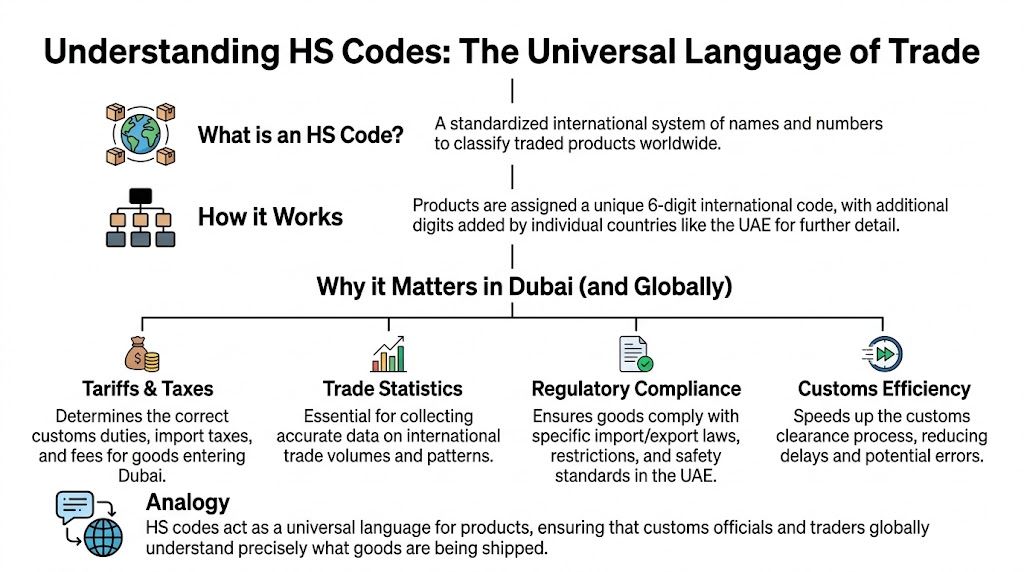
How the code is structured
At its base, the global HS system starts with 6 digits. The UAE’s customs tariff extends that structure further.
According to Dubai’s 12-digit HS code transition overview, Dubai and the UAE fully transitioned in 2026 from an 8-digit to a 12-digit HS code system, extending the global 6-digit code with six additional digits for national specificity and supporting more precise product classification. That same source notes that this supports accurate duty calculation, typically 0% to 5% for most goods.
In practical terms, importers in Dubai now have to think in layers:
- First 6 digits. The international product identity.
- Next 2 digits. GCC regional detail.
- Final 4 digits. UAE-specific detail.
If you’re still thinking only in broad 6-digit or older 8-digit terms, you can miss the level of precision now expected in declarations.
Why customs cares so much
The code isn’t there to make life difficult. Customs uses it to decide several things at once:
- Duty treatment based on the tariff line attached to that product
- VAT relevance at import stage
- Restriction checks for goods that need special review
- Trade reporting so authorities can track product flows accurately
- Clearance handling because precise classifications reduce ambiguity
That’s why hs code dubai searches often lead people into confusion. They expect a label. What they really need is a compliance decision.
Customs doesn’t clear “products”. It clears classified goods tied to a specific tariff line.
Why the 12-digit shift changes real business decisions
A broad code might once have been enough to get a shipment moving. The 12-digit approach pushes importers to be more exact. That affects how you prepare invoices, set up item masters, brief your broker, and forecast import cost before you buy stock.
It also matters when two products seem similar but are not treated identically. A product’s material, function, ingredients, or intended use can change the right classification. That’s why a founder importing accessories, packaged goods, or components can’t rely only on catalogue wording.
If you’re still fuzzy on the terminology, this plain-English guide to the Harmonized Tariff Code is useful for understanding how trade classification terms are often used across borders.
Why entrepreneurs should care early
The best time to solve classification is before you place a large order, not when the goods are already at the airport or port. If you know the likely HS code early, you can ask better questions about import cost, document requirements, and whether the product needs extra review.
That turns the code from a customs obstacle into a planning tool.
How to Find and Validate Your UAE HS Code
Finding the right HS code starts with your product, not with a search box. If you type a vague term into a tariff database, you’ll often get several close matches. The better approach is to build the product profile first, then use official tools to narrow the options.

Start with the product facts
Before you open any customs tool, write down the details that drive classification:
- Function. What does the item do?
- Material. Is it plastic, cotton, steel, leather, or mixed?
- Composition. What is it made from, especially if it has multiple components?
- Form. Is it raw material, a finished item, a part, or a kit?
- Use case. Is it for household use, industrial use, medical use, or personal wear?
- Packaging and presentation. Sometimes the way goods are presented affects how they’re viewed.
A silicone kitchen tool, for example, shouldn’t be classified the same way as a machine part made from a similar material. Function often matters more than surface appearance.
Use official UAE tools, not guesswork
The UAE’s tariff system now expects more precise classification. According to the official Integrated Customs Tariff guidance from Dubai Customs, the 12-digit tariff extends the global 6-digit HS code with UAE-specific digits, enabling more accurate classification and reducing customs verification time. The same guidance states that Al Munasiq processes plain-language product inputs, predicts codes with high accuracy, flags prohibitions, and provides duty rates. It also states that Mirsal 2 offers binding rulings through digital submissions for specialised goods.
That gives you two different tools for two different jobs.
Use Al Munasiq to narrow the likely code
Al Munasiq is useful when you already know your product well enough to describe it clearly. Enter plain-language descriptions, but make them specific.
Good input:
- “Men’s cotton knitted t-shirt”
- “Stainless steel insulated water bottle”
- “Plastic storage box for household use”
Weak input:
- “Clothes”
- “Bottle”
- “Plastic item”
The more specific your description, the more useful the prediction becomes. If the result shows multiple possible classifications, compare them against the product’s material and function. Don’t choose the first code because the wording looks close enough.
Check whether the code matches the real item
Once you have a likely tariff line, test it against the product itself.
Use this checklist:
- Does the material match?
- Does the product function match?
- Does the wording describe a finished product or only a part?
- Would a customs officer looking only at the goods agree with your classification?
- Does the tariff line trigger any restrictions, duty treatment, or review conditions you need to understand?
Many businesses make a common mistake. They find a code that feels commercially convenient, not a code that is legally defensible.
If your code only makes sense when explained by a salesperson, it’s probably too weak for customs.
When to seek a binding ruling
Some products are too specialised, too technical, or too new to classify confidently from a simple search. That includes mixed-material goods, electronics with unusual functions, machinery parts, bundled products, and products that sit between two categories.
That’s where a binding ruling matters. Through Mirsal 2, you can submit details digitally and ask customs to confirm the classification. For a business, this does something very valuable. It replaces uncertainty with a documented position.
A simple working method for importers
Here’s a practical workflow that keeps classification organised:
| Stage | What you do | Why it matters |
|---|---|---|
| Product review | Collect specs, photos, composition, and intended use | Reduces vague descriptions |
| Tool search | Check likely codes through official customs resources | Gives you a shortlist |
| Internal match test | Compare wording to the actual item | Filters out weak matches |
| Risk review | Consider duty, VAT, and restriction implications | Prevents surprises |
| Validation | Seek a ruling for complex goods | Adds legal certainty |
For regular importers, this shouldn’t be a one-off exercise. Build a product master list with the approved code, item description, supplier references, and supporting documents. That makes repeat shipments much easier to manage.
Common HS Code Examples for Dubai's Key Industries
Examples make classification easier to understand because they show how customs thinks in product terms, not marketing terms. Dubai Customs tracks foreign trade volumes by HS codes, and that data supports business planning and trade analysis through Dubai trade statistics by HS code. The same dataset context highlights specific duty examples such as 0% for pure-bred Arabic horses under HS 01011010 and sport horses under HS 01012910, and 5% for certain frozen meats under HS 02045032.
That doesn’t mean every product in a sector follows the same rate. It does show how detailed classification can shape cost expectations.
HS Code Examples by Industry in Dubai 2026 Tariff
| Product Category | Example Product | Illustrative 12-Digit HS Code | Standard Duty Rate |
|---|---|---|---|
| Live animals | Pure-bred Arabic horse | 010110100000 | 0% |
| Live animals | Sport horse | 010129100000 | 0% |
| Food products | Certain frozen meat products | 020450320000 | 5% |
| Electronics | Smartphone | 851713000000 | Check the applicable tariff line |
| Eyewear | Sunglasses | 900410000000 | Check the applicable tariff line |
| Plastics | Plastic articles under the broader 392690 family | 392690000000 | Check the applicable tariff line |
How to read these examples properly
The table is useful as a learning aid, not as a shortcut for filing declarations. A code that looks close to your product may still be wrong if your item differs in composition, breed, use, or presentation.
A smartphone is a good example. The tariff guidance notes that a code such as 85171300 becomes 851713000000 in the 12-digit system for formatting purposes. That shows the structure, but your actual declaration still needs to match the customs description and current tariff treatment attached to that item.
The same applies to categories like plastics. A broad family code may point you in the right direction, but many plastic goods need further review before you can rely on a final 12-digit classification.
Industry-specific caution points
Different sectors create different classification traps:
- Fashion and textiles often turn on fabric type, knit versus woven construction, and whether the item is apparel or an accessory.
- Electronics can hinge on principal function. A device that records, transmits, charges, or measures may belong in very different places.
- Food and beverage products often need close reading of ingredients, preservation method, and packaging form.
- Automotive parts must be checked carefully to confirm whether the item is a general-use article or a vehicle-specific component.
- Cosmetics and personal care products may involve both customs classification and separate compliance questions.
If you’re building a business that relies on local production, supply planning, or imported inputs, sector context matters as much as the product line itself. This overview of the UAE manufacturing industry is useful for understanding how imported components and finished goods fit into broader commercial activity.
A “similar product” is not a safe basis for declaration. Customs classifies the item in front of them, not the one you imported last month.
What these examples mean for budgeting
Examples help you estimate landed cost early. They also help you write better supplier instructions. If you know the likely classification family, you can ask suppliers for the exact material breakdown, function notes, and item descriptions needed to support the final code.
That’s a better way to budget than waiting for a broker to fix everything after the shipment is already moving.
The High Cost of HS Code Misclassification
A wrong HS code doesn’t create one problem. It creates a chain of problems.
The first issue is usually delay. The shipment gets flagged, questioned, or held while customs asks for clarification. Then the financial effects start to spread. Storage builds up. Delivery commitments slip. Your customer or retail launch date moves. Your finance team starts reconciling import documents that no longer match the original assumptions.
According to the UAE air cargo requirement explained in this UAE NAIC HS code advisory, the 6-digit HS code declaration mandate for air waybills took effect on 29 February 2024, and misclassification can lead to penalties up to AED 50,000+ and shipment holds. The same advisory notes that using tools such as Al Munasiq and obtaining binding rulings through Mirsal for complex goods are key ways to reduce these risks.
What a bad code can trigger
Misclassification can affect several parts of the business at once:
- Customs penalties when the declared code is inaccurate
- Shipment holds while officers review the product more closely
- Cash-flow pressure because goods can’t be sold while delayed
- Pricing errors if duty and VAT assumptions were wrong at the start
- Audit friction when customs records and accounting records don’t line up
For many businesses, the hidden cost is management time. Someone has to answer customs questions, collect revised documents, speak to the supplier, coordinate with logistics, and explain the issue internally.
Why cost estimates go wrong
Importers often calculate landed cost too early and with weak inputs. They use a guessed code, apply a rough duty assumption, and move on. That works until the declaration is challenged.
If you need a simple framework for modelling import charges before committing to a purchase, an import tax calculator can help you think through the components. It’s not a substitute for classification, but it does highlight why the code has such a direct effect on final cost.
VAT problems don’t stay inside customs
The customs code also touches accounting. If the import declaration, duty treatment, and VAT records don’t match, your tax file can become messy quickly. That’s especially true when your team is trying to reclaim input tax or explain imported stock values in later filings.
Businesses that want to tighten that side of compliance usually need a cleaner process between customs data and finance records. This guide to VAT filing in the UAE is a useful companion if you’re trying to understand how import documentation flows into tax reporting.
The cheapest time to fix a classification error is before the goods ship.
Why repeat mistakes get more expensive
One misclassified shipment is bad enough. Repeating the same mistake across multiple items is worse because it points to a weak internal process. Importers then spend more time defending declarations instead of building a consistent import routine.
That’s why product classification shouldn’t sit in a forgotten spreadsheet or in one person’s inbox. It needs an owner, a validation method, and records that can be reused with confidence.
How Smart Classic Streamlines Your Customs and VAT Compliance
Most businesses don’t struggle with HS codes because the rules are impossible. They struggle because classification sits across too many teams at once. Procurement has one description. Sales uses another. The supplier invoice uses a third. The customs declaration needs a fourth version that is precise enough for tariff purposes, and the finance team then needs the final record to match the VAT treatment.
That gap between customs and accounting is where avoidable problems show up.
A commonly missed issue is the VAT side. As noted in this guide on HS codes, VAT compliance, and free zone treatment in the UAE, the 5% VAT on imports is a critical consideration, and 18% of 2025 disputes were tied to VAT-HS mismatches. The same source explains that correct HS classification is important for free zone entities seeking the proper treatment and for mainland firms trying to claim Input VAT Credit accurately.
Why importers need one joined-up process
Many founders assume customs and VAT can be handled separately. In reality, they constantly interact:
| Business activity | Customs impact | VAT impact |
|---|---|---|
| Importing stock | Requires accurate product classification | Affects import VAT records |
| Using a free zone structure | Depends on correct declaration handling | Influences tax treatment |
| Booking landed cost | Relies on duty assumptions tied to the code | Affects inventory and tax entries |
| Reclaiming input VAT | Needs supporting import documents | Depends on consistent accounting records |
When these records don’t line up, the business spends more time correcting history than planning growth.
Where practical support helps most
For many SMEs, the most useful help isn’t abstract advice. It’s operational support in places where errors usually happen.
That often includes:
- Preparing product descriptions properly so customs declarations reflect the actual goods
- Coordinating document flow between supplier, shipper, broker, and internal staff
- Checking whether the code used in shipping documents matches the accounting treatment
- Reviewing free zone versus mainland implications before stock starts moving
- Keeping import records organised for later VAT filing, audit support, and management reporting
This is also where new UAE businesses often underestimate setup decisions. Your company structure, trading model, and movement of goods all affect how easy or difficult compliance becomes later.
Businesses that are still at the formation stage should understand the tax side early. This overview on how to register for VAT in the UAE is useful because VAT readiness starts before the first return is filed.
What an integrated adviser actually changes
A good compliance adviser doesn’t just “know the rules”. They reduce friction between departments and deadlines.
They help the business:
- Classify products more consistently by using the right documentation from the start.
- Prepare customs-ready descriptions instead of relying on supplier shorthand.
- Align customs data with finance records so VAT entries follow the actual import event.
- Spot risk earlier when a product looks ambiguous or likely to trigger questions.
- Support repeatability by creating records that the business can reuse for later shipments.
That matters for startups importing their first small batch and for established companies running regular shipments. The need is the same. You want your customs position, VAT position, and business records to tell the same story.
The practical advantage for founders
Founders usually don’t want to become tariff specialists. They want stock to arrive, compliance to stay clean, and tax records to hold up under review.
That’s why specialist support can save more than time. It can protect margin. If your landed cost assumptions are more accurate, your pricing improves. If your import VAT records are cleaner, your finance function works with less friction. If your customs filings are more defensible, you reduce the chance that an avoidable classification issue interrupts the business.
Strong import compliance isn’t only about avoiding problems. It also gives the business cleaner numbers to plan with.
For a new business in Dubai, that’s a serious advantage. It means your import process supports growth instead of constantly interrupting it.
Mastering HS Codes for Seamless Dubai Trade
The phrase hs code dubai sounds technical, but the business meaning is straightforward. Your product needs a precise customs identity before it can move smoothly through the UAE system.
The biggest shift for importers is practical, not theoretical. The move to the 12-digit tariff means broad product labels and inherited old codes are no longer enough. You need clearer product data, better validation, and stronger alignment between customs records and VAT treatment.
That work pays off quickly. Accurate classification supports better landed cost planning, cleaner declarations, fewer surprises during clearance, and more reliable tax reporting. It also gives you a stronger foundation if you’re importing regularly, scaling across multiple SKUs, or trading through different UAE business structures.
Businesses that treat classification as part of operations, not as last-minute paperwork, tend to move with fewer disruptions. If you want expert guidance on classifying goods, handling import documentation, and keeping your customs and tax position aligned, speaking with a UAE compliance specialist is the smartest next step.
Your HS Code Questions Answered
Is an HS code the same as an HTS code or tariff code
Not exactly. HS code usually refers to the international classification framework used worldwide at the core level. HTS code is a term often used in some countries for their tariff schedule extensions. Tariff code is a broader everyday term people use for the customs classification applied for duty purposes.
In Dubai practice, people often use these terms loosely. What matters is whether you’re using the correct UAE tariff classification for the goods you’re declaring.
Do free zone shipments use different HS codes
The product itself doesn’t become a different product because it is shipped into or through a free zone. The key issue is how the goods are declared and what customs and VAT treatment applies in that movement. Businesses operating in free zones still need accurate classification because the code affects compliance, documentation, and tax handling.
If you’re using a free zone company, don’t assume the zone status removes the need for precise coding. It usually makes correct paperwork more important.
How often should I review my product classifications
Review them whenever one of these changes:
- The product changes in material, function, or composition
- The supplier changes and the product specification shifts
- The customs tariff updates
- Your business model changes between free zone, mainland, re-export, or local sale
- A shipment is questioned by customs or your broker spots an inconsistency
For stable products, keep a controlled product master and re-check it whenever there is a regulatory or operational change. Classification is not a set-and-forget task.
If you want clear, practical help with product classification, import paperwork, VAT alignment, and wider UAE business compliance, speak with Smart Classic Business Hub. Their Dubai team supports entrepreneurs, SMEs, and investors with company formation, PRO services, VAT-compliant accounting, and the hands-on guidance needed to keep trade operations organised and compliant.