
Your payroll cut-off is tomorrow. A project ran late, your team stayed back, and now the overtime tab in your spreadsheet looks more dangerous than the deadline that caused it. That’s a familiar place for new business owners in Dubai.
Most overtime errors don’t happen because employers are careless. They happen because payroll teams mix up basic salary with total pay, software is configured with the wrong formula, or someone assumes the same rule works for every employee type. In the UAE, that assumption is expensive.
If you’re searching for how to compute overtime in uae, the legal formula is only the starting point. The challenge lies in applying it correctly across normal weekdays, rest days, public holidays, night work, and variable-pay staff. That’s where businesses usually slip.
Why Getting Overtime Pay Right is Non-Negotiable in the UAE
A late payroll correction is rarely just a payroll correction. It usually starts with one disputed overtime line, then turns into back-pay calculations, manager approvals pulled from WhatsApp, and an employee asking what else in the payslip is wrong.
In the UAE, overtime errors create legal and operational problems at the same time. The legal exposure matters, but the day-to-day disruption is what catches business owners off guard. Once pay is processed incorrectly, HR, finance, line managers, and often senior leadership all get pulled into fixing something that should have been handled by rule from the start.
The risk is higher in businesses with variable pay structures. Commission-based employees are a common example. Employers often assume commission should flow into overtime automatically because it appears in monthly earnings. In practice, overtime is tied to the correct salary base under the law, and payroll teams need to separate basic salary from allowances, incentives, and other earnings before they calculate anything. The same problem shows up in payroll software that maps overtime to “gross salary” by default. If that field is wrong, every calculation after it is wrong too.
That is why overtime compliance has to be treated as a system issue, not a one-off payroll task. Contracts, attendance rules, manager approvals, and pay elements all need to align. If one part is configured badly, the error repeats every month.
What usually breaks first
The first failure point is usually not the formula. It is setup.
- Salary fields are mapped incorrectly. Payroll uses total monthly pay instead of basic salary.
- Employee categories are grouped too broadly. Sales staff on commission, shift teams, and office employees get assigned the same overtime rule.
- Attendance settings miss premium hours. Night work, rest day work, and public holiday work are recorded as ordinary extra hours.
- Approval trails are weak. Managers approve overtime informally, but payroll has no clean record for audit or employee disputes.
I see this often in smaller companies because payroll ownership is split. HR holds the contract, operations approves the hours, and finance runs the pay file. Unless one person checks the full chain, errors sit unnoticed until an employee raises them alongside questions about leave, final settlement, or other entitlements linked to UAE leave policies.
A practical rule works well here. If your contract wording, timesheet logic, and payroll configuration do not match, your overtime result is probably unreliable.
The Official UAE Overtime Calculation Formula Explained

A common payroll problem in the UAE starts like this. A sales employee stays late for month-end closing, the manager approves three extra hours, and payroll pays overtime on the employee’s full earnings, including commission and transport allowance. The employee is happy. The calculation is still wrong.
The legal starting point is narrower than many business owners expect. Overtime is calculated from the employee’s basic monthly salary, then converted into a daily and hourly rate using the standard divisors applied in UAE payroll practice.
The core formula
Use this sequence:
- Daily wage = Basic salary ÷ 30
- Hourly wage = Daily wage ÷ 8
- Overtime pay = Hourly wage × applicable overtime rate × overtime hours
That structure matters because many payroll systems default to total gross salary, annual salary logic, or custom work-month settings. Those shortcuts create the wrong overtime base.
If you want a practical cross-check on salary components, compare your overtime setup with the way you calculate leave salary in the UAE. The same salary-field confusion often affects both.
Start with basic salary only
For overtime, basic salary is the key pay element. Housing, transport, fixed allowances, and commission should not be rolled into the overtime base unless the contract and payroll design have been reviewed very carefully and you have a specific legal reason for doing so.
Smaller companies commonly slip in this area.
Their payroll file may contain one field called "salary" even though the employee’s package includes several components. If the software uses that combined figure for overtime, every extra hour is overstated. If the system excludes part of basic salary because the field mapping is poor, the employee is underpaid instead.
Commission-based employees cause even more confusion. In practice, many employers assume variable pay should increase the overtime base because it reflects what the employee earns. The safer approach is to separate variable earnings from basic salary in the payroll structure and calculate overtime from the contractual basic amount unless legal advice on that employee category says otherwise.
Apply the correct premium
Once you have the hourly rate, apply the correct overtime category.
| UAE Overtime Pay Rate Multipliers (2026) | |
|---|---|
| Overtime Scenario | Applicable Pay Rate |
| Regular overtime on normal working days | 125% |
| Overtime on holidays, rest days, or night shifts between 10 PM and 4 AM | 150% |
| Public holiday work without a compensatory day off | 250% |
The multiplier should come from the actual work pattern recorded in attendance. It should not come from a manager note, a spreadsheet label, or whatever code payroll used last month.
I regularly see systems where all approved extra hours flow into one overtime bucket. That works until someone works on a public holiday, or finishes a shift after 10 PM, and the software still pays the standard rate. The issue is rarely the law. It is the pay code setup.
The divisors are fixed for a reason
The divide-by-30 and divide-by-8 method creates consistency across payroll. Businesses sometimes try to replace it with annualised hourly rates, roster-based averages, or imported templates from other countries. That usually creates reconciliation issues, especially when employees compare overtime, leave salary, and final settlement figures.
Overtime also does not sit apart from the rest of payroll. Attendance, rest day rules, and absence coding affect the result, which is why it helps to review your wider UAE leave policies at the same time.
Keep control over limits and exceptions
Standard working time rules still matter. Overtime is generally subject to limits, and entries above the normal threshold should be reviewed before payroll is finalised.
A practical approval chain usually works best:
- attendance records the actual extra hours
- the manager confirms why those hours were worked
- payroll assigns the correct overtime category
- HR reviews exceptions, especially night work, rest day work, and public holiday entries
That last review step catches the expensive mistakes. In one company, a Friday support shift may be ordinary overtime. In another, it may be rest day work at a different premium. The formula is simple. Classifying the hours properly is where compliance usually succeeds or fails.
Worked Examples for Salaried and Hourly Employees
A common payroll problem looks like this. The manager approves extra hours, the attendance system captures them, and payroll still produces the wrong amount because every overtime entry sits under one generic code. The formula may be correct. The setup is not.
Example one with a fixed basic salary
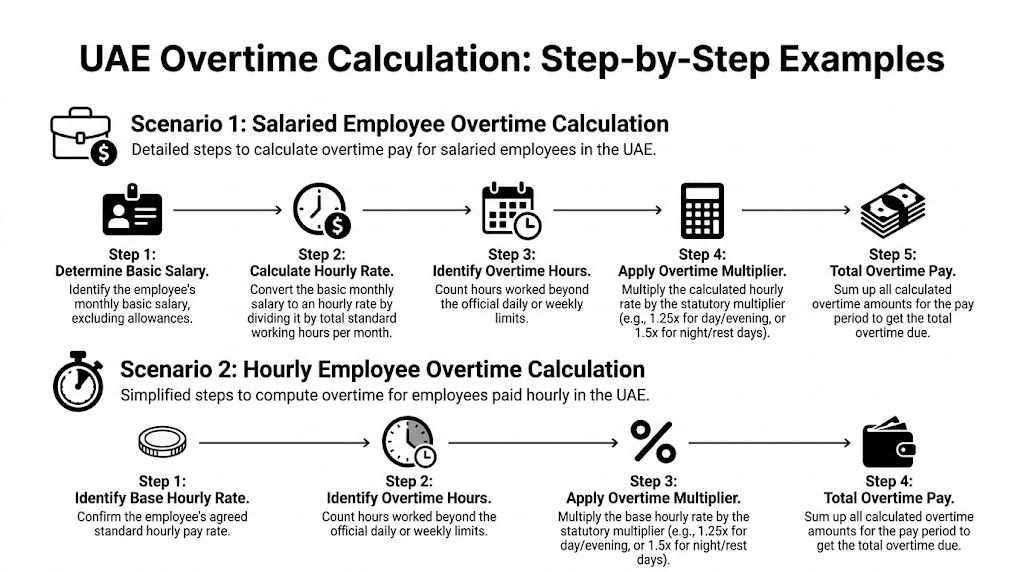
Start with a fixed basic salary of AED 3,500. To convert that into an overtime rate:
- Daily wage = 3,500 ÷ 30 = AED 116.67
- Hourly wage = 116.67 ÷ 8 = AED 14.58
- Regular overtime pay = 14.58 × 1.25 × overtime hours
If the employee records 100 overtime hours on ordinary workdays, the overtime amount comes to AED 1,822.50.
The arithmetic is straightforward. The practical issue is whether payroll is using the right salary base and the right overtime category. I often see software pulling from total monthly pay instead of basic salary, or applying one multiplier to every extra hour in the month. Both errors create disputes quickly.
How to handle a mixed overtime month
A more realistic month usually includes more than one overtime type. Using the same hourly rate of AED 14.58, payroll should split the entries before calculating pay.
If the employee has:
- overtime on normal workdays, apply 1.25
- overtime that qualifies for the higher category, such as rest day or relevant night work, apply 1.50
- public holiday work without a compensatory day off, apply 2.50
Keep each category on a separate pay code. Do not merge them into one line called “OT”.
That matters in two places. First, the employee can see how the figure was built. Second, payroll can reconcile overtime properly against attendance, leave, and final settlement records. Businesses often spot these mismatches while reviewing leave salary calculation in the UAE, because the same salary elements and divisors need to stay consistent across payroll.
Some employers also ask whether extra hours can be offset through time in lieu policies. That question needs careful handling in the UAE context, especially if the payroll team is trying to substitute time off for an amount that should have been paid through a statutory overtime category.
Example two with an hourly-paid employee
For an hourly-paid employee, the calculation depends on one point being clean from the start. The contractual hourly rate must be clearly stated and mapped correctly in payroll.
The process is usually:
- confirm the contractual hourly rate
- identify the overtime hours that qualify
- apply the correct multiplier by category
- total each category separately
If the hourly rate in the contract and payroll record already matches, regular overtime is calculated at 1.25 of that rate. Higher-category overtime is calculated at 1.50. Public holiday work without a compensatory day off is calculated at 2.50.
The trade-off is administrative. Hourly workers are simpler to calculate if the system is configured properly, but more error-prone if payroll forces them into a monthly salary template and re-derives an hourly rate from the wrong field. That misconfiguration is common in smaller businesses using one payroll rule set for everyone.
The more difficult cases sit just beyond these examples. Commission earners, mixed salary structures, and variable monthly income need a method that is consistent enough to defend if an employee asks how the number was produced.
Navigating Special Cases and Legal Exceptions
The standard formula is clean. Real payroll isn’t. The difficult cases are the ones that sit between contract design and wage calculation, especially where income changes month by month.

Commission-based and variable-income staff
One of the biggest unresolved issues in public guidance is variable pay. A verified compliance note highlights a major gap: for employees such as commission-based sales staff, commissions must be treated as part of salary for overtime purposes, but there is no clearly defined method in common guidance for dealing with fluctuating monthly earnings, which creates compliance risk for startups and SMEs, as noted in this overview of UAE overtime law gaps.
That matters because many Dubai businesses hire staff whose earnings are uneven. Sales teams, recruiters, property-related roles, and some business development positions don’t always fit neatly into a fixed-salary model.
What works in practice
When the law is clear on principle but thin on method, employers need a defensible internal approach. That means:
- Write the method into policy. If commissions are included, document how payroll determines the relevant base.
- Apply the same method consistently. A reasonable method used every month is easier to defend than ad hoc adjustments.
- Separate fixed and variable elements clearly. Contracts and payroll codes should not blur allowances, incentives, and salary components.
- Escalate edge cases before payroll closes. Don’t let the accounts team improvise treatment for a high-earning commission month.
A lot of employers ask whether time off can replace overtime payments. The answer depends on the specific legal context and the arrangement being used, so any internal workaround should be policy-led rather than informal. If you’re reviewing alternatives, these time in lieu policies are useful background reading because they show how structured policy drafting can prevent messy payroll disputes.
A variable-pay employee is where weak contracts and weak payroll design collide. Fix the structure first. The spreadsheet won’t solve it on its own.
For businesses checking employment records or labour status while resolving disputes, the Ministry-related tools in this labour inquiry services guide can help frame the compliance process.
Exempt roles and grey areas
Not every employee is treated the same way in practice. Senior management and certain supervisory roles may fall outside normal overtime treatment depending on their legal classification and the authority built into their role. The error here is assuming a senior title alone creates exemption.
What works is role-by-role review. Check the contract, reporting authority, operational responsibility, and how the role functions in reality. What doesn’t work is labelling someone a manager in payroll while treating them like a standard staff member in attendance, approvals, and workload control.
Common Payroll Pitfalls and How to Avoid Them
A typical overtime dispute starts long before payroll closes. A supervisor approves extra hours in WhatsApp, attendance shows a different total, the payroll system applies overtime to gross salary instead of basic salary, and the employee spots the shortfall on the payslip.
That sequence is more common than businesses expect. In the UAE, overtime errors usually come from setup and approval failures, especially after a software migration or a rushed payroll go-live. The formula may be correct on paper, but the wrong pay element, wrong attendance rule, or wrong earning code still produces the wrong result.
The businesses that struggle most are not always the ones ignoring the law. They are often the ones relying on payroll software defaults that were built for another market, or trying to force commission-heavy roles into a basic overtime template without defining what counts as the overtime pay base.
The mistakes I see most often
- Using the wrong pay base. Payroll teams sometimes calculate overtime on total package, fixed allowances, or another blended amount when the system should isolate basic salary.
- Treating variable pay as if it were simple salary. Commission-based employees create real confusion. If contracts, pay components, and payroll rules are not aligned, overtime gets applied inconsistently from one month to the next.
- Leaving default software rules untouched. Many systems use monthly-to-hourly conversion rules that are not configured for UAE practice.
- Failing to split overtime categories. Normal overtime, night overtime, rest day work, and public holiday work need separate treatment in the system.
- Approving hours outside the payroll trail. Chat messages, verbal approvals, and handwritten adjustments are hard to defend later.
- Skipping exception reviews. Long overtime entries, repeated weekend work, or unusual spikes should be checked before payroll is finalised.
One issue deserves extra attention. Commission structures often expose weak payroll design faster than any other employee category. If the contract does not clearly separate basic salary from incentive pay, the payroll team ends up guessing, and different administrators may process the same case differently.
How to avoid these errors
Start with system design, not just policy wording. Payroll should have a separate field for basic salary, separate overtime earning codes, and approval flows that tie attendance to manager sign-off. If one person can override hours manually without explanation, the process is already too loose.
Then test live scenarios before each payroll change. I usually recommend checking at least one standard salaried employee, one shift worker, and one employee with commission or other variable pay. That is where hidden configuration mistakes show up, especially if the software is auto-calculating hourly rates or pulling from the wrong salary field.
| Payroll issue | Better practice |
|---|---|
| Salary field confusion | Map basic salary as a separate payroll input and lock the formula source |
| Generic OT code | Create distinct codes for regular, night, rest day, and holiday OT |
| Commission-based employee processed manually each month | Define contract wording and payroll rules so the overtime base is applied consistently |
| Manual approvals in chat apps | Use formal manager approval tied to attendance records |
| Payroll-only review | Add HR review for exceptions and unusual entries |
Good controls are not glamorous, but they prevent expensive rework. The strongest setup is one where an owner, HR manager, or labour officer can trace each overtime payment from attendance record to approval to payslip without needing the payroll administrator to explain what happened.
Frequently Asked Questions About UAE Overtime
Do overtime rules differ between mainland and free zone companies
The practical answer is that employers still need to assess the labour framework that applies to their workforce and contracts. Businesses shouldn’t assume a free zone setup automatically removes overtime obligations. The safer approach is to review the governing employment rules for the entity and align payroll policy to that framework.
Are all managers exempt from overtime
No. A senior-sounding title by itself isn’t enough. The core issue is the employee’s legal classification, authority, and role in practice. If you want to treat a position as exempt, review the contract and job function carefully rather than relying on labels.
What records should a business keep
Keep records that allow you to prove three things: the employee worked the hours, the company approved them, and payroll paid them correctly. In practice, that usually means attendance logs, overtime approvals, payroll registers, payslips, and the policy that explains how overtime is classified.
Keep records in a form that an auditor or labour officer can follow without needing your payroll manager in the room to explain every line.
Can payroll software automate everything
No. Software can calculate quickly, but it can’t fix bad policy, bad contracts, or bad input data. Automation works best when someone has already defined which employees are eligible, which pay elements are included, and which overtime category applies.
Ensure Full Compliance with Expert Payroll Support
Calculating overtime in the UAE is a compliance task first and a payroll task second. The formula is standardised, but the difficult part is applying it correctly across employee categories, pay structures, approvals, and records. If your team is still handling these decisions manually, risk builds steadily in every pay cycle. Businesses that need a cleaner process should review specialist support and payroll-focused resources such as this UAE payroll advisory page.
If you want payroll that holds up under scrutiny, Smart Classic Business Hub can help you put the right structure behind it, from compliant payroll handling to broader accounting and business support in the UAE.