
A founder in Dubai can have a strong product, loyal early customers and a capable team, yet still hit the same ceiling. Sales depend on the founder, delivery requires more staff for every new client, and compliance questions appear whenever the company enters a new emirate, free zone or market. The business works, but the model doesn't travel well.
That ceiling usually isn't a product problem. It comes from how the company creates value, delivers it and gets paid. Business model innovation gives founders a practical way to redesign those connections, whether that means moving from projects to retainers, packaging expertise into a digital service, building a platform, or serving regional clients from a UAE base.
Beyond the Product Moving Your Business Forward
A Dubai-based professional services firm may begin with bespoke assignments. The founder wins each client through personal relationships, prepares every proposal, supervises delivery and invoices after completion. The service quality is strong, but growth stalls because the founder remains the channel, the sales process and the quality-control system.
The obvious response is often to improve the service. Add features, hire more specialists or redesign the website. Those changes may help, but they don't address the central constraint. The firm still sells time in custom packages, acquires customers through the same limited channels and carries delivery risk on every engagement.
Business model innovation asks a different question: what must change so the company can create and capture value more reliably?
The answer might be a diagnostic product that leads into a recurring advisory plan, a standardised compliance package, a partner-led distribution model or a digital platform that allows customers to complete part of the process independently. The underlying expertise may stay the same. The commercial architecture changes.
The model is larger than the offer
A useful review covers four connected areas:
- Value proposition: What job is the customer hiring the business to perform?
- Value architecture: Which people, partners, processes and systems deliver that promise?
- Revenue model: What does the customer pay for, and when?
- Operating discipline: Which activities must remain controlled as the business expands?
Distribution deserves special attention. A capable company can still struggle if it relies on one referral source, one founder or one advertising channel. A practical review of selecting effective distribution channels can help founders compare direct sales, partnerships, marketplaces and digital acquisition before committing budget.
For anyone assessing how to make money in Dubai, the same principle applies. The opportunity isn't only in finding an attractive sector. It lies in designing a model that can sell, deliver, collect payment and remain compliant without depending on heroic effort.
Practical rule: If growth adds work faster than it adds contribution, redesign the model before expanding the team.
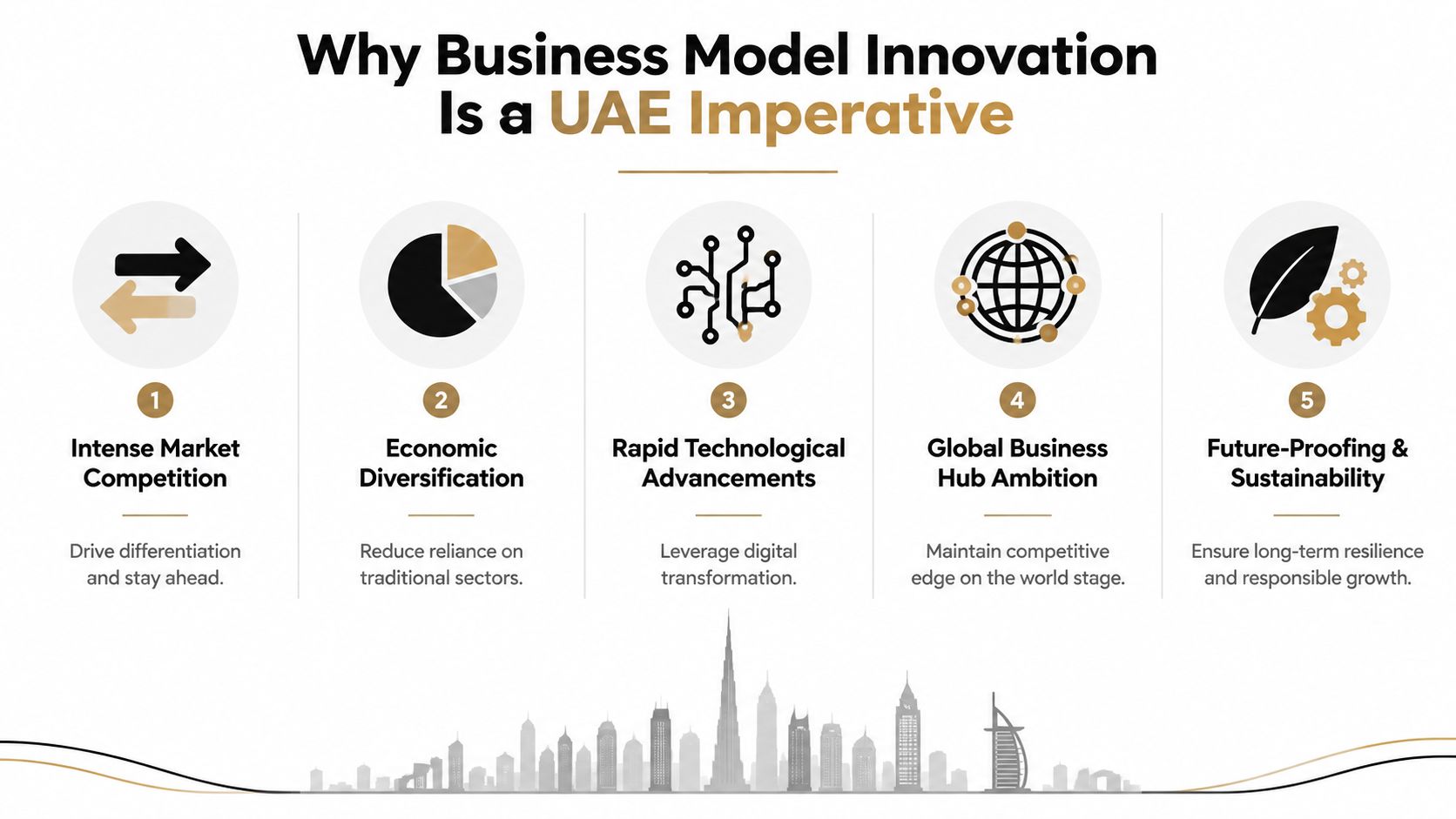
Why Business Model Innovation Is a UAE Imperative
Intense competition and diverse customer segments mean a business model must survive real market pressure, not just a promising launch. UAE founders often serve nationals, residents, visitors and regional clients at the same time. A model built around slow administration or the founder's personal relationships can lose its advantage as soon as a more digital competitor enters the market.
The country's innovation trajectory reinforces this pressure. The UAE moved from 36th in the Global Innovation Index in 2019 to 19th in 2024, while its 2024 profile ranked it first globally for entrepreneurship policies and culture. It also ranked first for tertiary inbound mobility and third for research talent in businesses. These conditions support talent inflows, experimentation and new routes into regional markets, according to the 2024 Global Innovation Index profile.
Strong inputs still require stronger execution
The UAE's innovation profile also points to a gap between capability and commercial output. In 2024, the country ranked 19th for innovation inputs but 50th for outputs, indicating that infrastructure, policy and talent are progressing faster than their conversion into commercial results.
For founders, that gap is a practical warning. Access to funding networks, skilled people and supportive infrastructure does not create a scalable company by itself. The business still needs a defined customer problem, disciplined unit economics, repeatable delivery and a compliant route to market. A strong concept becomes durable only when those elements work together under operating pressure.
Entrepreneurship activity adds context. The Global Entrepreneurship Monitor 2025-2026 report ranked the UAE first globally for the fifth consecutive year. More than one in five adults were engaged in entrepreneurship, with a Total Early-stage Entrepreneurial Activity rate of 19.2%. Activity reached 19.6% among nationals and 22.4% among residents, showing the contribution of the international workforce to business creation.
Policy is moving innovation into the operating model
The UAE's national entrepreneurship and SMEs agenda aims to make the country an entrepreneurial nation by 2031. Its emphasis on digitalisation and reducing administrative burdens matters to founders because tested models still need to scale through licensing, compliance and market expansion. The National Agenda for Entrepreneurship and SMEs presents entrepreneurship as an economic capability, not only a startup activity.
Business model innovation therefore becomes a practical survival discipline. Founders should design for regulatory agility, digital delivery and regional expansion from the outset. Treating these requirements as paperwork added after the commercial design can force expensive changes to the licence structure, delivery process or pricing model.
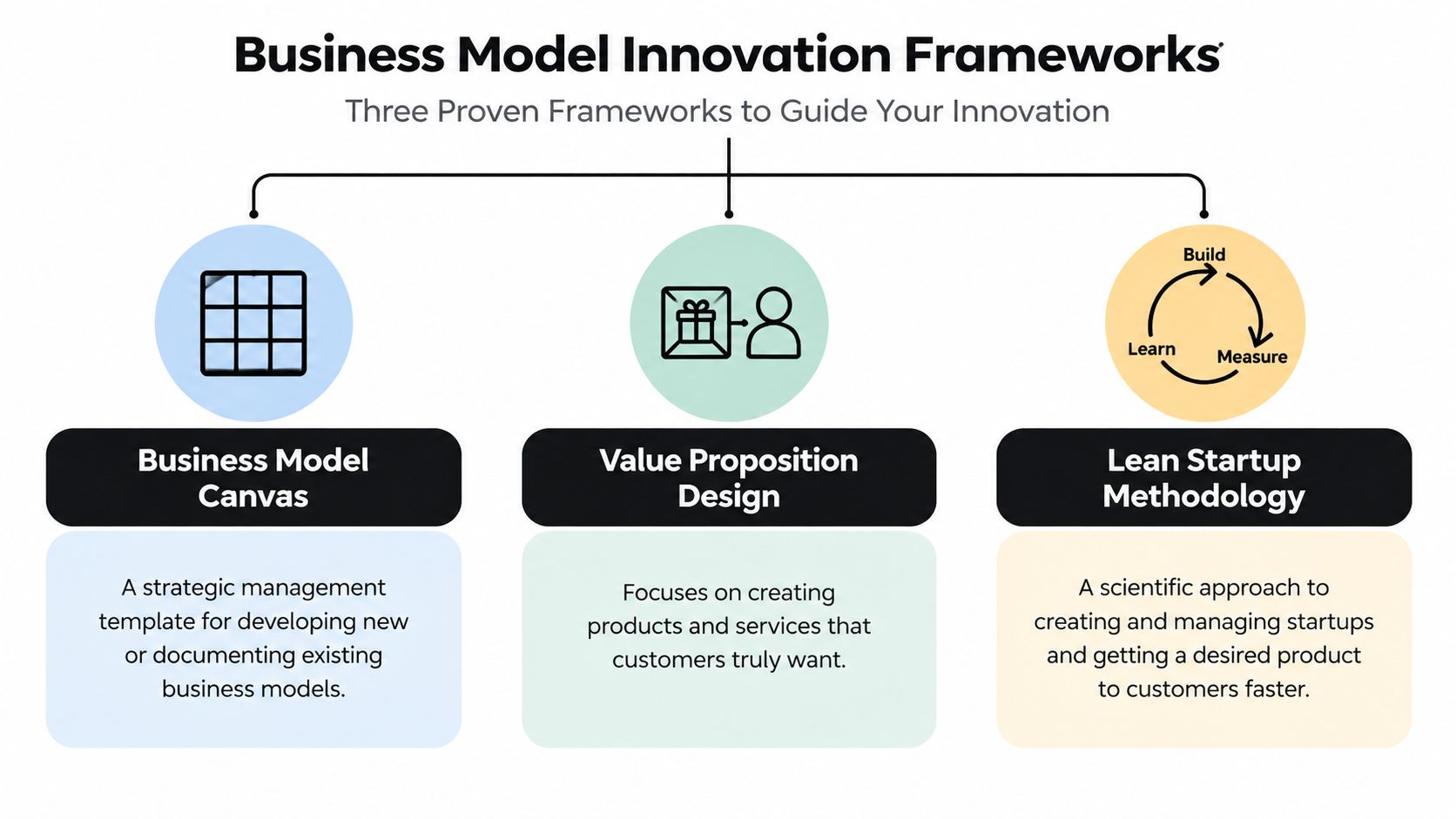
Three Proven Frameworks to Guide Your Innovation
A founder facing weak margins needs a different diagnostic tool from one who understands the customer problem but cannot charge for solving it consistently. Frameworks make those assumptions visible and help UAE founders connect commercial choices with licensing, delivery capacity and compliance requirements.
Use the Business Model Canvas as the business blueprint
The Business Model Canvas places the operating logic on one page. Map customer segments, value propositions, channels, customer relationships, revenue streams, key resources, key activities, key partners and cost structure.
Use it to expose contradictions, not as a presentation slide. A premium advisory service cannot depend on low-touch onboarding, unlimited customisation and a low monthly fee without showing which cost absorbs the difference. A platform model needs a credible reason for both sides to join before network effects can develop.
Update the canvas whenever the business changes its licence activity, delivery geography, partner structure or pricing logic. These decisions affect one another. A service expanding from Dubai to other emirates, for example, may need to review its delivery partners, operating permissions and customer support model together.
Apply Jobs-to-be-Done to the customer problem
Jobs-to-be-Done focuses on the progress a customer wants to make. A UAE SME may not be buying bookkeeping as a technical service. It may be hiring a provider to reduce uncertainty before expansion, prepare reliable records for a financing decision or avoid delays during a compliance process.
Interview customers about the event that triggered the purchase, what they tried before, what made the decision difficult and what outcome would make the service feel complete. Asking only whether they like the current product can hide an unresolved job.
Treat revenue model innovation as a commercial experiment
Revenue model innovation changes the unit, timing or conditions of payment. Options include subscriptions, retainers, usage-based pricing, transaction fees, productised services, licensing and platform commissions. The choice should reflect buying behaviour and the cost of delivering the promise.
A subscription may improve predictability while creating an unprofitable service obligation. A platform may extend reach, but it must address trust, quality and partner incentives. Freemium can encourage adoption, while free users still consume support and infrastructure. Test the payment structure with a defined customer group before changing the company's full pricing system.
| Framework | Best for | Key question it answers |
|---|---|---|
| Business Model Canvas | Seeing the whole system | Which parts of the model conflict with one another? |
| Jobs-to-be-Done | Uncovering the core customer need | What progress is the customer trying to make? |
| Revenue model innovation | Redesigning how value is captured | What should the customer pay for, and under what conditions? |
Use one framework thoroughly rather than completing all three superficially. The output should be a testable decision, such as a revised offer, customer segment or payment condition, rather than a collection of attractive diagrams.
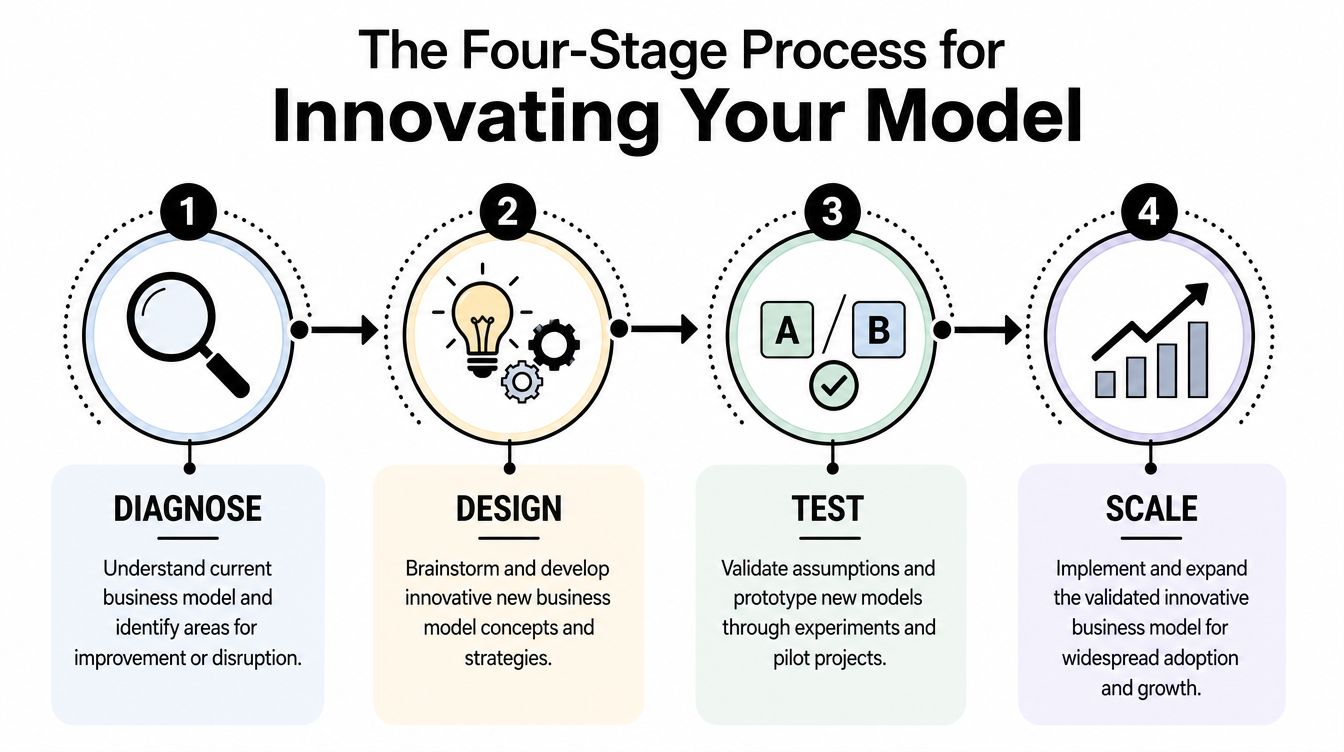
The Four-Stage Process for Innovating Your Model
A founder in Dubai can have strong demand and still build the wrong business. The warning signs usually appear before expansion: every client needs a different delivery process, margins vary sharply, or licensing and invoicing requirements were left until late in the plan. Separate diagnosis, design, testing and rollout so each decision has evidence behind it.
Diagnose the constraint
Start with evidence from the existing business. Review win and loss reasons, delivery time, complaints, gross margin by service, founder involvement and the points where prospects leave the buying process. Map the model with the Business Model Canvas, then test the findings through a SWOT analysis.
Look for structural weaknesses, not isolated mistakes. If each new client requires a new process, the delivery architecture may be the constraint. If customers value the outcome but resist the invoice, the revenue unit may be poorly designed. If demand exists but acquisition costs fluctuate, examine channels, partnerships and customer concentration.
Design several models, not one polished idea
Build alternatives around the same customer job. A Dubai consultancy could compare a high-touch advisory retainer, a fixed-scope feasibility package and a software-supported compliance service. Each option affects staffing, pricing, licensing implications, support workload and cash-flow timing.
Record the assumptions behind every option. Rank them by risk and design the cheapest test that could disprove the most dangerous assumption. A feasibility study in the UAE can help connect market conditions, financial projections and compliance requirements before the company commits capital.
Test behaviour before building infrastructure
Use a landing page to test whether a defined segment responds to a specific offer. A paid pilot can show whether customers accept the proposed price and delivery format. A manual concierge service can test a platform workflow before the company pays to automate it.
Track actions, not compliments. Interest provides weak evidence. Signing a pilot, sharing documents, attending onboarding and renewing indicate stronger demand.
A useful test changes a decision. If the result cannot affect pricing, positioning, channel choice or delivery design, it is theatre rather than an experiment.
Scale through a controlled rollout
Scaling requires more than increasing sales. Review the business activity, ownership structure, contracts, invoicing, VAT treatment, staff capacity, data handling and support model. Mainland, free zone and offshore structures can create different operating requirements, so confirm the intended activity and customer geography before committing to rollout.
The UAE's policy direction supports digitalisation and lower administrative burdens, as noted earlier. That support does not replace implementation discipline. The founder remains responsible for selecting the right structure, documenting operating controls and proving that the model can deliver consistently as volume rises.
How UAE Companies Are Winning with New Models
Dubai offers a useful ecosystem for testing new commercial structures. Its startup ecosystem ranked 48th globally and first in the UAE in the StartupBlink Global Startup Ecosystem Index 2026, with an estimated startup base of USD 57.3 billion and annual growth of 6.9% between April 2025 and April 2026, according to Dubai's updated startup ecosystem guide. The same source reports that Dubai contains 86% of the UAE's recorded startups.
Those figures don't prove that a particular model will work. They do explain why partnerships, digital service bundling and rapid customer feedback can be easier to organise in Dubai than in a fragmented market.
From local service to repeatable platform
A traditional advisory business usually sells individual assignments. A business model innovation approach separates the repeatable elements from the specialist judgement. Standard documents, intake forms, status updates and routine checks can move into a digital workflow, while complex decisions remain with qualified advisers.
The result isn't necessarily a fully automated platform. It may be a hybrid service with self-service onboarding, fixed packages and human escalation. That structure can widen access without pretending that every regulatory or financial question has a simple answer.
From inventory ownership to coordinated supply
An asset-heavy operator carries the cost of vehicles, warehouses or specialist equipment even when utilisation changes. An asset-light model coordinates third-party capacity through technology, quality standards and service-level agreements.
The trade-off is control. The company reduces capital exposure but becomes more dependent on partner reliability. In the UAE, the model needs clear contracts, customer liability rules and an operating process for service failures. Lower fixed investment isn't the same as lower complexity.
From one-off sale to continuing relationship
Retailers and consumer businesses can redesign around replenishment, curated bundles or membership access. The commercial attraction is continuity, but the model fails if customers don't receive a meaningful reason to remain subscribed.
The strongest local models tend to combine a clear recurring benefit with flexible fulfilment. They use the UAE's dense business network to test partnerships, delivery options and customer segments before expanding regionally. The lesson isn't to copy a subscription model. It's to identify what customers need repeatedly and build the business around that recurring job.
Measuring Impact and Avoiding Common Pitfalls
A new model needs a measurement system that distinguishes activity from economic progress. Website traffic, registrations and social engagement may indicate attention, but they don't tell the founder whether the company can acquire customers profitably or deliver the promised outcome.
Track the relationship between customer acquisition cost, customer lifetime value, contribution margin, cash conversion and retention. For a project business, also monitor proposal-to-sale conversion, delivery hours and scope changes. For a platform, examine activation, repeat usage, supplier fulfilment and support burden.
Teams that need a more structured goal system can use guidance on effective impact measurement. The point isn't to collect more dashboards. It's to connect each metric to a decision owner and a specific action.

The UAE-specific risks that derail good models
Treating a free zone as a universal market permission. A free zone structure may suit the company's activity and operating plan, but founders still need to verify customer access, licences, contracts and any activity-specific approvals. Confirm the route before marketing the offer.
Underpricing compliance-heavy delivery. A service may look digital to the customer while requiring substantial review, documentation and regulated professional input behind the scenes. Price the actual workflow, not only the visible interface.
Scaling before the operating model is stable. More customers expose weak onboarding, slow collections and inconsistent service. Run a controlled rollout and document handoffs before adding new markets or channels.
Using AI only to reduce internal effort. The opportunity for existing SMEs is larger than faster administration. The 2025 MBRSG report on 81 UAE-based AI and digital SMEs notes that SMEs make up over 94% of UAE companies and contribute 60% of non-oil GDP, while focusing on adoption barriers, infrastructure and regulation. The report is discussed in coverage of the Dubai SME Forum.
AI can support a new revenue model through faster analysis, continuous monitoring, guided self-service or a productised expert service. It also introduces data governance, quality assurance and accountability requirements. A data analytics services provider can help establish the reporting layer, but management must still decide which customer outcome the data is meant to improve.
Your Innovation Checklist and Path to Implementation
Before changing the model, answer these questions in writing:
- Customer job: What urgent or recurring progress does the buyer need?
- Value promise: What outcome will the customer recognise and pay for?
- Delivery design: Which steps require expert judgement, and which can be standardised or digitised?
- Revenue unit: Is the company charging for time, access, usage, a transaction, an outcome or a continuing service?
- Channel mix: Can customers find and buy the offer without depending entirely on the founder?
- Compliance route: Does the proposed activity, structure and customer geography match the licensing and regulatory plan?
- Test design: What is the cheapest paid experiment that can challenge the riskiest assumption?
- Scale controls: Which metrics, processes and people must be in place before expansion?
The UAE's most resilient business models aren't necessarily the most disruptive product ideas. They are often the models built for regulatory agility, digital delivery and cross-border service in a market shaped by tax, licensing and visa requirements, a perspective highlighted in recent UAE business setup trends.
Smart Classic Business Hub can support founders with company formation, feasibility studies, business planning, financial management and ongoing compliance, helping connect the commercial model with the practical requirements of operating in the UAE. Its role is most useful when founders need to test whether a promising model is financially viable, correctly structured and ready for implementation.
If you're redesigning a UAE business model, visit Smart Classic Business Hub for support with feasibility planning, company formation, financial advisory and compliance. Bring the customer problem and your current model, then turn the next version into a decision-ready operating plan.