
You're looking at a spreadsheet assembled from three different systems, an investor deck built on assumptions, and a VAT file that still needs checking before the weekend ends. Sales figures don't match the accounting ledger. Customer acquisition costs change depending on who prepared the report. You know the business is moving, but you can't explain precisely where the cash is going or which decision deserves priority.
That's the point at which data analytics services stop being a technology upgrade and become an operating requirement. In the UAE, analytics must fit the way your company is licensed, taxed, financed and governed. A mainland retailer, a free zone consultancy, a multi-branch SME and an investor reviewing an Abu Dhabi acquisition won't need the same data setup.
Why UAE Founders Need Data Analytics Services Now
Data analytics services combine people, processes and tools that turn scattered records into decisions you can defend. The work may involve connecting your accounting platform to a point-of-sale system, cleaning customer records, building a management dashboard, or testing whether a forecast is reliable enough to influence purchasing.
The UAE market has moved well beyond experimentation. The UAE data analytics market outlook values the market at USD 1,884.8 million in 2024 and projects it to reach USD 5,167.4 million by 2030, with a projected 17.7% CAGR from 2025 to 2030. Predictive analytics was already the largest type in 2024, representing 38.73% of revenue, while prescriptive analytics is identified as the fastest-growing type.
That matters to a founder because your competitors aren't only using dashboards to describe last month's sales. They're using analytics to decide what to stock, which customers to retain, which branches to expand and which costs to challenge.
The UAE context changes the decision
A UAE company may operate across a mainland licence, a free zone entity, branches, related parties or overseas suppliers. Each arrangement can create different revenue streams, cost centres, approval paths and reporting responsibilities. If your data model ignores that structure, a polished dashboard can still produce the wrong answer.
VAT obligations add another practical pressure. Your records need to support reconciliations, transaction review and reporting, not merely produce an attractive monthly chart. Investor due diligence creates a second test. A buyer wants to trace revenue, margins, working capital and related-party activity back to underlying records.
Digital reach also increases the amount of usable business data. The UAE had 11.3 million internet users at the end of 2025, with 99.0% online penetration, alongside 23.0 million active mobile connections and 98.18% of federal government services available online, according to Digital 2026 UAE data from DataReportal. That connected environment gives businesses more signals, but only if someone organises and interprets them.
Practical rule: If you can't connect a reported number to a source record, owner and business action, you don't yet have management information. You have a presentation.
Start with the decisions that currently consume the most judgement. Define the source data, agree the calculation and assign someone to act on the result. That sequence is more valuable than buying another reporting tool.
The Four Types of Analytics Explained Simply
Take a Dubai retailer with a physical shop, an online store and sales coming through social channels. The four types of analytics describe how far the business moves from recording events to choosing actions.
Descriptive analytics asks what happened
The retailer's first dashboard might show sales by branch, product category, channel and date. It could reveal that the Dubai store generated less revenue last quarter than the online channel, while a particular product family produced the strongest gross margin.
This is the layer most SMEs already attempt with spreadsheets. It's useful, but it only describes the past. A monthly total won't explain the cause of a decline or tell the purchasing team what to do next.
Diagnostic analytics asks why it happened
The retailer then drills into the weaker store result. Perhaps footfall remained stable, but the store ran out of popular sizes, promotions were applied inconsistently, or a supplier delay affected a high-margin category.
Diagnostic analysis connects events instead of treating the sales figure as an isolated fact. It requires consistent product codes, channel definitions and dates. If one system records returns as negative sales and another excludes them, the diagnosis will be unreliable.
Predictive analytics asks what may happen
The retailer can use historic demand, seasonality, promotions and stock movements to estimate future requirements. Before Ramadan, the purchasing team can examine likely demand by product and location rather than ordering solely from intuition.
A forecast is not a promise. It's a structured view of possible demand that helps the owner weigh stockout risk, cash tied up in inventory and supplier lead times.
Prescriptive analytics asks what action makes sense
The final layer turns the forecast into a recommendation. The system might flag products for replenishment, suggest a transfer between branches, or identify customers for a targeted offer.
That recommendation still needs commercial judgement. A model may not know about a supplier dispute, a planned store closure or a cash constraint. Businesses that want to drive growth with data-driven insights should therefore connect every recommendation to an accountable decision-maker.
Most UAE SMEs are strongest at descriptive reporting and weakest at prescriptive action. The sensible next step isn't always advanced artificial intelligence. It may be a clean diagnostic report that finally explains why margin is falling.
Core Offerings Inside a Modern Analytics Engagement
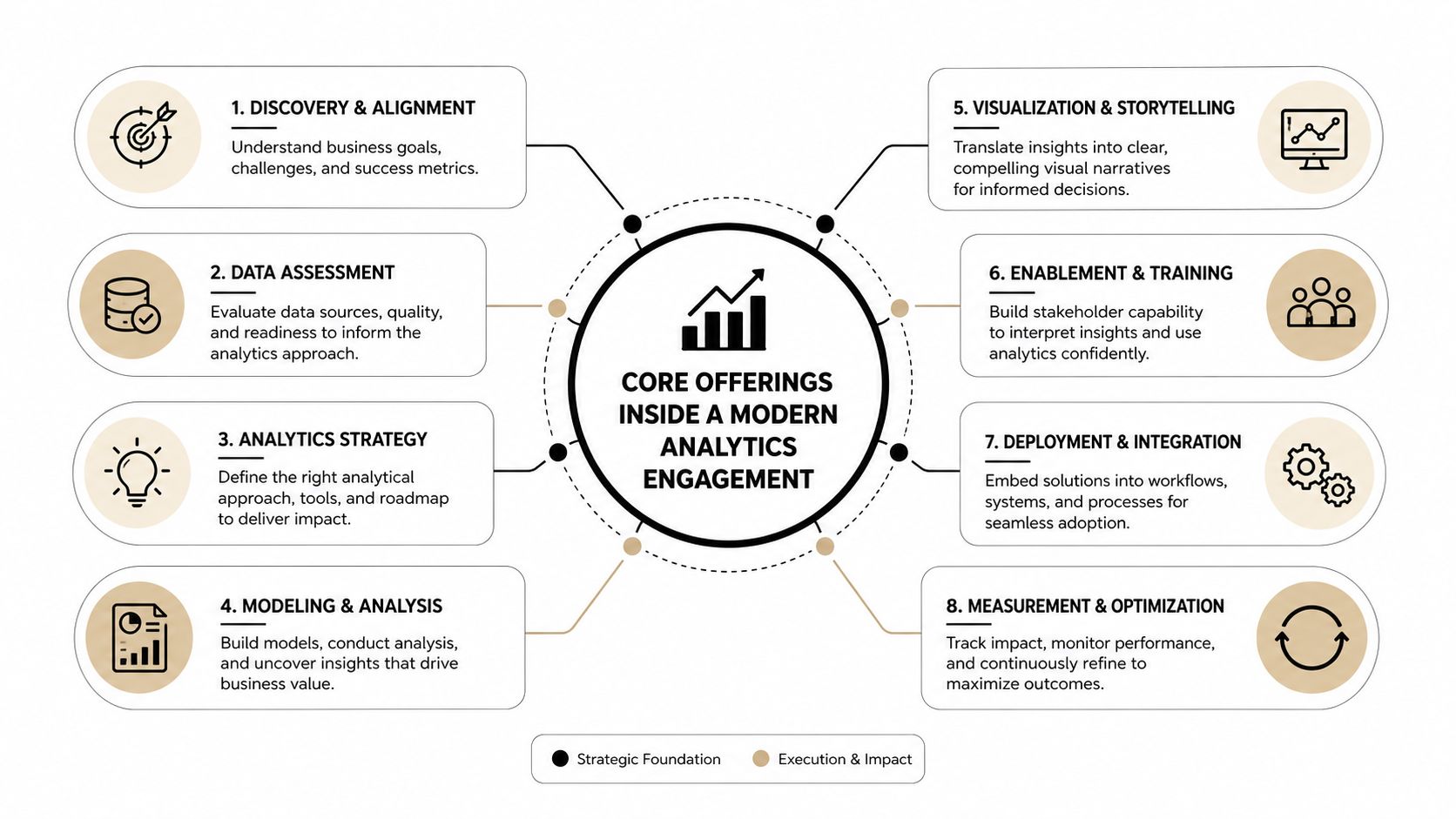
A vendor selling data analytics services should describe deliverables in operational terms, not hide behind broad claims about transformation. Ask what will be connected, what will be produced, who will use it and how the result will be checked.
Data engineering creates a usable foundation
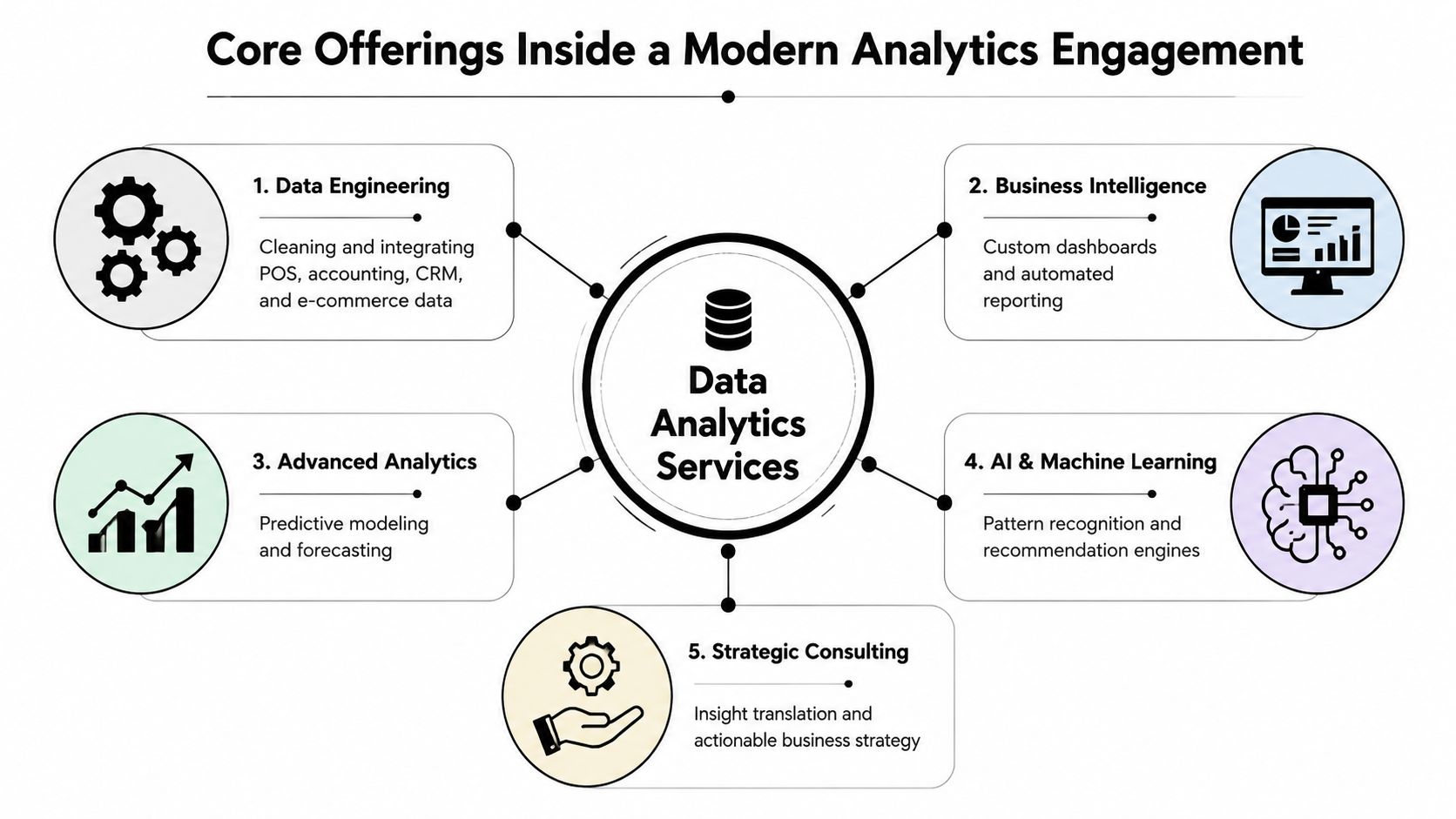
Data engineering cleans and integrates records from POS, accounting, CRM, e-commerce and other operational systems. It resolves duplicate customers, inconsistent product names, missing dates and conflicting revenue definitions.
For a UAE business, the immediate scenario is usually fragmented reporting across a mainland or free zone entity, multiple branches or separate sales channels. A proper data model should preserve entity, branch, channel and tax treatment rather than flatten everything into one unexplained total.
Business intelligence gives managers a shared view
Business intelligence turns prepared data into dashboards and automated reports. Power BI, Looker and Tableau can all work well, but the tool matters less than the design.
A useful UAE dashboard may show revenue, gross margin, receivables, inventory, cash movement, VAT-related reconciliations and branch performance. It should also show the definition behind each KPI. If the finance manager and sales director calculate “revenue” differently, the dashboard will create arguments rather than clarity.
Analytics as a service keeps capability flexible
An analytics-as-a-service arrangement gives a company ongoing access to reporting, maintenance and analysis without requiring a full internal team. This suits a growing SME that needs regular support but doesn't yet have a dedicated data function.
The provider should explain what the subscription includes. Clarify data refreshes, dashboard changes, user support, model monitoring, documentation and response times. A low monthly fee can become expensive if every integration or revision is treated as an extra project.
Machine learning supports specific decisions
Machine learning can help with demand forecasting, customer segmentation, churn signals, anomaly detection and recommendation engines. It should enter the project only after the business has stable definitions and enough trustworthy history for the intended use.
For example, an e-commerce company may want to separate repeat buyers from one-off promotional customers. A model can assist with segmentation, but the marketing team still needs to decide how those groups should be treated and whether the proposed action fits the brand.
Governance protects the business
Data governance sets access rights, approval rules, retention practices, audit trails and ownership. It also records how calculations are made and who can change them.
In the UAE, governance should connect directly to VAT record-keeping, financial controls, related-party review and investor reporting. If an FTA query or buyer diligence request arrives, your team should be able to reproduce the figure and explain its origin. A practical framework for data analysis can help teams structure the work before they select technology.
Management reporting also benefits from a defined performance system. If you're aligning dashboards with accountability, review the performance management system before commissioning a large build.
Real Outcomes for UAE Startups, SMEs and Investors
Analytics earns its place when it changes a decision, not when it sits unused on a screen. The following examples show the types of outcomes a well-scoped engagement can support. They're practical scenarios, not claims of published performance results.
A Dubai startup prepares for investor scrutiny
A startup may have strong sales but a weak explanation of customer quality. An analyst can build a cohort dashboard that separates acquisition period, channel, repeat behaviour, refunds and contribution margin.
The founder enters investor discussions with a traceable view of retention and revenue quality instead of a slide containing broad averages. That doesn't guarantee funding. It gives investors a clearer basis for testing the business model and gives the founder a more defensible answer when assumptions are challenged.
A Sharjah SME removes manual closing work
A growing SME may spend the month-end period collecting spreadsheets from finance, sales and operations. Automated reporting can consolidate approved records, apply consistent calculations and flag exceptions for review.
The benefit is not just speed. Management receives a repeatable view of performance, while the finance team spends less time copying figures and more time investigating unusual balances, overdue receivables and margin changes. For a business considering benchmarking analysis, consistent definitions are essential before any comparison is meaningful.
An Abu Dhabi investor tests an acquisition target
Seller-supplied numbers often need deeper examination. An investor can use analytics to compare bank movements, invoices, customer concentration, gross margin, working capital and related-party transactions across the available records.
The result is a diligence process based on reconciled evidence rather than a single management presentation. The model can also expose questions for the legal and financial advisers, such as unexplained revenue spikes, unusual supplier dependencies or inconsistent entity allocations.
An accounting firm reviews VAT risk
An accounting practice handling VAT returns can use anomaly detection to surface transactions that deserve human review. Examples include unusual tax coding, duplicate invoices, unexpected credit notes or transactions that don't reconcile with the underlying ledger.
The tool doesn't decide whether a transaction is compliant. It prioritises the review queue and preserves a record of the checks performed. That creates a stronger working process before an FTA review and helps the accountant explain how exceptions were identified.
The common thread is disciplined translation. Each organisation defines the decision first, then chooses the analytical capability that supports it.
Pricing Models and How to Choose a Vendor
Analytics quotes vary because providers may be selling a one-off build, ongoing access or decision support. Don't compare totals until you know what happens to data migration, integrations, training, documentation and support after launch.
| Model | Typical setup | Best for | Watch-out |
|---|---|---|---|
| Project-based fixed fee | Defined discovery, build and handover | A startup or SME with a clear reporting problem | Change requests and new data sources may cost extra |
| Monthly retainer | Ongoing analyst, dashboard and advisory support | A scaling business with changing questions | Confirm response times, included hours and ownership |
| Subscription analytics-as-a-service | Recurring access to reports, refreshes and support | Teams that need capability without building in-house | Check limits on users, integrations and customisation |
| Value-share arrangement | Fees linked to an agreed commercial outcome | Selected investor or performance projects | Define attribution, measurement and decision control carefully |
I don't recommend choosing a vendor on the lowest initial quote. A cheap dashboard built on unclean accounting data can create more work for your finance team and weaken confidence in every later report. Ask for a written scope that names the source systems, data owner, refresh frequency, KPI definitions and acceptance tests.
Questions for a UAE shortlist
- Local operating knowledge: Can the team work with mainland and free zone structures, branches and related entities?
- Tax awareness: Can it support VAT reconciliations and reporting workflows without presenting itself as a substitute for regulated tax advice?
- Data handling: Where will data be hosted, who can access it and how will the provider manage personal information?
- Language and adoption: Can the team support the people who use the reports, including bilingual operational teams where needed?
- Sector relevance: Can the provider show relevant experience with your revenue model, accounting system and reporting cadence?
- Handover quality: Will you receive data dictionaries, calculation logic, access documentation and training?
Microsoft users should also assess whether a provider can find the right Microsoft analytics partner for the complexity of the environment. For smaller projects, a specialised independent consultant may be more practical than a large systems integrator.
Implementation Roadmap and UAE Compliance Considerations
Analytics projects usually fail before modelling begins. Missing fields, inconsistent account codes, unclear ownership and disconnected systems cause more damage than an imperfect forecast.
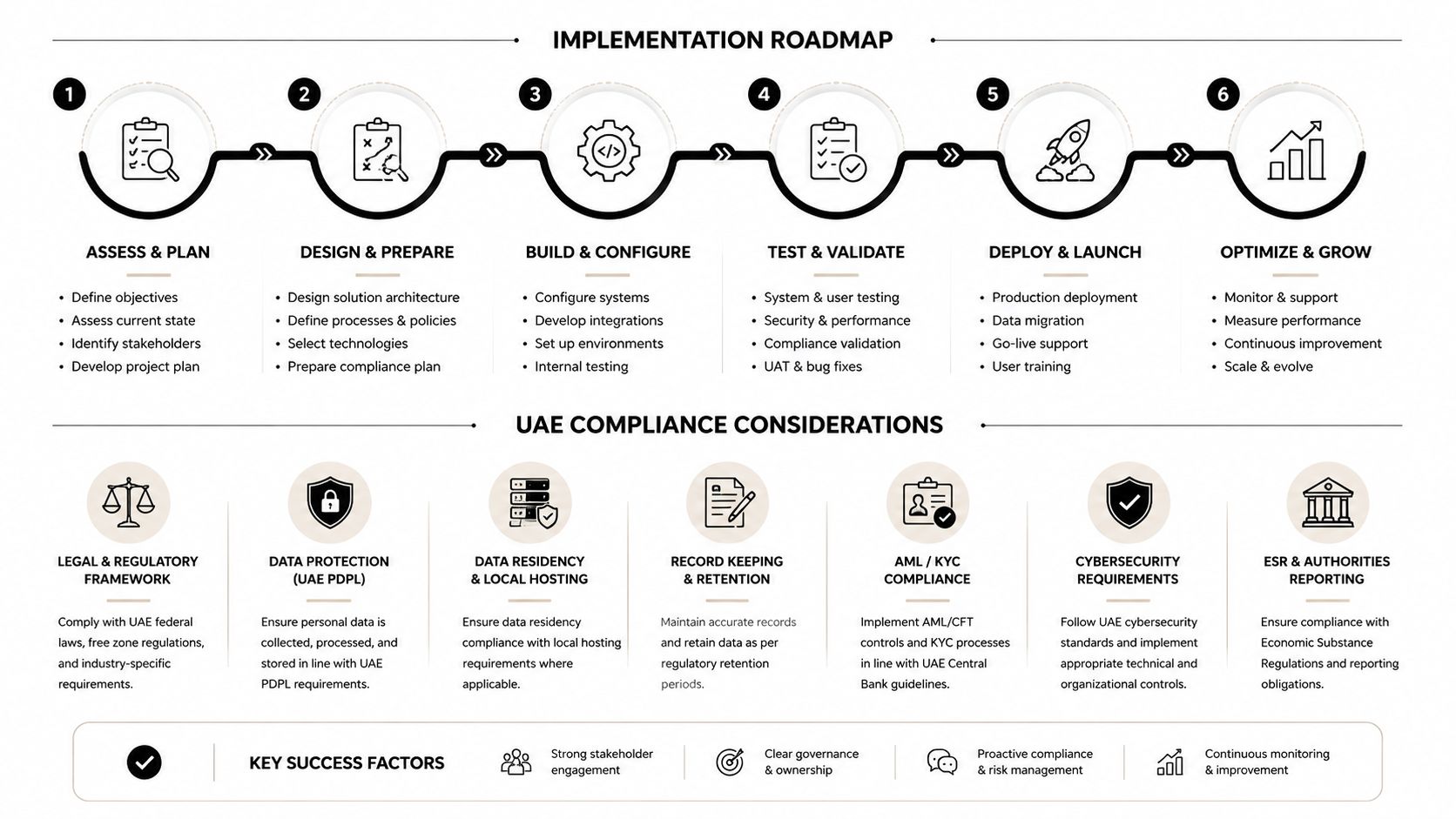
Follow five deliberate phases
- Discovery and data audit: List systems, owners, entities, reports and priority decisions. Test whether reported figures reconcile to source records.
- Foundation and integrations: Connect accounting, POS, CRM and e-commerce data. Standardise customer, product, branch and tax fields.
- Dashboard and reporting: Build a small set of management views with agreed definitions, permissions and refresh rules.
- Advanced modelling: Add forecasting, segmentation or anomaly detection only when the foundation is stable.
- Ongoing optimisation: Review adoption, exceptions, model performance and changing business requirements.
The first phase may take days for a simple operation or longer for a multi-entity company. Integration and dashboard work should be planned as a defined project, while advanced modelling and optimisation need ongoing review rather than an arbitrary launch promise.
Build compliance into the design
VAT records should preserve transaction detail, tax coding, reconciliations and approval evidence. Your team should be able to explain how a dashboard figure connects to the ledger and supporting documents.
Ultimate Beneficial Owner information also needs controlled ownership and accurate maintenance where relevant to the company's obligations. Don't allow ownership, entity or related-party fields to become informal spreadsheet notes that no one verifies.
Personal data requires careful access and handling under the UAE Personal Data Protection Law. Limit access by role, document retention and sharing practices, and ask the vendor how it protects data throughout the engagement.
A feasibility review can help test whether the proposed reporting model matches the commercial and regulatory reality of the business. Consider a UAE feasibility study consultant before committing to an expensive analytics build.
Common Myths, First Steps and Your Next Move
Myth one, analytics is only for large corporates. A small UAE company can start with reconciled sales, cash flow and receivables reporting. The scope should match the decisions, not the company's image.
Myth two, you must hire a data scientist. Many founders need a capable analyst, finance lead and implementation partner before they need advanced modelling. Clean data and clear questions create the first gains.
Myth three, AI replaces judgement. Models identify patterns and prioritise actions. The owner still weighs supplier relationships, cash constraints, customer context and regulatory risk.
Use a simple starter plan:
- First 30 days: Audit data sources and define two or three decisions that need better evidence.
- By day 60: Launch a first dashboard and automate one recurring report.
- By day 90: Pilot one predictive or prescriptive use case and review its commercial impact.
Don't wait for perfect data or a large transformation budget. Book a discovery call, request an analytics readiness assessment, and ask for a UAE-specific checklist that covers entity structure, VAT workflows, access controls and investor reporting.
Smart Classic Business Hub helps UAE founders and SMEs connect financial reporting, VAT-compliant accounting, performance management and business planning with practical data analytics services. Visit Smart Classic Business Hub to discuss your current systems, define the first decisions to improve and choose a workable implementation path.