
Your team is busy. Sales is chasing new business, operations is fixing delivery issues, and managers are solving the same people problems every week. Yet targets still slip, accountability feels uneven, and every quarter ends with the same conversation: everyone worked hard, so why does progress still feel messy?
That's where many UAE startups and SMEs get stuck. They don't have a people problem. They have a clarity problem. Good employees can still pull in different directions when no one has a shared view of priorities, standards, and outcomes.
A performance management system fixes that when it's built properly. Not as a slow HR ritual. Not as a stack of forms at year-end. But as a practical operating system for aligning people, decisions, and business goals. In the UAE, that matters even more because performance data can support growth, governance, hiring decisions, and talent retention in ways many smaller businesses still overlook.
Moving Beyond Guesswork in Your Business
A familiar pattern shows up in growing companies across Dubai. The founder starts with a tight team and direct control. Everyone sits close enough to solve issues quickly, priorities change fast, and work gets done through constant conversations. Then the business grows.
One team member owns sales. Another handles client delivery. Someone else manages hiring, admin, and vendor issues all at once. Suddenly, the founder spends more time clarifying who should do what than steering the business.
The symptoms are easy to recognise:
- Targets keep moving: Staff hear new priorities every week and stop treating any goal as fixed.
- Managers react late: Problems only surface once a client complains or a deadline is already missed.
- Strong employees get frustrated: They perform well, but they can't see how their work links to promotion, recognition, or bigger opportunities.
- Founders become the bottleneck: Every key decision flows back to one person.
This is usually the point where business owners think they need stricter supervision. In practice, they need a better structure.
Why informal management stops working
What works for a team of a few people often fails once the business becomes more complex. Verbal instructions get interpreted differently. Good intentions replace clear accountability. Reviews become subjective because no one agreed in advance what success looked like.
Practical rule: If your managers need to “explain performance” from memory, you don't have a system. You have opinions.
A solid performance management system gives the business a common language. It tells each employee what matters, how progress is measured, when reviews happen, and what happens next. That reduces confusion and cuts the wasted effort that comes from teams working hard on the wrong tasks.
What changes when the system is strategic
Its value isn't limited to HR administration. A well-run system helps a business make sharper operational decisions. It shows where output is strong, where support is needed, which roles need redesign, and which managers are leading well versus merely staying busy.
For startups and SMEs, that changes the rhythm of the company. Instead of relying on instinct alone, leadership gets a repeatable way to connect daily work with larger goals such as revenue quality, delivery consistency, service standards, and team retention.
In other words, the performance management system becomes a business control tool. That's a different proposition entirely from an annual appraisal form.
What Is a Performance Management System Really
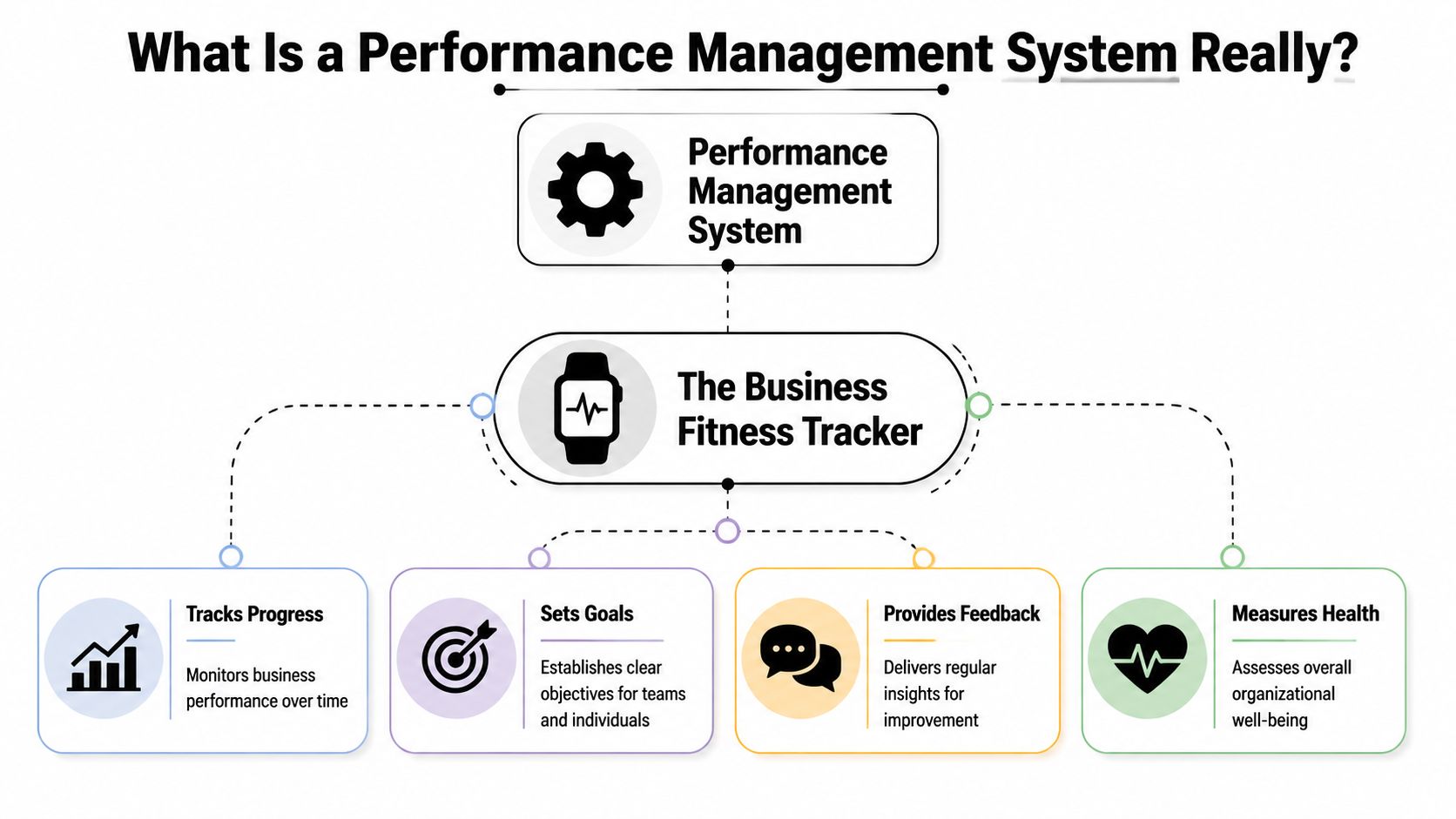
The easiest way to understand a performance management system is to stop thinking of it as a yearly HR event.
Think of it as the fitness tracker for your business. A yearly appraisal is like a medical check-up done too late. It may tell you something went wrong, but it won't help much if the damage has already affected clients, deadlines, or employee morale. A proper system tracks progress continuously, flags issues early, and helps managers adjust before small problems become expensive ones.
The cycle that actually works
Most effective systems follow a simple cycle.
Plan
Managers and employees agree on goals, expected behaviours, and the standards that define good performance.Act
People do the work. That sounds obvious, but this stage matters because goals must connect to real responsibilities, not generic job descriptions.Track
Managers review progress regularly through check-ins, delivery data, quality indicators, and observable outcomes.Review
Leaders evaluate what happened, identify development needs, recognise strong contribution, and adjust the next cycle.
That's why a modern performance management system is continuous. It lives inside weekly work, manager conversations, and team planning. It doesn't sit in a folder waiting for December.
What it is not
A lot of businesses say they have a system when they have one of these:
- An annual rating exercise: Too late, too narrow, and often disconnected from daily work.
- A spreadsheet of targets: Useful for tracking numbers, but not enough for coaching, accountability, or development.
- Manager discretion: This creates inconsistency. One team gets regular support, another gets silence until a problem appears.
A performance management system only works when employees know what is expected before they are judged on it.
The human side matters most
Software helps, but software alone won't fix weak management. The system depends on clear conversations, disciplined follow-up, and fair judgement. Managers need to know how to set realistic targets, give feedback without turning every conversation into criticism, and document progress in a way the business can use.
For agile companies, that's the advantage. A smaller business can build a clean process faster than a large organisation carrying old bureaucracy. If the system is simple, visible, and tied to business priorities, people will use it. If it feels like administrative theatre, they won't.
Core Features and Strategic Benefits for SMEs
SMEs don't need a complicated performance structure. They need one that improves execution. The best systems connect a few core features to decisions that affect revenue, service quality, hiring, and retention.
Goal setting that aligns the whole business
The first feature is disciplined goal setting, an area where many small businesses underperform because every department creates its own priorities. Sales wants volume, operations wants stability, finance wants control, and customer-facing staff want faster approvals.
When goals are set properly, teams stop competing for direction. That's why resources move more effectively when there's strong strategy and execution alignment. The value isn't theoretical. It shows up in fewer conflicting instructions, less duplicated work, and clearer ownership.
Continuous feedback that prevents avoidable mistakes
SMEs can't afford to let performance issues drift for months. One weak handover, one missed client update, or one repeated processing error can affect cash flow and customer trust.
A continuous feedback process helps managers correct course early. It also improves capability faster because employees aren't left guessing whether they are meeting expectations. In lean teams, that matters more than polished appraisal language.
Here's what tends to work best:
- Short manager check-ins: Frequent, focused conversations beat long, formal review meetings.
- Role-specific feedback: Staff respond better when managers link comments to actual tasks and outcomes.
- Documented action points: Verbal guidance is quickly forgotten. Notes create accountability.
Recognition that supports retention
Many founders underestimate how often strong employees leave because their contribution feels invisible. Recognition doesn't need to mean expensive reward schemes. It means the business can clearly explain what good performance looks like and show that it leads somewhere meaningful.
That includes internal growth, expanded responsibility, project leadership, and in some companies, stronger support for succession planning. It also sharpens hiring decisions. If your business is scaling and role clarity is weak, support from a structured hiring partner can help connect recruitment to measurable outcomes, not just CV screening. That's especially relevant when reviewing recruitment process outsourcing as part of wider workforce planning.
Better decisions with less founder dependence
A good system reduces one of the biggest operational risks in smaller companies. The founder no longer has to personally interpret every personnel issue.
Instead, managers can answer practical questions with evidence:
| Feature | Strategic benefit for SMEs |
|---|---|
| Clear goals | Better alignment across small teams |
| Regular check-ins | Faster correction of delivery problems |
| Documented reviews | More consistent promotion and support decisions |
| Recognition links | Stronger morale and lower avoidable turnover |
That's when the performance management system stops feeling like HR overhead and starts acting like management infrastructure.
Measuring What Matters with the Right KPIs
A performance management system gets stronger or weaker based on one decision: what you choose to measure.
Bad KPIs create noise. They look active on a dashboard but don't help managers make better decisions. Good KPIs show whether the business is moving in the right direction and whether each function is contributing in a way that supports that goal.
The UAE public sector has already signalled where modern practice is heading. The Federal Authority for Government Human Resources stated that Injazati, an AI-powered system scheduled to go live across federal entities in January 2026, integrates Objectives and Key Results (OKRs), Key Performance Indicators (KPIs), and Core Competencies to redefine how employees plan and track impact, according to the FAHR announcement on Injazati. For business owners, that's a useful benchmark. It shows that outcome-based planning and measurable tracking are not passing trends.
Start with the business goal, not the metric
Many SMEs reverse the process. They ask what they can measure first, then build goals around available data. That usually produces vanity metrics.
A better approach is:
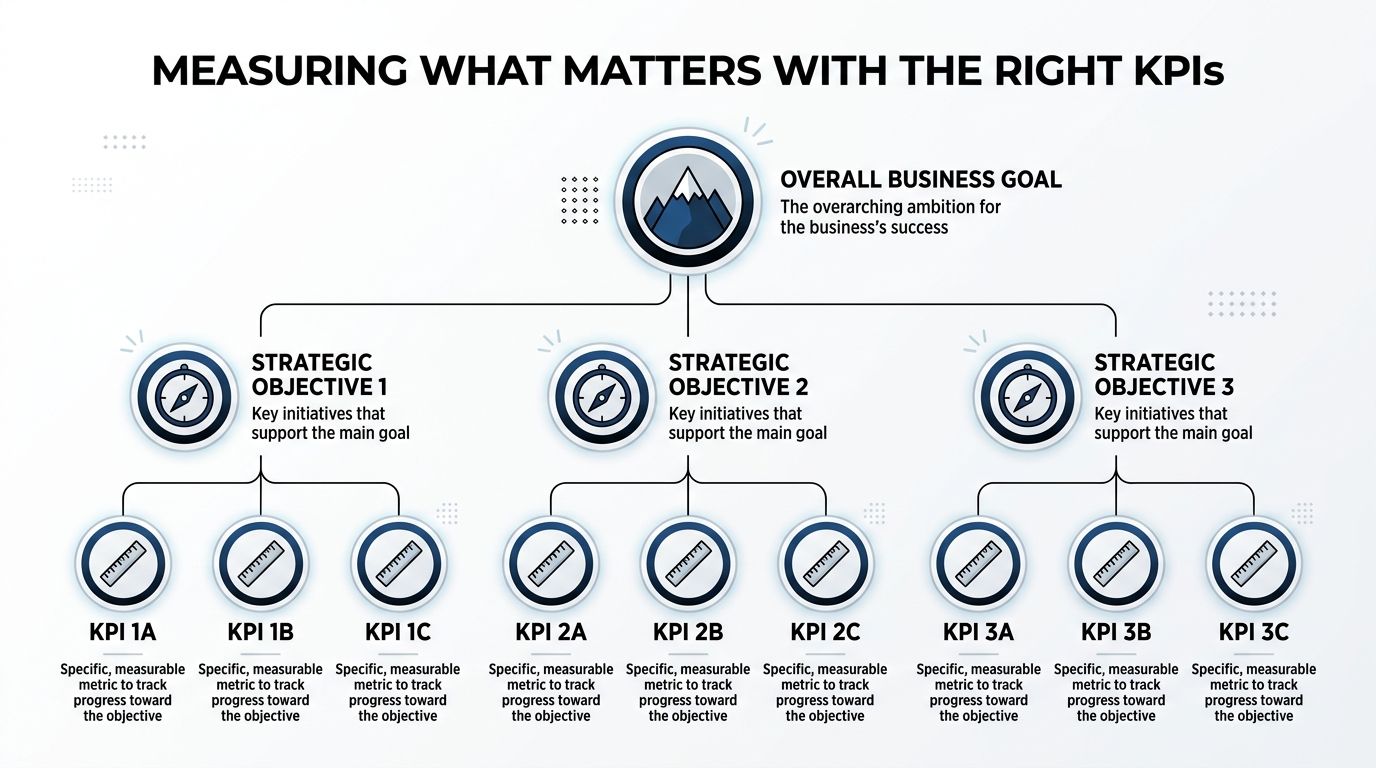
- Define the business objective: Increase client retention, improve collection discipline, shorten delivery delays, or strengthen service consistency.
- Choose the strategic objective: Identify what each team must do to support that outcome.
- Assign KPIs carefully: Select indicators that reflect progress, not just activity.
Key test: If a KPI changes but no one knows what action to take next, it's probably the wrong KPI.
For finance-linked roles, measurement should also connect to reporting discipline. If you're trying to improve operational control, useful indicators often sit close to billing accuracy, collection timing, project margin visibility, and forecasting quality. Tools and templates such as a cash flow statement template can help companies structure the financial side of that measurement more consistently.
Example KPIs for SME business functions
| Department | Example KPI | What It Measures |
|---|---|---|
| Sales | Qualified opportunities progressed to proposal stage | Sales pipeline movement and discipline |
| Marketing | Lead quality by campaign source | Whether marketing activity supports commercial priorities |
| Operations | On-time completion against committed deadlines | Delivery reliability |
| Customer service | Resolution within agreed internal service standard | Responsiveness and follow-through |
| Finance | Invoice processing accuracy | Control and administrative quality |
| HR | Time to complete onboarding milestones | Readiness of new hires |
The point isn't to copy the table exactly. It's to keep each KPI tied to a decision the business cares about.
Use governance, not just dashboards
As companies grow, KPI definitions often drift. One manager counts differently from another. A number gets reported without context. Then confidence in the system drops.
That's why governance matters. If you want a practical reference on metric discipline, especially for scaling firms that need cleaner reporting standards, the guidance on audit-ready KPIs for SaaS is useful because it focuses on consistency, ownership, and definition control. Those principles apply well beyond software businesses.
A KPI framework should answer four questions clearly: what the metric means, who owns it, how often it's reviewed, and what response it triggers when it moves off target.
A Practical Roadmap for Implementation
Most performance management systems fail at rollout, not design. The framework may look sensible on paper, but managers don't adopt it, employees don't trust it, and leaders overload the process with too many forms too early.
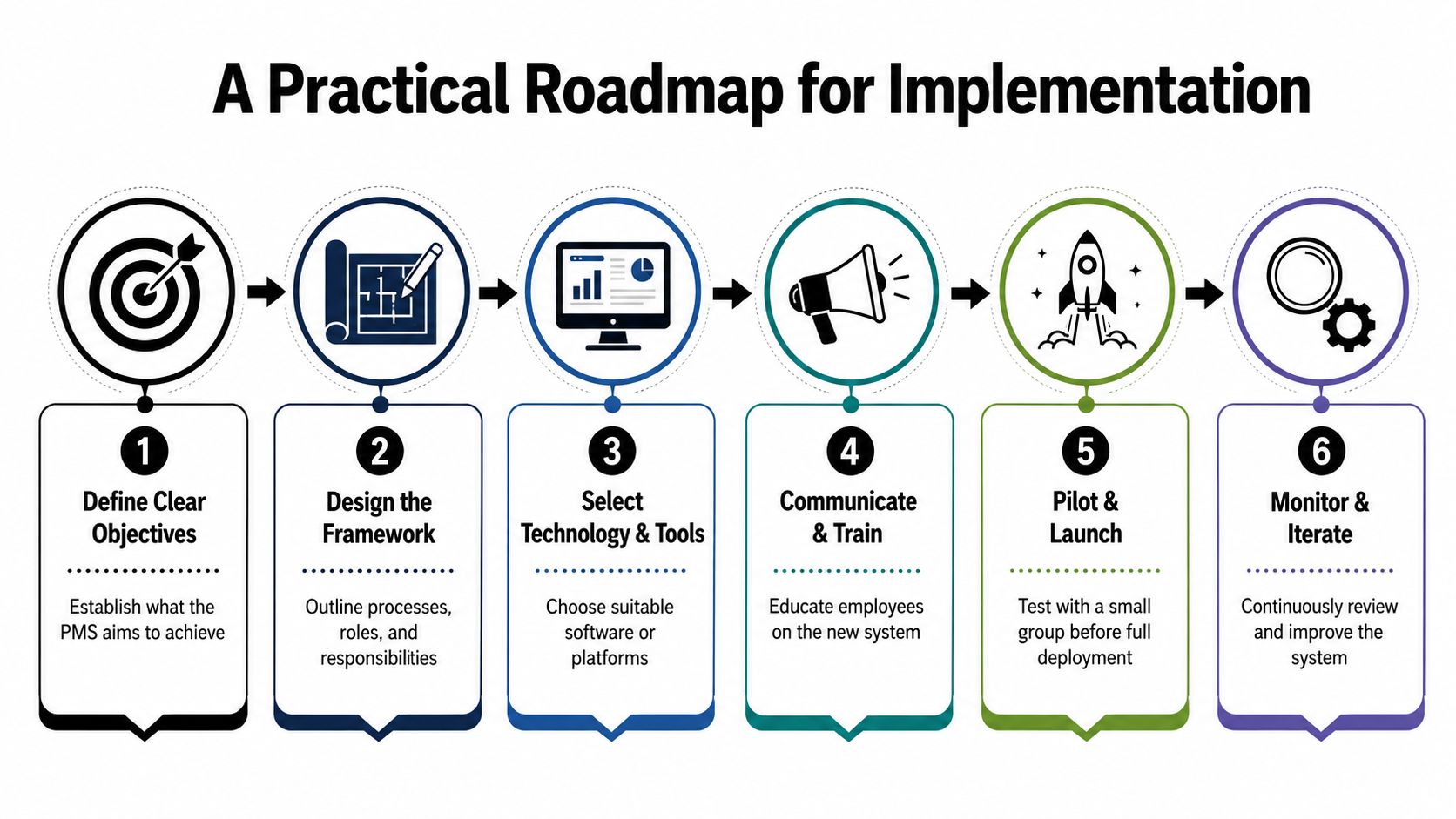
A better approach is phased implementation.
Step one and step two
Start with the commercial reality of the business. What are you trying to improve right now? Growth quality, operational discipline, team accountability, customer retention, or management consistency? If leadership can't answer that, the system will become vague immediately.
Then design the framework around those priorities. Keep it lean. Define roles, review frequency, approval points, and the difference between objective results and behavioural expectations.
A practical starting structure usually includes:
- Quarterly or monthly goal setting: The cadence should match the speed of the business.
- Manager check-ins: Short, regular discussions with notes.
- A documented review cycle: This creates consistency and reduces subjective decisions.
Step three and step four
Choose technology only after the process is clear. Many companies buy software first and then try to force management behaviour into the tool. That's backwards.
When selecting a platform, test for these points:
- Ease of use: Managers won't maintain a system that feels administrative.
- Role-based visibility: Staff should see what they need without excessive complexity.
- Reporting clarity: Leadership needs usable summaries, not cluttered dashboards.
After that, communicate the change properly. Employees need to know why the business is introducing the system and how it benefits them. If the message sounds like surveillance, adoption will suffer. If the message focuses on fairness, development, clarity, and recognition, resistance drops.
Rollout succeeds when managers treat the system as part of leadership, not an HR task they complete at the end of the month.
Step five and step six
Pilot with one team before full launch. Sales, operations, or a project unit often works well because the outputs are visible and the learning is immediate. Use the pilot to test meeting cadence, KPI quality, and manager capability.
Then iterate. Remove duplicated steps. Simplify language. Fix rating criteria if they create confusion.
A structured cycle matters. The UAE Federal Authority for Government Human Resources has already formalised a clear review rhythm for federal employees, with the final annual assessment under Injazati conducted in November and December before the new performance cycle begins, as outlined in the FAHR Injazati initiative details. Even at that level, timing and process design are deliberate.
That's the lesson for SMEs. Don't aim for complexity. Aim for a repeatable process people can run.
The UAE Advantage Connecting Performance to Growth
In the UAE, a performance management system can do more than improve internal discipline. It can support compliance, strengthen leadership decisions, and create documented evidence that helps businesses retain valuable talent.

Why the UAE context changes the value of performance data
The local market rewards businesses that stay organised. Founders need stronger governance as they scale, especially when they're balancing hiring, immigration processes, financial compliance, and client delivery all at once.
The UAE has also continued to modernise public-sector performance infrastructure. In 2024, the country launched the Proactive Government Performance System, building on Adaa 2.0 and Adaa 3.0. It has trained 200 employees in performance management and data analysis and is designed to save over 250,000 hours annually while supporting AI-driven strategic oversight, according to Gulf News coverage of the UAE performance system rollout. That direction matters because it reflects a wider operating environment that increasingly values structured, data-led execution.
For businesses, the implication is straightforward. Performance data is becoming more useful when it is clean, credible, and linked to strategic goals.
The overlooked link to talent retention and visa strategy
Many companies miss an opportunity. They run performance reviews for internal use only and never connect the data to broader talent decisions.
That's a mistake in the UAE. Certain high-value talent pathways place weight on outstanding performance, but many businesses don't maintain the records needed to demonstrate it clearly. At the same time, only 38% of workers in the UAE believe their performance reviews influence career advancement or external recognition, according to RSI Concepts' discussion of performance reviews in the UAE. That gap matters.
If employees can't see how reviews affect progression, recognition, or sponsorship support, they stop trusting the process. If the company can't evidence strong contribution, it weakens its case when trying to retain key people.
Compliance and credibility matter too
Dubai has also formalised public-sector performance rules through Executive Council Resolution No. (39) of 2018, which established a system with five mandatory phases: planning, periodic review, appraisal, calibration with percentage adjustment, and reward and recognition, as set out in the Dubai Executive Council resolution PDF%20of%202018.pdf). Private companies don't mirror that framework directly, but the principle is relevant. Credible performance systems need structure, review points, and consistent standards.
For a startup or SME, this creates a practical advantage. A documented performance history can support promotion decisions, manager accountability, succession planning, and stronger talent conversations for employees building long-term careers in the Emirates. It also fits naturally into broader planning for founders exploring the realities of launching and scaling a startup in Dubai.
Your Next Steps to Strategic Performance
A performance management system isn't useful because it looks organised. It's useful because it helps the business run better. It gives managers a repeatable way to set expectations, track progress, correct issues earlier, and recognise strong contribution with evidence instead of opinion.
For SMEs and startups in the UAE, the upside is bigger than internal order. A stronger system improves alignment, supports better financial and operational decisions, and creates documentation that can matter for growth, governance, and talent retention. That's why businesses that treat performance as a strategic asset usually make better decisions than those that handle it only as an HR requirement.
If your current approach depends on memory, informal updates, or last-minute reviews, the next step is to simplify and formalise. Start with business priorities. Build a small framework managers can use. Define a handful of KPIs that support decisions. Then create a review rhythm that people trust.
The best system is not the most advanced one. It's the one your managers can run consistently and your employees can understand clearly.
Done well, performance management becomes part of how the company grows. It sharpens execution. It reduces avoidable friction. It helps leadership spend less time chasing clarity and more time making decisions that move the business forward.
If you want help building a performance management approach that fits your company structure, reporting needs, and UAE growth plans, Smart Classic Business Hub can help you connect HR processes, financial control, compliance, and business strategy into one workable system.