
You’re probably looking at Dubai from one of three positions right now. You have a skill and want to freelance legally. You have capital and want to invest without making an expensive structural mistake. Or you want to build an operating business and need to know what occurs after the glossy promise of “easy setup”.
That’s the key question behind how to make money in dubai. It’s not only about choosing a revenue stream. It’s about getting the legal status, company structure, banking readiness, and compliance mechanics right so your income is durable, usable, and scalable.
Dubai still attracts people because it’s ambitious, fast-moving, and tax-efficient. But the old oil narrative is outdated. The practical opportunity sits in trade, tourism, services, finance, digital work, and property. Founders who do well here usually aren’t guessing. They match the right earning model to the right legal vehicle, then they stay disciplined on approvals, documentation, and cash flow.
Your Blueprint for Prosperity in the New Dubai Economy
Dubai rewards people who arrive with a plan, not people who arrive with a slogan. Many first-time founders still assume the city’s wealth story is tied to oil. It isn’t. Oil once accounted for 50% of Dubai’s GDP, but now contributes less than 1%. The economy is driven by sectors such as wholesale and retail trade at 26%, transport and logistics at 12%, financial services at 10%, and tourism, which reached 20% of GDP in 2024, according to the Dubai economy overview.
That matters because it changes where real income comes from. In practice, Dubai is a platform economy. People make money here by selling expertise, moving goods, serving visitors, structuring investments, and building companies that plug into those flows.
A useful way to think about it is simple:
- Freelancers monetise specialist skills.
- Founders build repeatable revenue through licensed activity.
- Investors use property or regulated vehicles to produce cash flow.
Dubai’s advantage is that all three paths can operate inside a tax-efficient environment if structured properly. If you’re still deciding what lane fits you best, this guide to the best business ideas in the UAE is a practical starting point.
The Foundation Your Legal Status and Visa Strategy
The first mistake people make is assuming they can start earning first and fix paperwork later. In Dubai, that approach creates problems quickly. Clients ask for invoices. Banks ask for documents. Landlords, platforms, and authorities all care whether your activity matches your legal status.
For many readers, the first real decision isn’t the business idea. It’s the visa route.

When a freelance visa is enough
A DED freelancer visa suits people selling their own time and expertise. Designers, marketers, consultants, developers, writers, trainers, and similar solo operators often start here because it’s lighter than launching a full operating company.
Recent data states that over 10,000 DED freelancer visas were issued in 2025, with setup fees ranging from AED 7,500-20,000. The same source notes that 40% of freelancers fail renewals because of audit non-compliance, according to this guide on freelancer visas and zero-investment business ideas in Dubai.
That failure rate tells you something important. Entry is only half the job. Renewal discipline matters.
A freelancer visa usually works when:
- You are the service. Your income depends on your expertise, not on staff, stock, or a physical storefront.
- Your client base is varied. You invoice project by project, monthly retainer by monthly retainer.
- You want lower complexity. You’re validating demand before committing to a broader company structure.
It stops being enough when you need larger procurement contracts, multiple employees, broader licensing, or a structure that signals a bigger operational footprint.
Practical rule: If the business can’t run without you personally doing the work, a freelance route may fit. If the business should make money while you step away, you’re already thinking like a company owner.
When an investor route makes more sense
If you’re placing capital into a UAE venture or property-backed strategy, your visa logic changes. You’re no longer only proving your right to reside. You’re aligning residency with an ownership position and long-term financial planning.
That’s why many investors review the practical criteria for securing a visa for investors before choosing the underlying asset or company form. The visa and the investment need to support each other. Too many people choose them separately and create friction later.
The investor path generally suits:
- Property buyers who want residency linked to a qualifying investment
- Shareholders entering an existing UAE company
- Founders who need a residency framework tied to a licensed business
If your priority is this route, it helps to study the current investor visa requirements in the UAE before signing any incorporation or property documents.
Employment visas and the side-hustle trap
Some people start in Dubai on an employment visa and assume they can freelance on the side. That’s where reality gets uncomfortable. Paid side activity still has to align with permissions and licensing.
The issue isn’t whether you can physically find clients. You can. The issue is whether you can do so legally, invoice properly, and renew your status without complications.
Here’s the cleaner way to think about visa choice:
| Path | Best for | Main strength | Main weakness |
|---|---|---|---|
| Freelance visa | Solo service providers | Lower setup commitment | Renewal and compliance can be mishandled |
| Investor visa | Capital-backed founders and investors | Stronger ownership alignment | Requires more planning upfront |
| Employment visa | Salaried professionals | Stable base residency | Side income can create legal grey areas |
What usually goes wrong
The common problems are rarely dramatic. They’re procedural.
- Mismatch of activity and permit. The work you do doesn’t match the legal activity you selected.
- Weak record-keeping. You earn money but don’t maintain the paperwork needed for renewal and banking.
- Late restructuring. You begin as a freelancer, then outgrow the setup but delay formal conversion.
Most Dubai setup problems don’t begin with bad intentions. They begin with people treating compliance as admin instead of infrastructure.
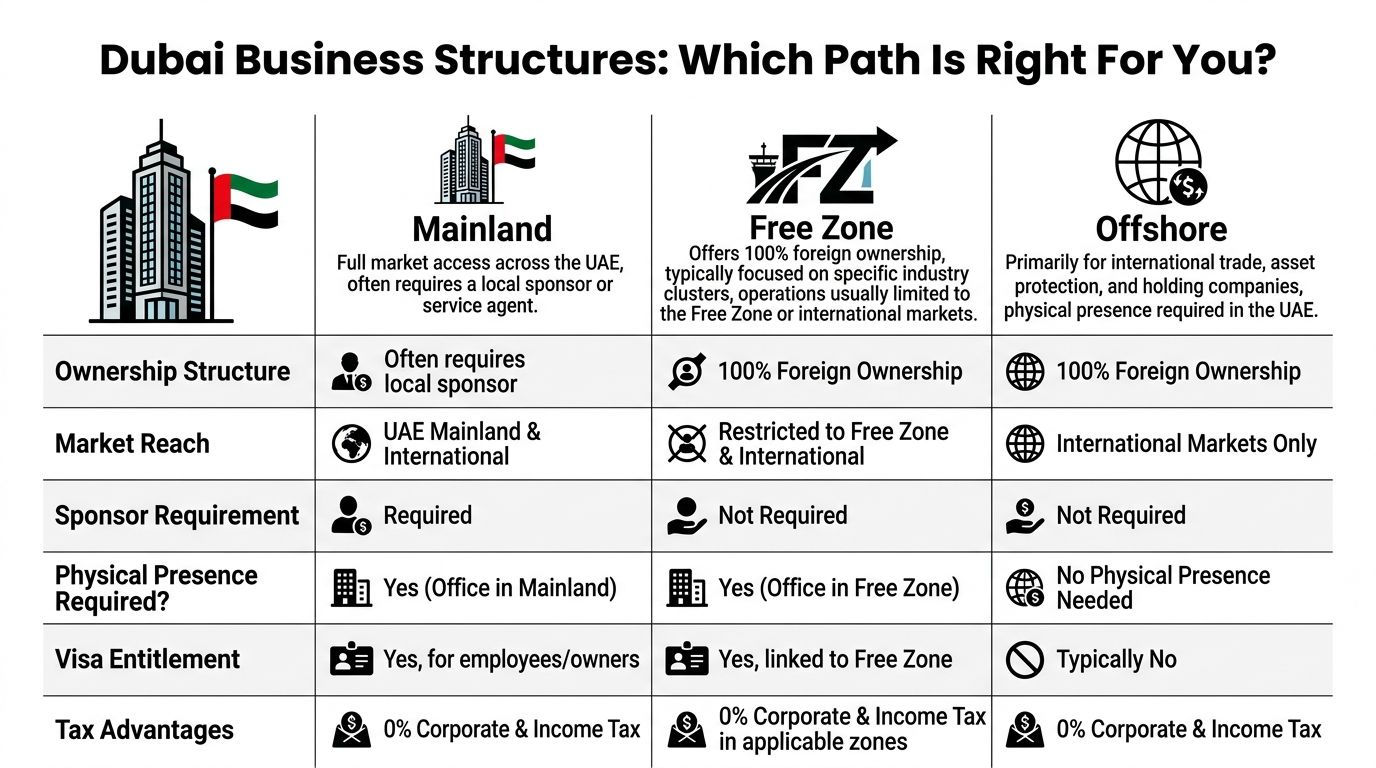
Mainland Free Zone or Offshore Choosing Your Business Structure
Business structure determines what you can sell, where you can sell it, how banks assess you, and how easy it is to scale. This decision affects revenue more than most founders realise.
A lot of new entrants choose a structure based on whichever consultant mentions the lowest starting price. That’s a poor filter. You should choose based on market access, ownership preference, operational needs, and the type of counterparties you plan to deal with.
Mainland when local market access matters
Mainland is usually the right answer when your customer base sits across the UAE and your business needs broad domestic access. Retail concepts, local service businesses, contracting models, and businesses that expect direct interaction with the UAE market often lean this way.
The upside is practical freedom. You’re not trying to engineer around market-access limitations. The trade-off is that setup and ongoing obligations can be more involved depending on the activity.
Mainland tends to fit founders who say things like:
- “I need to sell directly into the local market.”
- “I expect government or broad local commercial work.”
- “My business model depends on being present across the UAE, not only inside a zone or overseas.”
Free zone when precision beats breadth
Free zones work well when the business has a clear activity, an international orientation, or a service model that doesn’t require broad onshore access on day one. They’re often a strong fit for consultants, digital businesses, holding entities, specialist traders, and founders who want a simpler entry.
One of the main attractions is 100% foreign ownership in free zones such as DMCC, as outlined in this mainland versus free zone comparison for Dubai founders. That ownership clarity is one reason many first-time international entrepreneurs begin here.
Free zone structures are often better when:
- You value speed and administrative clarity
- Your clients are international or concentrated
- Your business belongs to a sector cluster that benefits from a specialised ecosystem
Offshore when the goal isn’t local trading
Offshore structures are a different animal. They’re usually used for international trade, asset protection, or holding arrangements rather than day-to-day operating activity inside the UAE.
That makes offshore useful in the right context and disappointing in the wrong one. If you need a visible trading presence, staff, office activity, and practical local operations, offshore may not match your commercial reality.
Offshore is often chosen for what it sounds like, not for what it actually does. If you need an operating business, don’t force a holding structure to do an operating job.
A practical comparison
| Structure | Ownership | Market reach | Best use case | Main trade-off |
|---|---|---|---|---|
| Mainland | Depends on the activity and legal setup | Broad UAE access | Local trading and service delivery | More operational complexity |
| Free zone | Often strong foreign ownership positioning | Zone and international focus, depending on model | Consulting, digital, specialist trade, startup entry | Local market access can require planning |
| Offshore | Suited to holding and international structuring | International and asset-focused | Holdings, international ownership structures | Not ideal for day-to-day UAE operations |
How founders should actually decide
Most good decisions come down to three filters.
First, ask where the customer sits. If the customer is inside the UAE and broad market access is central, mainland often deserves serious attention.
Second, ask whether the business is operator-led or system-led. A solo advisory practice can do well in a free zone or freelance setup. A logistics business, retail concept, or wider service operation may need a more expansive structure.
Third, ask what “scale” means in your case. Some founders think scale means social media reach. In reality, scale means contractability, banking comfort, staffing flexibility, and fewer structural bottlenecks.
What doesn’t work
What fails most often is copying someone else’s structure. Your friend’s free zone consultancy setup may be excellent for a solo marketing business and completely wrong for product import, local contracting, or a property-adjacent operating company.
The right structure is the one that matches your actual revenue engine. Not the cheapest brochure. Not the fastest sales pitch. The one that lets your business earn legally, get paid cleanly, and expand without redoing everything six months later.
The Launch Plan From Idea to Official Company Registration
A business idea in Dubai becomes real when it survives paperwork. Until then, it’s only intent. The founders who launch smoothly usually do one thing well before they submit anything. They define the activity with precision.

In a free zone like DMCC, which hosts over 24,000 companies, a business can be operational within one week. Annual licence fees range from AED 10,000-50,000, and 40% of rejections come from mismatched business activities and office leases, according to the DMCC business setup guide.
That rejection pattern is the real lesson. Registration problems often begin before submission.
Start with market validation, not logo design
Most founders waste energy choosing a brand identity too early. The better starting point is checking whether the business model makes sense in the UAE context.
Ask practical questions:
- Who pays first? End consumers, SMEs, enterprise clients, tourists, landlords, distributors?
- What licence activity best reflects the service or trade? Broad wording sounds flexible, but mismatch creates problems later.
- What office requirement fits the licence? Don’t select an office package before confirming the activity allows it.
If your business depends on local relationships, test demand through direct outreach and meetings. If it’s digital or international, test it through actual offer pages, discovery calls, and sample invoicing logic.
The actual registration flow
The setup sequence is usually straightforward when the documents and activity line up.
Choose the business activity
This is the legal heart of the company. If the activity is wrong, the rest of the file becomes fragile.Reserve the trade name
A compliant, available name clears one obvious point of friction early.Secure initial approvals
This confirms that the authorities are broadly comfortable with the application.Prepare formation documents
This may include the MoA and related incorporation records, depending on the structure.Finalise office or desk arrangement
Many founders stumble with this step. The office solution has to match the approved activity and the rules of the jurisdiction.Pay licence fees and collect the licence
Once the file is accepted and fees are settled, the company becomes operational.
A fast setup doesn’t mean a rushed setup. In Dubai, speed comes from alignment, not improvisation.
Where launches stall
The delays usually cluster around three areas.
| Friction point | What founders assume | What actually causes trouble |
|---|---|---|
| Business activity | “We can adjust it later” | The wrong activity can affect approval, banking, and invoicing |
| Office selection | “Any flexi-desk will do” | Lease type and activity must fit each other |
| Documents | “A basic file is enough” | Inconsistent descriptions trigger avoidable questions |
What works in practice
Founders who launch cleanly tend to be boring in the best way. They use consistent descriptions across the application, keep shareholder documents orderly, and make sure the actual business model matches the paperwork.
They also think one step ahead. Before they file the company, they ask whether the structure will satisfy a bank, whether the activity supports future hiring, and whether the office setup will still make sense after the first stage of growth.
That’s how a launch stops being an administrative event and becomes a commercial one.
Activating Your Business Banking VAT and Tax Residency
A licence lets you exist. A bank account lets you operate. Those are not the same thing.
Many founders are surprised when they complete incorporation and then discover that banking takes judgement, not just documents. Banks in the UAE don’t only check whether your company is registered. They assess whether the business makes commercial sense, whether the activity is transparent, and whether the profile matches the expected flow of funds.
Why bank applications get stuck
Banks want to understand who owns the company, what it sells, who pays it, and why the volume of transactions is credible. A weak application often has one of two problems. Either the business description is too vague, or the documents don’t support the story.
A strong banking file usually includes:
- Clear activity language that matches the licence and real operations
- Shareholder and identification records that are current and consistent
- Commercial evidence such as contracts, proposals, supplier links, or a functioning website
- A sensible explanation of expected transaction flows by geography and business type
If your company says “consulting” but can’t explain what kind, for whom, and how money moves, expect questions.
VAT is operational, not theoretical
Founders often treat VAT as an accountant’s issue. That’s too late. VAT affects pricing, invoicing, purchasing, and record-keeping from the start.
The easiest way to stay clear-headed is to understand the difference between input and output VAT in practical terms. This explainer on VAT input and VAT output is useful because it frames the issue through everyday business transactions rather than abstract tax language.
Your real task is consistency. If sales invoices, expense records, supplier documents, and bookkeeping all tell the same story, VAT compliance becomes manageable. If they don’t, reconciliation turns ugly very quickly.
Clean books aren’t only for tax filings. They make banks, auditors, and future investors more comfortable with your business.
Why tax residency matters strategically
A Tax Residency Certificate isn’t just a bureaucratic trophy. In practice, it can support cross-border credibility, help document where you are fiscally based, and make certain international relationships easier to manage.
That matters for founders who invoice abroad, hold regional structures, or need cleaner documentation for counterparties and institutions. The certificate doesn’t replace proper planning, but it can strengthen it when the company has been set up and maintained properly.
The founders who struggle most
The hardest cases are usually not the smallest businesses. They’re the ones with confusing paperwork. A modest consultancy with orderly invoices, coherent activity wording, and disciplined accounting often moves more smoothly than a supposedly larger venture with inconsistent records.
If you want to make money in Dubai and keep that money usable, banking and compliance can’t be afterthoughts. They’re part of the revenue system.
Monetisation Models Profitable Revenue Streams in Dubai
Once the legal and financial base is stable, the revenue model becomes the true differentiator. In Dubai, money is usually made through one of three routes. You sell your skill. You sell through a company. Or you deploy capital.
The strongest operators often combine them over time.
The freelancer who productises expertise
A solo consultant arrives with a marketable skill. Maybe it’s digital marketing, branding, recruitment support, operations consulting, or specialist advisory work. At first, income comes directly from hours, projects, and retainers.
That’s a valid starting model because Dubai has a deep business ecosystem full of companies that need specialist support without full-time headcount. But there’s a ceiling if you only sell labour.
The consultants who increase earnings usually do two things:
- Narrow the offer so buyers understand exactly what they’re purchasing
- Package delivery into retainers, audits, managed services, or implementation projects
A general “business consultant” struggles. A consultant who helps trading firms organise sales operations, documentation, and market entry has a much clearer route to revenue.
The founder who builds around trade or digital sales
Another common route is setting up a company that sells products or structured services. In Dubai, this often works well when the business sits near real demand flows such as tourism, B2B support, niche trade, or specialist online retail.
The trap is thinking access equals demand. Dubai gives you access to customers, logistics, and infrastructure. It doesn’t guarantee product-market fit. Founders who do well usually enter with one sharp offer, one identifiable buyer group, and a clear fulfilment model.
A practical sequence looks like this:
- Start with one sellable line, not a catalogue of possibilities.
- Make the buying path frictionless through quotations, payment readiness, and clear terms.
- Use the licence strategically so the business can expand into adjacent activities later without structural confusion.
The easiest money in Dubai usually comes from solving a boring, expensive problem for a customer who needs the solution now.
The investor who prefers passive income
Property remains one of Dubai’s clearest income engines when the asset, area, and management approach are right. According to this analysis of passive income options in Dubai real estate, well-located properties can generate 5-7% net rental yields after expenses. Some sub-markets perform better, with Palm Jumeirah studios around 9% and JLT studios at 8-9%. The same source notes that Dubai REITs are required to distribute 80-90% of net profits as dividends, contributing to average REIT yields of 6-8%.
Those figures matter because they show there isn’t only one way to monetise property here.
A simple comparison helps:
| Model | How income is earned | Who it suits | Main trade-off |
|---|---|---|---|
| Long-term rental | Ongoing tenant rent | Investors who want steadier operations | Less upside than highly optimised short-term strategies |
| Short-term rental | Higher-yield guest stays with active management | Owners in tourist-heavy or premium locations | More operational intensity and regulatory handling |
| REIT investing | Dividend distributions from regulated vehicles | Investors who want property exposure without direct ownership admin | Less direct control over the underlying asset |
What works and what disappoints in property
The romantic version of Dubai property investing is easy money. The real version is area selection, unit economics, building quality, management discipline, and regulatory compliance.
What often works:
- Studios and smaller units in high-demand districts
- Assets that suit either long-term tenants or licensed holiday-home operations
- Investors who treat property like a business line, not a trophy purchase
What often disappoints:
- Buying for branding instead of yield
- Ignoring service charges, furnishing needs, or management drag
- Assuming any unit in a famous area will perform well
The hybrid path usually wins
The most resilient earners in Dubai rarely rely on one stream forever. A freelancer may turn a service into an agency. A founder may use operating profits to buy income-producing property. An investor may pair property with a licensed advisory or trading venture.
That’s the overlooked point in most articles about how to make money in dubai. The city works best when you stack income intelligently. Earned income builds capital. Structured business income builds scale. Capital income adds resilience.
If you choose one path today, choose the one that gives you room to graduate into the next.
Your Dubai Success Checklist and Next Steps
If you want a clean route from idea to first revenue, keep the process brutally simple and disciplined.
The working checklist
- Define your earning model first. Decide whether you are monetising skill, building an operating company, or deploying capital.
- Choose the right legal status. Don’t freelance through the wrong visa or invest through the wrong ownership structure.
- Match the business activity to reality. Your licence should describe what you sell.
- Select the structure based on market access. Mainland, free zone, and offshore each solve different problems.
- Prepare for banking before incorporation finishes. Keep your documents, commercial story, and ownership records consistent.
- Set up accounting early. VAT, bookkeeping, and audit readiness get harder when ignored.
- Build one revenue stream well before adding another. Expansion is easier when the first engine is stable.
- Review tax residency needs if you operate internationally. Cross-border founders benefit from getting this right early.
The mistakes that cost people time and money
Common pitfalls
Choosing a licence activity because it sounds broad, then discovering it doesn’t fit the actual business.
Picking a structure for low headline cost instead of market suitability.
Treating banking as automatic after licence issuance.
Running side income informally and assuming it can be regularised later.
Buying property for prestige rather than cash flow.
Delaying bookkeeping until renewal, audit, or account-opening pressure appears.
The practical answer is to treat Dubai setup as a commercial system, not a paperwork event. Legal status, company form, compliance, banking, and monetisation all affect each other.
That’s where specialist support earns its keep. Smart Classic Business Hub helps founders, freelancers, and investors handle company formation, PRO work, VAT-compliant accounting, tax residency certificates, audit support, and related setup mechanics so the business can start on a cleaner footing and grow with fewer avoidable roadblocks.
Frequently Asked Questions
Can I start a business in Dubai remotely
Yes, parts of the process can be handled remotely, especially in structures designed for simplified setup. But remote formation still depends on accurate documents, activity selection, identity records, and approvals. The main risk isn’t distance. It’s mismatch. If your documents and business description are coherent, remote setup can work smoothly. If they aren’t, being physically present won’t fix the underlying issue.
What’s the most realistic starting path for one person
For one person selling expertise, a freelance route is often the cleanest entry. It keeps the structure aligned with the fact that you are the income engine. If the work begins to require staff, broader contracting power, or a more substantial commercial presence, that’s usually the point to consider a fuller company structure.
How much should I budget for a legal start
The budget depends on your visa path, company structure, office requirement, and compliance needs. Where verified figures exist, freelance setup fees range from AED 7,500-20,000, and annual licence fees in a free zone example range from AED 10,000-50,000. Beyond those figures, you should also reserve room for documentation, banking preparation, accounting, and practical operating costs.
How quickly can I become operational
A straightforward free zone case can move fast. In the DMCC example cited earlier, a business can be operational within one week when the file is compliant and the activity, office arrangement, and documents align properly. Delays usually come from inconsistency, not from the system itself.
Is property the best way to make money in Dubai
It can be an excellent path, but not for everyone. Property suits investors who understand yield, area selection, and management. If you need active cash flow from your own effort, a service business or consultancy may produce income sooner. Property often becomes more powerful when paired with an existing business or income stream rather than treated as the only plan.
If you want expert help turning your Dubai income plan into a compliant, bankable, and scalable setup, Smart Classic Business Hub can support the full process, from company formation and PRO services to VAT-compliant accounting, tax residency certificates, audit support, and practical guidance on choosing the right structure for your goals.