
You’ve secured your trade licence, opened the company file, and you’re getting ready to hire your first employees. Then payroll comes up, and suddenly the practical questions start. How do salaries need to be paid in the UAE? Can you transfer wages from your business account? What will the authorities expect from you each month?
That’s where many new founders first ask what is WPS in UAE. It sounds technical, but the idea is straightforward. WPS is the system that connects payroll, labour compliance, and business stability. If you get it right from the start, your company runs more smoothly. If you treat it as an afterthought, payroll can become the first serious compliance problem your business faces.
A lot of entrepreneurs think of WPS as paperwork. It’s more accurate to think of it as part of the foundation of a lawful UAE business, just like your trade licence, establishment card, and proper employment contracts. It protects employees, gives regulators visibility, and gives employers a clear process for paying wages in a compliant way.
Your First Step in UAE Payroll What is WPS
You hire your first employee, agree the salary, and set a start date. Then a practical question lands on your desk. How exactly must wages be paid in the UAE so your company stays on the right side of labour rules?
WPS stands for Wage Protection System. For a new business owner, the simplest way to understand it is this. WPS is the approved salary payment system used for many private sector employees in the UAE, and it gives the authorities a clear record that wages were paid properly through authorised channels.
That matters because payroll in the UAE is a regulated activity. It is not only an internal bookkeeping task. Once you hire under the relevant labour structure, salary payment becomes part of your compliance obligations, much like keeping valid contracts and maintaining the right company records.
Why the system exists
WPS was created to reduce late salary payments, underpayment, and disputes over whether wages were paid at all. In practical terms, it creates a documented payment trail.
For employees, that trail helps protect their right to be paid correctly and on time. For employers, it provides evidence. If a worker raises a complaint or an authority reviews your payroll history, proper WPS records help show that your company met its obligations.
A simple way to view it is this. WPS works like a controlled payroll checkpoint. Your business does not just decide salaries internally and send money however it likes. The payment has to move through an accepted process that can be checked and verified.
Practical rule: If your business will employ staff under a MOHRE-governed setup, prepare for WPS during company setup, before the first salary cycle begins.
Why founders should take it seriously from day one
Early-stage companies often focus on hiring, sales, visas, and office space. Payroll gets pushed down the list until the first payday is close. That is where problems start.
If your WPS process is not set up properly, the issue is rarely limited to one late transfer. It can lead to employee complaints, compliance scrutiny, and disruption that pulls your attention away from running the business. For that reason, WPS should be treated as part of the foundation of an operationally stable company, not as an admin item to fix later.
For a founder, the key points are clear:
- Salary payments must follow an approved process
- Accurate payroll data matters
- Delays create compliance risk quickly
- Good setup prevents avoidable issues later
So when someone asks what is WPS in UAE, the practical answer is straightforward. It is the system that turns payroll from a private internal task into a traceable, compliant business function. Getting it right early helps protect your staff, your licence position, and the day-to-day stability of your company.
Understanding the WPS Ecosystem
WPS isn’t one portal doing everything. It’s a coordinated system involving regulators, financial institutions, and the employer. If you understand who does what, the process becomes much easier to manage.
To make it simple, think of WPS like a controlled payment corridor. Your company sends salary data and funds into that corridor. Different parties verify, route, and record the transaction so wages reach employees through approved channels.

Who sits inside the system
Three groups matter most.
| Party | Main role | Why it matters to you |
|---|---|---|
| MOHRE | Oversees labour compliance and monitors salary payment behaviour | This is the authority watching whether wages are paid as required |
| UAE Central Bank | Supports and regulates the electronic salary transfer framework | It helps ensure salary movement happens through authorised channels |
| WPS agents | Approved banks, exchange houses, and financial institutions that process salary transfers | Your business uses one of these to submit and execute payroll |
The employer’s role is just as important. Your company prepares the monthly payroll data and initiates payment correctly. The system doesn’t fix bad internal records. It only processes what you submit.
What MOHRE and the Central Bank each do
MOHRE is the rules side of the system. It links wages to employment records, contract terms, and employer obligations. If salaries are delayed or the data doesn’t line up, MOHRE can treat that as a compliance issue.
The Central Bank is the payment control side. It sits in the regulated financial layer. That means wages aren’t being handled through informal or untraceable methods. They move through approved institutions in a trackable way.
Think of MOHRE as the referee and the Central Bank as the secure payment rail. One checks compliance. The other helps ensure the money moves through the proper route.
Why approved agents matter
Many new business owners get confused here. They assume any bank transfer counts. It doesn’t work that loosely. WPS uses approved institutions, often called WPS agents, to receive the salary file, validate it, and process the payment.
That’s why opening the right company account and selecting the right payroll channel isn’t an admin detail. It’s part of compliance design.
If your setup is weak, payroll becomes reactive every month. If the ecosystem is set up properly, salary processing becomes routine, traceable, and far less stressful.
The WPS Process in Action
Once the system is in place, WPS follows a repeatable monthly flow. This is the part most founders need to understand in practical terms. Not because they’ll always do it themselves, but because they’re still responsible if something goes wrong.
The heart of the process is the Salary Information File, usually called the SIF. This is the payroll data file your company prepares and submits each month through an approved channel. It contains the core salary details the system needs to process payment correctly.
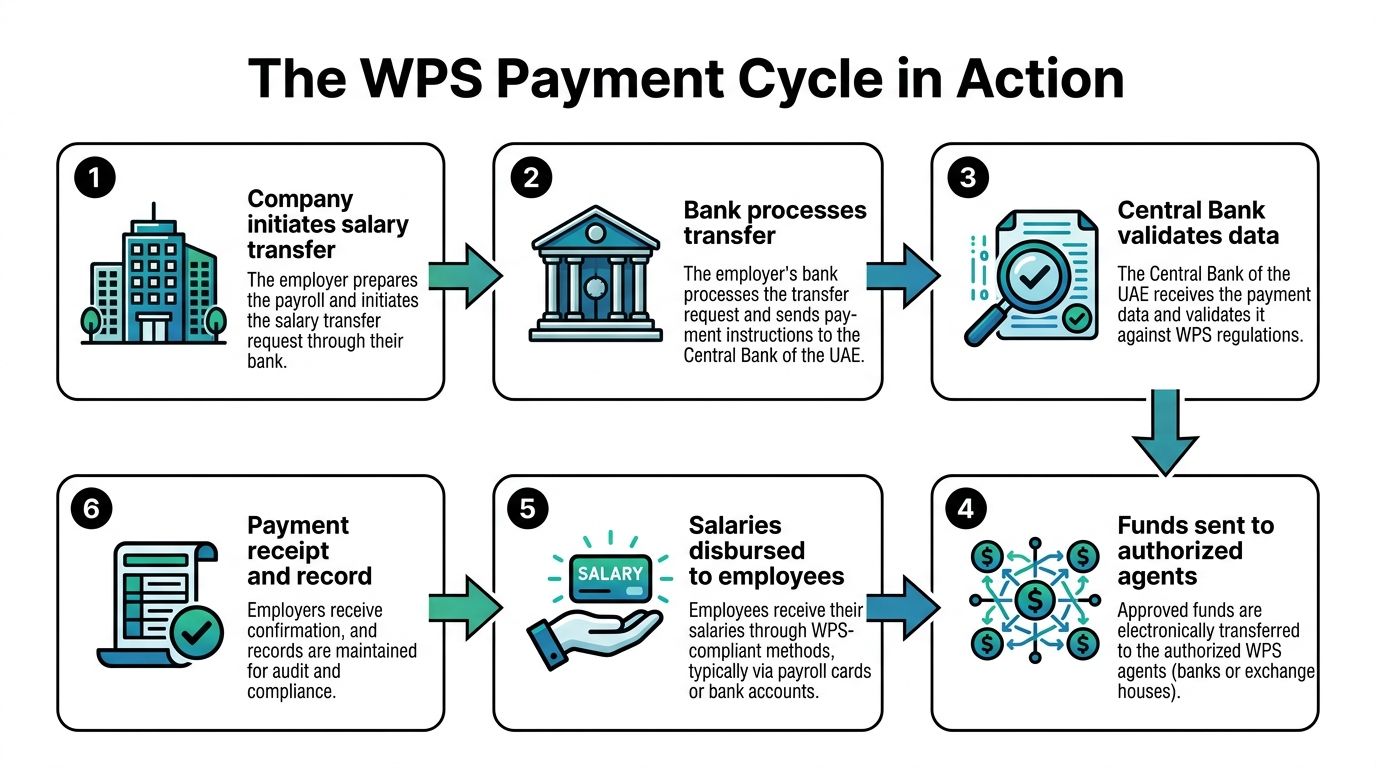
The six-step payment flow
Here’s the process in plain language.
Your company prepares payroll
You finalise who is being paid, what each person is owed, and whether any lawful deductions or allowances apply.You generate the SIF
The file includes employee wage information, contract-linked details, and payment instructions. Accuracy matters here because the system will process exactly what you submit.You send the file through your WPS channel
This is typically done through your approved bank or another authorised WPS agent.The file is checked and validated
The payment data is reviewed inside the WPS framework before salaries move forward.Funds are routed for salary disbursement
Once accepted, salaries are transferred to employee bank accounts or WPS-compliant salary cards, depending on the setup.Records are created for compliance
The employer receives payment confirmation, and the transaction becomes part of the auditable payroll record.
Why the SIF is so important
The SIF is more than a spreadsheet. It’s the formal monthly instruction set for your wage payments. If an employee’s details are wrong, if the salary amount doesn’t match what should be paid, or if contract data isn’t reflected properly, the error travels into the compliance process.
That’s why businesses often run into avoidable trouble not because they meant to underpay anyone, but because their internal payroll data wasn’t clean.
A reliable SIF usually depends on four things:
- Clean employee master data
- Correct contract records
- Accurate monthly payroll calculations
- A review step before submission
A simple example
Suppose you hire a sales coordinator in Dubai. At month-end, your finance team calculates salary, checks attendance-related inputs, and confirms the final payable amount. That information goes into the SIF. The file is submitted through your approved WPS route, reviewed, and then the salary is sent to the employee’s registered account or payroll card.
If the employee’s bank-linked information is wrong, the payment may fail. If the salary figure is incorrect, you may face a payroll dispute. If the file isn’t submitted on time, you create a compliance risk.
Good WPS management starts before payroll day. It starts with organised employee records, correct contracts, and disciplined monthly review.
What founders often misunderstand
A common mistake is treating WPS as “the bank part” of salary payment. It’s broader than that. WPS is a joined-up process where data quality, timing, and fund transfer all matter together.
That’s why payroll shouldn’t sit in isolation from HR records and finance controls. If one side is messy, the whole process becomes fragile.
Fulfilling Your Legal Payroll Duties in the UAE
A new company can be profitable on paper and still create risk for itself if payroll is handled casually. In the UAE, wage payment is not just an internal finance task. It is part of your legal operating framework.
That distinction matters. WPS compliance helps show that your business is paying people correctly, on time, and in line with recorded employment terms. For a founder, that is not administrative box-ticking. It is part of building a company that can hire confidently, pass routine checks, and avoid avoidable disputes.

Your baseline obligations
Your payroll duties start with the business itself being properly set up. If the company records are incomplete or inactive, payroll compliance becomes harder from the beginning.
In practical terms, employers usually need the following in place:
- Valid company registration: Your trade licence and establishment details must be current for the relevant labour arrangement.
- A suitable corporate banking setup: The business needs an account with a bank or approved institution that supports salary transfers through the WPS framework.
- MOHRE access for labour administration: The company must be able to manage the required labour-side processes through the proper official channels.
- Timely monthly salary processing: Salary details must be submitted through the approved WPS route each payroll cycle.
- Payment in line with contract terms: Wages should be paid on the contractual due date, or on a regular monthly basis where that timing is not otherwise specified. As noted earlier, delays beyond the permitted period can trigger compliance concerns.
What good compliance looks like month to month
A more casual approach is insufficient for UAE payroll compliance. You need a repeatable process that links HR records, payroll calculations, approvals, funding, and document retention.
A useful way to view it is as a chain. If one link is weak, the whole payment cycle is exposed.
A practical monthly process usually includes:
Check employee records before payroll is finalised
Employee names, labour records, salary terms, and payment details should match your latest approved files.Verify salary components against the contract
Basic salary, allowances, deductions, and any other approved elements should reflect the signed employment terms.Review variable pay carefully
Overtime, unpaid leave, commissions, and similar items often cause errors because they change from month to month. If you need a clearer reference point, this guide on how to compute overtime in UAE can help.Approve and submit the payroll file on time
Someone responsible should review the final figures before submission through the approved channel.Ensure the payroll account is funded
A correct submission can still fail if the company has not placed enough funds in the account at the right time.Keep the supporting record
Save confirmations, payroll reports, contracts, amendments, and related employee documents in an organised file.
If your paperwork is still spread across email threads, shared folders, and separate departments, payroll errors become more likely. Keeping contracts, approvals, and authority records together with your wider legal documents makes payroll control much easier.
Where founders usually run into trouble
The problem is often not refusal to pay. It is inconsistency between systems.
For example, HR may record a salary revision, finance may continue using the old amount, and the bank submission may reflect something else again. Once that happens, the company is no longer dealing with a simple admin mistake. It is dealing with a compliance issue that can lead to employee complaints, rejected files, or questions from the authorities.
This is why WPS should be treated as part of business infrastructure, much like licensing, bookkeeping, and tax records. A company that handles payroll with discipline is usually easier to manage across the board. A company that leaves payroll to last-minute manual checks tends to create problems in several areas at once.
Free zone businesses can have different administrative arrangements. But where MOHRE rules apply, WPS duties should be treated as active, recurring responsibilities that need proper oversight.
Common WPS Mistakes and How to Avoid Them
Most WPS problems don’t start with deliberate misconduct. They start with ordinary operational mistakes. A wrong employee record. A delayed approval. An unfunded payroll account. A file submitted without final review.
Those mistakes matter because regulators take wage payment seriously. According to this summary of WPS enforcement and penalties, non-compliance can lead to fines up to AED 5,000 per violation under Ministerial Decree No. 739 of 2016. The same source states that failure to pay salaries on time can trigger automated MOHRE alerts and potential work permit revocations, which can stop a company from hiring new staff. It also notes that by October 2015, WPS already covered approximately 3.5 million workers, based on ILO reporting.

Four mistakes that cause the most trouble
1. Submitting inaccurate employee data
This happens when employee names, account-linked details, or salary figures don’t match the underlying records. The result can be a rejected or failed payment.
Avoid it by making one person responsible for a final pre-submission check.
2. Paying late because payroll started too late
Some founders only think about payroll when the due date is close. That creates room for internal delays, missing approvals, or banking cut-off problems.
A better habit is to work backwards from the salary due date and lock the payroll review earlier.
3. Treating contract changes casually
Salary revisions, unpaid leave, and similar changes should be reflected properly in records and payroll handling. If they aren’t, the submitted amount may not align with what the authorities expect to see.
That’s one reason leave salary calculations need extra care. If you’re reviewing that area, this article on how to calculate leave salary in UAE can help you check the payroll logic.
4. Assuming one missed cycle won’t matter
This is a dangerous mindset. Once the system flags non-compliance, the issue can quickly move beyond payroll and affect staffing, immigration processes, and overall operations.
A WPS problem rarely stays inside payroll. It often spreads into hiring, employee relations, and government approvals.
A simple prevention model
Use this short control table as a monthly discipline.
| Risk area | Common cause | Better approach |
|---|---|---|
| Data errors | HR and finance records don’t match | Reconcile employee records before payroll closes |
| Late salary | Payroll starts too late | Set internal cut-off dates before the due date |
| File rejection | SIF prepared without review | Add a final validation step |
| Compliance escalation | Issues ignored after first failure | Correct and resubmit immediately |
What is WPS in UAE, at its most practical level? It’s a system that rewards discipline and exposes weak payroll management very quickly.
Streamlining WPS with Payroll and Accounting Software
Manual payroll can work when a business is tiny, but it becomes risky as soon as your employee records, allowances, leave entries, and salary dates start moving at the same time. WPS adds another layer because the data must be translated into a compliant monthly submission.
That’s where payroll and accounting software become useful. Its core value isn’t just speed. It’s consistency.
What software helps you control
A good payroll setup can support:
- Cleaner employee master data so salary records stay aligned with contracts
- More accurate calculations for recurring payroll items
- Structured SIF preparation with less manual copying
- Better audit trails for finance, VAT-ready accounting, and internal review
When payroll data sits inside disconnected spreadsheets, small errors travel fast. When it sits inside an organised system, the business can review, approve, and store records with far less confusion.
Why record quality matters
WPS compliance depends on the quality of underlying data. If employee files are scattered across inboxes, paper folders, and ad hoc spreadsheets, payroll mistakes become much more likely.
That’s why founders often benefit from reviewing broader file organisation, not just payroll mechanics. A practical guide to employee records management software can help you think through how employee data, documents, and compliance records should be stored and maintained.
Well-run payroll is usually a sign of well-run records. The two are closely connected.
Software won’t replace judgement. Someone still needs to review exceptions, verify changes, and approve the final payroll run. But the right system reduces manual handling, makes recurring tasks easier, and turns WPS from a monthly scramble into a controlled process.
Let an Expert Handle Your WPS Setup and Management
Founders often discover the hard part of WPS isn’t understanding the definition. It’s managing the details month after month without a miss. Registration, employee records, salary file accuracy, payment timing, and labour follow-up all need to line up.
That’s why many businesses decide not to carry the entire burden internally. Professional support makes sense when payroll touches company formation, MOHRE procedures, banking coordination, accounting, and staff onboarding all at once.
An experienced UAE business support team can help at three critical points:
- During setup, by aligning trade licence details, labour records, and payroll readiness
- During operations, by supporting payroll preparation, document control, and compliance routines
- During problems, by helping the company respond quickly if there’s a payroll mismatch, failed file, or labour query
For businesses that need help dealing with labour-related follow-up, Ministry of Labour inquiry services can be part of a practical support structure.
The smartest approach for many SMEs is simple. Keep strategic oversight in-house, but let specialists handle the parts where technical mistakes create legal risk. That gives the owner visibility without forcing them to become a payroll compliance expert.
Your WPS Questions Answered
Do free zone companies always use WPS
Not always in the same way. It depends on the legal and regulatory framework your company operates under. The key point is not to assume. Check whether your employees fall under a MOHRE-governed setup and confirm the payroll route that applies to your entity.
Can commission or variable pay go through WPS
Variable pay can be part of payroll, but it must be handled properly in your records and monthly salary submission. The important thing is that the payment aligns with the employee’s documented entitlement and is reflected accurately in payroll data.
What should I do if a WPS payment fails
Act quickly. Check the employee data, identify the mismatch or payment issue, correct the record, and resubmit through the proper channel. Don’t leave a failed payment sitting unresolved, because delay can turn an admin error into a compliance issue.
If you’re setting up a company or cleaning up an existing payroll process, Smart Classic Business Hub can help you handle WPS as part of a wider compliance strategy. From company formation and PRO support to VAT-compliant accounting and ongoing payroll coordination, their team helps UAE businesses build systems that work properly from day one.