
You’re probably in one of three situations right now. You’ve got a weekend road trip in mind and don’t want visa surprises at the border. You’ve booked a work meeting in Muscat and need the cleanest path with the least back-and-forth. Or you’re a Dubai resident who assumed UAE residency alone is enough, only to realise Oman looks at more than just where you live.
That’s where most generic guides fall short. The main question isn’t only how to get an Oman visa. It’s whether you qualify as a Dubai resident, whether your profession is eligible, whether your UAE residence status is valid enough, and whether your paperwork matches the route you’re choosing.
For busy clients, I typically outline a clear process. Start with eligibility. Then choose the entry route that fits your trip. Then prepare documents in the format immigration systems and border officers accept. That sequence saves time, avoids avoidable rejections, and keeps business travel from turning into an admin problem.
Confirming Your Eligibility as a Dubai Resident
Friday afternoon is when this usually goes wrong. A Dubai resident has the car packed or a Muscat meeting booked, then discovers the problem is not the passport alone. It is the resident profile behind the application. Oman checks whether you qualify as a UAE resident applicant, and that turns on your passport validity, your UAE residence validity, and the profession recorded on your UAE file.
The checks that decide whether you can apply
Start with your passport. If it is close to expiry, fix that before anything else. Oman applications and entry checks commonly expect enough remaining validity on the passport to support the trip and the visa route you choose, and weak validity is one of the fastest ways to create a preventable problem.
Next is your UAE residence status, a detail that often presents challenges for Dubai residents. Immigration does not look only at the fact that you live in the UAE. Officers and online systems look at whether your residence document is valid, whether your Emirates ID and visa details match your passport, and whether the status is strong enough for the category you are applying under. The Royal Oman Police eVisa portal sets out the document framework applicants use, including passport details, residence evidence, and supporting uploads through the official Royal Oman Police eVisa system.
Then comes the point many generic guides miss. Profession matters.
For UAE residents, eligibility can depend on the profession shown on your residence record, labour record, or related UAE documents. Your actual day-to-day role is not the deciding factor if the official record says something else. I have seen applicants describe themselves as managers or consultants, only to find their residence file carries a different designation that affects visa eligibility.
Practical rule: Check the profession printed on your UAE records, not the title in your email signature, LinkedIn profile, or company org chart.
What business travellers should verify early
Business travel adds another layer. If you are travelling for meetings, site visits, supplier discussions, or a corporate event, the cleanest file usually includes proof of the business purpose. Depending on the case, that can mean an invitation letter from the Oman-based company, hotel details, return travel, and company documents that clearly support why you are entering Oman.
This matters even more if your profession category is borderline or your travel pattern looks frequent. A business reason that is clear on paper is easier to process than one explained verbally at the counter.
If your UAE residence status itself needs attention first, review the underlying process here: how to get a UAE residence visa.
A quick screening order that saves time
Use this order before you pay for anything:
- Check passport validity and make sure it comfortably covers your trip.
- Check your UAE residence validity and confirm your Emirates ID details match your passport.
- Check the profession on your UAE record against the category you plan to apply under.
- Match the trip purpose to the paperwork. Leisure and business trips should not be documented the same way.
- Review consistency across all documents. Names, passport numbers, profession details, and residence information should line up exactly.
Clients lose time by applying first and checking eligibility later. The faster path is the opposite. Confirm the resident profile, confirm the profession, confirm the document validity, then file under the route that matches the trip. That is the approach with the fewest surprises.
Choosing Your Path: Oman eVisa vs Visa on Arrival
A common Dubai client scenario is simple. The flight is booked, the hotel is confirmed, and the only unanswered question is whether to clear the Oman visa before leaving or deal with it at the border. The right answer depends less on convenience and more on how strong the resident profile looks on paper.
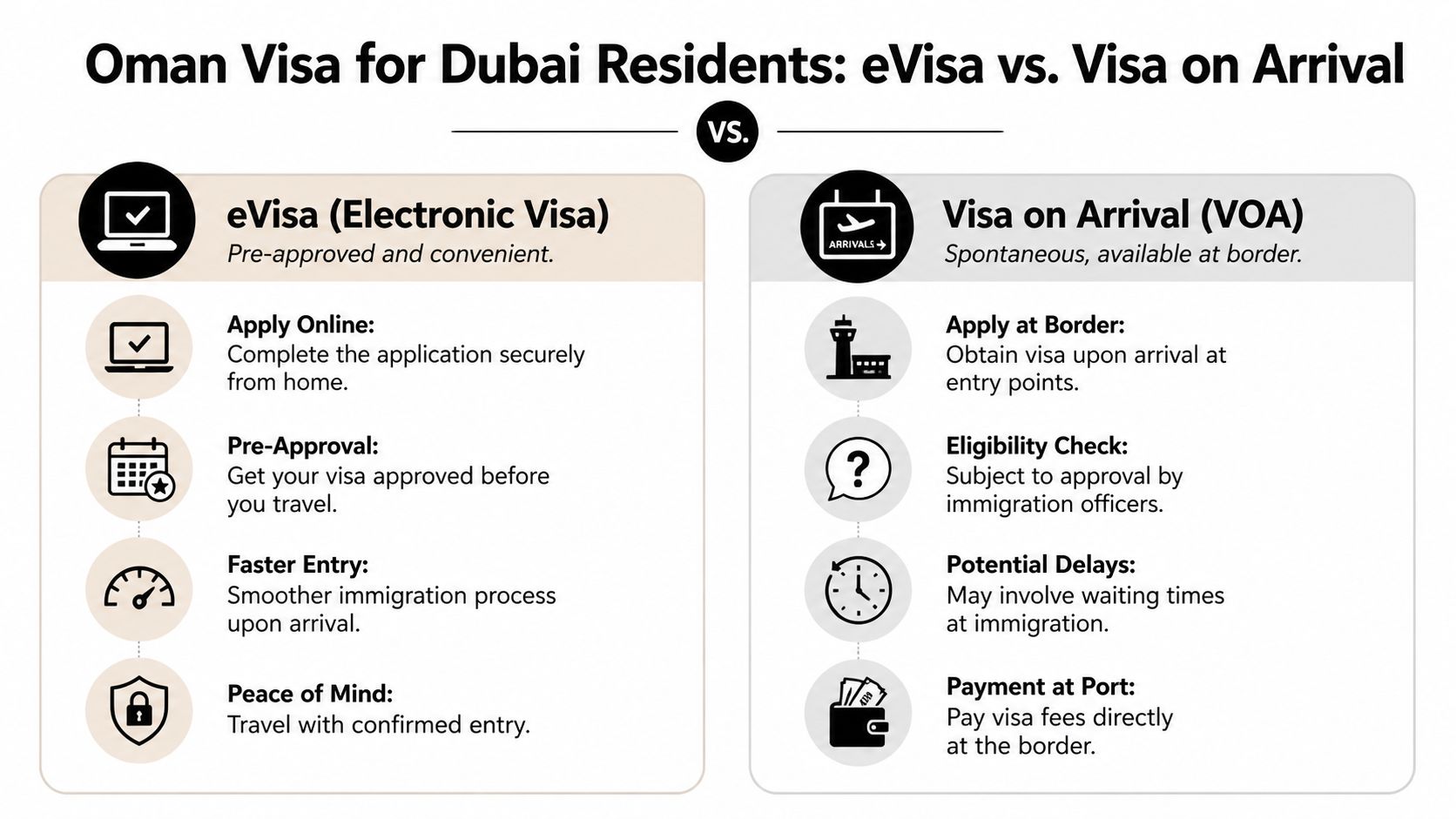
For a Dubai resident, this decision is not only about speed. It is about risk. If your UAE residence visa is valid, your profession is clearly eligible, and your trip purpose is easy to document, both routes can work. If any of those points is weak, the eVisa usually gives you more control.
The real trade-off
The eVisa suits travellers who want the decision handled before they reach Muscat airport or a land border. I recommend it for fixed itineraries, business visits, family travel, and any case where a delay at immigration would create a bigger problem than the application itself.
The visa on arrival suits residents whose paperwork is clean, whose profession category is straightforward, and whose trip is short and uncomplicated. It saves pre-travel admin, but it also leaves the final check to the officer on the day.
That distinction matters.
Side-by-side comparison
| Route | Best for | What works well | What can go wrong |
|---|---|---|---|
| eVisa | Planned trips, business visits, residents with fixed schedules | You get a decision before travel and can correct issues before departure | Wrong visa type, mismatched document details, or weak supporting papers can delay approval |
| Visa on arrival | Short leisure trips, last-minute travel, residents with a clear eligibility profile | Less advance paperwork and faster prep before departure | Questions at the counter about profession, residence validity, or trip purpose can slow entry or stop it |
When the eVisa is the safer choice
Use the online route if the trip has no room for uncertainty. That includes meetings, event attendance, onward travel, or hotel bookings you do not want to risk.
It also makes more sense for business travellers. If you are entering Oman for meetings, site visits, or partner discussions, a pre-filed application with matching company papers is cleaner than explaining the purpose verbally on arrival. In borderline cases, that difference matters.
Another practical point is document review. Before filing or travelling, check that your UAE residence record is current and consistent with your passport details. If you need to confirm status first, do a UAE visa check by passport number before choosing the Oman route.
When visa on arrival is still reasonable
Visa on arrival can work well if all four of these are true:
- Your UAE residence is valid with comfortable time left
- Your profession category is clearly acceptable
- Your trip purpose is simple and easy to prove
- You are comfortable with border processing on the day
This route is often fine for a short personal trip. I am more cautious with it for corporate travellers, frequent cross-border travellers, and anyone whose profession title does not fit neatly into the usual accepted categories.
If there is any doubt, clear it before departure. At the border, there is less room to fix a mismatch in profession, residence validity, or supporting documents.
How to Secure Your Oman eVisa Online
A common Dubai scenario is simple. Flights are booked, the hotel is confirmed, and the application stalls because the UAE residence visa is close to expiry, the profession title does not match what the traveller entered, or the supporting file is unreadable. The Oman eVisa process is straightforward. The resident-status checks around it are where delays usually start.
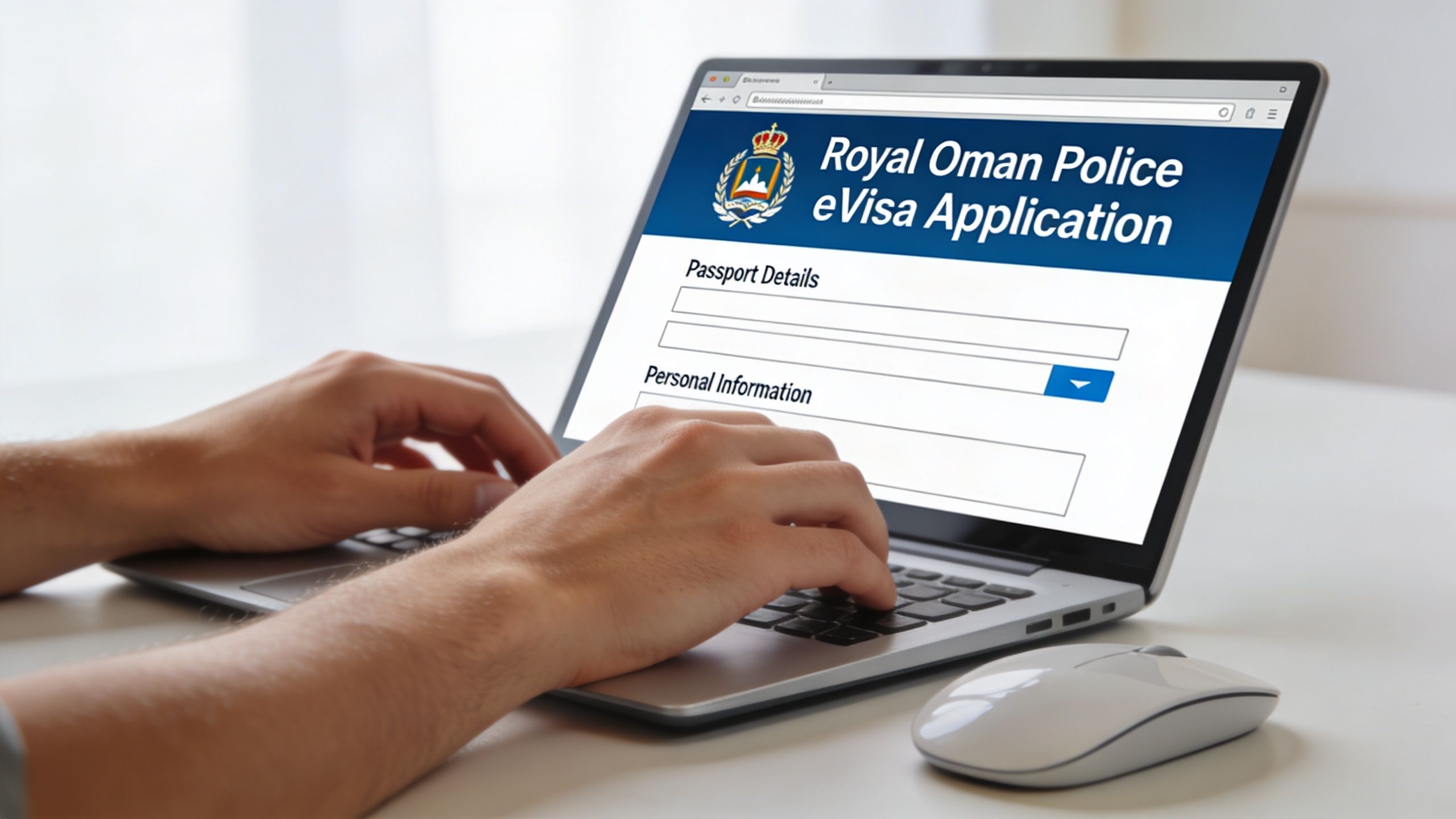
Prepare the digital file set first
Before you open the Royal Oman Police portal, build the file set properly. For a Dubai resident, that means more than a passport scan.
Keep these documents ready:
- Passport copy: clear scan, with enough validity left for travel
- Recent passport-size photo: current image, plain background, no heavy edits
- UAE residence visa copy: make sure the residence status is valid and readable
- Emirates ID copy
- Travel support documents: hotel booking, return or onward ticket, and other papers that fit the trip purpose
- Business support papers if relevant: company letter, host invitation, or meeting details for corporate travel
The resident point matters here. An Oman eVisa decision is not based only on nationality. Officers also look at whether the applicant is a valid UAE resident at the time of travel and whether the profile makes sense for the stated purpose. For business visitors, that means the company name, job title, and trip reason should line up across all documents.
Fill the form exactly as your documents show it
Use the passport as the master record. Enter the name in the same order. Match the passport number character by character. Use the same date format shown in your official documents where the form requires it.
Then cross-check the UAE side. If the residence record, passport details, or identity record do not align, fix that before you submit. A quick UAE visa check by passport number helps confirm the underlying residence details before you file the Oman application.
Profession fields need extra care. Dubai residents often type a simplified job title that sounds cleaner in English. That creates avoidable problems if the residence record shows something else. If you are travelling for meetings or site visits, use the same employer and role details shown in your UAE records and supporting company papers.
Upload clean files and review like an immigration case
Poor uploads slow down good applications. Use bright, straight scans. Avoid cropped corners, shadows, reflections on laminated cards, and mobile screenshots that cut off key data.
I tell clients to review the application in this order: passport, UAE residence, profession, trip purpose, then attachments. That sequence catches most errors before payment. For business travellers, add one more check. The invitation letter and the applicant's employer details should match the purpose declared in the form.
Submit only after that review. Then save the confirmation, track the status through the same portal, and keep the approval in both phone and printed form. If you are applying online but still planning a self-drive entry, the practical border side is separate from the visa itself. This guide to a smooth road trip to Oman from Dubai is useful for the crossing and driving logistics.
Securing a Visa on Arrival by Land or Air
You do not want to discover a profession mismatch at the border after a two-hour drive from Dubai or after landing in Muscat with a meeting on the calendar. Visa on arrival works best for residents whose UAE status is clean, current, and clearly eligible on the Oman side.
If you’re driving from Dubai
At the land border, officers will focus on the basics first. Passport. Valid UAE residence status. Emirates ID. If any of those details are unclear, the fact that you live in Dubai will not help by itself.
For eligible UAE residents, visa on arrival is still a practical option for short visits. The problem is predictability. I usually tell clients to choose this route only if their profession is clearly accepted, their UAE residence has enough validity left, and the trip is simple. Family visit, weekend travel, short personal visit. Those cases usually move well. Borderline profession categories and time-sensitive business travel do not.
If you are taking your own car or a financed vehicle, treat the visa and the border crossing as two separate checks. Entry permission is one part. Vehicle documents, insurance, and exit formalities are another. For the road logistics, this guide to a smooth road trip to Oman from Dubai is useful.
One more point that catches residents off guard. Border officers can be stricter in practice than online summaries suggest. If your residence visa is close to expiry, your job title is loosely translated, or your travel purpose sounds commercial without supporting papers, expect questions.
If you’re flying into Muscat
Airport processing is usually cleaner than land entry because the flow is controlled and signage is better. That does not mean officers will overlook weak paperwork.
Keep your passport, boarding pass, Emirates ID, and any supporting documents together before you join the queue. For a straightforward tourist or family trip, that may be enough if you are clearly eligible. For business-related travel, I recommend carrying the company invitation or meeting details even if the visit is short. Residents often assume visa on arrival covers every quick work trip. It does not always work that way at the counter, especially if your stated purpose sounds commercial.
Flying also reduces one common land-border issue. There is less confusion around vehicle ownership, insurance, and exit processing. If the trip matters and timing is tight, air entry is often the safer operational choice.
What usually gets approved without delay
Officers want a file that makes sense at a glance:
- Original passport with valid UAE residence status
- Emirates ID that matches your residence record
- A profession that aligns with the accepted resident categories
- A clear visit purpose that matches what you say at the counter
- Business support papers if the trip involves meetings, site visits, or client work
The common mistakes are predictable. Residents rely on an old understanding of the profession list. They assume any Dubai residence visa qualifies. They describe a business trip as tourism, then present company documents only after questions start. That is the kind of inconsistency that slows entry or pushes an officer to refuse the on-arrival route.
Visa on arrival is fine for low-risk travel with clean resident credentials. If the trip carries commercial importance, your profession sits in a grey area, or your UAE residence validity is getting tight, secure the visa in advance instead.
Navigating Oman Visas for Business and Corporate Travel
Business travel is where shortcuts usually fail. Many applicants assume a standard visitor mindset is enough because the destination is nearby and the trip is short. In practice, Oman business travel needs sharper documentation, better sponsor coordination, and cleaner application discipline than leisure travel.
The sponsorship letter is not a formality
For a proper business visa file, the sponsor side matters. The official processing window is 4 to 5 working days for an Oman business visa, but incomplete documentation or vague sponsorship letters can extend processing to over 8 days, according to the business visa guide for UAE residents.
That same guidance also notes that mismatched data between the passport and application form accounts for an estimated 15 to 20 percent of initial rejections. Those aren’t complex legal failures. They’re admin failures.
A sponsor undertaking letter should clearly state why the traveller is visiting. If the purpose is a meeting, say that and support it. If it’s a conference, attach the conference details. If it’s partner discussions, the invitation should reflect that specifically. Generic wording triggers more scrutiny.
Business travel rule: If a letter could be reused for ten different travellers without changing the substance, it’s probably too vague.
Document quality affects timing
The same business visa guidance highlights practical technical standards that many travellers ignore. Passport bio pages and UAE residence visa copies should be submitted as high-resolution scans at a minimum of 300 DPI in JPEG or PDF format. Sponsor company registration and Civil Number verification can also add time to the process.
For company teams, this matters even more. Group applications amplify small errors. One mismatch in a passport number, one weak scan, or one unclear purpose letter can affect timing across the file.
Corporate travel works better with internal discipline
If your company sends people to Oman regularly, the effective solution isn’t chasing each trip case by case. It’s creating a standard travel-document pack and approval workflow. This is why broader reading on Passport Premiere on corporate travel is helpful. Good travel policy reduces last-minute document chaos before visa filing even starts.
For entrepreneurs and SMEs, the practical distinction is simple:
- Tourist-style filing suits leisure visits.
- Business filing needs a sponsor-backed, purpose-specific record.
- Urgent meeting travel should never rely on vague letters or loosely assembled scans.
- Repeat corporate travel should be standardised internally.
Business visas don’t become difficult because Oman is nearby. They become difficult because companies underestimate the level of detail the file needs.
Avoiding Common Application Mistakes and Finding Help
Most visa problems aren’t dramatic. They’re small errors that pile up. A wrong data entry, a poor scan, a misunderstood profession category, or a weak business letter can turn an otherwise routine application into a slow one.
The mistakes that come up most often
Three error groups show up repeatedly.
Document errors are the most common. This includes unclear passport scans, cropped UAE residence copies, mismatched spellings, and details entered from memory instead of from the document itself. If the form says one thing and the uploaded passport says another, the application becomes harder to approve.
Eligibility errors come next. Some Dubai residents file first and only later discover that their profession doesn’t fall within the accepted list for the route they chose. Others focus on passport validity and forget to check the remaining validity of their UAE residence status.
Purpose errors affect business travellers the most. A person travelling for meetings but filing casually, with generic supporting language, often invites more scrutiny than expected.
A practical troubleshooting list
- Wrong visa path: Stop and re-check whether your trip is leisure or business in substance, not just in your own description.
- Upload problems: Replace mobile snapshots with proper scans if the file looks dark, skewed, or cut off.
- Data mismatch: Compare every typed field against the passport image before re-submitting.
- Profession uncertainty: Verify this before making travel commitments.
- Group travel friction: Handle files in a coordinated way, especially when a company is moving several employees.
Clean applications are usually simple. Messy applications become “complicated” because applicants try to fix them after submission.
When to get help
If the issue is technical, the Royal Oman Police eVisa support route is the first place to start. If the matter involves business sponsorship, corporate documentation, or a batch of travellers, external administrative support becomes more useful.
For companies that already rely on organised immigration and compliance support, a structured company PRO services package is often the difference between one clean submission and several rounds of corrections.
The key is knowing when self-service is enough and when the file has crossed into “don’t improvise” territory.
Frequently Asked Questions About the Oman Visa
Can every Dubai resident apply for an Oman visa?
No. Residency in Dubai doesn’t automatically make every applicant eligible. Your passport validity, your UAE residence status, and your profession category all matter. Profession eligibility is the point many people overlook.
Is visa on arrival always the fastest option?
Not always. It’s the most spontaneous option, not always the most reliable one. If your trip is important, your eligibility is borderline, or your arrival timing is tight, pre-approved eVisa processing is often the safer choice.
Do I need to travel from the UAE if I hold an Oman eVisa as a UAE resident?
No. Once issued, the Oman eVisa can be used to travel to Oman from anywhere in the world, not only from the UAE. That makes it useful for Dubai residents who are travelling internationally and entering Oman from another country.
What should business travellers carry beyond the usual passport and ID?
Business travellers should think beyond identity documents. If the trip relates to meetings, events, or commercial discussions, carry the supporting business record that matches the application, such as invitation material or sponsor documentation. Border and visa review become easier when the purpose of visit is clearly documented.
What if my profession is not on the approved list?
Don’t assume you can explain it away at the border. If your profession doesn’t appear to fit the approved categories, pause the application and verify your options properly before travelling. This is one of the main reasons applicants lose time and money.
Can families travel together if one person is handling the planning?
Yes, but each traveller’s document position should be checked individually. Don’t assume one person’s eligibility covers everyone else. Family trips go more smoothly when each passport, residency record, and application file is reviewed on its own merits.
What if I’m driving my own car to Oman?
Visa isn’t the only checkpoint. Make sure your vehicle paperwork is in order and that your insurance arrangements are valid for Oman. Drivers often focus heavily on immigration and forget the vehicle side until they reach the border.
Is a business visa the same as a tourist visa if I’m only going for one meeting?
Accurately state the purpose. If the visit is indeed work-related, especially where an Omani company is involved, a business route and proper supporting paperwork are the safer approach. “It’s only one meeting” doesn’t help if the file looks inconsistent.
If you need help reviewing your eligibility, UAE residence status, or travel paperwork before applying for an Oman visa, Smart Classic Business Hub can help you sort the underlying documents properly and avoid preventable delays. For Dubai residents managing business travel, residency matters, or wider PRO requirements, their team offers practical support that saves time and cuts down on filing mistakes.