
You’ve set up the company, opened the bank account, signed the office lease, and started speaking to customers. Then VAT appears on the to-do list and the mood changes. Most founders don’t struggle because VAT is impossible. They struggle because one missed step at the start turns into filing problems, blocked input tax claims, and awkward questions when the FTA asks for records.
That’s why good vat services in dubai matter. They don’t just file forms. They help you decide when to register, how to issue invoices, what to do with imported software and consulting costs, and how to keep your books in a shape that survives scrutiny. In Dubai, VAT is part of doing business in a mature, organised market. Once you understand the rules and build the right routine, it becomes manageable.
Navigating VAT in Dubai's Business Landscape
A common Dubai startup sequence looks like this. A founder signs with an overseas software provider, pays a foreign marketing agency, invoices the first local clients, and assumes VAT can wait until turnover grows. A few months later, the business discovers that some of those imported services may already carry VAT consequences under the Reverse Charge Mechanism, and the books were never set up to track them properly.

That is a costly way to learn the rules.
Dubai is fast to set up, fast to sell in, and often fast to expand beyond the UAE. VAT needs to keep pace with that reality. The practical problem is not the headline rate. It is the day-to-day treatment of transactions, especially where local sales, foreign suppliers, free zone activity, and digital services meet.
For new businesses, the Reverse Charge Mechanism is one of the easiest areas to miss. If you buy consulting, software, advertising, or other services from suppliers outside the UAE, the supplier may not charge UAE VAT. That does not always mean the transaction is outside the VAT system. In many cases, your business must account for VAT itself under RCM, record it correctly, and support the treatment with proper documentation. If that step is missed, the exposure usually appears later during return preparation or an FTA review.
Why VAT needs attention from the start
Early VAT decisions shape more than filing. They affect pricing, contract wording, invoice design, bookkeeping logic, and cash flow.
A founder who quotes fees without clarifying whether VAT is included can lose margin. A business that accepts weak supplier documentation can struggle to recover input tax. A company that buys services from abroad without checking RCM treatment can end up with underreported VAT even though no tax appeared on the supplier invoice.
These are operational issues first, tax issues second.
What good VAT support looks like
Strong vat services in dubai should cover the actual pressure points a young business faces:
- Transaction mapping: reviewing how local sales, exports, imported services, and mixed-use costs should be treated
- RCM assessment: checking whether services bought from abroad trigger self-accounted VAT
- System setup: aligning accounting codes, invoice formats, and document retention with UAE VAT rules
- Return review: making sure figures submitted to the FTA match the underlying records
- Risk spotting: identifying trouble areas such as free zone transactions, blocked input tax, and missing tax invoices
There is a real trade-off here. A general accountant can often manage routine entries and deadlines. That may be enough for a business with simple local billing and low transaction complexity. Once the company starts importing services, working across borders, or handling different types of supplies, specialist VAT input usually saves money by catching errors before they turn into assessments or penalties.
The practical approach
The businesses that stay out of trouble usually do three things early. They classify transactions properly, keep evidence in order, and review unusual purchases before filing season arrives.
That approach removes a lot of the stress from VAT. It also gives founders a clearer view of margin, tax recovery, and compliance risk while the business is still growing.
Understanding Your VAT Obligations
A common Dubai startup scenario goes like this. The founder is still focused on sales, signs up overseas software tools, hires a foreign consultant, pays local setup costs with VAT, and assumes tax can wait until revenue grows. That is often where the first VAT problem starts. In practice, obligations can begin before the business feels established, especially if it imports services and triggers reverse charge treatment.
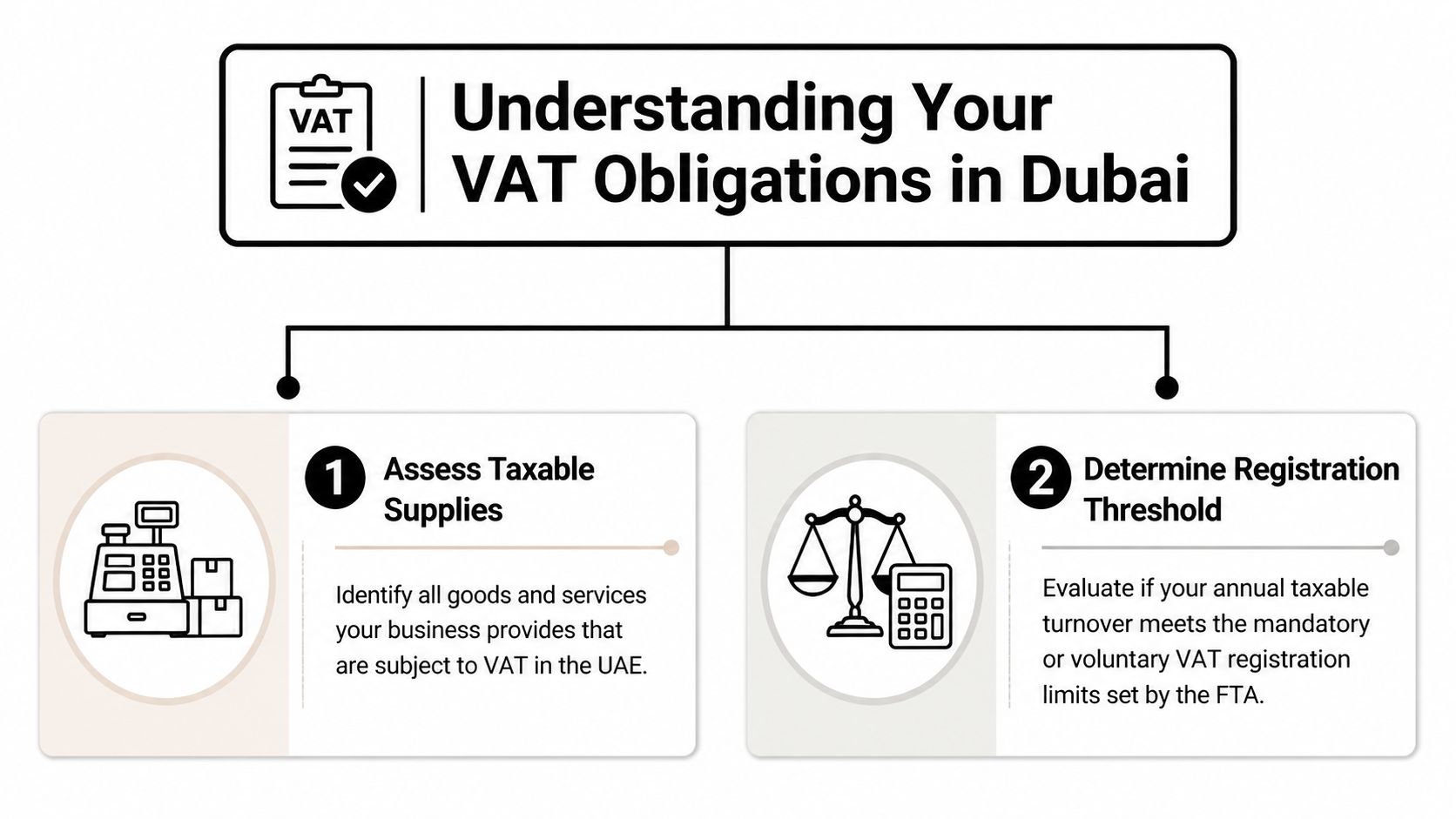
The registration thresholds still matter. Mandatory registration applies once taxable supplies and imports exceed AED 375,000 over the relevant period. Voluntary registration is available from AED 187,500. Those numbers are simple. The judgment around them is not.
The two thresholds that matter
| Threshold | What it means | Practical effect |
|---|---|---|
| AED 375,000 | Mandatory VAT registration | The business must register within the required timeframe and account for VAT correctly |
| AED 187,500 | Voluntary VAT registration becomes available | The business can register earlier if input tax recovery or commercial positioning justifies it |
Crossing the mandatory threshold is usually clear enough once records are accurate. The harder cases sit below it. Founders often ask whether voluntary registration is worth the extra admin. The answer depends on spend, customer profile, and whether the business is already exposed to VAT on costs or imported services.
Where founders usually misread their position
Revenue is only part of the analysis. VAT follows the nature of the supply, where it is treated as supplied, who the customer is, and whether the business is buying services from outside the UAE.
That last point is missed often.
A Dubai company might buy software subscriptions from Europe, marketing services from the UK, or design work from India. No UAE VAT appears on the supplier invoice, so the founder assumes there is no UAE tax issue. In many cases, that is wrong. The Reverse Charge Mechanism can require the UAE business to account for VAT on those imported services itself. If that treatment is missed, the error usually surfaces later during a return review or FTA audit, when the fix is more expensive and the explanation is harder.
When voluntary registration makes commercial sense
Voluntary registration is usually worth a close look in three situations:
- Startup costs are high: fit-out, professional fees, software, and outsourced support can create recoverable input VAT
- Customers are mainly VAT-registered businesses: adding VAT is less likely to disrupt pricing discussions in a B2B model
- Imported services are already part of operations: early registration can help align reverse charge treatment and input tax recovery from the outset
There is a trade-off. Early registration can improve cash flow if the business has recoverable input tax. It also creates filing, invoicing, and record-keeping obligations from day one. Registering early without proper controls usually causes different problems from registering late, but it still causes problems.
Different business models create different risks
A local consultancy, an e-commerce seller, and a company with regional group support costs do not carry the same VAT exposure.
A few patterns come up repeatedly:
- Local service businesses need to check whether their supplies are standard-rated, zero-rated, or outside the scope based on the facts
- Cross-border B2B businesses need to review place of supply and customer status carefully
- Businesses buying services from abroad need a clear reverse charge review, not just invoice posting
- Digital and platform-led models often need tighter classification because billing flows can hide the supplier and recipient
This is why I tell founders to test obligations transaction by transaction, not by company type alone. Two businesses with the same licence can have very different VAT positions if one serves only UAE clients and the other relies heavily on foreign vendors and overseas customers.
A practical obligation check
Use this sequence:
- Identify what you are supplying or buying
- Confirm where the customer or supplier sits
- Check whether the transaction creates output VAT, input VAT, or reverse charge VAT
- Measure taxable turnover properly
- Decide whether registration is already required or commercially sensible
If the registration question is becoming real, a step-by-step guide to how to register for VAT in the UAE helps founders prepare before they apply.
One more practical point. Input tax recovery depends on evidence. Poor invoice quality, missing TRNs, and inconsistent supplier records create problems even where the underlying cost is legitimate. Businesses processing high volumes of purchase invoices often use tools such as AI-powered VAT invoice parsing to extract and review invoice data more consistently, especially before quarter-end checks.
Founders usually get into trouble when they treat VAT as a filing task instead of an obligation test. The safer approach is to identify the transactions that create exposure early, especially imported services under the Reverse Charge Mechanism, then build the records around those facts.
The VAT Registration and Bookkeeping Process
A common founder mistake looks like this. The TRN is approved, sales start, expenses flow through the bank, and nobody has decided how imported software subscriptions, foreign consultants, or marketplace fees will be recorded. By the first return, the business is not dealing with one VAT task. It is cleaning up three months of preventable errors, often including Reverse Charge Mechanism entries that were never posted.

The registration process itself is straightforward if the facts are clear. Delays usually come from inconsistent trade licence details, weak turnover support, unclear business activities, or documents that do not match the application. The portal will accept what you enter. The FTA will still expect it to make commercial sense.
What to prepare before you apply
Start with the documents, then complete the form. That order saves time.
Prepare these early:
- Trade licence: current, readable, and aligned with the activity you describe in the application
- Identity documents: passport, Emirates ID, and ownership details where applicable
- Turnover support: invoices, contracts, bank activity, or other records that support current or expected taxable revenue
- Business profile: address, contact details, banking information, and a clear summary of what the company buys and sells
Forecasts need discipline. If projected turnover is overstated, understated, or disconnected from signed contracts and actual trading plans, the application can trigger extra questions. I usually advise founders to build the number from real transactions and committed pipeline, not optimism.
If you need a practical portal walkthrough, this guide on how to register for VAT in the UAE is useful for the application steps.
A registration process that holds up under review
A clean application usually follows a simple sequence:
- Open the FTA e-Services account
- Set up the taxable person correctly
- Complete the registration form using commercial facts, not generic descriptions
- Upload supporting documents in a clear, consistent format
- Review the application for mismatch risks before submission
The last step matters more than many founders expect. If the company says it offers local marketing services but its records show foreign ad platforms, imported freelance support, and overseas clients, the VAT profile is more complex than the short description suggests. That does not block registration, but it affects what the books need to capture from day one.
Bookkeeping starts before the first return
Registration is only the start. The key control point is the ledger.
Every sale, cost, tax invoice, credit note, and foreign supplier charge needs a place in the records. That includes expenses many new businesses post casually to software or admin costs. Imported services often create reverse charge VAT, even when the supplier did not charge UAE VAT. If those entries are missed, the first VAT return is wrong before anyone opens the form.
Invoice handling is where problems usually begin. Supplier names get shortened, invoice dates are posted to the wrong period, and attachments go missing. For teams processing a high volume of bills, AI-powered VAT invoice parsing can help standardise extraction before the data reaches the accounting file.
If a foreign supplier invoice has no UAE VAT on it, do not assume it is irrelevant for VAT. It may still need a reverse charge entry.
What VAT-ready books look like
Good bookkeeping for VAT is specific. It is not just "keeping the invoices."
Use this checklist:
- Sales are coded by VAT treatment: standard-rated, zero-rated, exempt, and out-of-scope items should not sit in one revenue bucket
- Purchase invoices are stored and matched: each claim should tie to a readable document and the booking entry
- Foreign supplier costs are flagged: software, subscriptions, cloud tools, advisory fees, and contractor charges often need reverse charge review
- Customer and supplier details are consistent: names, dates, values, and TRNs should match the supporting documents
- Credit notes and adjustments are tracked properly: they affect the return and should not be buried in net expense or revenue figures
Small businesses often postpone this discipline until the quarter-end rush. That approach usually creates rework, weak evidence for input tax claims, and avoidable exposure on imported services. Set up the coding logic early, train whoever enters the bills, and review foreign costs monthly. That is what keeps registration useful instead of turning it into an admin milestone with no control behind it.
Filing Returns and Managing Ongoing Compliance
A common quarter-end problem looks like this. The sales side is ready, the VAT return deadline is close, and finance is still chasing missing supplier invoices, credit notes, and foreign software bills that no one reviewed for reverse charge treatment. The return can still be filed, but the risk sits underneath it.
That is why ongoing compliance matters more than the act of submitting the VAT 201. Filing is the final step. Effective control comes from what the business checks during the period, especially where imported services are involved.
Good compliance starts with records that can survive scrutiny. Tax invoices need the required FTA details, and the supporting file should make sense to someone other than the person who posted the entry. If your input VAT claim depends on an unclear invoice, a payment with no matching document, or a foreign supplier cost left in a generic expense code, the problem does not stay hidden for long.
RCM deserves special attention here. New Dubai businesses often buy software subscriptions, ad platforms, cloud hosting, design work, or consulting from suppliers outside the UAE. Those invoices may arrive with no UAE VAT charged. That does not end the analysis. In many cases, the business must assess VAT itself under the reverse charge mechanism and reflect it correctly in the return. If that review happens only at filing time, errors are easy to miss.
A practical month-end VAT close usually covers four checks:
- Sales completeness: confirm all invoices and credit notes for the period are recorded with the correct VAT treatment
- Input tax support: confirm purchase claims are backed by valid tax invoices and tied to the ledger entry
- RCM review: scan foreign supplier payments and service invoices before closing the period
- Reconciliations: match VAT balances to the accounting records, bank activity, and major supplier accounts
Timing affects cash flow as much as compliance. A late or inaccurate return can trigger penalties, delay internal reporting, and force corrections in the next period. I see this most often in young companies where operations, procurement, and finance work in separate silos. The issue is rarely one big mistake. It is ten small delays that reach the VAT return at once.
The best filing process is predictable. It runs on dates, assigned owners, and a short review of exceptions before submission. For businesses building that routine internally, Cloudvara's solutions for compliance show the kind of workflow support that helps keep documents, approvals, and recurring tasks under control. If you need a practical local reference for the submission process itself, Smart Classic explains the steps in its guide to VAT filing in the UAE.
A clear division of responsibility helps avoid avoidable errors:
| Role | What they should do |
|---|---|
| Operations | send contracts, supplier bills, and supporting documents to finance on time |
| Bookkeeper or accountant | post entries correctly, review VAT codes, and reconcile the ledgers |
| Reviewer | check unusual items, imported services, and final return figures before filing |
That final review matters. The person entering invoices should not be the only person deciding whether a foreign service triggers RCM or whether input tax is recoverable. One disciplined check before submission is cheaper than fixing the issue after filing.
Navigating VAT Audits and Common Penalties
A founder signs up for overseas software, pays a foreign marketing consultant, and books both as routine expenses. Six months later, the FTA asks for records. The issue is not the size of the spend. The issue is that nobody checked whether those purchases triggered VAT under the Reverse Charge Mechanism.

That is how many VAT audits start in practice. The return looked fine at filing stage, but the supporting records, tax treatment, and internal reasoning were never strong enough to survive review.
RCM is one of the costliest gaps for new Dubai businesses because it hides inside normal operating expenses. Software subscriptions, cloud tools, design work, advisory fees, and other imported services often arrive without UAE VAT on the invoice. That does not end the VAT analysis. Your business may need to self-account for output VAT and, depending on recoverability, claim the corresponding input VAT correctly.
EASMEA’s guide on VAT for services in the UAE outlines this risk clearly. I see the same pattern repeatedly. The finance team records the invoice as an expense, the payment clears, and the VAT review never happens.
Why audits expose RCM mistakes quickly
FTA reviews usually focus on records that can be tested against accounting data, supplier profiles, and tax returns. Foreign supplier payments stand out fast, especially where the general ledger shows recurring service costs but the VAT return does not reflect reverse charge entries.
Common reasons businesses miss RCM include:
- foreign supplier invoices are booked without a VAT code review
- the bookkeeper does not know whether the supplier is outside the UAE
- procurement approves digital tools without telling finance how they are billed
- teams assume "no VAT on the invoice" means "no VAT issue"
A foreign invoice without UAE VAT should trigger a tax check.
What auditors usually ask for
During an audit or tax review, the FTA may ask for the transaction trail, not just the return totals. That means the business should be ready to produce:
| Area | What should be available |
|---|---|
| Imported services | supplier invoices, contracts, payment proof, VAT treatment memo if the position was not obvious |
| Input VAT claims | valid tax invoices, proof the cost relates to taxable business activity, ledger postings |
| Sales treatment | invoices issued, customer contracts, support for zero-rated or exempt treatment where used |
| Return support | reconciliations between accounting records and filed VAT returns |
Weak bookkeeping results in a tax problem. Good small business financial management does not replace VAT advice, but it gives you the clean ledgers and document trail needed to defend your position.
Penalties usually follow habits, not one dramatic event
Many founders expect penalties only where there is obvious fraud. In reality, repeated carelessness creates exposure quickly. Late registration, incorrect returns, unsupported input tax recovery, and missed reverse charge entries can all lead to assessments, corrections, and penalties.
The trade-off is simple. A business can spend time each month reviewing unusual items, or spend far more time later rebuilding records under deadline. The second option is what usually makes audits expensive.
Other issues that often trigger adjustments include:
- claiming input VAT on incomplete or invalid invoice support
- treating zero-rated and exempt supplies as if they were the same
- applying free zone assumptions without checking the actual transaction
- taxing a service incorrectly because the place of supply was never reviewed
How to reduce audit risk before the FTA contacts you
Audit readiness comes from routine controls. It does not come from scrambling after an email arrives.
Use a short monthly check:
- scan the supplier ledger for non-UAE service providers
- review new expense categories such as software, consulting, and digital advertising
- confirm VAT codes used on imported services
- reconcile VAT return figures to the detailed ledger
- keep invoices, contracts, and payment support together by tax period
- document the reason for any unusual VAT treatment while the facts are still clear
If a business does only one thing after reading this section, it should be this: review every recurring foreign service payment for RCM. That single control catches a disproportionate share of the mistakes that later surface in VAT audits.
How to Choose the Right VAT Service Provider
Not every business needs the same level of VAT support. A solo consultant with a small number of invoices may need registration and periodic filing help. A growing SME with imported services, multiple revenue lines, and expansion plans needs a provider that can think beyond the return.
The wrong way to choose a provider is to compare only filing fees. Cheap routine work becomes expensive very quickly if the adviser misses a classification issue, doesn’t challenge your records, or disappears when the FTA asks questions.
What service scope should include
A serious VAT provider should be able to cover some or all of these areas, depending on your needs:
| Service type | What it should involve |
|---|---|
| Registration support | threshold review, portal application, document checks |
| Ongoing filing | return preparation, review, submission support |
| Bookkeeping and reconciliation | ledger checks, invoice validation, transaction coding |
| Advisory work | place of supply, imported services, free zone and mainland questions |
| Audit support | document preparation, response handling, issue analysis |
If a firm only offers “we’ll file your VAT” without asking how your business trades, that’s a warning sign.
Questions worth asking before you appoint anyone
Use the first call to test how they think. Ask direct questions.
- How do you handle imported services and RCM? If the answer is vague, move on.
- Who reviews the filing before submission? You want a process, not a single overworked preparer.
- What records do you expect from us each period? Good providers have a clear document list.
- How do you deal with errors found after submission? Mistakes happen. The key is how they are managed.
- Will you support us in an FTA query or audit? Filing is easy to sell. Audit support is where capability shows.
What a good working relationship looks like
The best provider is usually the one who prevents errors before they harden into a filing position. That means they ask for context. They query unusual transactions. They tell you when your internal process is the core problem.
For smaller companies, a provider who also understands broader small business financial management can be useful because VAT rarely fails in isolation. It usually fails alongside poor bookkeeping, weak approvals, or inconsistent expense handling.
One practical option in Dubai is Smart Classic Business Hub, which provides VAT-compliant accounting, filing support, and related business compliance services for UAE entities. That matters if you want one firm to understand both setup history and ongoing tax administration.
Trade-offs to accept
There is no perfect package. Businesses usually choose between:
- Lower cost and more internal work
- Higher oversight and less internal strain
- Basic filing support versus strategic transaction advice
If your business is simple, a lean arrangement can work. If you’re importing services, changing structure, or moving between free zone and mainland operations, buying only the cheapest filing package is often a false economy.
The right provider doesn’t just keep you compliant. They reduce decision fatigue for the founders and finance team.
Practical VAT Questions for Dubai Businesses
Most VAT problems don’t come from the headline rules. They come from edge cases in normal trading. These are the questions founders and managers ask once the business is already moving.
How does VAT work if my free zone business sells to the mainland
Don’t assume the free zone licence answers the VAT question by itself. The VAT treatment depends on the transaction, the place of supply, and what is being sold. A common mistake is to treat “free zone” as a complete shield from VAT exposure. It isn’t.
This gets harder when businesses expand and start shifting activity between jurisdictions. Guidance on transitions between free zone and mainland operations is still a real knowledge gap in the market, particularly around timing, liabilities, and practical implementation. If your operating model is changing, review the VAT impact before the first mainland invoice is issued, not after.
Can I claim back VAT on business setup costs
Potentially, yes, if the business is properly registered and the input VAT is recoverable under the rules. The practical issue is evidence.
You need valid supporting invoices and records that connect the cost to the business. Setup-stage claims often fail because the company spent money before the recordkeeping process was organised. Founders paid personally, invoices were issued in the wrong name, or documents were never collected centrally.
Can I recover VAT on employee-related expenses
Sometimes, but not automatically. Employee expenses need careful review because not every payment linked to staff creates a recoverable input position. The answer depends on the nature of the expense, the documentation, and whether the cost is borne for the business.
The safe approach is to create an expense policy that tells staff what documentation finance requires before reimbursement is approved.
What if I buy software from outside the UAE
Treat it as a VAT review point every time. Imported software is one of the most common examples behind reverse charge issues. Don’t rely on the supplier invoice format alone. Review where the supplier is based, what service is being provided, and how the business should account for it.
How long should I keep VAT records
Maintain them in an orderly archive that can be searched and produced. VAT records are not just for filing. They are your defence if a transaction is challenged later.
As a foreign visitor, can I claim tourist VAT refunds in Dubai
Yes, the tourist refund scheme is a real and established part of the UAE’s digital tax administration. The system processed 3.2 million electronic tax refund applications between 2018 and 2019, and by the end of 2019 daily applications had risen to 983,000, supported by 52 self-service kiosks, according to CLA Emirates’ overview of VAT in the UAE since 2018.
For ordinary shoppers, the practical takeaway is simple. Keep the purchase documents and use the approved refund system correctly before departure. The infrastructure is there, but the refund still depends on following the scheme’s process.
Clean records solve more VAT questions than clever arguments do.
What if I’m closing the business or turnover drops
VAT doesn’t disappear just because activity slows down. You may need to assess whether de-registration is appropriate, whether final returns are complete, and whether outstanding input or output tax issues remain unresolved. This is also the point where old bookkeeping shortcuts become expensive because every inconsistency surfaces during closure.
What document should I prepare when making or approving business payments
Businesses that want tighter payment controls often standardise approvals and supporting documents before money leaves the account. A simple internal process around payment support helps finance match bank transactions back to invoices and VAT records. If you need a structured format, Smart Classic provides a payment voucher form that can support that internal discipline.
If you need practical help with VAT registration, bookkeeping alignment, return filing, or resolving imported service and audit risks, Smart Classic Business Hub can support the compliance side of your UAE business while you stay focused on operations and growth.