
Your Dubai trading company has steady orders, supplier invoices in email, and sales totals in a spreadsheet. You've treated VAT as something to sort out at year-end, then discover in October that the business crossed the registration line earlier. Now the accountant needs to establish when registration became necessary, check invoice treatment, and reconstruct records while you're still running the business.
Good VAT accounting services in Dubai prevent that scramble. They connect the registration decision to daily bookkeeping, a controlled period close, and the evidence behind each return. The important question isn't who will submit your return. It's who will keep the business ready to submit an accurate one.
Registration Lines Every Dubai Business Should Know
UAE VAT triggers a Dubai ledger must track
| Situation | Official line | What the books must do |
|---|---|---|
| Mandatory registration | AED 375,000 taxable supplies and imports | Track taxable turnover and identify the registration obligation |
| Voluntary registration | Above AED 187,500, including qualifying expenses | Document supplies or eligible startup expenses |
| Standard rate | 5% since 1 January 2018 | Code standard-rated sales and purchases |
| Commercial property | Generally 5% on sales and leases | Separate property income from other supplies |
| Return and payment | Within 28 days after the tax period | Prepare the return and payment, including periods with no tax payable |
| Record retention | At least five years | Keep invoices, contracts and accounting support |
The Ministry of Finance VAT guidance sets the AED 375,000 mandatory threshold, the AED 187,500 voluntary threshold, and the standard 5% rate introduced on 1 January 2018; commercial-property sales and leases are generally subject to that standard rate. Eligible startups can also consider voluntary registration based on qualifying expenses, rather than waiting for sales to build.
The Federal Tax Authority's return and payment guidance requires registered businesses to file and make the related payment within 28 days after their tax period ends. The retention and nil-return duties in the table belong in the same compliance calendar, not in a separate folder nobody checks.
Registration starts with classification
A bank deposit isn't automatically taxable turnover. Your ledger needs to distinguish standard-rated, zero-rated, exempt and out-of-scope transactions, rather than treating every receipt as the same kind of sale.
Zero-rated and exempt are not interchangeable terms. They can have different consequences for registration analysis and input-tax recovery, so a founder should not choose a code just because neither results in VAT being charged to the customer.
Say the trading company reviews only its calendar-year sales. A busy period before October could create a registration obligation that its year-end process won't identify promptly. The accountant needs dated sales records, import information and a forward order view, not just a final annual total.
Keep a dated registration decision
Use a UAE VAT registration threshold checklist to organise the supporting records. Mark the business as below the voluntary line, between the registration lines, or beyond the mandatory line, and record who reviewed that conclusion.
Your tracker should contain:
- Actual activity: Taxable supplies and imports, with reconciled totals.
- Expected activity: Orders and contracts that may change the registration position.
- Decision evidence: The calculation date, supporting documents and reviewer's conclusion.
Practical rule: Keep the calculation that supported a decision not to register, not just the documents used when registration eventually happens.
Don't combine historical and forecast turnover into an invented single test. Keep the retrospective and forward-looking assessments separate, so another reviewer can follow how the registration decision was reached.
Core VAT Accounting Services in Dubai
A provider's scope should follow the life of a transaction, from registration planning to an answerable tax return. A package labelled accounting and VAT can otherwise leave important work between the founder, bookkeeper and filing agent.
Core VAT accounting services and their timing
| Service | Timing | Main output |
|---|---|---|
| VAT registration | One-off | FTA approval and registration record |
| Bookkeeping and coding | Monthly | Coded ledger with linked tax invoices |
| Return filing | Each tax period | Submitted return and payment confirmation |
| Compliance monitoring | Ongoing | Threshold tracker and deadline calendar |
| Audit and query support | As needed | Transaction-to-return file |
| Software and e-invoicing set-up | One-off, then ongoing | Structured invoice data and migration plan |
Separate projects from recurring work
Registration support should establish the correct entity, review its licence and activity, assess the registration position, and preserve the application and approval records. It shouldn't stop at obtaining portal access.
Bookkeeping then becomes recurring work. Each sale, purchase and import needs the right tax treatment, with the invoice or other supporting document linked to the entry. Return preparation uses those records, but it also requires review, reconciliation and approval.
A sensible engagement separates:
- Recurring delivery: Ledger maintenance, coding, period reviews, returns and deadline monitoring.
- Project work: Registration, historic clean-up, software configuration and migration.
- Conditional support: FTA queries, unusual transactions and technical advice outside the routine scope.
For example, importing services may require a reverse-charge assessment, meaning a review of whether the customer must account for VAT instead of the supplier. That decision is advisory work, not merely typing an overseas invoice into software.
At Smart Classic Business Hub, we offer VAT-compliant accounting, accounting and bookkeeping, audit services and company formation. When comparing a proposal, match the actual deliverables to your business rather than assuming that every service sits inside a recurring fee.
The useful output isn't only a submitted return. It's a ledger, supporting file and review record that the founder can access after the filing has been completed.
How Property, Trade and Free Zones Change VAT
A property business, goods trader and free-zone consultancy can all operate in Dubai while needing very different transaction checks. The accountant must understand what was supplied, where it moved, and which entity made the supply.

Property and trading scenarios
Consider a landlord collecting rent, a deposit and a contribution towards fit-out work. Those receipts shouldn't all inherit the same tax code because they arrived from the same tenant. The accountant needs to establish what each payment represents and how the contract describes it.
A refundable security amount, a charge for services and payment towards a supply raise different questions. The first document to request is the lease or sale contract with its charge schedule.
Now consider a trader whose overseas supplier invoice agrees with the purchase order, but whose customs records identify a different importing entity. The stock purchase may be genuine, yet the VAT treatment still needs investigation before anyone claims recovery.
Match the supplier invoice, shipment details, customs information and ledger entry. The first document to request is the complete import file, not just the supplier's invoice.
Free-zone and overseas scenarios
A free-zone company selling to a mainland customer shouldn't assume its address settles the VAT treatment. Goods and services need separate analysis, and designated-zone treatment requires attention to the actual transaction rather than a general free-zone label.
Use this explanation of whether free-zone companies are exempt from UAE VAT to frame the questions. The first document to prepare is a free-zone supply memo describing the parties, supply, movement of goods where relevant, and proposed treatment.
For registration monitoring, the FTA registration guidance requires assessment over the previous 12 months and against expected activity in the next 30 days; it also explains that non-UAE businesses making taxable UAE supplies may need registration regardless of turnover where no other party accounts for the tax. Those are separate assessments, not historical turnover plus forecast turnover added together.
An overseas business therefore needs to identify who supplies what, where the supply belongs, and who accounts for VAT. Its starting document is a cross-border supply memo, supported by the contract and customer details.
How a VAT Period Is Closed in Dubai
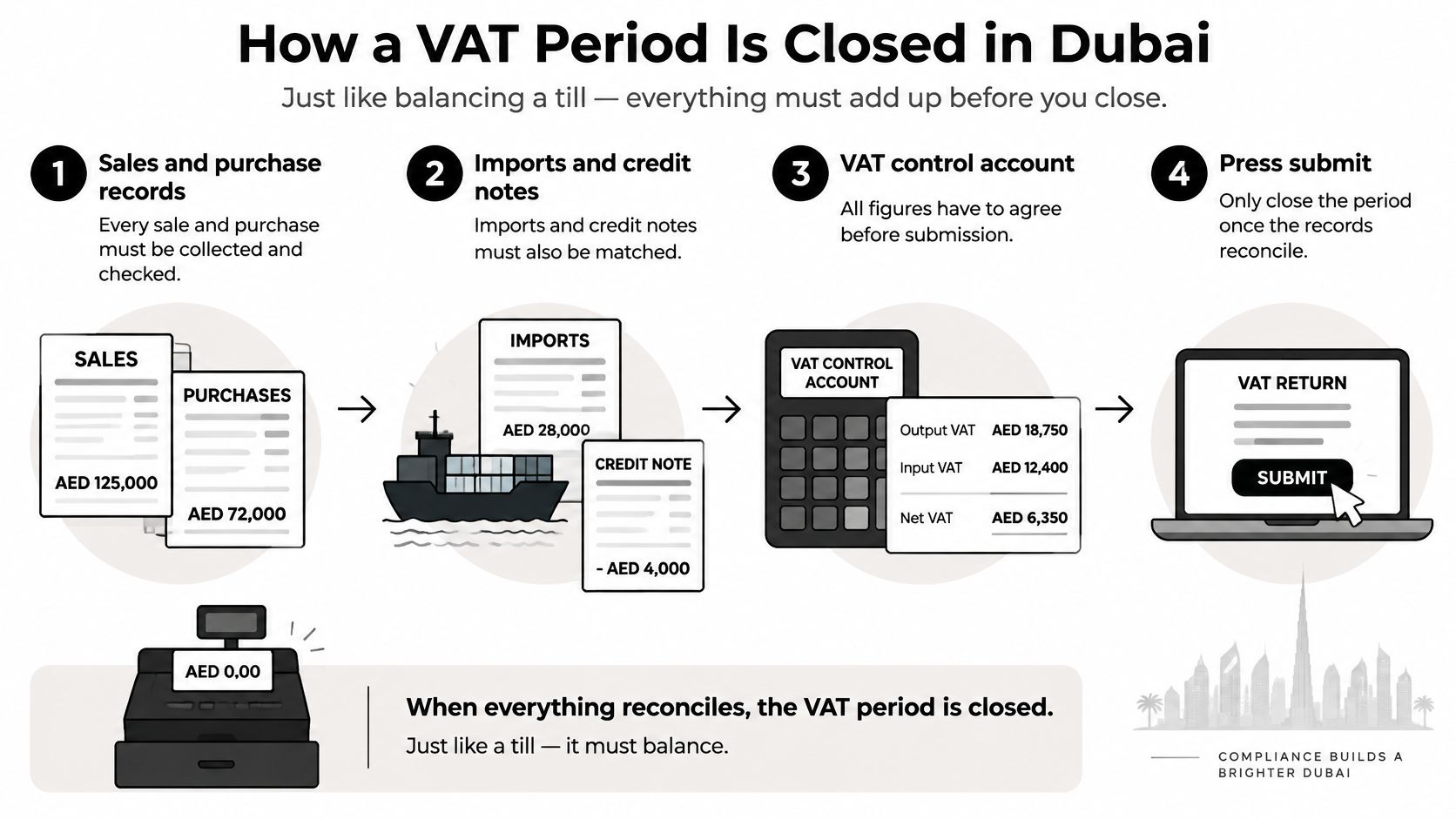
Closing a VAT period is like balancing a till. The sales record, money movements, refunds and supporting paperwork must tell a consistent story before the accountant presses submit.
The FTA's VAT filing guidance explains that tax periods are generally quarterly, although the authority can assign different periods; returns and payment are due within 28 days, and filing remains necessary even when no tax is payable. Supporting records must generally be maintained for at least five years, including the accounting documents behind the entries.
Build the return from reconciled transactions
Classify each supply.
Review the transaction's substance before accepting the software's default tax code. A customer being overseas doesn't, by itself, settle the treatment. The common slip is copying the code from an earlier invoice without checking whether the underlying facts match.Match the supporting documents.
Connect sales invoices, purchase invoices, import papers and credit notes to their ledger entries. Check that a credit note refers to the transaction it corrects and hasn't been entered as an unrelated expense. Missing documents should appear on an exception list with an owner.Reconcile the VAT accounts.
Compare output VAT, recoverable input VAT, import entries and the VAT control account with the proposed return. Explain differences rather than forcing the figures to agree through an unsupported journal. A balance that matches only because someone posted a plug entry isn't a completed reconciliation.
Resolve exceptions before approval
Review unresolved items.
Examine missing supplier details, mixed business and personal costs, unallocated deposits and unusual intercompany entries. Record the decision and its basis. Where the facts remain incomplete, identify the appropriate treatment rather than assuming recovery is available.Approve, submit and arrange payment.
Give the authorised reviewer a return summary, reconciliation and list of significant judgements. Keep submission and payment as separate checklist items, because completing one doesn't demonstrate completion of the other. Preserve both confirmations.Archive the complete period file.
Retain financial statements, wage records, fixed-asset registers, inventory quantities and values, invoices, contracts, licences and documents supporting accounting entries. Save the final return, reconciliations and approval record alongside them. Confirm whether particular records require a longer retention period before deleting anything.
A posted invoice proves that someone entered a transaction. A complete close file explains why it appeared in the return in that form.
Make the deadline a review window
Use a monthly working rhythm even when the assigned tax period is longer. Collect documents throughout the month, reconcile bank and supplier accounts, and send missing-evidence requests while staff still remember the transaction.
Maintain an exception register with the supplier, invoice reference, issue, responsible person and resolution. At period-end, the reviewer should be resolving identified questions, not discovering that an entire import folder is missing.
That division also makes responsibility visible. The founder approves commercial explanations, the bookkeeper maintains records, and the reviewer signs off tax judgements before filing.
Why Evidence and E-Invoicing Decide Input VAT
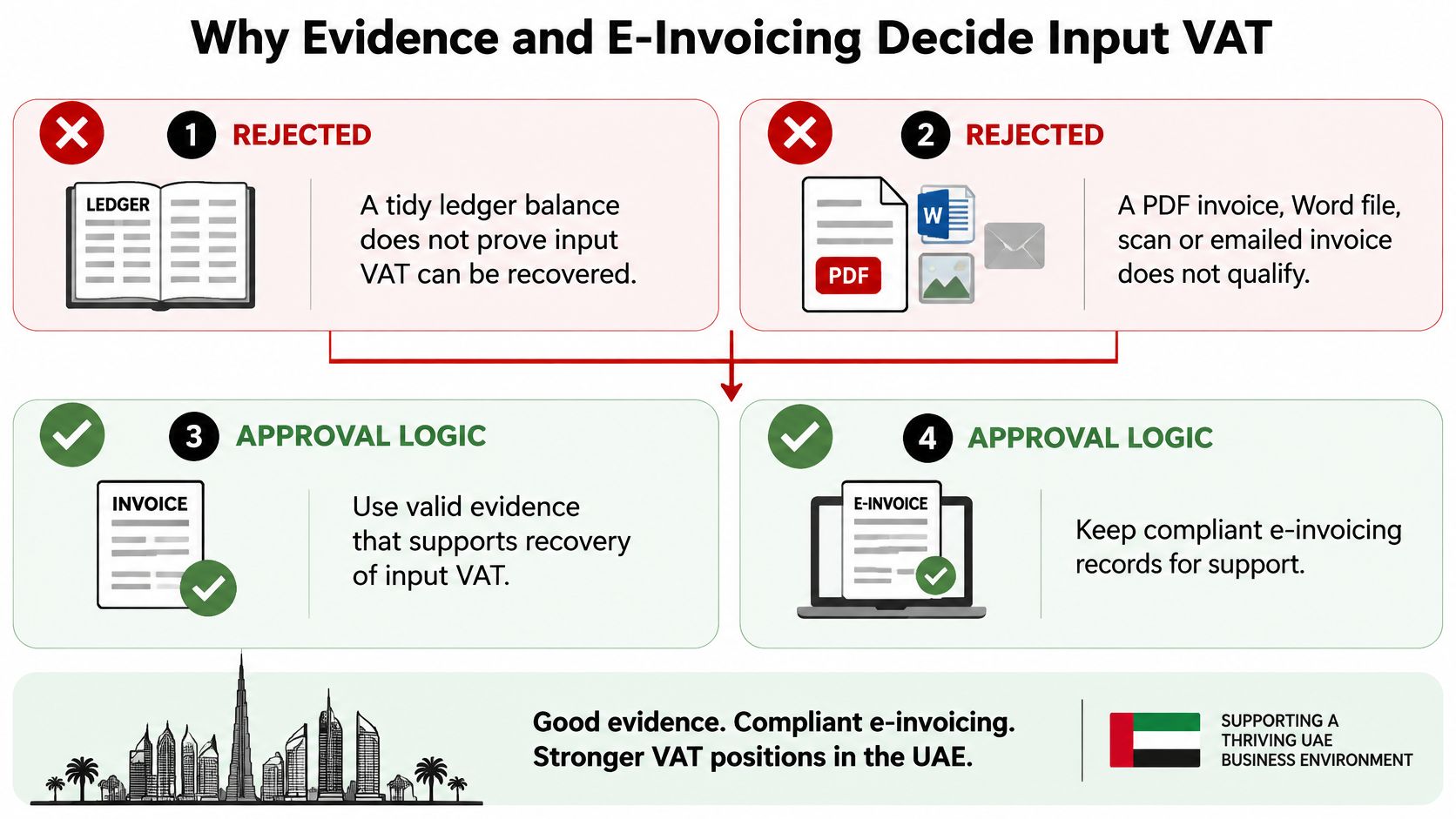
A tidy ledger balance doesn't prove that input VAT is recoverable. A PDF invoice doesn't prove that a business has implemented e-invoicing either. These are separate questions, and confusing them can lead to an unsuitable software purchase.
The FTA's UAE e-invoicing materials describe an e-invoice as structured invoice data exchanged electronically and reported to the FTA, not a PDF, Word file, scan or invoice sent by email; they also cite Ministerial Decision No. 244 of 2025 on implementation and Ministerial Decision No. 64 of 2025 on accredited service providers. That distinction doesn't mean every PDF is automatically invalid evidence for VAT purposes. It means an electronic-looking document isn't the same as a compliant structured e-invoice.
Test the system, not the sales demonstration
Run a sample sale, refund and supplier purchase through the proposed system. Check:
- Structured fields: Can it generate the required data, rather than just render an invoice image?
- Corrections: How does it represent credit notes and partial refunds?
- Validation ownership: Who receives errors, corrects the source record and confirms acceptance?
- External transactions: How are marketplace settlements and overseas supplier invoices matched?
- Migration continuity: Do document links, access controls and change histories survive the move?
A software connector or API capability is useful only if someone owns the failed transactions. Include exception handling and migration support in the implementation scope.
Build an evidence file alongside the ledger
The FTA decision on accounting records and commercial books issued in 2026 addresses requirements for maintaining accounting information. A practical accounting record-keeping process should make those records retrievable by transaction, entity and period.
For staff reimbursements, preserve the supplier document and business purpose, not merely the employee's claim form. For intercompany charges, retain the agreement and allocation basis. Flag entertainment, mixed-use costs and free-zone dealings for a documented recovery assessment rather than automatic acceptance.
If you sell through crowdfunding, the PledgeBox guide to crowdfunding tax compliance offers useful context for organising campaign-related tax questions. It doesn't replace a UAE-specific assessment of the rewards, customers and supplies involved.
Keep an error log that distinguishes a proposed correction to an earlier return from an adjustment considered for a later period. The reviewer should document the applicable treatment, not net an old problem against current activity.
A cheap package can become expensive to replace if its invoice data, supporting documents and audit trail can't move into the e-invoicing framework.
What Changes the Cost of VAT Accounting
There isn't a meaningful single Dubai price for VAT accounting. The work follows the transaction volume, supply mix, entity structure and condition of the records, not the name on the trade licence.
What makes Dubai VAT accounting light or heavy
| Factor | Lighter engagement | Heavier engagement |
|---|---|---|
| Transaction volume | Dozens of local invoices | High-volume retail or marketplace sales |
| Entities | One mainland licence | Mainland plus a free-zone entity |
| Imports | Occasional | Regular customs and reverse-charge entries |
| Supply mix | Mostly standard-rated | Zero-rated, exempt and out-of-scope mixed |
| Records | One cloud ledger | Spreadsheets, PDFs and a second system |
| Scope | Return preparation only | Audit file, advisory and e-invoicing migration |
Read the workload behind the fee
A small local service business with organised invoices presents a different workload from a marketplace seller receiving batched settlements. The seller's accountant must separate sales, platform fees, refunds and settlement timing rather than treating each bank receipt as revenue.
Entity count matters too. A mainland company and a free-zone company need clear ownership of transactions and separate supporting records where appropriate. Intercompany balances introduce another reconciliation task, even if the same founder owns both businesses.
Imports add work when customs information, supplier documents and accounting records arrive through different people. The heavier engagement isn't one with more invoices. It's one requiring more investigation and judgement for each transaction.
Compare like-for-like proposals
Record condition can change the initial project substantially. A functioning cloud ledger may need review and correction, while disconnected spreadsheets and document folders may require reconstruction before recurring work can begin.
Buying advice: Separate the cost of repairing yesterday's records from the cost of maintaining tomorrow's books.
Prepare a short scope brief covering:
- Volume and channels: Sales invoices, purchase invoices, credit notes and payment platforms.
- Entities and trade: Licences, related entities, import patterns and cross-border activity.
- Record condition: Current software, missing periods and document storage.
- Required outputs: Returns, reconciliations, management reports, query support and migration work.
Then compare exclusions. A low recurring fee may leave invoice chasing, import reconciliation, historic corrections or technical advice outside the engagement. That isn't necessarily poor value, provided the split is explicit and someone else owns the omitted tasks.
Keep quoted dirham fees in the proposal, where they can be tied to a defined workload. The better comparison is the total cost of a complete process, including the work your own team must still perform.
How to Choose a VAT Accountant in Dubai
Choose someone who can explain and defend a return, not merely upload it. Portal familiarity matters, but the stronger test is whether the accountant can trace an unfamiliar transaction from its supporting documents to the final treatment.
Use a decision list
- Test FTA process knowledge. Discuss registration assessments, assigned periods, submission records and how queries are handled. Look for a clear process rather than a promise that everything is covered.
- Read the written scope. Identify who classifies supplies, pursues missing invoices, prepares returns and handles periods with no tax payable. Make sure query support has a stated boundary.
- Check sector fit. A property business needs contract analysis, while a trader needs import reconciliation. Request an explanation using a scenario that resembles your actual activity.
- Inspect the audit trail. Review how the software records changes, restricts access and preserves attachments. A screenshot of a dashboard doesn't demonstrate retrievable evidence.
- Name the reviewer. Establish who resolves exceptions before the authorised person approves filing.
Give each proposal the same hypothetical problem: an overseas supplier invoice, an incomplete import file and a customer refund spanning reporting periods. Evaluate how the adviser identifies missing facts and documents a conclusion.
A careful answer may include a request for more evidence. An immediate answer without looking at the transaction can be less reassuring than a well-defined review process.
Apply the same standard to our scope
At Smart Classic Business Hub, we provide VAT-compliant accounting, audit, accounting and bookkeeping, alongside company formation and other business consultancy services. We also inform clients about upcoming yearly UAE compliances.
Those services make us a firm to assess against your requirements, not a substitute for checking the engagement terms. Our broader work includes financial management advisory, corporate finance, feasibility studies, business plans, PRO services and liquidation, but your VAT proposal should identify the services relevant to your business.
Clarify who maintains the registration tracker, who holds the retained record file, and how you obtain your records if the engagement ends. Also establish how work outside the recurring scope is approved before it begins.
Reject an unexplained quote, whether high or low. If a proposal can't describe input-tax evidence, exception review or structured invoice data, the deliverable is too vague to compare fairly.
Confirm Your VAT Scope Before You Hire
Write a one-page scope brief before requesting a fee. Include the licence type, registration position, entities, sales channels, imports, commercial-property activity and current accounting software.
State whether invoices live in the ledger, in PDF folders or across spreadsheets. Include unresolved matters such as missing supplier documents, unreconciled imports or a planned system change, so they're priced openly rather than discovered after appointment.
Turn the brief into an engagement decision
- Bring the filing history: Provide recent returns and supporting reconciliations, or explain why no returns exist.
- Set the review date: Arrange the scope discussion about a month before the next period ends, rather than leaving it until filing time.
- Allocate ownership: Agree in writing who owns classification, evidence collection, approval, submission and payment arrangements.
If the company is still being formed, include VAT design in the setup work. Establish the chart of accounts, invoice process and document store before transactions become difficult to reconstruct.
We can guide clients from business setup into tax and accounting services and related business support. Bring the brief to a scope discussion at our Baniyas Square, Dubai office, and use it to agree a workable division of responsibilities.
Smart Classic Business Hub offers VAT-compliant accounting, bookkeeping and audit services alongside company formation and ongoing compliance guidance. Visit Smart Classic Business Hub to discuss your transaction mix, current records and next filing period, and request a clearly defined VAT accounting scope.