
No. Free zone companies in the UAE are not automatically exempt from VAT, and the normal 5% UAE VAT rate still applies in many cases. The only limited exception is for certain goods transactions involving Cabinet-listed Designated Zones. Services are still subject to the standard 5% VAT rate, even if the company is in a free zone.
That's where many founders get misled. They hear “free zone” and assume “tax free” across the board. For corporate structuring, free zones can offer clear advantages. For VAT, the question is much narrower. It isn't “Are you in a free zone?” It's “Is your zone officially listed as a Designated Zone, and what exactly are you supplying?”
If you're asking are free zone companies exempted from VAT in UAE, the safest starting point is this: your licence location alone doesn't decide the answer. Your VAT position depends on two things working together. First, the legal status of the zone. Second, the type of transaction, especially whether you deal in goods or services and whether the customer is in another designated zone or on the mainland.
Founders usually get stuck in three places:
- They confuse free zones with Designated Zones
- They apply goods rules to services
- They assume VAT registration can be ignored if they chose a free zone setup
Those assumptions can create expensive filing and invoicing problems later. A service startup in a free zone can still have regular VAT obligations. A trading company in a designated zone can still trigger VAT when goods move to the mainland. And a low-turnover business still needs to watch the registration threshold carefully.
Are Free Zone Companies Automatically Exempt From VAT
No. A free zone licence by itself does not give a company blanket VAT exemption in the UAE. The only special VAT treatment starts with a narrower test. Is the free zone one of the Cabinet-listed Designated Zones? Even then, the benefit is limited and usually relates to certain goods movements, not everything the business sells. The Federal Tax Authority explains this in its guide on VAT treatment of designated zones.
That point matters because many founders hear “free zone” and translate it as “tax free.” For VAT, that shortcut causes trouble. A free zone name is a setup detail. VAT looks at the legal status of the zone, what you are supplying, and where that supply goes.
A simple way to keep it straight is to separate two labels. “Free zone” is the business address label. “Designated Zone” is the VAT rule label. Those two labels are not interchangeable.
Why founders get this wrong
The confusion usually starts with benefits getting mixed together. Free zones can offer ownership, customs, and setup advantages, so first-time founders often assume VAT follows the same pattern. It does not.
VAT works more like a filter than a badge. The same company can have one transaction treated one way and another treated differently, depending on whether it is supplying goods or services, and whether those goods stay inside a qualifying designated-zone chain or move to the mainland.
That is why a consultancy in a free zone can still face normal VAT rules, while a trader handling goods in a Cabinet-listed Designated Zone may get different treatment for a specific movement of stock.
The better question to ask
A more accurate starting question is not “Am I in a free zone?” It is this set of checks:
- Is my zone officially listed as a Designated Zone?
- Am I supplying goods or services?
- Are the goods staying within designated-zone conditions, moving to another zone, or entering the mainland?
- Have my taxable supplies created a VAT registration requirement?
That fourth point gets missed often. Service startups in free zones tend to focus on the licence and forget the registration threshold. If their revenue reaches the threshold, the free zone setup does not remove the need to register and account for VAT.
What to keep in mind from the start
Three practical rules help avoid early mistakes:
- Check the exact zone status. Not every free zone is a Designated Zone for VAT.
- Split goods from services in your head. They often follow different VAT outcomes.
- Watch mainland connections carefully. Goods moving out to the mainland, or services supplied under normal UAE VAT rules, can change the result fast.
So, two companies with similar free zone licences can end up with very different VAT positions. The deciding factor is not the brochure description of the zone. It is the combination of designated-zone status, what is being supplied, where it goes, and whether registration has already been triggered.
How UAE VAT Works for Businesses Today
A free zone licence does not place a business in a separate tax universe. For day-to-day operations, UAE VAT usually works in a very familiar way. A registered business charges VAT on taxable sales, collects it from the customer, deducts eligible VAT it paid on business costs, and reports the difference to the Federal Tax Authority.
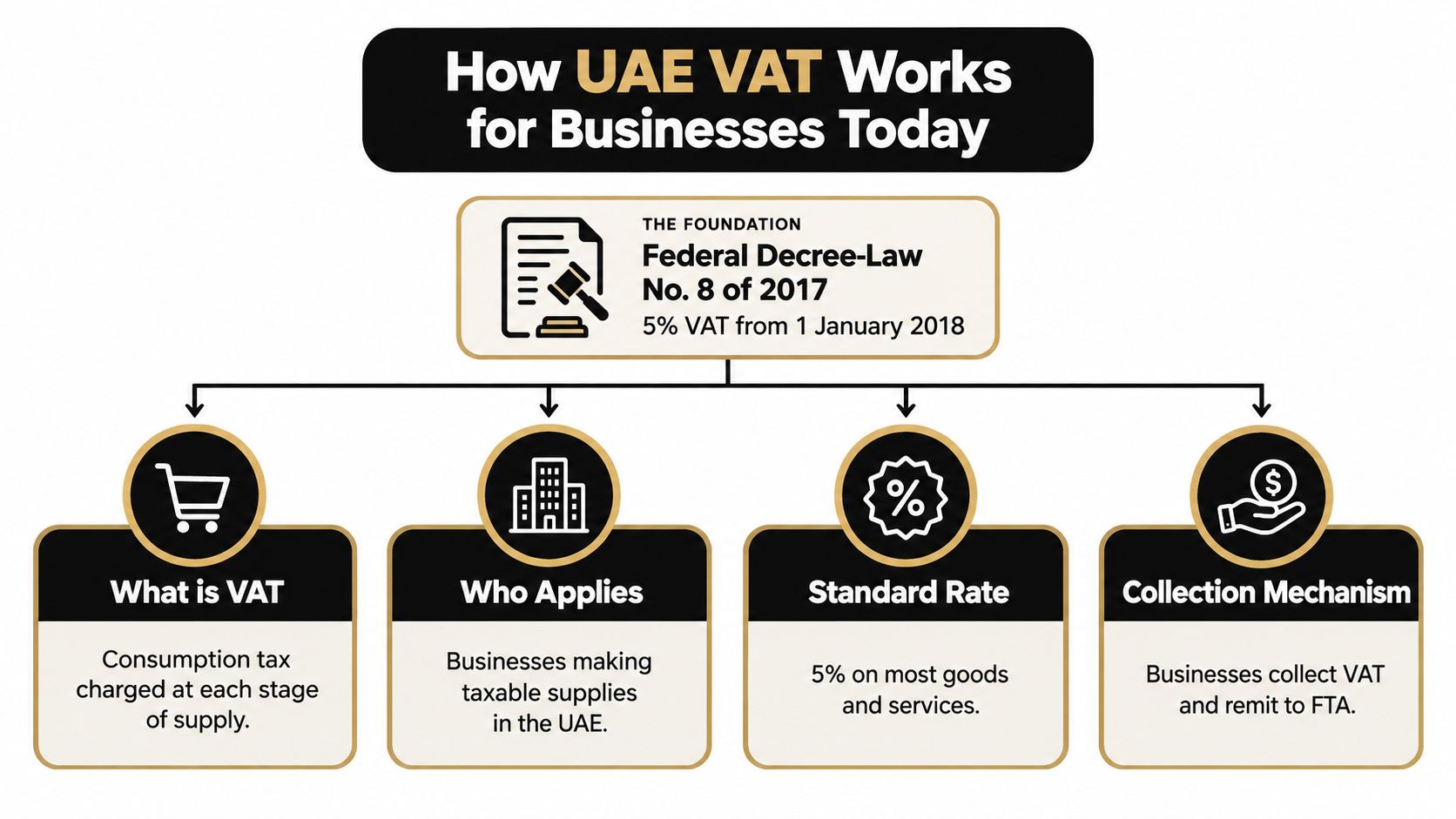
The standard UAE VAT rate is 5%. For a first-time founder, it helps to see VAT as a flow rather than a penalty. You add VAT to taxable invoices where required. You may recover VAT on qualifying business purchases. Then you file a return and pay the net amount due, or claim a refund if your recoverable input VAT is higher.
The basic mechanism in plain English
Here is the usual pattern:
- You sell a taxable product or service. If the supply is subject to the standard rate, you charge 5% VAT on the invoice.
- You collect that VAT from the customer. That amount is not your revenue. You are holding it to report to the FTA.
- You pay VAT on business expenses. This is often called input VAT.
- You offset eligible input VAT against output VAT. Output VAT is the VAT you charged on your sales.
- You file your VAT return and settle the difference. If you collected more than you paid, you pay the balance. If you paid more than you collected, a refund position may arise.
A simple example makes this easier. If a registered consultancy bills a client AED 10,000 for a taxable service, the invoice becomes AED 10,500. The AED 500 is VAT collected. If that consultancy also paid VAT on software, office costs, or subcontractor services that qualify for recovery, it may deduct that amount in its return before paying the net VAT due.
What founders often miss
The practical work is not just charging 5%. It is also documentation.
A VAT system only works cleanly when your records match your tax treatment. That means keeping tax invoices, tracking expenses properly, applying the correct treatment to each sale, and filing on time. If the paperwork is weak, even a correct VAT position becomes harder to defend.
This catches service startups more often than goods traders. A founder may assume, "We are in a free zone, so VAT probably does not apply," and delay registration or invoicing checks. The bigger risk is much more ordinary. Revenue grows, the registration threshold is crossed, and the business has already made taxable supplies without setting up the VAT process properly.
Why this matters before you even look at zone rules
Many founders expect VAT questions to start with geography. In practice, the first operational question is usually much simpler. Are you making taxable supplies, and if so, have you set up invoicing, record-keeping, and filing correctly?
That is why the free zone discussion can feel confusing at first. The special rules do exist, but they sit on top of the normal VAT system rather than replacing it. So before getting into designated-zone treatment, it helps to understand the default engine first. The default engine is 5% VAT, proper invoices, input VAT recovery where allowed, and regular FTA filing by registered businesses.
Designated Zones Versus Non Designated Free Zones
Here is the contrarian point founders usually hear too late. A free zone company is not put into a VAT-free bucket just because the licence says "free zone."
For VAT, the question is narrower. Is the business operating in a Designated Zone that appears on the Cabinet list, or in a free zone that is not designated for this special treatment? That single test removes a lot of the confusion.
A designated zone works like a controlled customs island for certain goods movements. It is a specific geographic area with controls around entry, exit, storage, and handling of goods. A non-designated free zone may still be a free zone for company formation and regulation, but for VAT it usually follows the normal UAE position unless a specific rule says otherwise.
Why the licence name can mislead founders
Many first-time founders read "free zone" on the trade licence and assume the VAT answer is already settled. It is not.
The VAT analysis starts with the official list, not the branding of the jurisdiction. If the zone is named in the Cabinet decision, it can qualify for the special designated-zone treatment. If it is not listed, the company is generally treated like any other UAE business for VAT purposes. You can check the official UAE designated zones list, which names the relevant zones and their effective dates.
If you want a practical cross-check before reading the legal list, this guide to designated free zones in the UAE is a helpful starting point.
The special treatment is narrower than people expect
The exemption myth usually breaks.
The designated-zone concept was built mainly for goods in a controlled area. It was not created as a blanket VAT holiday for every sale made by a company inside that zone. That is why two businesses in free zones can have very different VAT outcomes, even if both are properly licensed and both use the words "free zone company" in their documents.
A warehouse trader in a Cabinet-listed zone may get special treatment for some goods movements. A consulting startup in a free zone may still be dealing with ordinary VAT rules from day one.
| Feature | Designated Zone | Non Designated Free Zone |
|---|---|---|
| VAT test | Must appear on the Cabinet list | Not on the Cabinet list for special VAT treatment |
| What the status is built around | Controlled movement, storage, and handling of goods | Normal UAE VAT rules |
| Goods position | Some goods transactions may get special treatment depending on where the goods move | Goods generally follow normal UAE VAT rules |
| Services position | Services usually follow the standard VAT position | Services usually follow the standard VAT position |
| Licence wording | "Free zone" alone does not decide the VAT result | "Free zone" alone does not decide the VAT result |
The practical takeaway
Founders should separate two questions.
First, where is the company established? Second, what is being supplied and where is it going? The first question tells you whether designated-zone rules might apply at all. The second question decides whether those rules change the VAT result.
That is why "free zone" is only the starting label. VAT answer comes from the Cabinet-listed designated-zone test, then the supply facts.
VAT Rules for Goods and Services in Free Zones
The key mistake is treating a free zone address like a blanket VAT shield. It is not. For this part of the analysis, the question is narrower: are you dealing in goods, and if yes, where are those goods physically moving?
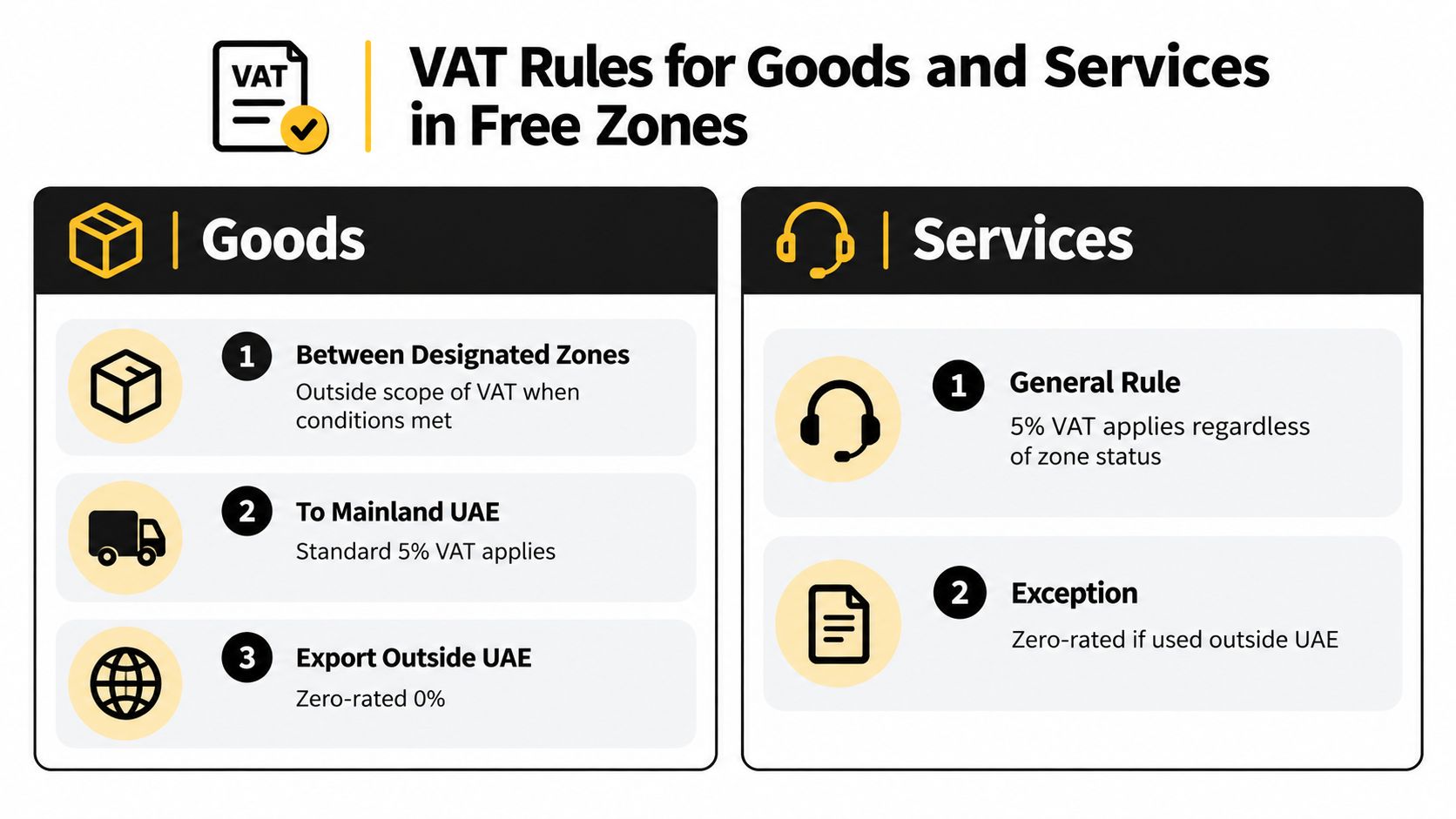
Goods treatment turns on movement and destination
For goods in a Cabinet-listed Designated Zone, VAT works a bit like a border test inside the UAE system. The company name stays the same, but the VAT result can change once the goods cross into a different place.
Under the designated-zone rules cited above, goods moving from one qualifying Designated Zone to another may be treated differently from goods leaving a Designated Zone for the UAE mainland. Once the destination is the mainland, the special goods treatment usually falls away and the transaction is generally brought into the normal VAT net.
That is why two stock movements by the same trader can produce different VAT outcomes on the same day. The deciding fact is often the destination, not the licence.
A practical goods matrix founders can use
Use this simple grid for goods transactions:
| Goods movement | Usual VAT direction to check |
|---|---|
| Designated Zone to another Designated Zone | May qualify for special designated-zone treatment, subject to the conditions being met |
| Designated Zone to UAE mainland | Usually treated under normal UAE VAT rules, with import treatment becoming relevant |
| UAE mainland to Designated Zone | Often needs normal VAT and import analysis, not a blanket exemption assumption |
| Within the same Designated Zone | The facts still matter, especially whether the goods are stored, used, or consumed there |
A warehouse business should read this table almost like a route map. Start with the physical location of the goods. Then trace where they go next.
Why services do not benefit from the goods exception
Services do not ride along with the goods exception.
If your invoice is for consulting, design, marketing, software support, management work, or another service, the designated-zone goods rules are usually not the test that decides the VAT result. Founders often mix these up because both invoices come from the same free zone company. VAT does not group them that way. It looks first at what is being supplied.
A four-question check before you invoice
Before issuing or accepting an invoice, ask:
Is the supply goods or services?
This is the first fork in the road.If it is goods, is the business operating from a Cabinet-listed Designated Zone?
If not, the special goods treatment usually does not apply.Where are the goods going?
Zone to zone and zone to mainland can lead to different outcomes.Are the goods being used or consumed inside the zone?
Storage and movement can be treated differently from actual use.
The error that causes trouble
A common founder mistake is borrowing a goods rule and pasting it onto a service invoice. For example, a business hears that some designated-zone goods movements may sit outside the usual VAT treatment, then uses that idea for an advisory fee or monthly retainer.
That is where filings start to go wrong. The invoice can be incorrect, the customer may reject the treatment, and the VAT return may need correction later.
VAT Registration Thresholds for Free Zone Companies
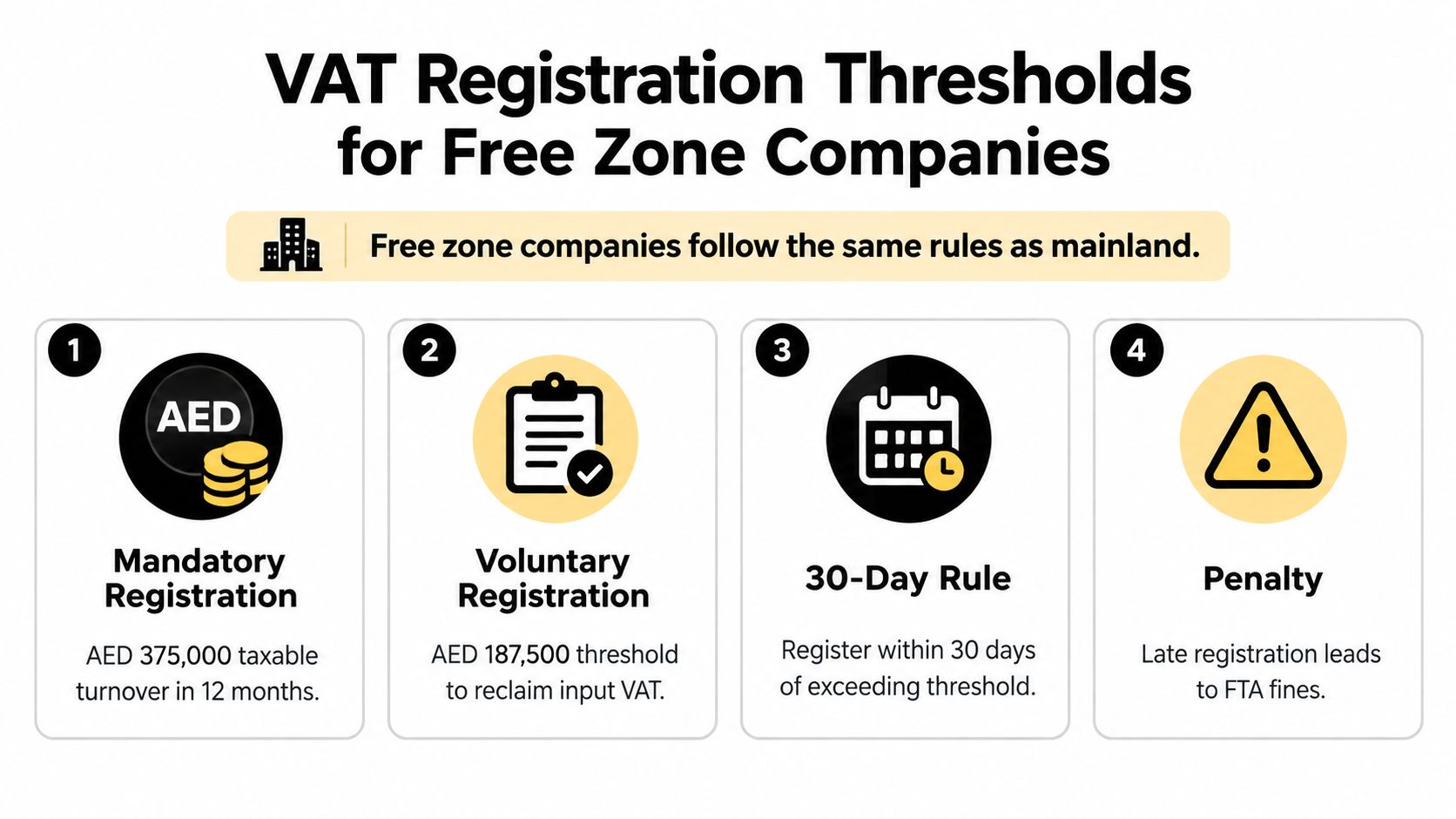
Here is the part many founders get backwards. A free zone licence does not decide whether you register for VAT. Your turnover and the type of supplies you make decide that.
For VAT registration, a free zone company is measured under the same UAE framework used for other businesses. The key number is the mandatory VAT registration threshold of AED 375,000.
Why this catches free zone startups early
The common mistake is simple. A founder hears that some goods movements involving a Cabinet-listed Designated Zone can receive special treatment, then assumes the business can ignore VAT registration until much later.
That shortcut causes problems, especially for service companies.
If you run a consulting firm, marketing agency, software support business, design studio, or recruitment company from a free zone, your sales can still count toward the registration threshold in the normal way. Your office location does not wash those supplies clean of VAT rules. For many service startups, the risk is not charging VAT incorrectly on a single invoice. It is missing the point where registration becomes required.
For a closer explanation of how taxable turnover is measured, this guide on the VAT registration threshold in the UAE is a useful reference.
The overlooked point about services
Founders often focus on designated zones because the goods rules sound dramatic. Services are usually less dramatic and more relevant.
A simple comparison helps. The designated-zone test works a bit like a special gate for certain goods transactions. Service invoices usually do not pass through that gate first. They are checked under the regular VAT rules, so a free zone service startup can reach the registration threshold even if the founder keeps hearing that “free zone” and “designated zone” mean tax relief.
That is why turnover tracking matters from month one.
Two checks to make before the threshold sneaks up on you
Which of your supplies are taxable?
Do not group every invoice under one free zone label. Review what you sell and whether those sales form part of your taxable turnover.Could you request an exception instead of full registration?
Some businesses that make only zero-rated supplies may be able to apply for an exception from mandatory registration. That needs a proper review of the supply profile, not a guess based on the company being in a free zone.
Good records help here. If you are still connecting the dots between tax registration, company details, and formal identifiers, this startup guide to business IDs gives useful background.
A practical habit that saves trouble
Check your issued invoices, signed proposals, and expected billings every month. That habit works like a dashboard light in a car. It warns you before the engine overheats.
Some businesses use Smart Classic Business Hub at this stage for factual support with VAT registration and accounting for UAE companies.
Practical Examples of VAT in Free Zone Transactions
Rules stick better when you can see them in motion.

Example one goods moving between designated zones
A trading company stores packaged products in a Designated Zone and transfers those goods to a customer located in another qualifying Designated Zone.
The likely VAT result is that this movement can fall outside the scope of VAT, because it is a goods movement between qualifying designated zones under the official designated-zone rules discussed earlier.
Why founders get confused here: they correctly hear “no VAT” in this scenario and then assume that means their entire business is VAT-free. It doesn't. The result belongs to this transaction pattern, not to the company as a whole.
Example two goods going from a designated zone to the mainland
The same trading company now sells part of its stock to a customer in mainland Dubai.
This time the outcome changes. Goods supplied from a designated zone to the mainland are treated as imports and taxed at the standard 5% rate under the official designated-zone rules already noted above.
So the product didn't change. The company didn't change. Only the destination changed. That single change can alter the VAT treatment.
The easiest way to avoid mistakes is to treat goods movement like a route map. Start point matters, but destination often decides the VAT outcome.
Example three service company in a free zone
Now take a marketing agency licensed in a free zone. It invoices a mainland client for campaign planning, content work, and account management.
This is a service supply, not a goods movement. So the designated-zone goods exception is not the rule to use. The agency needs to apply the normal VAT treatment that applies to services.
Many startup founders answer the wrong question. They ask, “Am I in a free zone?” when they should ask, “Am I billing for services?” For agencies, consultants, and similar businesses, that second question is usually the one that drives the answer.
A fast pattern check
If you want a quick mental test, use this:
- Physical goods between qualifying designated zones: may receive special treatment
- Physical goods entering the mainland from a designated zone: standard VAT treatment applies
- Services from a free zone business: normal VAT rules apply
That won't replace a proper invoice review, but it helps founders stop making blanket assumptions.
Staying Compliant and Next Steps for Your Free Zone Company
The safest VAT approach for a free zone company is to stop thinking in labels and start thinking in checks. Most problems happen when a business uses one broad assumption for every invoice.
A simple compliance checklist
Keep your review process practical:
- Confirm zone status: Check whether your free zone is a Cabinet-listed Designated Zone before applying any special goods treatment.
- Classify every supply properly: Separate goods from services on each transaction. Don't let the free zone label do the thinking for you.
- Watch turnover regularly: Monitor whether your taxable activity is moving toward the AED 375,000 registration threshold discussed earlier.
- Keep invoice support: Store contracts, shipping records, tax invoices, and transaction notes so the VAT treatment can be explained later.
- Escalate mixed cases early: If a transaction involves goods, services, mainland movement, or unclear use, get it reviewed before filing.
If you want a practical reference point for your internal process, this VAT compliance checklist is a useful place to start.
What founders should do before filing season
Don't wait for filing time to sort out classification. By then, the issue has already happened at invoice stage.
A better approach is to review your setup in this order:
- Your zone status
- Your supply types
- Your customer locations
- Your turnover trend
- Your record-keeping discipline
That order keeps the analysis clear. It also reduces the chance that your accountant has to untangle months of mixed assumptions later.
Good VAT compliance in a free zone business usually comes from boring habits. Correct invoice classification, regular turnover checks, and clean records solve more problems than complicated tax theories.
If you're still unsure whether your free zone activity creates VAT obligations, that uncertainty itself is a signal to review the structure properly. It's much easier to fix treatment before issuing invoices than after customers, customs records, and filings all need correction.
If you need help checking whether your free zone is a Designated Zone, registering for VAT, or setting up VAT-compliant bookkeeping for a service or trading business, Smart Classic Business Hub can assist with the practical side. Their team supports UAE company setup, VAT registration, accounting, and compliance so founders can match their business model to the correct VAT treatment from the start.