
Goods are arriving. Your supplier is ready to ship. You're planning to hold inventory in the UAE, then re-export part of it across the Gulf and sell part into the local market. At that point, the wrong question is not “Which free zone is cheapest?” It's “Which setup gives my goods the right VAT treatment, customs flow, and operating model?”
That's where designated free zones in uae matter. Many founders know the UAE has a broad free-zone network, and the UAE Ministry of Economy and Tourism says investors can access more than 40 multidisciplinary free zones with full foreign ownership. What often gets missed is that only some of these zones are treated as Designated Zones for VAT on goods, and that difference changes how import, storage, re-export, and mainland release should be structured.
If you trade physical goods, run e-commerce fulfilment, or depend on customs-controlled warehousing, designated status isn't a technical footnote. It affects cash flow, paperwork, and whether your operating model works cleanly in practice. The Upfreights guide to logistics hubs in the Middle East is a useful companion if your decision also depends on regional shipping lanes and hub selection.
This guide gets straight to the best options and offers key insights into the specific purpose of each.
Practical rule: Free zone status alone doesn't decide VAT treatment on goods. The zone's designated status, your activity, and where the goods move next do.
1. Jebel Ali Free Zone JAFZA
JAFZA is the default answer for serious goods movement in Dubai, and in many cases that answer is correct. It was established in 1985 and is widely described as the first free zone in the UAE, a milestone that helped define the country's modern free-zone model around foreign ownership, customs advantages, and sector clustering.
For trading businesses, the fundamental strength isn't just reputation. It's the practical link between port handling, customs processes, storage options, and onward distribution. If your model depends on containers, bonded movements, or regional re-export, JAFZA is built for that kind of operational discipline.
Where JAFZA works best
JAFZA suits importers, distributors, contract manufacturers, automotive traders, FMCG operators, and businesses that need to move goods through a port-led supply chain without creating unnecessary VAT friction on every step. It's also one of the zones commonly recognised as a Designated Free Zone in UAE tax discussions, which matters for eligible goods transactions.
That makes it stronger for physical trade than for founders who just want a low-cost licence and a desk. If your real business is inventory, customs documentation, and container planning, JAFZA makes more sense than a prestige office address with limited warehousing.
- Port-led execution: JAFZA's integration with Jebel Ali Port is the main draw for companies that import in volume and re-export regularly.
- Facility range: It supports more than just offices, with options that typically include warehouses, plots, and industrial configurations.
- Banking familiarity: Suppliers, freight partners, and banks generally understand the zone and its operating profile.
- VAT relevance: Designated-zone treatment is commercially useful when your transactions involve eligible goods flows rather than service-heavy billing.
Trade-offs to watch
JAFZA isn't the cheap option. It's usually chosen because mistakes are costly in trade, and this zone reduces some of those mistakes by giving operators a mature customs and logistics environment.
The downside is that mature infrastructure usually comes with tighter compliance expectations. Hazardous goods, industrial activity, bonded storage, and HSE-sensitive operations need more planning, not less.
JAFZA is strong when your business model begins with goods movement. It's less compelling if your business is mainly consulting, software, or admin-heavy trading with no real warehouse need.
If you're still deciding between jurisdictions, this comparison of mainland vs free zone in Dubai helps clarify when a zone like JAFZA is the right fit.
2. Dubai Airport Freezone DAFZ
Dubai Airport Freezone is built for speed, value density, and air cargo logic. If your stock is high-value, time-sensitive, or difficult to carry in long port cycles, DAFZ is often the cleaner answer than a seaport-led zone.
The zone typically proves more suitable for electronics traders, pharmaceutical distributors, luxury product importers, and aerospace-adjacent businesses. The zone is widely listed among the UAE's designated free zones for VAT purposes, so it remains relevant for eligible goods transactions, not just premium office setup.
Best use case
DAFZ works when delay costs more than rent. Businesses that depend on quick customs release, airport adjacency, and efficient handling of smaller but more valuable shipments usually benefit most.
That's very different from bulk import models. If your margin depends on large warehouse footprints and slower inventory turns, DAFZ can feel expensive for what you need.
- Air cargo advantage: It suits businesses that re-export quickly or rely on short lead times.
- Setup convenience: Operators often value the integrated government-facing processes and business services.
- Partner confidence: Multinationals and institutional counterparties generally recognise the DAFZ name.
- Designated-zone relevance: For goods structures that qualify, the VAT treatment can support a cleaner trading flow than a non-designated zone.
What doesn't work as well
DAFZ is not the best place to chase warehouse scale. You choose it for speed, not for massive storage economics.
It can also be the wrong fit for companies that expect the words “free zone” to mean all transactions are outside normal VAT logic. That assumption creates problems fast. The core distinction matters here: designated-zone treatment is relevant to goods, while services still follow normal VAT rules. That difference is explained clearly in Cin7's note on Designated Zones and Free Zones.
If your company invoices advisory work, support contracts, subscriptions, or technical services alongside goods, DAFZ only helps if the transaction mapping is done properly. Too many businesses choose the zone first and ask the VAT question later.
3. Dubai South Dubai Aviation City and Logistics District
Dubai South is the zone I'd look at when the business needs room to scale, not just a licence to start. It's attractive for logistics operators, fulfilment businesses, aviation suppliers, and e-commerce companies that want a long runway for warehousing and operational growth.
Its appeal is structural. You're not buying into a legacy district with limited expansion logic. You're choosing a master-planned logistics and aviation environment with strong relevance for businesses that need to grow into larger storage and movement patterns.
Why it stands out
Dubai South makes sense for operators who want airside-adjacent logistics with a broader development story around them. It also benefits from strategic connectivity to Jebel Ali, which matters if your business uses both sea and air channels rather than committing fully to one.
A lot of founders underestimate that hybrid point. In practice, some of the strongest UAE trading setups use one zone because it keeps options open across multiple cargo modes.
- Scalable footprint: Better suited than many legacy office-first zones for fulfilment and logistics expansion.
- Hybrid logistics logic: Useful for businesses that need access to both air-linked and port-linked flows.
- Operational planning: Stronger for inventory-heavy models than for prestige-driven office presence.
- VAT position: Dubai Aviation City is commonly treated as a Designated Zone for VAT purposes in the relevant context.
The trade-off
Dubai South can require patience. Some facilities and plots sit within phased development patterns, so availability and exact fit-out options can vary.
That's not necessarily a weakness. For the right operator, phased development is acceptable if the zone gives a more future-proof base than a tighter, older district. A market guide discussing UAE free zones notes that setup timelines are often in the rough range of two to four weeks, alongside the UAE's specialised zoning approach across logistics, industrial, finance, and tech activities. In practice, though, warehouse readiness and approvals matter more than headline incorporation speed.
A fast licence doesn't solve a slow warehouse handover. For logistics businesses, the property and customs setup usually matter more than the incorporation certificate.
4. KEZAD Group Khalifa Industrial Zone and Free Trade Zone of Khalifa Port
KEZAD Group is where I'd send businesses that think in industrial terms, not just commercial ones. If your business needs land, process flow, heavy logistics support, or room for build-to-suit operations, KEZAD is often one of the strongest options in the country.
This isn't a polished office-centric zone pretending to be industrial. It's designed for operators in manufacturing, processing, large-scale warehousing, and supply chains that need direct access to port infrastructure and strong road connectivity.
Who should consider KEZAD
Food processing, metals, chemicals, polymers, automotive supply, industrial trading, and project cargo businesses are the most obvious fit. Companies with serious inbound raw materials or outbound finished goods benefit from the port-zone relationship.
KEZAD also matters in the designated free zones in uae conversation because multiple Abu Dhabi zones are commonly cited on designated-zone lists, including Khalifa Port Free Trade Zone and Abu Dhabi Airport Free Zone, as explained in this designated free zones overview from UAQ Free Trade Zone. That same distinction is important on the corporate-tax side too, because designated status can intersect with whether a business may qualify as a Qualifying Free Zone Person for access to the 0% corporate tax rate on qualifying income.
What works and what doesn't
KEZAD is excellent for substance. It's less attractive if all you need is a presentable office, fast meetings in central Dubai, and a light admin setup.
- Industrial depth: Better for production and processing businesses than image-conscious service firms.
- Land and warehouse logic: Stronger where custom space planning matters.
- Port proximity: Valuable for import-heavy or export-heavy supply chains.
- Serious operating model: Good fit when customs, utility planning, and sector-specific infrastructure matter.
The practical drawback is lead time. Build-to-suit and industrial execution usually take longer than taking a ready office in a more commercial zone.
Businesses considering Abu Dhabi should also review broader free zone options in Abu Dhabi before choosing KEZAD, especially if they're balancing industrial needs against office, mobility, and staff access.
5. Sharjah Airport International Free Zone SAIF Zone
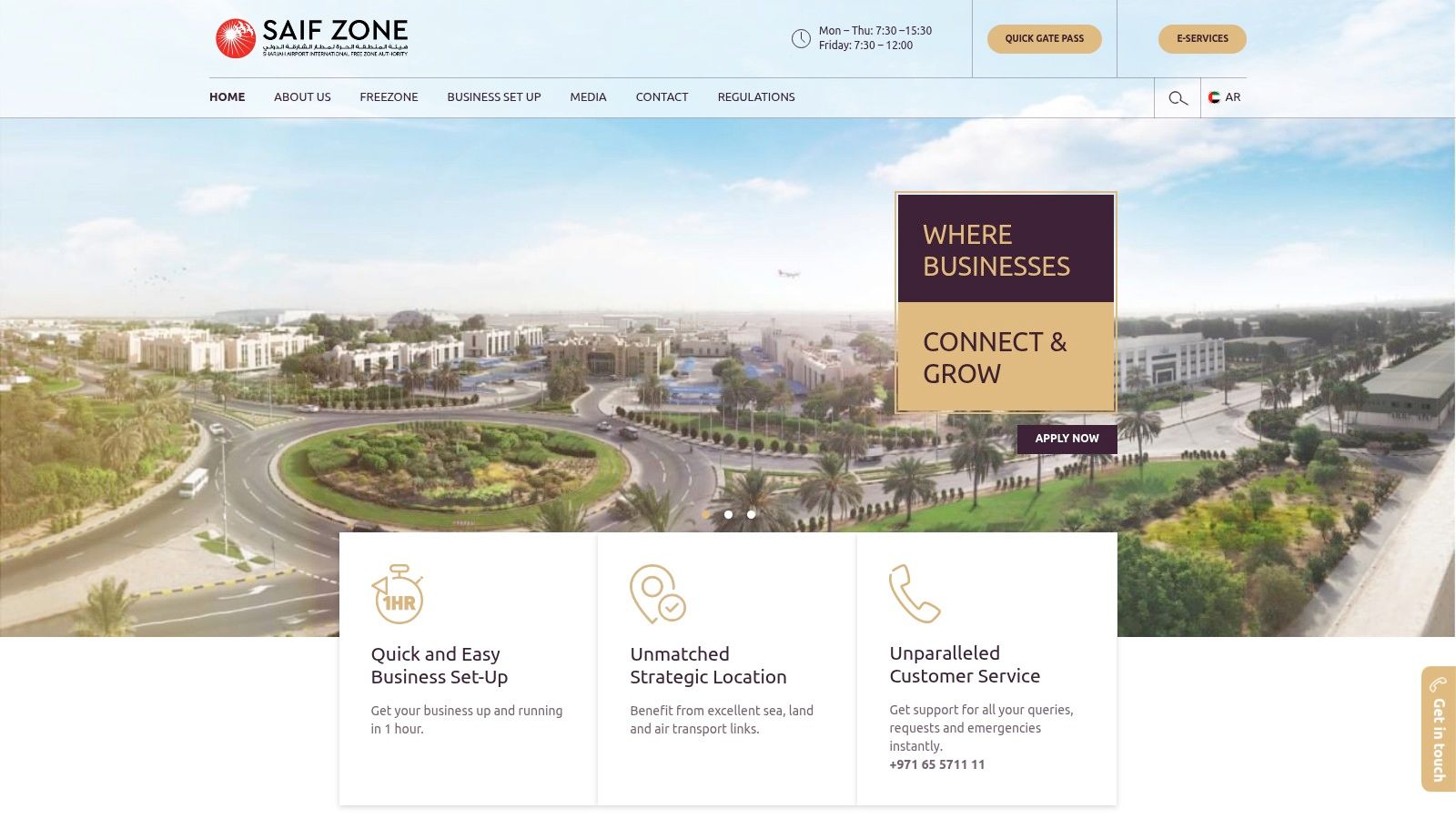
SAIF Zone is a practical choice for founders who want a recognised designated-zone option without jumping straight to top-tier Dubai pricing. It has stayed popular because it tends to align with the needs of trading SMEs, light manufacturing operators, and businesses that want airport access with a simpler cost profile.
I wouldn't call it the most glamorous address. I would call it one of the more commercially sensible ones for many early-stage or mid-market trading companies.
Why traders like SAIF Zone
SAIF Zone usually appeals to businesses that need warehouses, straightforward setup, and workable logistics, but don't need the full premium ecosystem of JAFZA or DAFZ. Its airport adjacency helps with certain cargo profiles, and Sharjah's broader commercial environment often suits cost-conscious operators.
For businesses evaluating VAT structure, the key isn't just that SAIF Zone is commonly treated as designated. The key is understanding that the UAE has more than 40 free zones overall, but only around 23 are on the Designated Zone list used for VAT treatment, according to CLA Emirates' explanation of Designated Zones and VAT applicability. That's why assumptions based on the phrase “free zone” alone are risky.
The real trade-off
SAIF Zone is often a good value choice, but value choices come with context. Some banks, global suppliers, and large counterparties still respond faster to the biggest Dubai names, especially when the relationship is new.
- Cost control: Better suited to budget-sensitive trading and light industrial setups.
- Operational practicality: Useful for firms that need warehouse and visa functionality more than brand prestige.
- Faster decision-making: Often easier to justify for SMEs that want a clear operating base.
- Designated status: Relevant for businesses moving goods under the right customs and VAT conditions.
If your model is “import, hold, re-export, and occasionally release to mainland,” SAIF Zone can work well. If your model is “raise investor confidence with a headline address,” another zone may serve you better.
6. RAKEZ RAK Free Trade Zone, RAK Maritime City Free Zone, and RAK Airport Free Zone
RAKEZ is one of the most practical answers for entrepreneurs who need cost efficiency and operational flexibility more than a Dubai postcode. It manages multiple jurisdictions, and that matters because some of those jurisdictions are relevant in the designated-zone context for goods-based businesses.
What RAKEZ does well is reduce setup friction for SMEs that still need proper infrastructure. You can enter at a modest level, then expand into warehousing or industrial use without rebuilding the whole company structure from scratch.
Where RAKEZ earns its place
RAKEZ is a sensible option for import-export SMEs, manufacturers, online sellers with stockholding needs, and founders who want a one-stop approach to licensing and facilities. Independent market guides place the UAE's total free-zone count at around 46 across the seven emirates, reflecting years of launches, mergers, and rebranding. In that wider context, RAKEZ stands out because it offers a broad operating range rather than a single narrow use case.
That range helps when a business is still evolving. Many companies start with one trade activity, then add warehousing, processing, packaging, or regional distribution later.
Practical limitations
RAKEZ won't carry the same prestige signal as a flagship Dubai free zone. For some founders that doesn't matter at all. For others, especially those dealing with image-sensitive international clients, it can matter during the first few onboarding conversations.
- SME-friendly structure: Strong for businesses that need affordability and room to adjust.
- Multi-jurisdiction flexibility: Useful when the operating model may change over time.
- Broader facility choice: Better than office-only zones for businesses that may need storage or industrial use later.
- Location trade-off: Less central for teams that need frequent Dubai-based meetings.
The right way to evaluate RAKEZ is simple. If the business wins on margin discipline, sensible overheads, and practical operations, RAKEZ is often attractive. If the business wins on prestige, centrality, and brand optics, it may feel like a compromise.
7. Expert Solution Navigating Setup with Smart Classic Business Hub
Choosing among designated free zones in uae is rarely just about the zone. It's about matching the zone to the transaction flow, licence activity, customs pathway, VAT treatment, and long-term compliance burden. That's exactly where a setup adviser earns their fee, and where Smart Classic Business Hub has a clear advantage.
Smart Classic isn't just a company formation shop. The firm combines setup support with the work founders usually discover later, such as PRO services, VAT-compliant accounting, audit support, liquidation, tax residency certificate support, legal coordination, recruitment assistance, and practical planning around growth. That matters because most setup problems don't begin at licence issuance. They begin when the company starts trading and real documents have to match the legal structure.
Why this matters in designated-zone cases
A designated-zone strategy only works when the paperwork aligns with the operating reality. If a business says it will trade goods but mainly invoices services, the zone choice may not deliver the expected VAT outcome. If it needs customs-controlled storage but leases the wrong facility type, the structure can become clumsy fast.
That's where Smart Classic is useful. The team can compare jurisdictions, advise on free zone versus mainland positioning, and connect setup choices to ongoing compliance rather than treating incorporation as a one-time event. Businesses looking specifically at free zone company setup in the UAE can use that support to avoid choosing a zone based only on headline marketing.
What works well with Smart Classic
Smart Classic fits founders who want one coordinated provider instead of five separate specialists. That's especially valuable for foreign investors, SME owners, and first-time UAE entrants who need practical guidance, not just documents.
- End-to-end support: Company formation, compliance, PRO work, accounting, audit, and liquidation can be handled in one advisory relationship.
- Local execution: A Dubai-based team with local networks can help reduce avoidable delays.
- Advisory depth: Feasibility studies, business planning, and financial guidance are useful when the setup decision affects future expansion.
- Operational extras: Recruitment help, legal support, and co-working access make the service broader than basic incorporation.
- Cost visibility: Responsive consultations and a cost calculator help founders plan before committing.
The honest limitations
Smart Classic is best for UAE-focused setup and growth. If a client is looking for broad multi-country restructuring with minimal UAE substance, this won't be the core value proposition.
Also, bespoke support means you usually need a consultation before final scope and pricing become clear. For serious investors, that's normal. Good setup advice is rarely one-size-fits-all.
The most expensive mistake in UAE setup is choosing a structure that looks cheaper on day one but creates tax, banking, or customs friction once trading starts.
7-Point Comparison of UAE Designated Free Zones
| Free Zone / Service | Implementation Complexity 🔄 | Resource Requirements ⚡ | Expected Outcomes 📊⭐ | Ideal Use Cases 💡 | Key Advantages ⭐ |
|---|---|---|---|---|---|
| Jebel Ali Free Zone (JAFZA) | 🔄 Medium–High, stricter HSE/customs bonding and permit processes | ⚡ High, premium rents, large plots/warehouses, port integration costs | 📊 High trade throughput and lower landed cost; ⭐ strong logistics performance | 💡 Trading, logistics, light/advanced manufacturing, FMCG, petrochemicals, automotive | ⭐ Deep port‑air integration, mature infrastructure, published tariffs, VAT Designated Zone |
| Dubai Airport Freezone (DAFZ) | 🔄 Medium, streamlined on‑campus services but premium compliance | ⚡ High, premium rentals, airside facilities and specialised units | 📊 Fast customs clearance and reliable air cargo SLAs; ⭐ suited to time‑sensitive goods | 💡 Electronics, pharmaceuticals, luxury goods, aerospace, express re‑exports | ⭐ Airside adjacency, strong banking/brand recognition, VAT Designated Zone |
| Dubai South (Aviation City & Logistics) | 🔄 Medium, greenfield phased development with scalable approvals | ⚡ Medium, competitive packages but variable facility availability | 📊 Scalable fulfillment capacity and future‑proof logistics; ⭐ good for large‑scale operations | 💡 E‑commerce fulfilment, MRO, large fulfillment centres, light manufacturing | ⭐ Master‑planned scalability, airside proximity, logistics corridor to Jebel Ali, VAT Designated Zone |
| KEZAD Group (Khalifa Industrial Zone & FTZ) | 🔄 Medium–High, industrial permits and longer lead times for custom builds | ⚡ High (but cost‑efficient at scale), large land, build‑to‑suit warehouses, industrial utilities | 📊 Strong port‑zone synergies for heavy industry; ⭐ efficient large‑scale production/logistics | 💡 Food processing, metals, polymers, chemicals, automotive, heavy logistics | ⭐ Deep‑water port adjacency, sector parks, industrial incentives, VAT Designated Zone |
| SAIF Zone (Sharjah Airport) | 🔄 Low–Medium, quick on‑site setup and visa services | ⚡ Low–Medium, competitive operating costs, offices/warehouses/plots | 📊 Fast incorporation and cost‑efficient operations for SMEs; ⭐ rapid mobilization | 💡 Trading, light manufacturing, jewellery, cost‑sensitive air freight | ⭐ Rapid setup, competitive costs, airport adjacency, VAT Designated Zone |
| RAKEZ (RAK jurisdictions) | 🔄 Low–Medium, one‑stop services and instant licence pathways | ⚡ Low, very competitive pricing and broad facility tiers for SMEs | 📊 Quick time‑to‑market and strong SME support; ⭐ scalable for startups and SMEs | 💡 SMEs, startups, industrial/warehouse users, cost‑sensitive operators | ⭐ Cost‑effective packages, online licences, large SME ecosystem, VAT Designated Zones |
| Expert Solution: Smart Classic Business Hub | 🔄 Low, consultancy handles formation/compliance but bespoke scopes require consultation | ⚡ Low–Medium, service fees vs. capital assets; reduces internal staffing burden | 📊 Faster compliant setup and reduced coordination overhead; ⭐ centralized advisory & compliance | 💡 Founders, SMEs, international investors seeking one‑stop UAE setup and compliance | ⭐ End‑to‑end services, local regulatory expertise, cost calculator, PRO/VAT/accounting support |
From Plan to Launch Making the Smart Choice for Your UAE Business
The right zone depends on what you move, where you move it, and how often you cross customs lines. That's why designated free zones in uae should be assessed as operating platforms, not just licensing locations. A trader moving palletised goods has different needs from a luxury distributor using air cargo, and both have different needs from a consulting firm that barely handles physical stock.
The first practical filter is simple. Are you mainly dealing in goods, or mainly selling services? If goods are central to the business, designated-zone status can be commercially useful because it affects how certain VAT rules apply to those goods movements. If services are central, designated status may sound attractive but deliver far less benefit in practice.
The second filter is logistics reality. Port-based zones work best when sea freight, customs-controlled warehousing, and container planning drive the model. Airport-linked zones work best when speed, value density, or short replenishment cycles matter more than storage economics. Lower-cost northern emirate options work well when founders need a sensible warehouse-led base and can live without the strongest Dubai brand recognition.
The third filter is compliance tolerance. Premium zones usually offer strong infrastructure and ecosystem familiarity, but they also tend to expect tighter operational discipline. Lower-cost zones can be very effective, but they still require proper transaction mapping, activity selection, and document control. A bad fit at setup usually shows up later in VAT handling, banking delays, customs confusion, or licence amendments.
This is why founders shouldn't reduce the decision to fees alone. A cheaper licence doesn't help if the warehouse model is wrong. A big-name zone doesn't help if your transactions don't benefit from designated-zone treatment. The right answer is the one that fits the business model cleanly and keeps future adjustments manageable.
That's also why working with a specialist is a practical investment, not an extra layer. A consultancy like Smart Classic Business Hub can compare jurisdictions, align the licence activity with the actual operating model, support documentation, and stay involved after incorporation when VAT, accounting, PRO, and compliance work become just as important as setup itself. That kind of continuity saves time, reduces avoidable mistakes, and gives founders space to focus on revenue, suppliers, and expansion instead of chasing preventable admin problems.
If you're weighing designated-zone options and want a setup that works in practice, not just on paper, Smart Classic Business Hub can help you compare jurisdictions, structure the right company, and manage the compliance work that follows. That includes free zone and mainland formation, PRO support, VAT-compliant accounting, audit, tax residency support, and hands-on guidance from a Dubai-based team that understands how UAE setup decisions affect day-to-day trading.