
The most common advice on the reverse charge mechanism UAE is now incomplete: treat it as a simple rule for imported services, record both sides of VAT, and move on. That approach misses the regulatory shift taking place in 2026. The UAE is narrowing reverse charge treatment at the customs import stage while extending it to selected domestic supply chains, including eligible scrap-metal and electronic-device transactions.
That change affects more than tax calculations. It changes who must verify VAT status, which documents belong in the audit file, whether import VAT must be funded before customs clearance, and how invoice workflows should operate. A business that applies one generic reverse charge rule to every transaction can create a customs delay, understate output VAT, or claim input VAT without adequate evidence.
Understanding the UAE Reverse Charge Mechanism
The reverse charge mechanism moves the VAT accounting obligation from the supplier to the recipient. Instead of the supplier charging UAE VAT on the invoice, the eligible UAE business calculates the tax, records the relevant output VAT, and reports the transaction through its VAT return. Where input VAT recovery is permitted under the normal rules, the recipient may also record the recoverable side.
The original purpose is practical. A non-resident supplier may not be registered in the UAE, yet the UAE still needs to collect VAT on a taxable supply consumed by a UAE business. The reverse charge places the compliance responsibility with the recipient, which is the party operating inside the UAE tax system.
That explanation remains correct, but it no longer describes the whole operating environment.
The 2026 policy pivot
The UAE has expanded reverse charge treatment beyond imported services into defined domestic sectors. The Ministry of Finance has announced a domestic reverse charge for eligible metal-scrap trading between registrants, effective 14 January 2026. Earlier guidance also addressed qualifying electronic-device supplies between registered businesses where the recipient acquires the devices for resale or manufacturing. The details and conditions differ by sector, so a business can't assume that one domestic reverse charge workflow will work for every commodity.
At the same time, the Federal Tax Authority has stopped the facility to declare VAT under reverse charge for imported goods under Article 48. Businesses importing physical goods may therefore need to pay import VAT in cash before customs clearance rather than relying on the previous treatment. The practical result is a policy split:
- Imported goods at customs can create an immediate cash-flow requirement.
- Imported services still require careful recipient self-accounting where the legal conditions are met.
- Designated domestic supplies can shift VAT liability to the registered buyer, but only when the sector rules and verification requirements are satisfied.
Practical rule: Never classify a transaction as reverse charge solely because the supplier is overseas or the invoice contains no VAT.
A finance team should now ask two separate questions. First, is this an import, and what does the current customs treatment require? Second, if it's a domestic supply, does the commodity fall within a specific reverse charge category and has the recipient completed the required checks?
That distinction is the foundation of a reliable reverse charge mechanism UAE workflow. The mechanism isn't disappearing. It's becoming more targeted, with greater operational responsibility placed on businesses that buy, resell, import, or process higher-risk goods.
Legal Framework and Eligibility Criteria
The legal foundation sits within the UAE VAT framework established by Federal Decree-Law No. 8 of 2017. The law treats a taxable person importing concerned goods or concerned services for business as making a taxable supply to itself and requires that person to account for the due tax. The statutory position is set out in the UAE VAT legislation and amendments.
The rule doesn't apply merely because a supplier is foreign. For a typical imported service or qualifying imported supply, the transaction needs to pass a set of legal tests.
The eligibility checklist
The supply must be taxable in the UAE. If the supply would be outside the UAE VAT system or would be exempt when supplied locally, reverse charge shouldn't be applied automatically. Place-of-supply analysis matters, particularly for services such as consulting, software, advertising, cloud access, and technical support.
The supplier must be non-resident. A foreign address on an invoice isn't enough by itself, but a UAE-resident supplier generally won't create the imported-supplier scenario. Check the contractual supplier, the invoice issuer, and the actual supply arrangement.
The recipient must be resident in the UAE and registered or required to register for VAT. The recipient is the party that self-accounts, so its VAT status must be established before the transaction is posted.
The supplier must not already charge UAE VAT. If a supplier is required to charge UAE VAT and has correctly done so, the recipient shouldn't duplicate the tax through reverse charge.
These tests should be recorded in the purchase review, not reconstructed months later when the VAT return is due. Keep the supplier invoice, contract, service description, payment evidence, and internal tax decision together.
Registration creates the compliance baseline
UAE-resident businesses must register for VAT if their taxable supplies and imports exceeded, or are expected to exceed, AED 375,000 during the relevant last 12-month or next 30-day period, as stated in the legislation linked above. This threshold is particularly important for growing businesses that begin purchasing overseas services before they have a mature tax function.
A startup should monitor taxable supplies and imports together rather than treating imported services as an isolated accounting issue. Businesses approaching the threshold can review the VAT registration threshold in the UAE and obtain professional advice before the registration position becomes urgent.
The threshold doesn't turn every overseas invoice into a reverse charge transaction. It determines whether the business is registered or required to register, which is one of the conditions that supports recipient accounting. The transaction itself must still be taxable in the UAE and must satisfy the remaining tests.
Cross-Border Imports Versus Domestic Sector Rules
The old mental model is simple: foreign supplier, no UAE VAT on the invoice, recipient applies reverse charge. That model is too broad for 2026, especially for physical goods.
The FTA has stopped the facility to declare VAT under reverse charge for imported goods under Article 48. Import VAT must now be paid in cash before customs clearance where that treatment applies, rather than being handled through the same reverse charge route businesses may have used previously. Traders and logistics teams should confirm the current import position before goods arrive, because an assumption made during procurement can become a clearance problem.
Imported services require a different review. Where the service is taxable in the UAE, supplied by a non-resident, received by a UAE-resident registered or required-to-register business, and not charged with UAE VAT by the supplier, the recipient generally self-accounts. The customs cash-flow issue for imported goods shouldn't be carried across to every service invoice, and the service reverse charge analysis shouldn't be used to justify a customs treatment that the FTA no longer permits.
Domestic reverse charge has a narrower scope
The domestic expansion targets defined sectors rather than all UAE-to-UAE transactions. For electronic devices, the FTA clarification applies only in the specified circumstances, including supplies to a registered recipient for resale or manufacturing. For eligible scrap-metal trading, the Ministry of Finance announced Cabinet Decision No. 153 of 2025, effective 14 January 2026, shifting VAT liability from seller to buyer between registrants.
A buyer in one of these sectors needs more than a supplier invoice. It may need a written declaration, confirmation of the supplier's or recipient's VAT registration, and invoice wording that states the reverse charge applies. Commodity classification also matters, so businesses should align VAT review with their HS code and customs classification process in Dubai.
| Transaction type | VAT treatment | Cash-flow impact |
|---|---|---|
| Imported taxable service from a non-resident supplier | Eligible UAE recipient self-accounts, subject to the legal conditions | Supplier doesn't charge UAE VAT. The recipient records the tax through its VAT return, with recovery subject to the normal rules |
| Imported goods at customs | Reverse charge facility for imported goods under Article 48 has been stopped by the FTA | Import VAT may need to be paid in cash before customs clearance |
| Eligible domestic scrap-metal supply between registrants | Buyer accounts for VAT under the designated domestic rule | Seller doesn't bear the VAT collection obligation, while the buyer carries verification and reporting duties |
| Qualifying electronic-device supply between registrants | Recipient accounts for VAT where the sector conditions are met | Cash flow may be neutral where recovery is available, but documentation and eligibility checks remain essential |
The table shows why “reverse charge” isn't a single cash-flow outcome. The treatment depends on whether the transaction is a service import, a customs import, or a designated domestic supply.
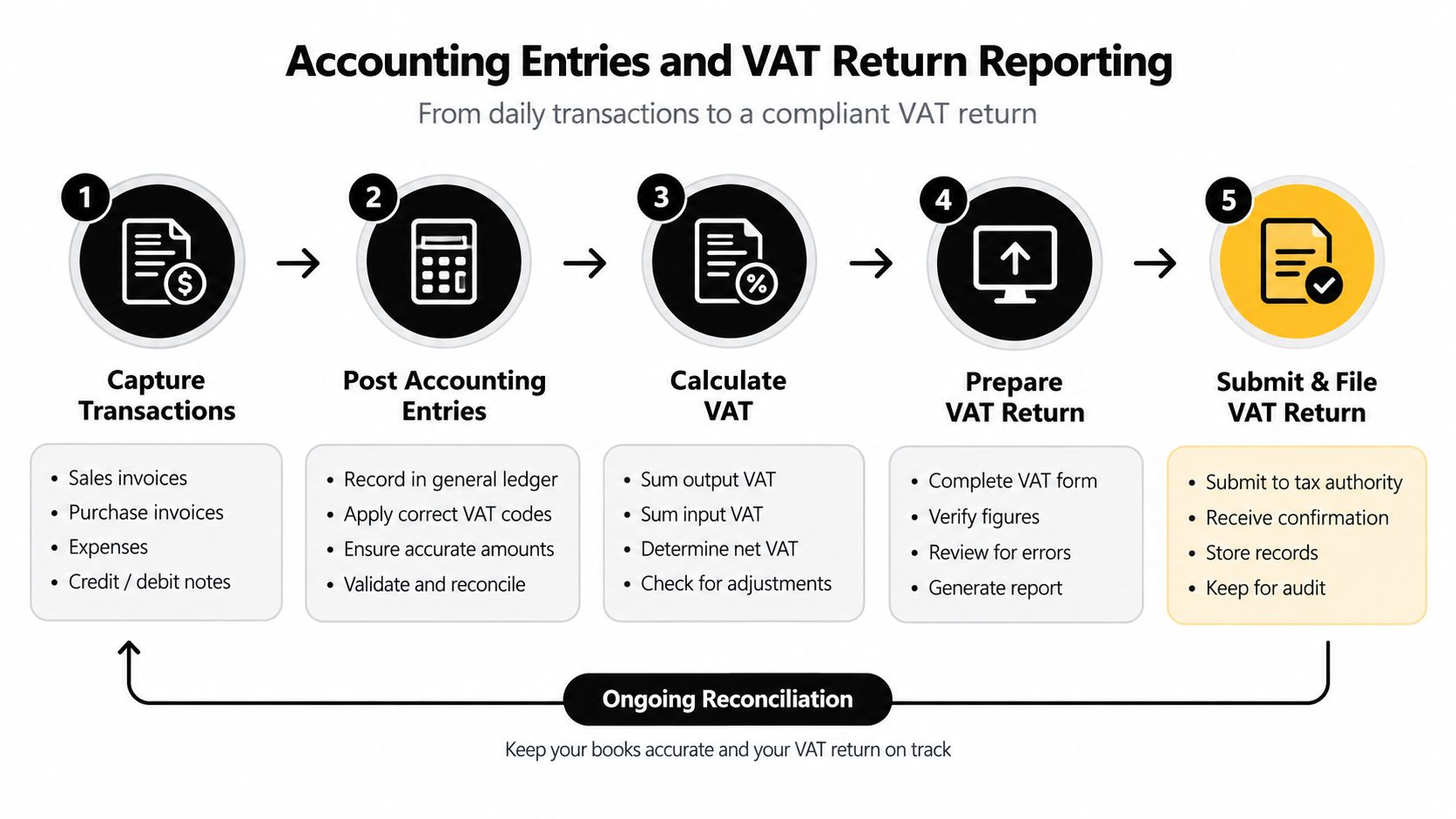
Accounting Entries and VAT Return Reporting
Reverse charge accounting has two sides because the recipient is both the party responsible for output VAT and, where eligible, the party claiming input VAT recovery. The entries can offset each other, but that doesn't remove the reporting obligation. A business that records only the input side may understate its VAT liability even if the eventual net cash position would have been neutral.
A workable posting sequence
Identify the taxable base. Start with the value of the imported service or designated domestic supply. Use the contract, supplier invoice, credit notes, and any related charges to establish what the supply includes.
Calculate the applicable UAE VAT. Apply the correct VAT treatment to the taxable value. Don't use a default rate without checking whether the supply is taxable, exempt, or subject to a different rule.
Post output VAT. The recipient's ledger should create a clear output tax entry for the amount due under reverse charge. This is the liability that would otherwise have been collected by the supplier.
Post recoverable input VAT separately. If the purchase supports taxable business activities and meets the normal input tax recovery conditions, record the recoverable amount in the input VAT account. If recovery is restricted, the non-recoverable portion must remain a business cost rather than being treated as an automatic offset.
Reconcile before filing. Match the purchase ledger, reverse charge schedule, general ledger, and VAT return. The review should identify missing overseas invoices, duplicate postings, credit notes, and entries where output VAT exists without a corresponding recovery assessment.
The VAT return connection
The FTA's VAT Returns User Guide states that reverse charge supplies are declared in Box 3, including imported services where the customer must account for VAT. That makes Box 3 a key control point for imported-service reviews.
The accounting system should distinguish reverse charge output VAT from ordinary supplier-charged VAT. A useful schedule can include the supplier name, country, invoice date, supply description, taxable value, VAT treatment, output tax, input recovery decision, and supporting-file reference. This creates a direct trail from the source invoice to the return.
Businesses should also configure their accounting software to flag overseas suppliers and designated domestic commodities. A blank VAT line on an invoice isn't proof that no VAT is due. It should trigger a tax review, particularly for recurring subscriptions, overseas professional services, digital advertising, and purchases connected with the designated domestic sectors.
For assistance with the return preparation and reconciliation process, businesses can review VAT filing services in the UAE. The important control isn't a particular software brand. It's the consistent connection between transaction classification, ledger entries, Box 3 reporting, and retained evidence.
Documentation and Invoice Requirements
Reverse charge transactions need a stronger audit file because the supplier may not issue a UAE VAT invoice. The recipient has to demonstrate why it applied the mechanism, how it calculated the tax, and why any input VAT claim was recoverable.
A complete file should be organised around the transaction rather than scattered across procurement, customs, and finance folders.
What the file should contain
- Commercial evidence: Keep the supplier invoice, purchase order, contract, statement of work, and payment record.
- Tax analysis: Record the supplier's residence, the place-of-supply conclusion, the taxable treatment, and the reason reverse charge applies.
- VAT evidence: Retain the calculation, ledger posting, VAT return working, and reconciliation to Box 3.
- Recovery support: Document how the purchase relates to taxable business activity and identify any restricted or non-recoverable input tax.
- Domestic verification: For a designated local supply, retain the relevant written declaration, VAT registration check, commodity assessment, and invoice statement.
- Import evidence: For goods, preserve customs declarations, clearance documents, and proof of any import VAT paid.
The 2026 documentation workflow has changed. The Ministry of Finance announced that Federal Decree-Law No. 16 of 2025 takes effect on 1 January 2026 and removes the need to issue self-invoices when applying reverse charge, while still requiring businesses to retain supporting documents. The Ministry of Finance announcement on the 2026 VAT amendments should be read alongside the business's transaction records and current FTA guidance.
Invoice controls for domestic schemes
Removing the self-invoice requirement doesn't mean removing the audit trail. For domestic scrap-metal and qualifying electronic-device supplies, the buyer and seller should agree the required documentation before the purchase is completed. The invoice should contain the statement required by the applicable rule, and the buyer should confirm that the supplier and recipient meet the relevant registration conditions.
A procurement team shouldn't approve a domestic reverse charge invoice based on a product label alone. The team should verify the legal category, the parties' VAT status, the purpose of the purchase, and the required declaration. If the transaction falls outside the designated conditions, ordinary VAT treatment may apply.
Supporting documents now do the work that businesses may previously have associated with a self-invoice. Retain them in a file that an independent reviewer can understand without relying on verbal explanations.
Common Compliance Risks and FTA Penalties
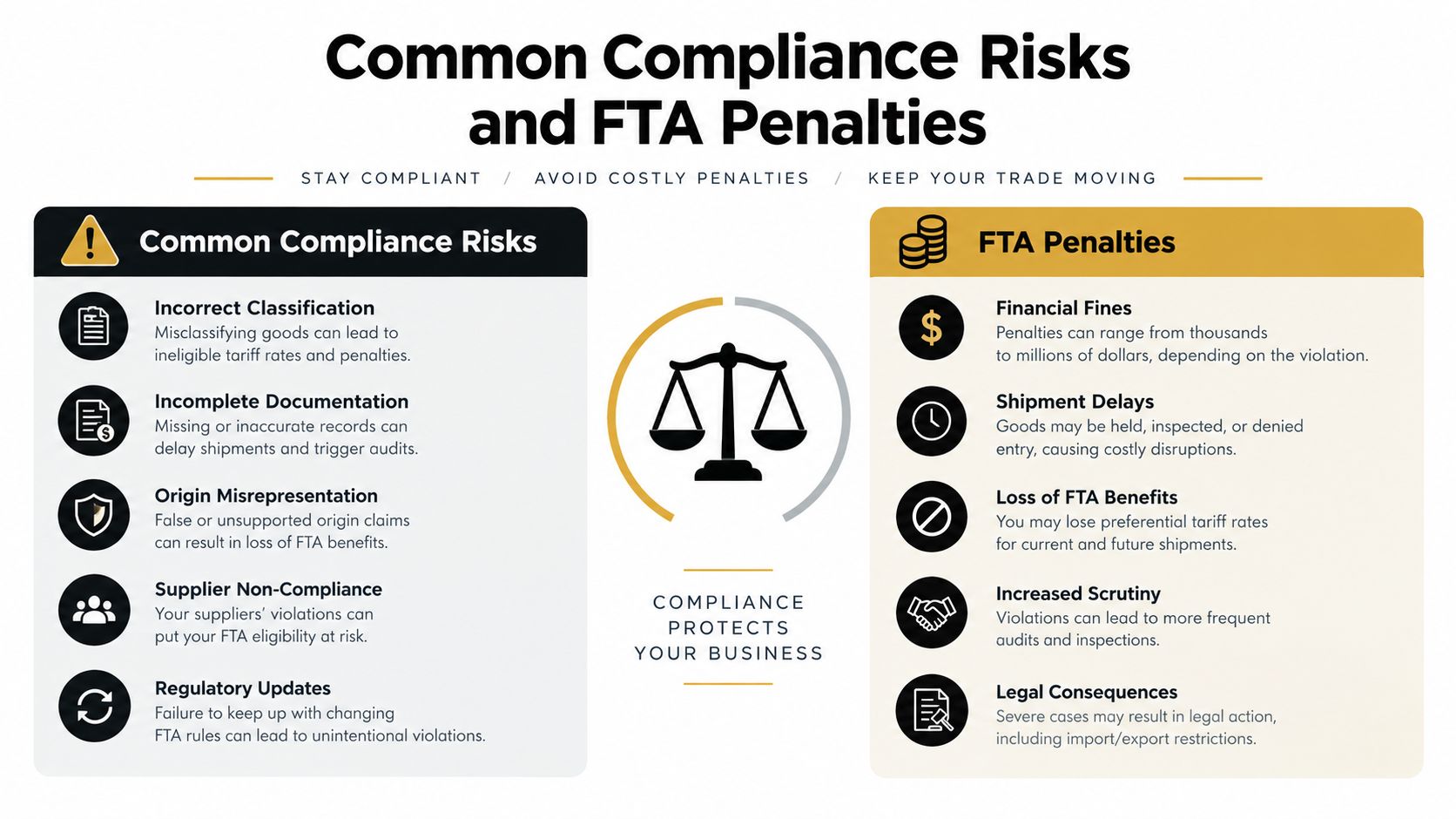
The most damaging reverse charge errors usually begin as workflow assumptions. A buyer sees no VAT on an invoice and posts the cost as if the transaction has no UAE VAT consequence. A customs team assumes the previous import facility still applies. A trader applies domestic reverse charge without checking whether the buyer is registered or whether the goods qualify.
Each failure creates a different risk.
Where businesses lose control
Customs assumptions: The FTA says it stopped the facility to declare VAT under reverse charge for imported goods under Article 48, meaning import VAT must be paid in cash before customs clearance. A business that budgets only the supplier payment may face an unexpected funding requirement at the port.
Incomplete supplier checks: An overseas supplier may not automatically create reverse charge, and a UAE supplier may not automatically qualify for a domestic sector rule. The buyer needs evidence for the supplier's status and the transaction's legal category.
One-sided accounting: Posting input VAT without output VAT understates the amount due. Posting output VAT without checking recoverability can also distort the business's cash-flow forecast.
Weak commodity classification: Scrap metal and electronic devices have sector-specific conditions. Procurement descriptions, stock codes, and commercial labels should match the VAT analysis.
Missing records: A business may have applied the right treatment but still struggle during an FTA review if it can't produce the invoice, contract, registration evidence, declaration, calculation, and return reconciliation.
A risk-control response
Build the review into accounts payable. Add a mandatory tax classification field for overseas suppliers and designated domestic goods, require a supporting-document reference before posting, and reconcile the reverse charge schedule to the VAT return before submission. If a transaction was missed or incorrectly classified, investigate promptly and determine the appropriate correction route with a qualified adviser or the FTA.
Penalties can arise from incorrect declarations, late payment, inadequate records, or failure to meet the conditions of a sector-specific mechanism. The amount and treatment depend on the relevant violation and circumstances, so businesses shouldn't rely on generic penalty tables copied from older articles. A documented correction process is more useful than assuming that a net-zero accounting result eliminates exposure.
Streamlining VAT Compliance with Smart Classic
The 2026 shift requires coordination between tax, procurement, customs, accounts payable, and management. A VAT return preparer working from the ledger alone may not know that a shipment required cash payment before clearance, that a scrap-metal supplier lacked the necessary registration status, or that an electronic-device purchase was for a purpose outside the qualifying rule.
Smart Classic Business Hub can support UAE businesses with VAT-compliant accounting, bookkeeping, VAT return preparation, audit-file organisation, and corporate finance advisory. Its Dubai-based consultancy work can also connect tax compliance with wider business needs such as company formation, tax residency documentation, financial management, and planning.
For reverse charge, the practical scope should be defined before engagement. Businesses may need a review of overseas supplier invoices, a reverse charge schedule, accounting-policy updates, invoice templates, domestic-sector declarations, or reconciliation procedures. They may also need help separating customs import VAT from recipient-accounted imported services so that the same transaction isn't processed twice.
A sensible implementation starts with a transaction map. List the business's overseas services, physical imports, scrap-metal purchases, electronic-device transactions, and other potentially designated supplies. Then assign an owner for supplier verification, VAT classification, document retention, return reporting, and final review. This is more dependable than asking the finance team to identify every reverse charge transaction at the end of the tax period.
Smart Classic Business Hub offers VAT-compliant accounting, reverse charge transaction reviews, VAT filing support, and audit-ready documentation for UAE businesses managing imported services and designated domestic supplies. Visit Smart Classic Business Hub to discuss your current workflow and align it with the 2026 VAT changes.