
You've renewed the trade licence for your Business Bay café, paid the premises costs and organised the staff rota. Then a late VAT-return penalty appears. In this hypothetical situation, the owner hasn't ignored the business. They've mistaken a completed renewal for a completed compliance cycle.
That's the practical problem with buying regulatory compliance services in Dubai as a generic package. You need to know which obligations apply, who handles each deadline and what evidence you'll receive when the work is done. The monthly fee matters, but so does the cost of work that nobody realised was excluded.
Why Compliance in Dubai Is Ongoing Maintenance, Not a Licence
A trade licence permits a business to operate within its authorised activities. It does not file tax returns, update ownership records or maintain required financial-crime controls. Treating licence renewal as the whole compliance cycle leaves obligations without an owner or deadline.
For a Dubai SME, compliance is recurring work across separate areas. Licensing and renewals keep permissions current; PRO transactions handle government-facing administration; and corporate records document ownership, control and governance. Where AML and counter-terrorism financing rules apply, businesses must also maintain the relevant controls. Tax reporting links bookkeeping to registrations, returns and payments.

The UAE's 5% VAT regime took effect on 1 January 2018. Eligible businesses must assess registration, issue compliant invoices, keep transaction records, file periodic returns, pay amounts due and retain documents under the UAE VAT legislation. Bookkeeping supports these obligations, not just internal reporting.
Corporate Tax has a separate registration process. VAT registration does not fulfil Corporate Tax registration, and not being VAT-registered does not determine a company's Corporate Tax obligations. Check each tax position separately, then assign responsibility for filings and payments. A licence alone says nothing about whether those tasks are on schedule.
The practical test is whether each obligation has a deadline, an accountable person and evidence of completion. A service arrangement should identify all three. Otherwise, work can fall between the business and its provider, and a missed deadline may bring penalties or disrupt cash flow.
Practical rule: Manage compliance as recurring work, not a certificate you buy.
The FTA's Corporate Tax registration announcement reflects the scale of Corporate Tax filing activity, but it does not establish a business's own obligations. Check the rules that apply to your company and keep the related tasks on a working schedule.
Six Compliance Services Dubai Businesses Buy and What Each Covers
The core purchase is defined work with a verifiable deliverable. A provider saying it handles compliance isn't enough. Ask which service families it covers and what it will hand back.
Compliance service families in Dubai
| Service | What it covers | Who usually needs it | Typical deliverable |
|---|---|---|---|
| Licensing and renewals | Trade or activity licence applications, amendments, renewals and relevant permits | New founders and businesses changing activity | Valid licence and renewal calendar |
| PRO services | Government transactions involving visas, Emirates ID, labour or municipality filings | Companies with staff or frequent government transactions | Filed transactions and official receipts |
| AML and CTF compliance | Risk assessment, customer due diligence, beneficial-owner checks and suspicious-transaction reporting where applicable | DNFBPs, including real-estate brokers, corporate service providers, auditors and precious-metals businesses | Written risk assessment and customer due diligence files |
| Corporate secretarial | Applicable registers, UBO updates, resolutions, share transfers and corporate filings | Businesses with ownership or governance changes | Updated registers and signed corporate records |
| Tax and reporting | VAT and Corporate Tax registration, invoices, returns, reconciliations and payment scheduling | Businesses assessing or managing tax obligations, including relief eligibility | Filed returns, reconciliation reports and payment records |
| Industry-specific compliance | Applicable virtual-asset, food-safety, real-estate, healthcare or professional requirements | Businesses operating in regulated activities | Relevant approvals and reporting schedule |
Use this as a scope map, not a declaration that every row applies to every company. Industry permissions and filing requirements need checking against the actual activity and licensing authority.
Where buyers misunderstand the scope
PRO support and AML work can involve some of the same documents, but they serve different purposes. A provider that processes government transactions hasn't necessarily assessed customer risk or reviewed the controls needed for a regulated activity.
Likewise, an active licence doesn't establish that corporate ownership records reflect a recent share transfer. The question isn't whether somebody holds the paperwork. It's whether the relevant records were reviewed, updated and submitted where required.
Consider contrasting service needs:
- A free-zone freelancer might need tax-status assessment, registration support and bookkeeping rather than an extensive administrative retainer. That conclusion still depends on their activity and circumstances.
- A property brokerage needs a scope that addresses its AML exposure, ownership records and applicable sector obligations, not merely licence renewal.
For the accounting component, compare VAT services in Dubai by their reconciliation and review deliverables, not just whether return submission appears in the package name.
Before requesting quotes, mark each service family as applicable, not applicable or requiring assessment. That gives providers the same starting point and makes exclusions easier to spot. Buying everything isn't automatically safer; buying an undefined package is harder to control.
What Missed Deadlines Cost in Penalties and Cash Flow
A missed Corporate Tax filing can cost money for every month it remains outstanding. Late payment creates a separate exposure, while missing records can create another problem altogether. Paying a penalty doesn't complete the underlying work.
Penalties for missed UAE tax obligations
| Obligation | Trigger | Penalty |
|---|---|---|
| Corporate Tax late filing | Each month or part of a month during the first 12 months | AED 500 per month |
| Corporate Tax late filing | Each month from the 13th month | AED 1,000 per month |
| Corporate Tax late payment | Unsettled tax, charged monthly | Calculated at 14% per annum on the unsettled amount |
| Corporate Tax records | Prescribed records not maintained | AED 10,000 per violation |
| Corporate Tax records | Repeat violation within 24 months | AED 20,000 |
| VAT late return | First occurrence | AED 1,000 |
| VAT late return | Repeated occurrence within 24 months | AED 2,000 |
| VAT late payment | Unpaid VAT under the cited guidance | Can accumulate up to 300% of unpaid tax |
The Corporate Tax amounts above should be checked alongside the FTA's Corporate Tax guidance, while the VAT amounts reflect the cited FTA VAT returns guidance. Confirm the currently applicable penalty rules before budgeting or calculating a liability, particularly when using older guidance.
The cash-flow problem is straightforward. A business may need to fund the original tax, administrative penalties and remedial accounting work at the same time. A low routine service fee offers little comfort if the engagement excluded deadline monitoring or payment reminders.
Recover in the right order
If you're already late, focus on completing the outstanding obligation rather than debating the next annual package.
- Reconcile and file. Complete the overdue return as soon as the figures can be supported. Don't submit estimates merely to make the task disappear.
- Address unpaid tax. Confirm the principal liability and arrange settlement promptly to limit further late-payment exposure.
- Repair the evidence. Identify missing prescribed records and reconstruct them from reliable invoices, statements and other supporting documents.
- Assign prevention tasks. Put the recurring checklist into a shared calendar with a named person responsible for each deadline.
Use a Corporate Tax filing-deadline review to establish the correct timetable for your business, rather than borrowing another company's dates.
Compare the service fee with the cost of an unmanaged deadline, not with the price of submitting a form.
A useful recovery engagement ends with a documented outstanding-items list. Otherwise, the founder may assume the problem is resolved when only the return has been filed.
Where AML and Beneficial-Owner Rules Reach Ordinary Businesses
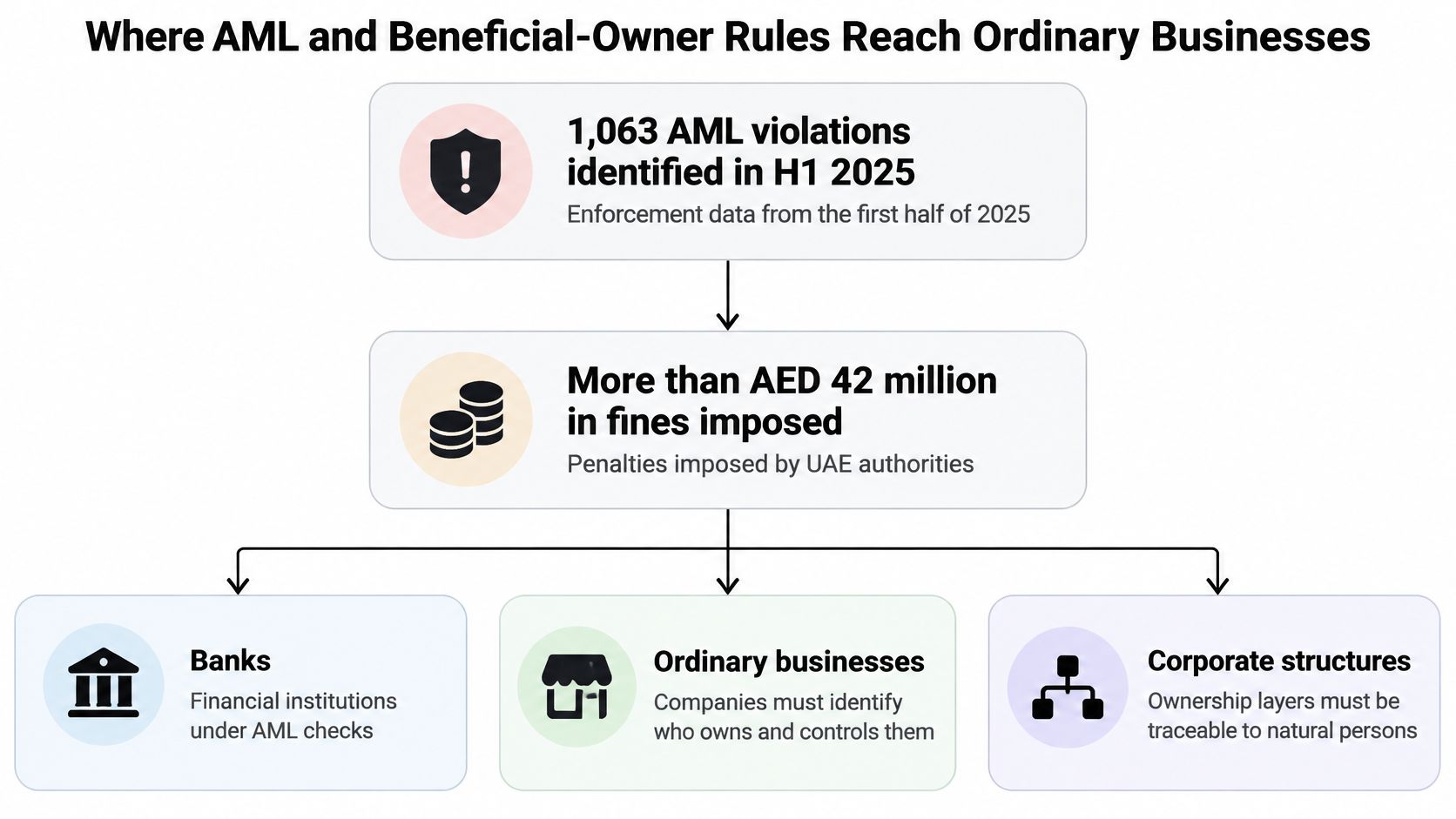
A small property brokerage completes a sale, while a corporate-services firm onboards a new client. Both may have AML obligations, even though neither is a bank. In the first half of 2025, UAE authorities identified 1,063 AML violations and imposed more than AED 42 million in fines. Real-estate brokerages accounted for 495 violations and AED 18.5 million, while corporate service providers and auditors received 95 penalties worth more than AED 4 million, according to the Ministry's AML inspection results.
Test the activity, not the company's size
The misconception that only banks need AML controls can leave ordinary SMEs exposed. Designated non-financial businesses and professions, commonly called DNFBPs, include real-estate brokerage, corporate services, auditing and precious-metals businesses. A small team or modest office does not determine whether the rules apply. The business's actual activities do.
- What do you do in practice? Compare services delivered with the relevant regulated categories, not just the wording on your website.
- Who are your customers? Consider whether you serve individuals, corporate structures or intermediaries.
- What evidence exists? Check that customer acceptance decisions and ownership checks are recorded.
- Who reviews concerns? Assign responsibility for assessing unusual activity and deciding whether escalation or reporting is required.
The controls should match the business's risks and customer base. A copied policy that does not reflect how the firm operates is unlikely to guide staff through a real decision.
Ownership checks need a traceable record
Under the UAE's Cabinet Decision No. 58 of 2020 on the Regulation of the Procedures of the Real Beneficiary, a person holding 25% or more of shares or voting rights, or exercising equivalent control, may qualify as a real beneficiary. Earlier official reporting recorded 89% disclosure coverage by July 2021 under the UAE beneficial-ownership programme.
Keep identity documents, ownership charts and a record of how control was established. Where an AML programme applies, link those records to customer due diligence and a proportionate risk assessment.
Suspicious-transaction reporting requires a defined review and escalation process under the applicable rules. An unusual transaction is not automatically reportable, and a salesperson should not dismiss a concern without review.
When comparing AML compliance support, ask the provider to show how a customer file moves from onboarding through risk review and escalation. A usable process helps staff apply controls; a folder of unused policies does not.
In-House, Outsourced or Hybrid Compliance Delivery
| Model | Best for | Cost pattern | Main risk |
|---|---|---|---|
| In-house compliance officer | Daily control needs and regulated activity | Salary, benefits and software | Dependence on an individual and gaps in specialist expertise |
| Full outsourced retainer | Early-stage SMEs with manageable transaction volumes | Recurring fee for an agreed service scope | Vendor dependency and vague exclusions |
| Project-based engagement | Setup, a defined review or liquidation work | Fixed or scoped project fee | Recurring tasks lapse after the project ends |
| Hybrid model | Growing SMEs with an established finance team | Internal staffing plus external specialist fees | Coordination overhead and unclear task ownership |
The right model depends on the work that must happen between filings. Outsourcing can give a founder access to specialist review without building an internal department, but it won't fix invoices that staff never submit. An internal employee offers closer access to transactions, but shouldn't be expected to resolve every specialist tax and AML question alone.
Low revenue isn't a delivery strategy
Small Business Relief applies where revenue is AED 3 million or less in the current and all previous tax periods, subject to applicable conditions. The 0% Corporate Tax band on taxable income up to AED 375,000 is a different concept, and neither should be treated as a blanket exemption from registration, records or filing; eligibility and available support should be checked through the FTA's Corporate Tax topics and guidance.
Before relying on relief, work through a decision sequence:
- Establish revenue history. Use accounting records for the relevant periods, not a rough bank-balance estimate.
- Check eligibility conditions. Review connected-person issues, free-zone status and any applicable restrictions or availability dates.
- Confirm the compliance steps. Determine registration, return and recordkeeping requirements separately from tax payable.
- Document the conclusion. Retain the calculation and the basis for claiming relief.
The FTA's Muwafaq Package includes SME-oriented assistance with registration, specialist support, affordable tax-accounting options and prioritised application processing. Explore that support before assuming the only choices are unsupported self-filing or an extensive retainer.
Delivery judgement: Keep routine work close to the people generating the records. Buy specialist review where mistakes require specialist knowledge to detect.
A single-owner business with straightforward transactions can consider a limited retainer. A company with finance staff and regulated activity should assess a hybrid arrangement: internal bookkeeping, external tax review and suitably qualified AML support. Neither is a universal answer.
What Drives Compliance Fees and What to Ask Providers
There's no meaningful universal price for compliance. A quote for clean bookkeeping and scheduled returns isn't comparable with a quote that includes historic corrections, ownership restructuring and customer-risk reviews.
Use the following questions to compare the work rather than the headline total.
Cost drivers and questions to ask providers
| Cost driver | How it moves the price | What to ask the provider |
|---|---|---|
| Legal structure | Different authorities and structures change the required submissions and coordination | Which authorities, entities and government charges does the quote cover? |
| Regulated activity | Sector approvals and deeper AML work expand the scope | Which AML tasks are included, and when are they repeated? |
| Transaction volume | More invoices and bank entries require more processing and reconciliation | Is pricing monthly, tiered or transaction-based? |
| Filing frequency | Additional returns require additional preparation and review | What is charged per return, amendment or correction? |
| Headcount and visas | Employee-related government transactions add administrative work | Can you provide an itemised transaction price list? |
| Ownership complexity | Layered ownership and changes require additional verification and updates | What does corporate secretarial work include? |
| Urgency and clean-up | Historic reconstruction and rushed work need separate scoping | Will you obtain approval before starting remedial work? |
| Government fees | Authority charges should be distinguished from professional charges | Are government fees included, estimated or excluded? |
Avoid assuming mainland work always costs more than free-zone work. The relevant comparison is the actual authority, activity, structure and required deliverables.
Why apparently similar quotes differ
Consider a hypothetical company comparing proposals. One includes bookkeeping and return preparation but excludes government fees, historic corrections and the AML risk assessment. Another includes those tasks, so its headline price looks higher.
The cheaper proposal may still be appropriate if the excluded work isn't needed. The problem arises when the buyer assumes both proposals cover the same obligations.
Ask each provider to classify charges as included, excluded or conditional. For conditional work, agree what triggers an extra fee and who must approve it.
A useful quote also explains what the client must supply. If the service assumes reconciled opening balances and organised invoices, say so before signing rather than discovering a clean-up charge during onboarding.
Don't use unverified fee bands to set the budget. Request an itemised proposal tied to your documents, workload and outstanding issues, with official charges separated from professional fees and supported by receipts where applicable.
A Recurring Compliance Checklist for Dubai Companies
Use this as an operating template, then adapt it to your registrations, authority requirements and assigned tax periods. The suggested owners are roles, not a requirement to hire separate people.

Monthly financial control
- Reconcile the ledger. Match sales, purchases, bank movements and tax invoices. Owner: bookkeeper.
- Resolve document gaps. Request missing invoices and investigate unmatched entries before they enter a return. Owner: finance lead.
- Prepare the pre-file review. Maintain a review pack so return preparation doesn't begin with an unstructured document search. Owner: tax preparer.
- Forecast tax funding. Identify expected liabilities and arrange funds before payment is due. Owner: business owner or finance manager.
A monthly review should produce an exceptions list, not just a set of reports. An unexplained balance needs a named person and a resolution date.
Each assigned VAT period
- Review supply classifications. Check taxable, zero-rated, exempt and out-of-scope treatment against the underlying transactions. Owner: VAT reviewer.
- Assess input-tax recovery. Retain the evidence supporting the treatment adopted. Owner: VAT reviewer.
- Approve and submit. Complete the reconciliation, authorise the return and retain submission confirmation. Owner: authorised filer.
- Pay and verify. Check payment completion rather than relying solely on an instruction to the bank. Owner: payment approver.
Use the return period assigned to the business. A monthly accounting rhythm doesn't mean every company has a monthly VAT filing obligation.
Annual and renewal-cycle work
- Review licence renewals. Start preparation before the applicable expiry date. Owner: administration lead.
- Prepare year-end reporting. Assemble financial statements and the Corporate Tax review pack. Owner: finance lead.
- Check retained records. Confirm supporting documents remain accessible and complete. Owner: records custodian.
- Review ownership and AML records. Confirm the UBO position and reassess applicable AML risks. Owner: governance or compliance lead.
Event-driven updates
- Assess corporate changes. Check notification requirements when ownership, address, activity, manager or share capital changes. Owner: corporate administrator.
- Reassess new business risks. Review a new customer type, service or operating arrangement before relying on existing controls. Owner: compliance lead.
- Update access and handovers. Adjust document permissions and task ownership when staff or providers change. Owner: business owner.
Keep a single compliance calendar and give every item a named accountable person. Store completion evidence alongside the task so a tick means the work can be demonstrated.
Pick a Compliance Partner Before Your Next Deadline
Choose the partner that can demonstrate control over your actual obligations, not the one with the longest service list. The strongest buying decision comes from testing how the provider handles documents, exceptions, approvals and handovers.

Test the people and the process
- Verify the firm and relevant credentials. Confirm its registration and who will perform the proposed work. Where tax-agent representation is offered, check the relevant registration rather than assuming any filing service has that status.
- Obtain a written responsibility map. List the service families, deliverables, exclusions, client inputs and approval responsibilities. Avoid descriptions that promise support without specifying outputs.
- Meet the account lead. Ask who answers technical questions, who handles absences and who escalates unresolved items. A shared inbox isn't a substitute for accountability.
- Test relevant AML experience. If you're a DNFBP, ask how the team would assess a sample customer file and document its decision. General administrative experience doesn't establish competence in risk assessment.
- Require itemised pricing. Separate professional fees, government charges and conditional work. Agree how additional work gets authorised.
- Check document custody. Establish where records are stored, who can access them and how you retrieve a complete copy. Your operational continuity shouldn't depend on a provider's goodwill.
- Agree response and exit terms. Record escalation arrangements, handover obligations and how unfinished work will be identified when the engagement ends.
A provider offering company formation, PRO support, tax residency certificates, VAT-compliant accounting, audit and liquidation may be convenient because related work sits under a broad service umbrella. That breadth is a starting point for questions, not proof that every task is included or performed by the same team.
Ask for evidence before committing
Request an anonymised example of a reconciliation pack, a completion checklist or a document-request schedule. The provider should be able to explain what you receive without disclosing another client's confidential information.
Also ask how it handles disagreement. If an invoice lacks support or a proposed treatment needs further review, you want a clear written exception and escalation route, not an unsupported assurance that everything is fine.
This week, map your obligations against the checklist, send the same scope to a shortlist of providers and compare their itemised responses. Then book a consultation before your next filing deadline, leaving time to resolve missing records rather than buying an emergency submission.
Smart Classic Business Hub offers company formation, PRO support, tax residency certificates, VAT-compliant accounting, audit and liquidation services from its Baniyas Square office in Dubai. Visit Smart Classic Business Hub to request a consultation, bring your licence, registration details and outstanding notices, and ask for an itemised compliance scope before your next deadline.