
When it comes to UAE corporate tax, there’s one number you absolutely must remember: nine.
Your corporate tax filing deadline is exactly nine months after your company's financial year ends. This isn't just for filing the paperwork; it's for paying any tax you owe, too. It’s a single, critical date that locks in your compliance for the year.
Decoding Your Corporate Tax Timeline
Getting your head around this nine-month rule is the first step to staying on the right side of the tax authorities. Just think of your financial year-end as the starting pistol. The moment it passes, the nine-month countdown begins.
For most businesses in the UAE, this is pretty straightforward. If you run on a standard calendar year (1 January to 31 December), your dates are predictable. For instance, if your financial year wrapped up on 31 December 2024, you have until 30 September 2025 to file your return and settle the payment.
It’s a simple calculation, but there's no wiggle room. The Federal Tax Authority (FTA) is clear: all submissions and payments must go through their digital platform, EmaraTax, by that final day.
The Nine-Month Rule Visualised
This simple timeline shows how the clock starts ticking right after your financial year-end, leading straight to your deadline.
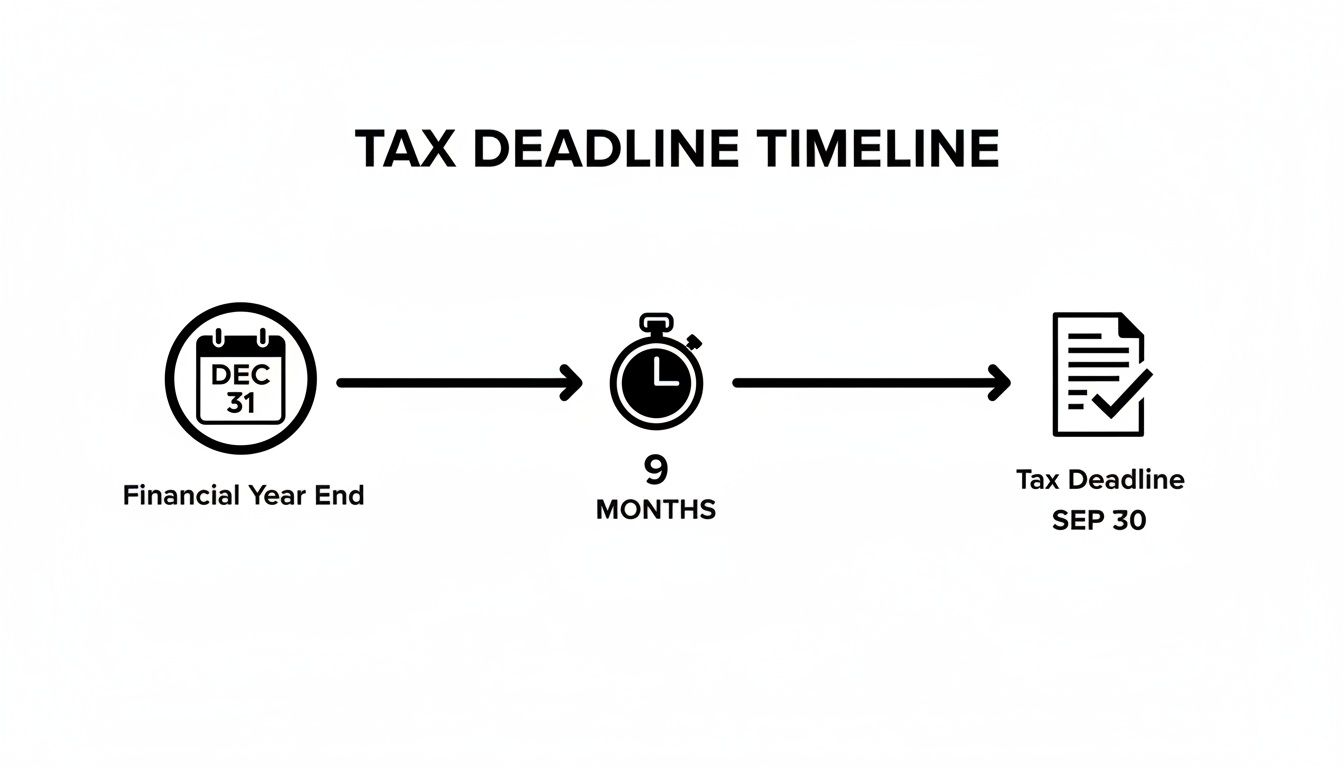
As you can see, the process is linear. Once your books for the year are closed, you have a set window to get everything in order.
How to Calculate Your 2026 Corporate Tax Deadline
Because not every company follows a standard calendar year, the deadline can fall at different times. This table breaks down how the nine-month rule applies to various financial year-end dates, helping you pinpoint your exact deadline.
| If Your Financial Year Ends On | Your Tax Filing and Payment Deadline Is |
|---|---|
| 31 December 2025 | 30 September 2026 |
| 31 March 2026 | 31 December 2026 |
| 30 June 2026 | 31 March 2027 |
| 30 September 2026 | 30 June 2027 |
Finding your deadline is as simple as finding your year-end date in the first column. The corresponding date in the second column is your target.
Why This Deadline Matters
The nine-month window isn't a grace period; it's your designated timeframe to get organised. It's meant to give you enough time to finalise your financial statements, calculate your taxable income correctly, and prepare an accurate tax return. The deadline is absolute.
A common slip-up we see is business owners assuming they can file on the deadline and pay later. Under the UAE's system, the due date is for both. Missing this single deadline can trigger immediate financial penalties.
This unified approach actually simplifies things by giving every company one clear target. Once you understand what corporate tax is in the UAE and how this timeline applies to your specific business cycle, tax season stops being a last-minute scramble. It becomes just another predictable part of running your business smoothly and staying in good standing with the FTA.
The Three Pillars of Tax Compliance

Getting your corporate tax right involves more than just circling one date on the calendar. Real compliance is built on three crucial pillars: Registration, Filing, and Payment. Each stage has its own unique deadline and rules. A slip-up in one can trigger a domino effect, quickly putting you on the wrong side of the Federal Tax Authority (FTA).
It’s a bit like building a house. Registration is your foundation—it has to be solid and done first. Filing is putting up the walls and roof. And payment? That's what secures the entire structure. You just can't skip a step or do them in the wrong order without creating some serious issues.
Pillar 1: Your Registration Deadline
Before you can even think about submitting a tax return, your company must be officially registered for corporate tax. This is the first, non-negotiable step. The deadline here is a bit tricky because it isn’t tied to your financial year-end. Instead, the clock often starts ticking the moment you get your business licence.
Missing this initial deadline is a common trap, especially for new businesses. A startup that launches in March might mistakenly think they have until after their first full financial year to register. The reality is their registration window could close much, much sooner, landing them with penalties before they've even earned enough to file a return.
The rule is straightforward: you must register before you can file. If you don't, your business is technically non-compliant from day one. This not only attracts penalties but makes the actual filing process a whole lot messier.
Pillar 2: The Filing Deadline
This is the deadline most business owners know about: you have nine months after your financial year ends to submit your tax return through the EmaraTax portal. This is your window to get all your financial documents in order, comb through your accounts, and calculate your taxable income correctly.
Let's look at two different businesses:
- Company A (Established): They run on a standard 1 January to 31 December financial year. For them, the filing deadline is always 30 September of the following year. Simple.
- Company B (New Business): They incorporated on 1 July and picked a 30 June year-end. Their first tax period might be shorter or longer than 12 months, but that nine-month filing rule still applies from their first year-end.
This standardised timeline became a major landmark for UAE businesses. The country's very first corporate tax filing deadline on 30 September 2025, was the final day for businesses whose financial years started on 1 June 2023. For the vast majority of companies with a calendar year from 1 January to 31 December 2024, the law is crystal clear: you have exactly nine months from your period-end to file. You can read more about this strict framework, which offers very few exceptions.
Pillar 3: The Payment Deadline
Now let's bust a dangerous myth. There is absolutely no grace period for payment. The deadline to pay your corporate tax bill is the exact same day as your filing deadline. The two actions happen together. They are not separate events.
This is a huge difference from tax systems in other countries, where you might get extra time to pay after you file. Here in the UAE, filing and payment are two sides of the same coin, due at precisely the same time.
This unified deadline actually simplifies things by giving you one single date to aim for. On or before that nine-month mark, you must have your return submitted and the FTA must have your full payment. Treating these as separate tasks is a surefire way to get hit with late payment penalties, which start adding up the very next day.
Managing Extensions and Correcting Mistakes
Even the most organised business can hit a snag. Knowing how to handle these bumps in the road is crucial for keeping your relationship with the Federal Tax Authority (FTA) on solid ground. Whether you need a bit more time or have to fix a mistake on a past return, the UAE tax system has clear pathways to follow.
Think of it like this: your corporate tax filing is a journey with a set destination and deadline. Usually, the path is clear. But what if a storm hits, or you realise you made a wrong turn earlier? You need to know how to communicate with the authorities to get back on track without causing bigger problems.
This section breaks down the official steps for those "what if" scenarios: requesting a filing extension (which is rare), correcting an error with a voluntary disclosure, and getting a formal opinion when you hit a grey area in the tax rules. Master these, and you can manage your tax obligations with confidence, even when things don't go exactly to plan.
Securing a Corporate Tax Filing Extension
First things first, let's be crystal clear: getting a filing extension is an exception, not a right. This isn't like other countries where extensions are almost automatic. The FTA only grants them in very specific, highly justifiable situations. You can't just ask for one because you're behind on your paperwork.
To even be considered, you have to submit a formal request to the FTA through the EmaraTax portal before your original filing deadline is up. And your reason needs to be rock-solid.
What counts as a valid reason? We're talking about serious, unavoidable circumstances, such as:
- A major unforeseen disaster: Think a fire or flood that wipes out your financial records right before the deadline.
- Sudden, serious illness: The incapacitation of a key person responsible for the tax filing, like your finance director.
- Massive corporate changes: A significant, last-minute merger or demerger that genuinely makes finalising the accounts impossible on time.
The FTA reviews each case individually, and approval is far from guaranteed. The best policy is to always work as if your original nine-month deadline is immovable.
Correcting an Error with a Voluntary Disclosure
So, you've filed your return, and then it hits you—you made a mistake. What now? The FTA has a formal process for this exact situation called a Voluntary Disclosure. This is the only official way to fix errors or omissions in a tax return you've already submitted.
Filing a Voluntary Disclosure is a sign of good faith. It tells the FTA you're committed to getting things right. The key is to act fast—you must submit the disclosure as soon as you spot the error, which is generally expected within 20 business days.
By coming forward and proactively correcting the record, you can often reduce or completely avoid the tough penalties that would apply if the FTA found the mistake during an audit. It’s always, always better for you to report a mistake than for them to discover it.
Seeking Clarity on Ambiguous Tax Issues
Sometimes, the tax law doesn't perfectly fit your unique business scenario. When you're in a grey area, guessing is a risky strategy. Instead, you can formally ask the FTA for their official take by submitting a Clarification Request.
This is an incredibly useful tool for businesses dealing with complex or unusual transactions. You lay out your specific situation and your question to the FTA, and they provide a binding written opinion. This gives you certainty and a defensible position, protecting you from potential penalties down the line. It's how you turn ambiguity into compliant, confident action.
The Real Cost of Missing a Deadline

Let's be clear: ignoring corporate tax deadlines in the UAE isn't a minor slip-up. It's a direct path to financial penalties that will eat into your profits and can seriously tarnish your business's reputation. The Federal Tax Authority (FTA) has a very clear penalty structure, making sure non-compliance has a real, tangible cost.
These penalties aren't there just to be punitive. They're designed to keep the system fair and maintain its integrity for every business operating here. Think of them less as a punishment and more like the late fees on a critical business loan—a financial consequence for not holding up your end of the deal. The ultimate goal is to encourage everyone to stay on schedule.
A Breakdown of Administrative Penalties
When you miss a deadline, the penalties generally hit you in three ways. Each one targets a different part of the non-compliance journey, from failing to register in the first place to delaying your actual payment.
Knowing what you're up against is the first step to avoiding these costs. Here’s a look at what you could be facing:
Late Registration Penalty: This is the first hurdle where many businesses stumble. If you fail to register for corporate tax within the FTA's specified timeframes, you're looking at a fixed fine of AED 10,000. That's a hefty price to pay before you've even filed a single return.
Late Filing Penalty: Maybe you registered on time, but you missed the nine-month deadline to submit your corporate tax return. That triggers another penalty, which is usually a fixed amount for each month (or part of a month) that your return is late.
Late Payment Penalty: This is where the costs can really start to spiral. This penalty is a percentage of the unpaid tax, and it compounds over time. It kicks in with an initial percentage for the first delay, then a higher monthly percentage is added for every month the tax isn't paid.
How Penalties Can Compound: A Real-World Example
Picture a small Dubai-based trading company, "Desert Pearl General Trading." They've had a decent year and calculated a corporate tax liability of AED 50,000. Their financial year ends on 31 December, so their filing and payment deadline is 30 September of the next year.
But an oversight happens, and they miss the deadline completely. Here’s how quickly the financial damage piles up:
- Month 1 (October): Right away, they get hit with a late filing penalty. But that's not all. A late payment penalty is also applied to the AED 50,000 they owe. A simple mistake has already become a two-pronged financial problem.
- Month 2 (November): The meter keeps running. Another monthly late filing penalty is added. More importantly, the late payment penalty continues to grow, increasing the total amount due.
- Month 3 (December): By now, the compounding effect is painfully obvious. The original AED 50,000 tax bill has ballooned, all because of penalties. What started as a missed date is now a serious financial headache impacting their cash flow.
The compounding effect is the real danger here. A single missed deadline creates a financial snowball. The longer the delay, the bigger and more damaging the final bill becomes, turning a manageable tax obligation into a major liability.
Even in its early days, the UAE's corporate tax system has seen incredible compliance. In a landmark announcement, the FTA confirmed that over 640,000 businesses had registered by mid-2025. This was well ahead of the critical September 30, 2025, deadline for companies whose tax period ended on December 31, 2024, showing just how seriously businesses are taking the nine-month rule. You can read more about this record-breaking compliance wave on the FTA's website.
This high registration rate sends a powerful message: the authorities are serious, and the business community is listening. Staying on top of your corporate tax filing deadlines isn’t just good practice—it's absolutely essential for your financial health and business integrity.
Your Corporate Tax Filing Checklist
Getting your tax filing right is all about preparation. Nobody wants to be frantically digging for documents just as that nine-month deadline looms. A little bit of organisation upfront makes the entire process smoother, more accurate, and a whole lot less stressful.
Think of this as your ultimate checklist for everything you need before you even think about logging into the EmaraTax portal. Ticking off these items won't just make filing easier; it will build a rock-solid submission that can stand up to any questions from the Federal Tax Authority (FTA).
Core Business and Financial Documents
Let's start with the basics. These documents are the bedrock of your tax return, proving your company is who it says it is and providing the high-level financial data for all your calculations. Without these, you're stuck at the starting line.
- Valid Trade Licence and Company Documents: This includes your up-to-date trade licence, certificate of incorporation, and memorandum of association. They confirm your legal status and what your business is permitted to do in the UAE.
- Audited Financial Statements: For many businesses, especially those hitting certain revenue thresholds, this is non-negotiable. An audit provides a verified, third-party stamp of approval on your company's financial health. Even if it's not mandatory for you, it's the gold standard for accurate reporting. If you need help here, our guide on choosing the best audit firms in Dubai is a great place to start.
- Trial Balance and General Ledger: These are the nitty-gritty details. They give you a complete breakdown of every single financial transaction throughout the year and form the backbone of your final financial statements.
Detailed Accounting and Transactional Records
Once you have your foundational documents sorted, it's time to gather the proof. These records are the evidence that backs up every number in your financial statements, from income and expenses to asset values.
This includes:
- Bank Statements: You'll need statements from all business bank accounts for the entire financial period to verify your cash flow and reconcile transactions.
- Schedules for Fixed Assets and Depreciation: This is a detailed list of all company assets, showing their purchase dates, costs, and how you've calculated depreciation for the tax period.
- Complete Records of Expenses and Revenues: This means every invoice you've sent and received, plus all receipts and proofs of payment. A well-organised system here is crucial for justifying every dirham you claim as a deduction.
Pro Tip: Meticulous records are your best defence in a potential tax audit. The FTA will want to see the evidence behind your numbers. Being able to pull up a specific invoice or contract on demand shows you’re transparent and diligent.
Specific Compliance and Disclosure Documents
Finally, some businesses need specialised documents based on their company structure or specific types of transactions. This often applies to companies in Free Zones or those with international dealings.
- Transfer Pricing Documentation: If your business has transactions with related parties or connected persons, you must have your transfer pricing disclosure forms and supporting documents ready. This proves the transactions were conducted at arm's length, just as they would be with an unrelated company.
- Free Zone Status Confirmation: If you're a Qualifying Free Zone Person claiming that 0% Corporate Tax rate, you'll need all the paperwork to prove you're eligible.
- Tax Group Information: Filing as part of a tax group? You'll need consolidated financial information and a clear record of all inter-company transactions.
Systematic preparation like this is the cornerstone of UAE tax compliance. It's why the FTA introduced firm registration deadlines, with FTA Decision No. 3 of 2024 setting clear timelines for everyone. Just look at the 2025 cycle: over 640,000 businesses registered before the September 30 cut-off for periods ending December 31, 2024. This shows the universal nine-month rule is now firmly established for all businesses. You can find more insights on the UAE Corporate Tax registration deadlines on simmons-simmons.com.
How to Ensure Timely and Accurate Filing
We've walked through the essentials of UAE corporate tax, from that critical nine-month filing window to the very real costs of getting it wrong. Knowing the rules is one thing. Putting that knowledge into practice, flawlessly, year after year? That’s a different ball game entirely.
Meeting your corporate tax filing deadlines isn't just about ticking a box to avoid penalties. It’s a powerful signal of your company's financial discipline and stability. The process isn't a single date on a calendar; it’s a year-round commitment to meticulous record-keeping, precise calculations, and a solid grasp of the UAE tax code. For most business owners, this can feel like taking on a second full-time job.
Bridging Knowledge and Execution
It's one thing to know the rules, but executing them perfectly is where things get tricky. The gap between understanding the deadline and lodging a fully compliant return is where mistakes creep in. A tiny miscalculation or a single overlooked document can snowball into major headaches, even if you file on time.
This is where professional expertise isn't just a help; it's a necessity. Partnering with a tax consultant transforms tax compliance from a painful obligation into a strategic advantage. It lets you shift your focus from just hitting deadlines to truly optimising your financial position within the law.
Think of a tax professional as the seasoned captain of your compliance ship. You know the destination—the filing deadline—but they’re the ones navigating the tricky currents of tax law, making sure you steer clear of hidden reefs and arrive safely and efficiently.
The Strategic Advantage of Expert Guidance
Bringing in tax experts offers clear advantages that go way beyond just filling out forms. It's a genuine investment in your company's long-term health and your own peace of mind.
Here’s what you gain:
- Avoiding Common Pitfalls: Professionals have seen it all before. They know the common errors businesses make—from dodgy expense deductions to transfer pricing mistakes—and they’ll make sure you avoid them.
- Optimising Your Tax Position: A good advisor will spot legitimate deductions and exemptions you might have missed, ensuring you pay precisely what you owe—and not a dirham more.
- Ensuring Future-Proof Compliance: Tax laws don't stand still. A dedicated professional keeps their finger on the pulse of regulatory changes, so your business stays compliant as the rules evolve.
- Freeing Up Your Focus: By handing off this complex function, you and your team can get back to what you do best: driving innovation, looking after customers, and growing the business.
Ultimately, timely and accurate filing is the bedrock of good corporate citizenship in the UAE. For those building a business from the ground up, understanding fundamental steps like how to secure a tax residency certificate in the UAE is just as vital. By relying on professional guidance, you ensure every piece of your compliance puzzle is handled with precision, letting you operate with total confidence.
Your Top Corporate Tax Questions, Answered
As businesses across the UAE get to grips with the new corporate tax system, it's natural for questions to pop up, especially about those all-important deadlines. Here are some clear, straightforward answers to the most common queries we hear.
What Happens If My Business Has No Taxable Income?
Even if your company made a loss or had zero taxable income for the year, you absolutely still have to file a corporate tax return. Think of it as a mandatory attendance check; the Federal Tax Authority (FTA) needs a complete record from every registered business, profitable or not.
Filing a "nil return" is how you prove you're compliant and avoid any penalties for non-filing. Make no mistake, failing to submit one by your corporate tax filing deadline is treated just like any other missed deadline and will lead to fines.
Can I Change My Company's Financial Year?
Yes, it's possible, but it’s not as simple as just picking a new date to push back your tax deadline. You'll need to submit a formal application to the FTA and get their approval.
To get the green light, you must have a solid commercial reason for the change, like aligning your financial year with a parent company's reporting schedule.
Remember, any change to your financial year directly resets your future corporate tax filing deadlines. Once the FTA approves your new year-end date, the nine-month submission rule will apply from that new date.
This is a process that needs careful handling to ensure there are no gaps or overlaps in your tax reporting periods, keeping you fully compliant.
Are Free Zone Companies Exempt From Filing?
This is a very common point of confusion. Being a Qualifying Free Zone Person (QFZP) and enjoying a 0% corporate tax rate does not mean you are exempt from filing. You still have to register for corporate tax and submit a tax return every single year.
Your tax return is your chance to formally demonstrate to the FTA that you meet all the conditions required to keep your QFZP status. Missing this crucial filing can put your tax benefits at risk and attract penalties.
What Is the Deadline for a Newly Incorporated Company?
For a brand-new business, your first tax period starts on the day you incorporate and ends on your chosen financial year-end. This means your first "year" could be shorter or even longer than the standard 12 months.
But the rule for your first corporate tax filing deadline doesn't change: it’s always nine months after the end of your first financial period. For example, if you set up your company on 1 May 2025 and choose a 31 December year-end, your first tax period is from 1 May 2025 to 31 December 2025. Your filing would then be due by 30 September 2026.
Is There a Grace Period If My Filing Is Rejected?
Some countries offer a brief window to fix and resubmit a rejected tax return, but the UAE's system is much stricter. It is absolutely vital that your return is accurate and complete the first time you submit it through the EmaraTax portal.
While the FTA might offer some guidance if they spot an error, counting on a grace period is not a smart strategy. The best approach is to prepare everything thoroughly, double-check all your numbers, and file well ahead of the final deadline. This gives you a buffer for any unexpected hiccups and is the only surefire way to meet your obligations on time.
Navigating the details of UAE corporate tax demands real precision and expertise. Smart Classic Business Hub provides comprehensive tax advisory and accounting services to ensure your business stays fully compliant, avoids expensive penalties, and leaves you free to focus on what you do best: growing your business. Contact us today to secure your peace of mind.