
You shortlist Sharjah, approve a low entry package, and expect to move quickly. Then the essential questions start. Does the licence cover the exact activity, not just a broad label? Can the company get the right facility type, enough visas, and a banking profile that matches how it will trade?
That is where many setups go off track.
Free zones in Sharjah are not interchangeable. SAIF Zone suits a very different business than Hamriyah. Shams and SPC appeal to founders who want a lighter entry model, but they are not built for every operating requirement. Healthcare, publishing, research, media, industrial trading, and logistics all sit on different approval paths, cost structures, and facility options.
The practical issue is rarely Sharjah itself. The issue is choosing a zone based on the headline licence price, then finding out later that warehouse access, office rules, regulator approvals, visa allocation, or bank onboarding do not line up with the business plan. That is where costs rise. That is also where timelines slip.
Sharjah works well for companies that compare properly before they apply. The stronger approach is to review the major zones side by side first, then narrow the shortlist by three filters: activity fit, facility requirement, and total setup cost, not just the starting package.
This guide is built for that decision process. It starts with a comparison table of the main Sharjah free zones, then breaks down each zone by cost, activity scope, and facility type. It ends with a setup checklist and the mistakes that delay approvals, banking, and launch.
1. Sharjah Free Zones A Quick Comparison
If you're shortlisting quickly, focus on three things first. Activity fit, facility requirement, and realistic cost exposure. Most problems in free zones in Sharjah start when founders compare only the licence headline and ignore warehouse needs, visa limits, approvals, or whether the zone suits the operating model.
At the broadest level, the market splits like this. SAIF Zone is a strong operational base for trading, logistics, and light industry. Hamriyah is the serious industrial and port-linked choice. Shams and SPC are easier entry points for service businesses. SRTIP suits innovation-led companies. SHCC is narrow by design and only makes sense for healthcare-related businesses.
What to compare before paying
- Activity scope: Check whether your exact activity is permitted, not just the category. “Consultancy” and “trading” are often too broad to rely on without line-by-line confirmation.
- Facility type: Some businesses can start with flexible workspace options. Others will need a warehouse, land, clinic unit, or approved commercial space.
- Cost visibility: Some zones publish entry-level package signals, while others work mainly on quotation. That changes budgeting.
- Banking practicality: Banks usually want a setup that matches the actual business. A mismatch between licence, facility, and turnover story creates friction.
- Growth path: Ask what happens when you add visas, lease a larger unit, or expand activities later.
Practical rule: Don't compare only year-one licence pricing. Compare the full operating setup you'll actually need.
The pricing gap is one of the least clearly explained parts of this market. BizStart UAE's Sharjah free zone overview notes examples such as Shams freelance licences from AED 5,500 including one visa, SAIF Zone industrial licences starting at AED 15,000+ for larger plots, and Hamriyah land leasing fees reaching AED 50 per square metre annually for heavy industry. The same source also cites three-year setup examples of roughly AED 25k for Shams and around AED 60k for Hamriyah, which is why founders should budget by business model, not by ad headline.
2. Sharjah Airport International Free Zone SAIF Zone
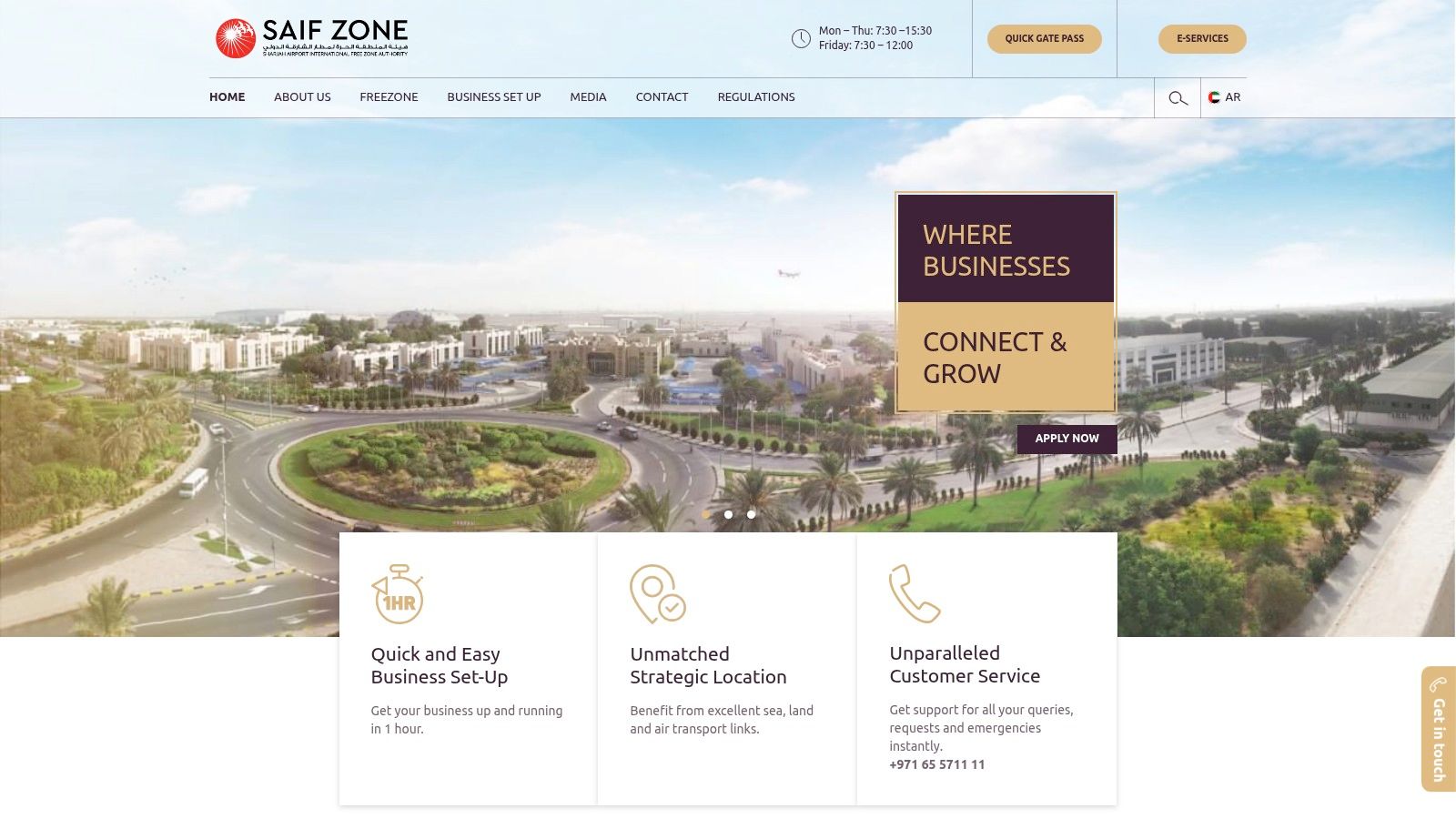
SAIF Zone is usually the first serious option I'd put in front of a founder whose business moves goods, depends on fast freight, or needs a setup banks and logistics providers already recognise. It's close to Sharjah International Airport and works well for trading, logistics, and light manufacturing businesses that need more than a paper company.
In 2024, SAIF Zone attracted over 700 companies, as reported by Gulf Time's coverage of Sharjah's 2024 free zone growth. That matters because mature zones with steady business inflow usually have clearer operating rhythms for leasing, approvals, and day-to-day support.
Where SAIF Zone works best
SAIF Zone suits companies that need operational credibility and physical infrastructure. That includes import-export firms, spare parts trading, packaging, light assembly, freight support, and service businesses that still want a stronger logistics-facing profile.
Its strongest practical advantages are straightforward:
- Airport adjacency: Useful when the business depends on air cargo, faster inventory turnover, or regional distribution.
- Range of facilities: Offices, warehouses, and industrial options make it easier to align the licence with the actual operation.
- Recognition: For many counterparties, SAIF Zone is familiar. That reduces the “explain your setup” problem.
SAIF Zone is rarely the cheapest option on day one. It often becomes the better option when the business actually needs to move goods.
Trade-offs to watch
This isn't the zone to choose just because you found a licence package online. Pricing can be quotation-led, especially when facilities are involved. Many activities also work better when backed by actual space rather than a minimal desk arrangement.
That doesn't make SAIF expensive in the wrong sense. It makes it practical. If the company needs warehousing, staff, cargo handling, or industrial workflow, SAIF often fits better than a service-led zone that looks cheaper at first and becomes restrictive later.
Official site: SAIF Zone
3. Hamriyah Free Zone Authority HFZA
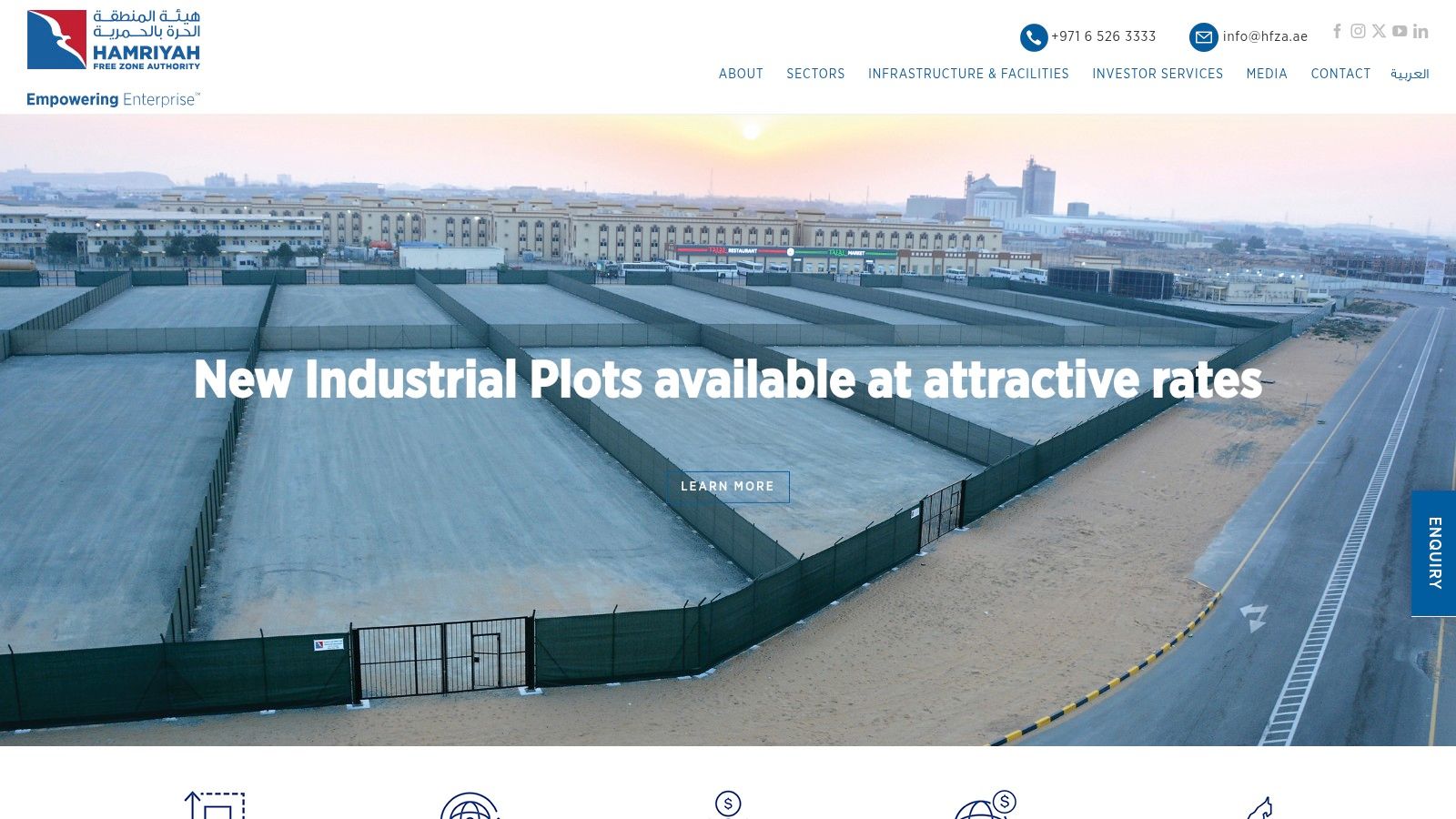
Hamriyah is the industrial heavyweight in Sharjah. If your operation needs port access, large plots, cluster-based infrastructure, or room for serious production, HFZA belongs on the shortlist early. It isn't trying to be a freelancer zone, and that's exactly its strength.
HFZA welcomed 900 companies and corporations in 2024, according to Sharjah free zones' official 2024 achievement announcement. One of the clearest signals of scale in that same report was Jagdamba Global Equipment Solutions establishing a production facility of about 644,000 square feet inside the zone.
Why industrial operators choose HFZA
HFZA is built around port-linked operations and industrial clustering. That changes the conversation. Instead of asking whether the zone can tolerate a manufacturing setup, you're dealing with a zone designed for it.
The same official announcement states that HFZA hosts over 450 companies in iron and steel manufacturing, occupying 50 million square feet, which represents about 16% of the free zone's total 300 million square feet area. Those figures tell you something practical. Suppliers, adjacent industries, technical services, and logistics support are already there.
- Best fit: Heavy industry, processing, fabrication, maritime-related businesses, oil and gas support, bulk trading.
- Facilities: Offices, warehouses, industrial plots, long-term expansion space.
- Real advantage: Direct seaport logic. That matters more than a cheap licence when the business depends on import-export flow.
What doesn't work well here
HFZA isn't ideal for founders who want a quick, digital-only, low-touch setup. Industrial activity usually means more technical review, more documentation, and more compliance around the site and operations. That's normal. It's not bureaucracy for its own sake. It's the cost of using a serious industrial base properly.
If you're choosing between SAIF and Hamriyah, the simplest rule is this. Choose SAIF when speed, airport access, and mixed-use operations matter. Choose Hamriyah when port logistics, land, and industrial scale matter more.
Official site: Hamriyah Free Zone Authority
4. Sharjah Media City Shams
Shams is one of the most practical entry points for founders who don't need industrial space and don't want a setup burden that belongs to a larger operation. It's especially common for media, marketing, e-commerce, consultancy, and digital service businesses that want flexibility rather than a warehouse lease.
The appeal is simple. Shams is digital-first, easier to manage remotely, and generally better suited to businesses that sell services, content, or online work rather than physical throughput.
Where Shams is strongest
For solo founders and small teams, Shams often works because it doesn't force industrial-style infrastructure onto a service business. Activity combinations can be broad, and the process is usually easier for companies that need a clean formation path without a large facility requirement.
A few things make it attractive in practice:
- Online setup flow: Applications and renewals are designed to be handled with less in-person friction.
- Service-business fit: Stronger for creators, consultants, agencies, e-commerce support, and digital operators.
- Lighter entry point: Better aligned with businesses that need a licence, visa planning, and room to start lean.
The RFZ overview of Sharjah free zones describes free zone structures in Sharjah as offering 0% personal income tax, along with multiple specialised licensing options and lower corporate tax rates compared with mainland UAE entities. For many expatriate founders and owner-operators, that makes service-led zones like Shams worth serious consideration when the business doesn't require industrial assets.
A cheap service-zone package only works if the bank, visa plan, and activity scope still make sense six months later.
Limitations founders underestimate
Shams isn't the right answer for manufacturing, deep logistics, or businesses that need serious storage and movement infrastructure. It can also create unrealistic expectations when founders assume “online setup” means every downstream step will be equally fast. Banking still depends on profile, documents, and substance.
That said, for the right activity, Shams removes a lot of setup drag. It's one of the cleaner ways to get a legitimate UAE presence without paying for space or complexity the company won't use.
Official site: Sharjah Media City Shams
5. Sharjah Publishing City Free Zone SPC Free Zone
A common SPC scenario looks like this. A founder wants one company that can cover consultancy, online selling, marketing support, and a few related service activities without being pushed into an industrial setup or a large facility commitment. That is where SPC usually earns a place on the shortlist.
SPC Free Zone began with a publishing focus, but its real appeal today is licensing flexibility for small and mid-sized businesses. It suits founders who want a practical Sharjah base and prefer a setup process that is easier to manage than the heavier approval path seen in more infrastructure-led zones.
Where SPC tends to fit best
SPC is usually strongest for businesses with mixed service and commercial activities. In practice, that often includes consultants, training businesses, e-commerce operators, creative firms, business support providers, and trading-related companies that do not need warehouse-heavy operations.
The main advantages are straightforward:
- Broader activity combinations: Useful for founders whose revenue comes from more than one line of work.
- SME-friendly structure: Better suited to smaller setups than free zones built around industrial land or logistics assets.
- Straightforward formation process: Many founders choose SPC because the package structure is easier to understand and compare.
Licence flexibility saves trouble later. I have seen founders choose the cheapest package first, then spend more correcting activity mismatches once banking, invoicing, or client contracts start to expose the gap.
What to check before you pay
SPC is not automatically the right choice just because the entry package looks simple. Verify three points first:
- Activity wording: Make sure the approved activities match what the business will sell.
- Visa planning: Check whether the package supports your real staffing plan, not just day-one needs.
- Facility expectations: Confirm whether you only need a registered address or may later need workspace, meeting access, or more visible substance for banking.
The trade-off is clear. SPC works well for flexible, multi-activity SME setups. It is a weaker fit for businesses that depend on port access, manufacturing capability, bulk storage, or freight movement. In those cases, SAIF Zone or HFZA usually make more operational sense.
Official site: SPC Free Zone
6. Sharjah Research Technology and Innovation Park SRTIP Free Zone
SRTIP is different from the usual low-cost setup conversation. This zone makes the most sense when the company's value sits in technology, R&D, advanced manufacturing, prototyping, sustainability, or intellectual property. If the core business is knowledge-based and collaboration matters, SRTIP can be more useful than a standard service licence.
Its location near University City supports that positioning. The attraction isn't just registration. It's access to an innovation environment that can support pilots, labs, partnerships, and talent pipelines.
Best use cases for SRTIP
SRTIP fits founders and teams who need more than a licence certificate. That includes tech startups, product development teams, sustainability ventures, engineering-led businesses, and companies that need a stronger innovation identity in front of partners or investors.
A practical shortlist for SRTIP looks like this:
- R&D-led companies: Businesses developing products, systems, or technical processes.
- University-adjacent ventures: Firms that benefit from research links or graduate talent.
- Prototype-focused teams: Companies that need an ecosystem with more technical relevance than a general free zone.
Don't choose SRTIP just because your business sounds “tech-enabled”. Choose it when innovation infrastructure actually supports the operating model.
Where people misjudge the fit
Some founders assume SRTIP is automatically better for any software or digital business. Not always. If the company is really a standard consultancy, marketing agency, or general e-commerce operation, a simpler zone may be easier and cheaper to manage.
SRTIP works when the business benefits from being in an innovation-focused environment. If that advantage is real, the zone can be a strong strategic fit. If it isn't, you're paying attention to branding instead of operating needs.
Official site: SRTIP Free Zone
7. Sharjah Healthcare City SHCC Free Zone
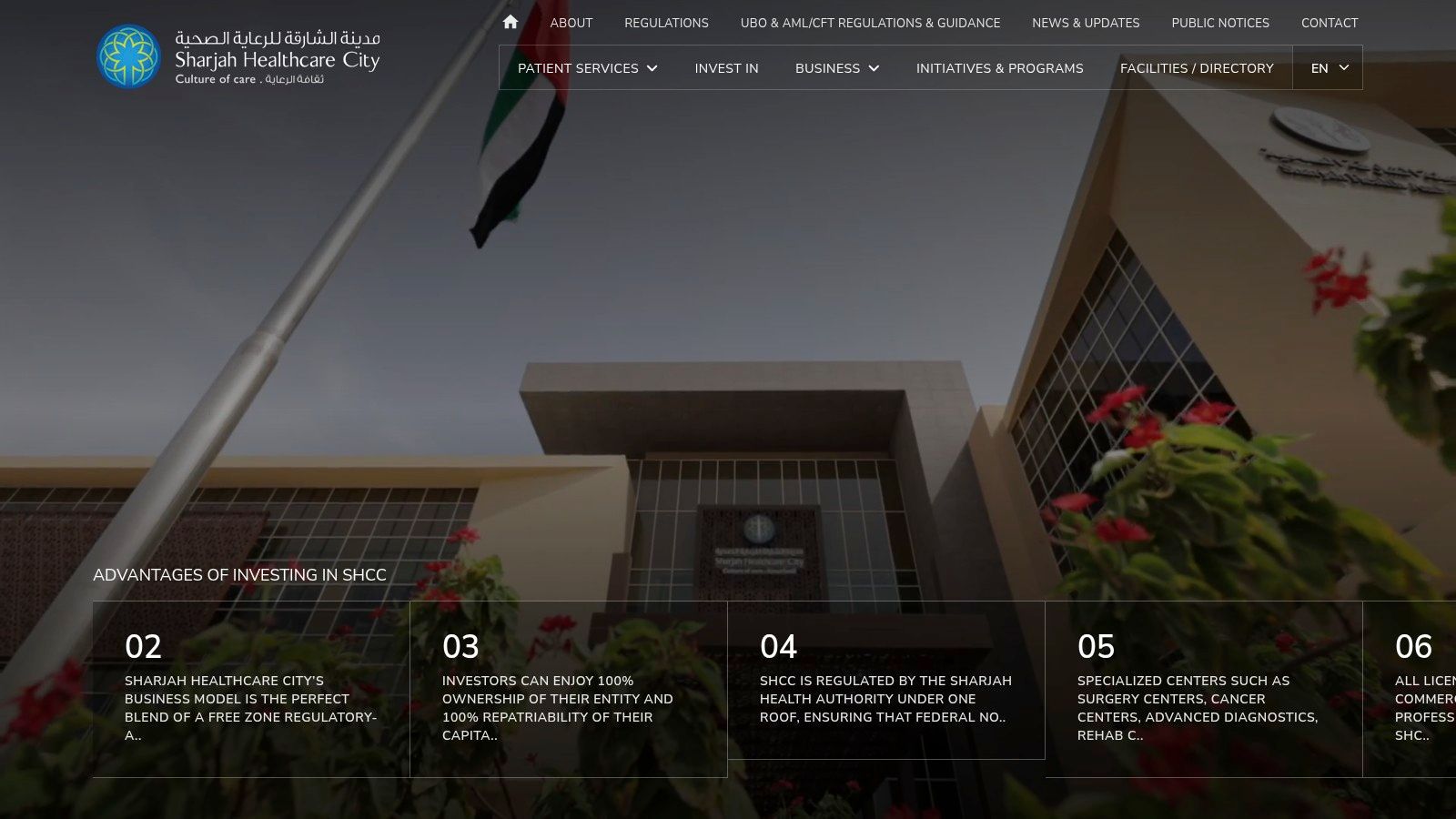
SHCC is specialised, and that's the whole point. If you're opening a clinic, diagnostics facility, wellness centre, pharma-related operation, or allied-health business, a general free zone usually creates the wrong path. SHCC exists to align facility licensing with healthcare-specific regulation.
That focus is useful because medical businesses don't just need a trade licence. They need approved premises, professional licensing coordination, and a setup that matches health authority requirements.
When SHCC is the right choice
Use SHCC when healthcare regulation is central to the business model. It's built for providers who need a structure that fits clinical and wellness operations rather than trying to adapt a general commercial zone.
Key reasons founders choose it include:
- Sector-specific regulation: Better aligned with medical and wellness activities.
- Facility approval path: Useful when the physical premises matter as much as the legal entity.
- Authority coordination: More practical for businesses that need both company setup and healthcare licensing steps.
Main drawback
The scope is narrow. That's a benefit when you're in healthcare and a limitation when you're not. A founder trying to force a general consultancy or unrelated trading business into SHCC is solving the wrong problem.
The other issue is procedural. Practitioner licensing and facility approvals can involve more than one step, so founders should plan for that from the start. In healthcare, the setup needs to be compliant before it needs to be quick.
Official site: Sharjah Healthcare City
8. Companies in Sharjah Free Zone A 2026 Guide
For founders who don't want to piece together the process from scattered zone pages and agent ads, Smart Classic's guide to companies in Sharjah free zone is one of the more useful practical resources because it stays focused on the three zones most businesses compare first: Hamriyah, SAIF, and Shams.
That focus matters. Most setup decisions aren't theoretical. They come down to a narrow choice between industrial scale, logistics practicality, and service-business flexibility. A guide that keeps those distinctions clear is more helpful than a broad directory that treats every free zone as interchangeable.
Why this guide stands out
The strongest part of the page is that it combines comparison with implementation. It doesn't stop at “choose a zone”. It gets into company types, formation steps, document preparation, legal forms, licensing routes, and the adjacent issues founders often ignore until they become delays.
That makes it useful for a few specific reasons:
- Zone-specific decision support: It's built around Hamriyah, SAIF, and Shams, which is where many real Sharjah setup choices happen.
- Practical formation detail: The page helps founders understand structure, licence fit, and paperwork before they submit.
- Beyond incorporation: It links company formation with PRO services, VAT-compliant accounting, tax residency implications, audit support, and even liquidation support when needed.
Where it's most useful
This kind of page is most valuable for founders who are already serious about launching and want fewer preventable mistakes. It helps when the problem isn't “What is a free zone?” but “Which one fits my activity, visa plan, and operating budget, and how do I prepare correctly the first time?”
The trade-off is that service-led guidance usually reaches its full value when there's direct consultation behind it. That's normal. Setup advice becomes useful when it's matched to the company's actual documents, ownership structure, activity list, and banking plan.
For anyone comparing free zones in Sharjah and trying to avoid wrong-turn costs, this is a sensible place to start.
Sharjah Free Zones: 8-Point Comparison
| Zone / Resource | Ideal use cases 💡 | Implementation complexity 🔄 | Resource requirements ⚡ | Expected outcomes 📊 | Key advantages ⭐ |
|---|---|---|---|---|---|
| Sharjah Free Zones: A Quick Comparison | Quickly shortlist suitable free zones and compare basics | Low, informational overview, no setup | Minimal, time to review infographic | High-level shortlist and faster decision-making | Fast, concise comparison of main zones |
| SAIF Zone (Sharjah Airport) | Trading, logistics, light manufacturing needing air‑cargo access | Medium, some activities need physical facilities | Moderate–high, office/warehouse leasing, customs processes | Strong logistics performance and bank recognition | Airport adjacency, mature infrastructure, customs benefits |
| Hamriyah Free Zone Authority (HFZA) | Heavy industry, manufacturing, seaport-dependent exporters | High, HSE and technical compliance often required | High, land/plots, port services, long‑term leases | Scalable industrial operations with port access | Deep‑water berths, industrial clusters, large-scale utilities |
| Sharjah Media City (Shams) | Digital media, e‑commerce, freelancers, agencies | Low, digital-first, fast online processes | Low, flexi-desk/no mandatory office for many activities | Rapid company formation and low entry cost | Fast issuance, flexible activity lists, competitive pricing |
| Sharjah Publishing City (SPC) | SMEs, multi‑activity founders, publishing and professional services | Low–Medium, streamlined packages but verify specifics | Low–moderate, bundled packages and visa options | Quick setup with multi‑activity flexibility | Broad activity scope, value packages, active support channels |
| SRTIP Free Zone | R&D, tech startups, advanced manufacturing, university collaborations | Medium, tailored licences and specific permitting | Moderate, labs, research partnerships, potential grant support | Access to talent, pilots, research collaboration opportunities | University adjacency, labs, incubator community |
| Sharjah Healthcare City (SHCC) | Clinics, diagnostics, pharma, wellness providers | High, healthcare facility approvals and practitioner licensing | High, clinical spaces, SHA practitioner approvals, compliance | Fully regulated healthcare operations in Sharjah | Purpose-built healthcare regulation, single-window facility pathway |
| Companies in Sharjah Free Zone: A 2026 Guide (service) | Founders wanting end-to-end setup in Hamriyah, SAIF, Shams | Low for user, consultancy handles complexity | Paid consultancy + documentation + PRO/accounting support | Faster approvals, compliant structures, cost-aware setups | 2026-specific guidance, cost calculator, end-to-end services |
Your Next Steps From Decision to Launch
Once you've narrowed the shortlist, the next step is execution. During this phase, founders either move cleanly from licence selection to launch, or lose weeks fixing avoidable errors. The process itself isn't mysterious. The discipline is what matters.
Start with the activity, not the package. The licence must reflect what the company does and what it may do in the near future. If you expect to add trading, warehousing, consultancy, clinical services, or technical R&D later, check expansion paths now. Changing structure after formation is always more annoying than getting it right at the start.
Then prepare the file properly. Shareholder passport copies, visa and entry status documents where relevant, business activity details, and any specialised approvals should be lined up before submission. Industrial businesses should be ready for technical and facility-related review. Healthcare businesses should expect regulatory coordination. Service businesses should still think ahead about banking, visas, and proof of operations.
A practical launch sequence usually looks like this:
- Confirm the exact activity: Get the zone to confirm the permitted activity wording before payment.
- Choose the right facility model: Don't pay for industrial space you don't need, and don't under-buy if the operation needs substance.
- Prepare shareholder documents early: Delays often start with missing or inconsistent documentation.
- Review visa needs realistically: A single-owner setup and a growing team require different planning.
- Plan the bank account in parallel: The bank view of your business should match the zone, activity, and operating story.
- Map post-licensing compliance: Accounting, VAT handling, tax residency questions, and renewals shouldn't be afterthoughts.
The best free zone choice is the one that still works after the company hires staff, opens a bank account, signs leases, and starts invoicing.
The most common pitfalls are predictable. Founders choose a zone because the ad looked cheap. They overlook hidden operating requirements. They assume all free zones handle the same activities equally well. Or they treat company formation as the finish line, when it's really the first compliance step.
If you want a broader planning view before choosing a structure, this strategic UAE company formation guide is a useful companion read.
For founders who'd rather get the structure, paperwork, and follow-through right the first time, working with a consultancy like Smart Classic Business Hub can save more than time. It can stop the kind of setup errors that create rework across licensing, immigration, banking, accounting, and later renewals.
If you want a practical route into the free zones in Sharjah without second-guessing every form, package, and approval step, Smart Classic Business Hub can help you compare the right zone, prepare the documents properly, handle PRO requirements, and support the business after formation with VAT-compliant accounting, audit, tax residency, and compliance services. It's a strong fit for founders who want direct advice, realistic cost planning, and a setup that works in practice, not just on paper.