
Your supplier just emailed the euro invoice, your operations team wants it paid today, and the numbers in your margin model already look tighter than they did yesterday. That's the situation for many Dubai businesses, especially when sales come in AED but costs, salaries, or freight settle in EUR, USD, or another currency. In that world, foreign currency exchange is not a travel counter decision, it's a treasury decision that affects cash flow, timing, and profit repatriation.
Why Foreign Currency Exchange Matters to UAE Businesses
A Business Bay design studio invoices Gulf clients in dirhams, then turns around and pays a European software vendor in euros. Nothing about that feels theoretical when the payment lands after the invoice date and the AED amount needed has shifted. For a UAE company, the problem is usually not “what is the tourist rate today”, it's “how much cash do I need to clear this supplier, this payroll run, or this dividend transfer without disturbing operations?”
The three moments where FX actually bites
The first hit is imports. If your company brings in inventory, machinery, software, or raw materials from abroad, the currency mismatch lands before the goods even hit your books. The second is overseas staff and contractors, where the payment date matters as much as the invoice amount. The third is profit repatriation, where cash has to leave the UAE cleanly and on time, often through a route that is more about documentation and conversion discipline than about the dirham itself.
The AED/USD peg changes the conversation. The UAE dirham is pegged to the U.S. dollar at AED 3.6725 per USD according to the Central Bank of the UAE, so the main exposure for local firms is usually not day-to-day AED/USD volatility, but the conversion risk between third currencies and USD-based pricing or hedging instruments (UAE exchange rate reference). That is why a one-size-fits-all consumer mindset fails. A founder who thinks like a traveller ends up chasing the wrong rate. A founder who thinks like a treasury operator looks at invoice currency, settlement timing, and conversion path.
Practical rule: if the payment leaves the UAE in a currency other than AED, treat it as a treasury event, not a retail exchange transaction.
The rest of this guide is built around those real business moments, so you can separate the exposures that matter from the ones that don't.
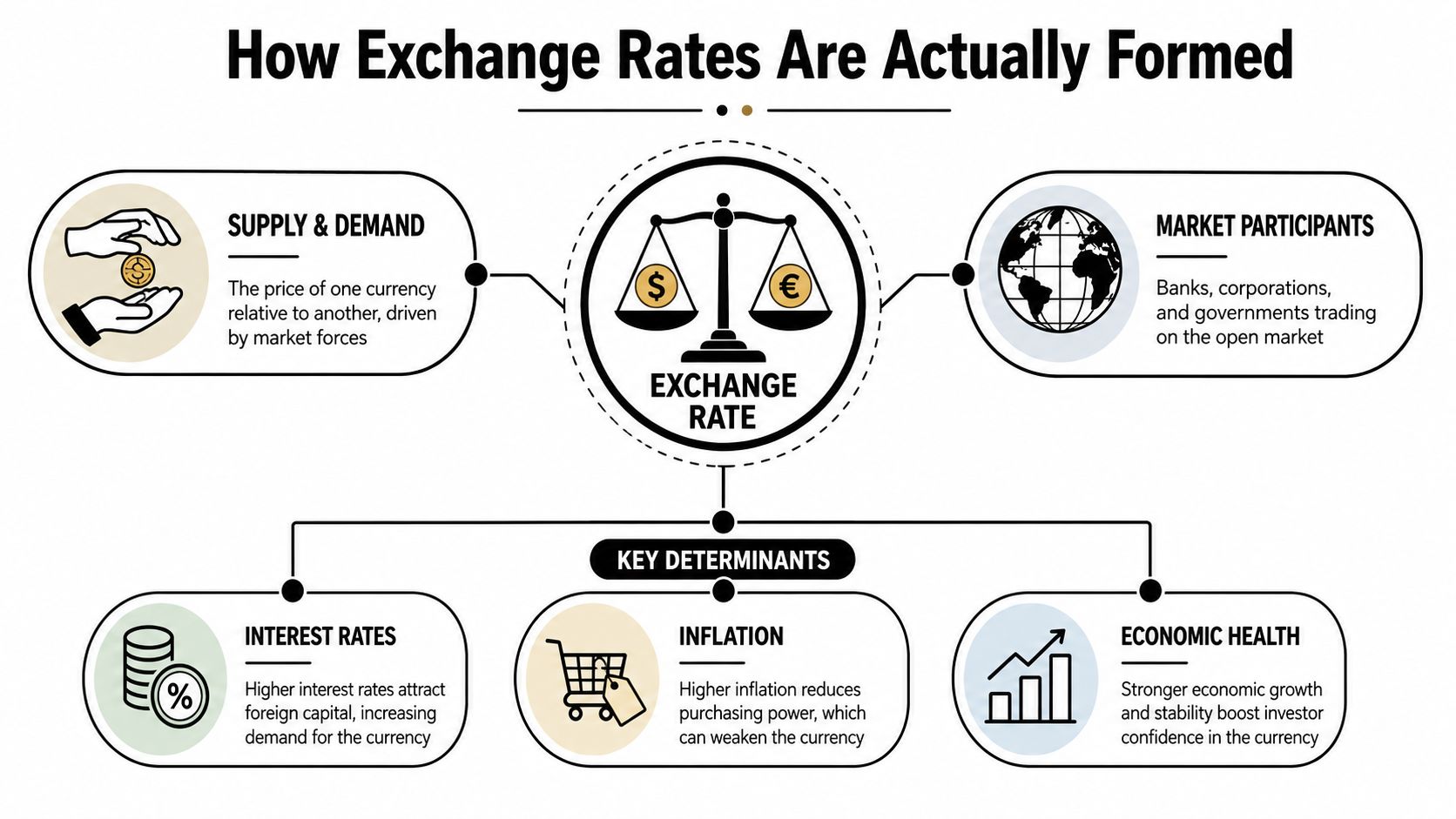
How Exchange Rates Are Actually Formed
A currency price is just the price of one country's money relative to another's. If more buyers need a currency than sellers are willing to provide, the price moves. That basic supply-and-demand logic sits underneath every quote your bank, exchange house, or platform shows you.
Spot, forward, and cross rates in plain language
The spot rate is the price for immediate exchange, the rate you'd use if cash moves now. A forward rate is a rate agreed today for a payment that happens later, which matters when your invoice is due in 30, 60, or 90 days. A cross rate is what you get when the two currencies in question are not quoted directly against each other, so the market often routes the conversion through a major reference currency.
That routing matters in the Gulf. The global FX market is highly concentrated around the U.S. dollar, and the BIS Triennial Central Bank Survey shows the dollar was involved in 89.2% of all FX transactions in April 2025, while the euro, yen, and sterling were involved in 28.9%, 16.8%, and 10.2% respectively (BIS survey). In practice, that means many non-USD deals ultimately touch USD liquidity somewhere along the chain.
A simple worked example helps. If you receive a euro invoice, the market doesn't care about your bookkeeping preference. Your provider will quote a euro rate, but the economics often sit inside a broader USD-centred liquidity system, especially when the bank is managing spreads, settlement timing, and its own inventory of currencies. If you want to understand the cost beyond the headline rate, a useful companion piece is hidden costs in forex trading, because the spread and the conversion path often matter more than the printed number.
Reading the quote the right way
Most retail customers assume banks “set” the rate. They don't. Banks usually pass through a market rate and add a margin, which is why two providers can quote different numbers for the same trade at the same moment. If your quote shows a buy rate and a sell rate, the difference between them is the bid-ask spread, and that spread is part of your cost.
The cheapest quote is not always the best quote if it fails on settlement speed, documentation, or transparency.
For UAE businesses, the peg simplifies one layer of risk. Because the dirham is fixed to the dollar at AED 3.6725 per USD, AED/USD spot movement is usually not where the pain sits. The primary problem is third-currency exposure, payment timing, and the conversion chain that settles in USD terms before it lands in your supplier's currency or your parent company's treasury stack.
Choosing the Right FX Provider in the UAE
A bank, a licensed money exchanger, a fintech platform, and an FX broker can all move money across borders, but they solve different problems. The wrong choice usually shows up as hidden margin, slow settlement, or too much paperwork for a payment that should have been routine. The right choice depends on whether you need convenience, repeatability, visibility, or price discipline.
| Provider type | Typical cost | Speed | Best fit |
|---|---|---|---|
| Local bank | Usually higher for non-urgent corporate flows, but bundled with account services | Often dependable, sometimes slower | Established SMEs that want one banking relationship and routine documentation handling |
| Licensed money exchanger | Often competitive for straightforward currency conversion | Fast for walk-in or simple transfers | Small businesses needing occasional conversions or cash handling |
| Fintech platform | Usually transparent on fees and spreads, but pricing varies by corridor | Often efficient for recurring transfers | SMEs with repeat international payments and a need for digital visibility |
| FX broker | Often strongest on pricing for larger, predictable flows | Can be fast, but process quality varies | Businesses with meaningful monthly volumes and a clear hedging need |
What each provider does well
Banks are convenient because the payment, compliance, and treasury relationship sit in one place. That convenience can save time when the transaction is sensitive or the documentation is messy. It also explains why many founders keep a corporate account with a bank first, then improve the workflow later through a dedicated business banking setup such as an established corporate account structure.
Licensed exchange houses are useful when the need is simple and the amount is not structurally complex. They suit smaller businesses that want quick conversion without building a heavy treasury stack. Fintech platforms are better for repeated international payments because they often surface fees, routing, and status updates more clearly than traditional channels. Brokers become valuable when the company is dealing with enough volume to justify tighter execution and more deliberate hedging conversations.
A practical decision rule helps:
- Use a bank when relationship continuity and documentation support matter most.
- Use a licensed exchanger when the payment is simple and speed matters more than treasury sophistication.
- Use a fintech platform when you have recurring cross-border payables and want cleaner visibility.
- Use an FX broker when you need pricing discipline on larger or predictable flows.
If you want a useful external comparison while shopping for payment rails, save costs on cross-border payments is worth reading because it frames cost as more than the headline rate. The lowest quoted margin is still expensive if the provider is slow, opaque, or hard to reconcile.
Red flag: if a provider can't clearly explain the spread, the transfer timeline, and the documents it needs, walk away.
FX Processes UAE Companies Run
Most UAE finance teams do not run “FX strategy” in the abstract. They run repeatable workflows, supplier payments, customer invoicing, dividend movements, and accounting entries. The first mistake is thinking the exchange decision happens when the wire is sent. In practice, the decision often happens earlier, when the purchase order is approved or the sales contract is signed.
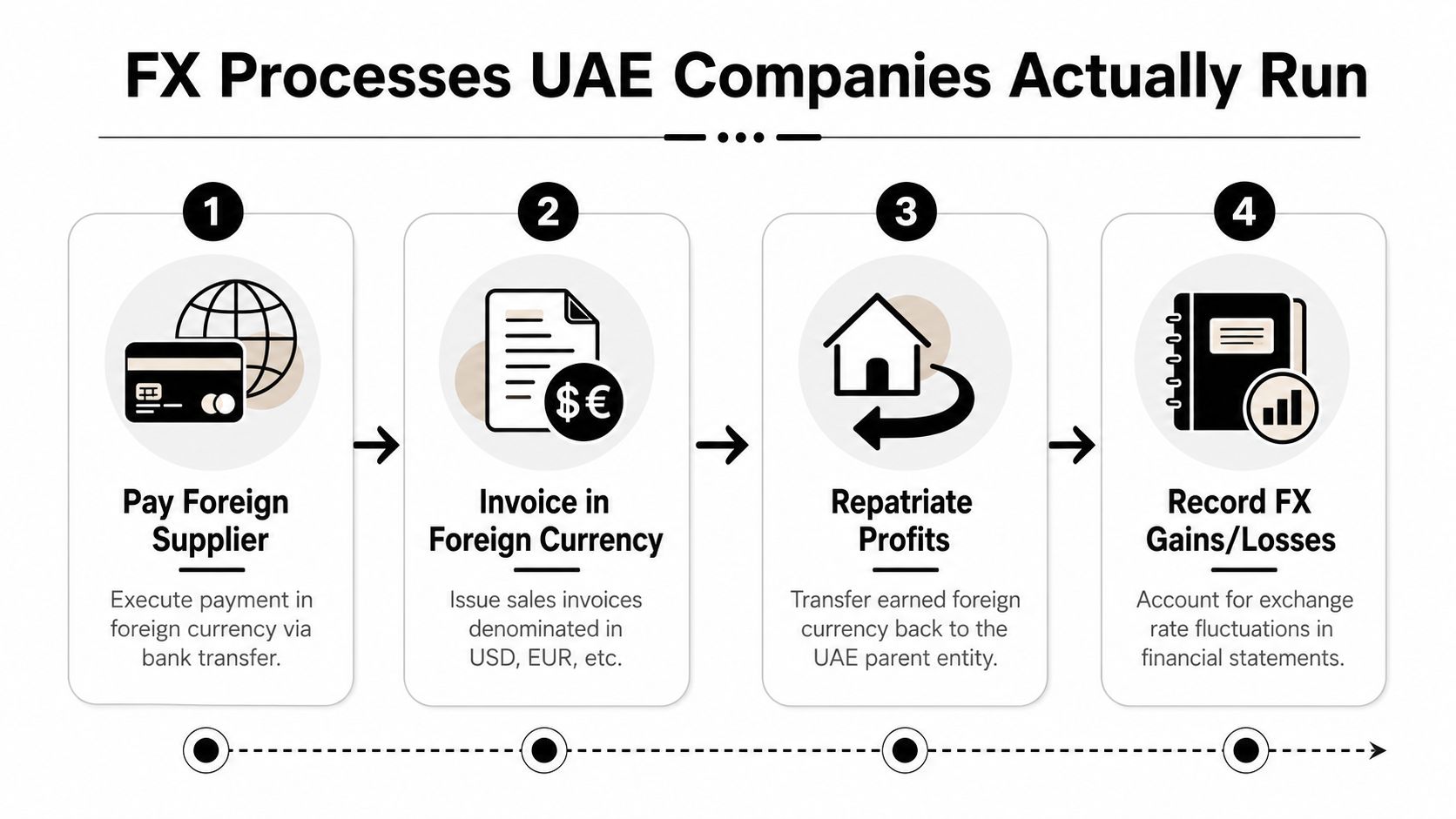
The payment journey from contract to ledger
A foreign supplier payment usually starts with the commercial contract, then the invoice, then the bank transfer, then the accounting entry. The FX choice can be locked at quote stage, at payment instruction stage, or at settlement stage, and each of those moments carries different risk. If the business waits too long, the AED value can move between approval and execution, even when the exposure itself is simple.
That is why clean paperwork matters. UAE banks commonly expect an invoice, the commercial contract, and KYC documentation for outbound payments. For higher-risk or more heavily monitored transactions, they may also ask for additional reporting forms or clarifications. When the file is clean, the payment often moves as a routine banking event. When the file is incomplete, a one-day transfer can turn into a long review cycle.
For founders comparing routes for overseas remittances, a guide on how to transfer cash from India to the UAE is useful because it shows how much of the process is documentation, not just rate shopping. That matters in UAE operations, where the operational bottleneck is often proving the source, purpose, and beneficiary path.
Invoicing, repatriation, and accounting
Some UAE companies invoice customers in foreign currency because their clients expect it. Others keep invoices in AED and only convert at settlement. Both approaches can work, but each one changes who carries the exchange risk and when. If your parent entity is outside the UAE, repatriating profits adds another layer, because the money must move cleanly through the right account path and be documented as a lawful return of earnings or capital.
The accounting treatment sits beside the payment treatment, not inside it. VAT is filed in AED even if the original invoice is in another currency, and the FX gain or loss is recorded separately in the accounts. That separation matters because a business can have a valid sales invoice and still record an exchange loss when the payment settles later than expected.
For UAE businesses, the key question is which currency exposure matters. The AED/USD peg removes most direct dollar volatility for local planning, so the bigger risk usually sits in EUR, GBP, INR, or other non-pegged currencies used for supplier invoices, management fees, or parent-company remittances. Once teams separate peg-related noise from true foreign exposure, they stop wasting time hedging the wrong thing.
For a practical treasury workflow, many founders keep the payment, the invoice, and the ledger entry in the same folder from day one. That habit saves time with bankers, auditors, and finance staff who inherit the file later. If your team deals with inbound remittances, intercompany transfers, or capital movements, a structured intercompany transactions framework is usually cleaner than treating each payment as a one-off.
Clean documentation is cheaper than a delayed transfer.
One operational habit I have seen work well is to assign the FX decision point before the invoice is due, not after. The finance team then knows whether to pay immediately, wait, or hedge, and the accounting team knows how to book the difference if the rate moves before settlement.
Practical Hedging Tactics That Actually Work
The best hedging tool is the one your team will use before the exposure turns into a surprise. For UAE SMEs, that usually means a small set of practical tools, not a fancy treasury stack. The right mix depends on whether the payment amount is known, the due date is fixed, and the business can tolerate short-term variation.
Timing, locking, forwards, and currency accounts
Payment timing is the simplest lever. If a supplier lets you pay early without penalty, you can remove part of the timing risk by settling when the cash is ready instead of waiting for the last minute. That works best when the business already has the dirham balance and the invoice is not disputed.
Rate locking at quote is useful when the purchase order is still open. A Dubai trading firm expecting to pay a USD 100,000 invoice in 60 days can ask the provider whether the rate can be fixed earlier through a formal forward structure or a quote-validity arrangement. The value is straightforward, it removes uncertainty from the budget. The trade-off is that you may give up upside if the market moves in your favour.
Forward contracts make the most sense for known future payables. If the amount and date are clear, you can agree the exchange today and avoid guessing where the market will be later. The IMF has framed forward contracts, better market transparency, and stronger surveillance as important tools in managing FX risk in changing market conditions (IMF GFSR chapter). For a finance team, that translates into one simple principle, certainty is worth paying for when the exposure is material and predictable.
Multi-currency accounts help when the business wants to hold money in the currency it will later spend. A freelancer paid in euros can keep euro balances rather than converting everything into AED and then back again for a euro invoice. That can reduce unnecessary round-trips, though it still leaves the business exposed if it holds the wrong currency for too long.
When each tactic makes sense
- Use timing control when the invoice is small, the due date is flexible, and the business can pay early.
- Use a locked quote or forward when the exposure is known and the budget can't absorb uncertainty.
- Use a multi-currency account when you regularly receive and pay in the same foreign currency.
- Do nothing special when the amount is immaterial relative to operating cash and the admin cost would outweigh the risk.
The most common mistake is over-engineering a small payment. The second mistake is ignoring a large payment because the team assumes the peg makes it harmless. The peg removes one type of volatility, but it does not remove third-currency exposure or the cost of paying at the wrong time.
Compliance and Provider Selection for UAE Operations
The provider you choose and the compliance work you must complete are part of the same decision. In the UAE, the safest route is to start with a regulated counterparty, then make sure your paperwork matches the payment purpose. A cheap transfer that triggers a compliance hold is not cheap anymore.
The sequence that keeps payments moving
First, pick the provider type, bank, exchange house, or regulated fintech. Then verify that the counterparty is properly licensed in the UAE and that it can support the payment corridor you need. After that, check its KYC and AML requirements, because providers will want to know who owns the company, what the payment is for, and why the counterparty is being paid.
Founders often underprepare in this area. Banks and regulated providers will generally ask for beneficial-ownership details and source-of-funds information when the payment pattern or relationship changes. They may also request supporting documents for routine outbound flows, especially when the transaction is large, unusual, or linked to intercompany movement.
For companies dealing with affiliated entities, the legal and accounting treatment needs to stay aligned. An intercompany invoice, a capital repayment, and a dividend-style remittance are not the same thing, and transfer pricing considerations can shape how the payment is documented and booked. If the commercial story and the banking file disagree, the payment is more likely to pause.
What good provider selection looks like
A useful way to judge a provider is to ask four questions before you commit:
- Can you process the exact currency corridor I need?
- What documents will you ask for on the first payment and on repeat payments?
- How do you show your margin, fees, and settlement timeline?
- What happens if compliance asks for more information after submission?
The provider should answer those questions in plain language. If it can't, the pricing almost never makes up for the operational risk. A business that sends regular cross-border flows also needs a provider that can explain whether it is acting as a bank, an exchange house, or a platform, because the regulatory treatment and service model are not interchangeable.
If your company is weighing cross-border commerce models as well as payment rails, the discussion around Merchant of Record options compared is helpful because it shows how payment structure and liability sit together. That is the same mindset you need for FX, where the payment corridor, compliance file, and accounting treatment need to match.
Decision filter: if the provider is easy to onboard but hard to reconcile, it will cost you later.
Putting It All Together for a UAE Finance Team
A good UAE FX workflow is boring in the best possible way. The dirham peg gives you a stable local anchor, the provider choice gives you execution quality, the hedge or timing decision removes avoidable uncertainty, and the compliance file keeps the bank moving. When those four pieces fit together, foreign payments stop feeling like emergencies.
A simple 30-day plan works well for small finance teams. Map every foreign-currency invoice by currency and due date, then compare the current provider margin against two alternatives. Next, mark the recurring exposures that deserve a forward contract or a multi-currency account, and clean up the documents your bank already asks for so each payment can be approved faster.
The biggest errors I see are consistent. Founders treat FX as an afterthought, ignore the cost of round-trip conversions, and pay too much for convenience that never survives a proper treasury review. The companies that do better are not the ones with the fanciest jargon, they are the ones that know which exposures are real under the AED/USD peg and which ones can be managed with discipline.
If you want this function handled as part of a wider finance and compliance workflow, Smart Classic Business Hub can help you organise the corporate structure, accounting support, and regulatory housekeeping around it. Visit Smart Classic Business Hub if you want a Dubai-based team to review your payment flows, tidy the paperwork, and put a cleaner operating rhythm around your foreign currency exchange process.