
You've probably got the folder on your desk right now, or a courier tracking page open, or a free zone officer telling you one stamp is missing. The frustration is the same every time. You did the work, you paid for the document, and now the process has stopped because somebody in the chain can't accept it yet.
That's the nature of document attestation in the UAE. It isn't a single stamp you collect at the end. It's a chain-of-custody process, and if one link is missing, the whole file can get bounced at the final counter. The UAE Ministry of Foreign Affairs said it received 3,777,893 document attestation requests in 2025, which tells you exactly how large and routine this process has become for both residents and cross-border applicants, not just one-off travellers or jobseekers. UAE MOFA's 2025 attestation request figures
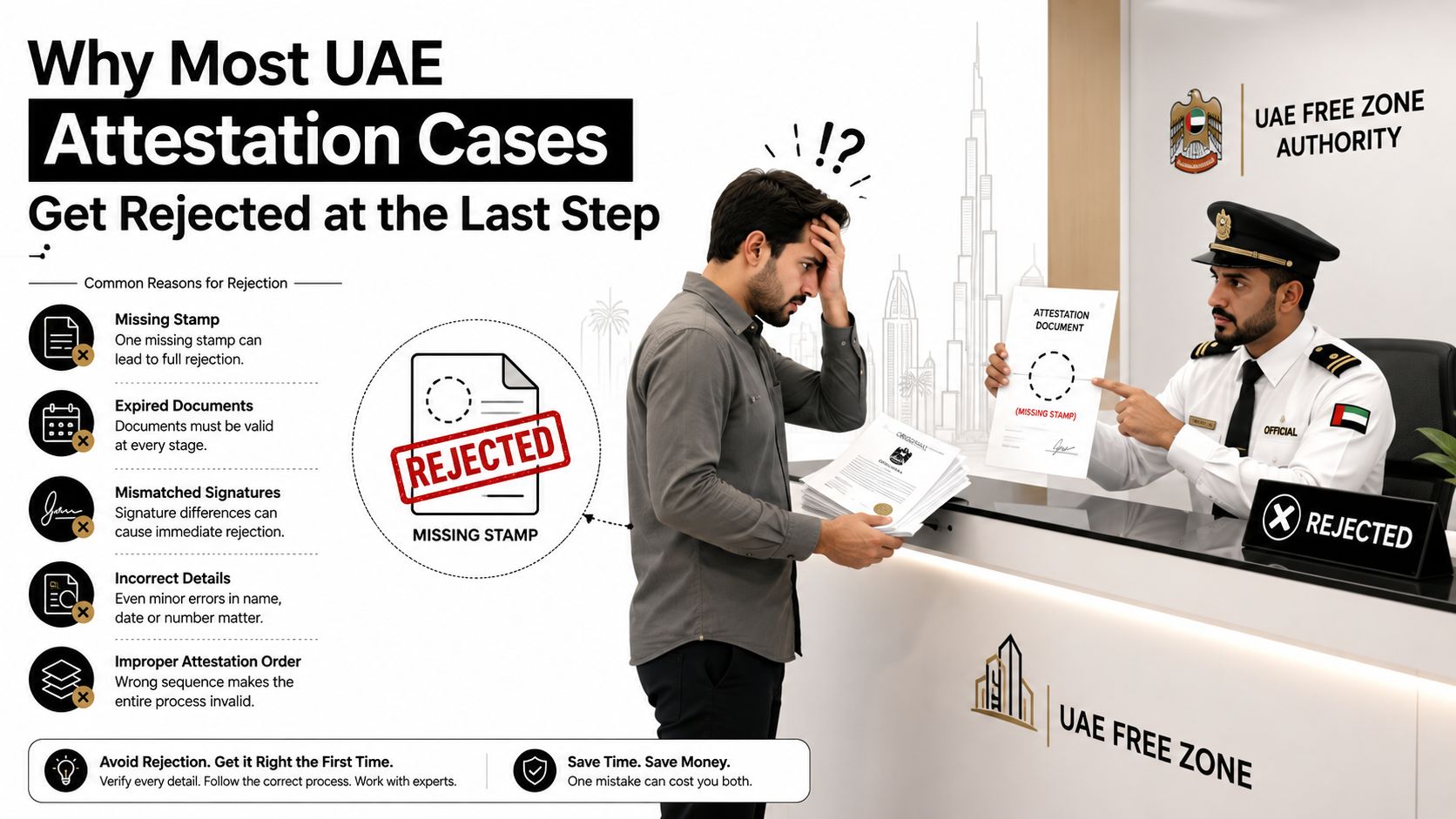
Why Most UAE Attestation Cases Get Rejected at the Last Step
A client walks into a government counter in Dubai with an original degree certificate, a passport copy, and confidence. The officer checks the file, then sends it back because the home-country verification step is missing. That is not bureaucracy for its own sake. That is the chain refusing to break for convenience.
Why the final stamp is never the first issue
The mistake people make is thinking attestation equals one transaction. It doesn't. The UAE process works like custody transfer, where each authority accepts responsibility only after the previous one has already verified the paper. UAE-based guidance describes the workflow as source-country notarisation or institutional verification, then the issuing country's Ministry of Foreign Affairs or equivalent, then UAE Embassy or Consulate legalisation, and finally MOFA attestation inside the UAE. Chain-of-custody explanation for UAE document attestation
That final MOFA step matters because it is the point that makes the document usable across government, banking, and court processes in the UAE. People lose days because they treat MOFA like a stand-alone service instead of the last checkpoint in a longer system.
Practical rule: if the document cannot prove where it came from, the UAE will not treat the final stamp as enough.
The current reality is more digital than the old paper-chasing version people still describe online. MOFA-linked guidance now points applicants through UAE Pass, document-type selection, prior legalisation confirmation, upload, payment, and courier pickup. If your file is incomplete before that submission, the digital front end does not save you. It sends you back faster.
What the rejection moment looks like
For a degree certificate, the problem is usually a missing foreign ministry stamp or a mismatch between the name on the degree and the passport. For a power of attorney, it is often a bad sequence, where the document was prepared but never fully legalised before it reached the UAE. For a commercial invoice, the mistake is often assuming a business paper can skip the trade-specific route.
The fix is simple in principle, annoying in practice. Build the file backwards from the end use. Ask what the receiving authority will accept, then make every upstream stamp line up with that requirement.
Apostille, Embassy Legalisation, and MOFA Attestation Explained
People throw these terms around as if they're interchangeable. They're not, and mixing them up is how applicants waste money on the wrong process.
Three different routes, three different outcomes
Apostille applies only where both countries are part of the Hague Apostille Convention. For documents going into the UAE from most non-Hague states, apostille is not the working route, so the normal path is still full legalisation. Embassy legalisation means the document gets verified by the issuing country's authorities first, then endorsed by the UAE Embassy or Consulate abroad. MOFA attestation is the final UAE-side stamp after the embassy stage.
A simple way to think about it. Apostille is a shortcut between certain countries. Embassy legalisation is the handoff from one government system to another. MOFA attestation is the local acceptance mark that lets the document work inside the UAE.
| Pathway | Where It Happens | Best For |
|---|---|---|
| Apostille | In the issuing country, through authorised Hague channels | Documents moving between apostille-participating countries |
| Embassy legalisation | Issuing country authorities, then UAE Embassy or Consulate | Documents from non-Hague states headed to the UAE |
| MOFA attestation | Inside the UAE | Final usability for government, banking, court, and licensing use |
If you're arranging any document through a remote origin country, a practical notary guide for home services can help you understand where notarisation fits before the embassy stage. That matters because bad notarisation at the start usually ruins the whole chain.
Which path you should choose before you pay anything
A degree certificate usually needs the full academic chain. A marriage certificate or birth certificate usually needs the personal-doc route. A company resolution or agency contract follows the commercial route, which is treated differently from personal paperwork.
If the receiving authority in the UAE is a ministry, bank, court, or licensing desk, don't guess the pathway. Confirm it first, because the wrong route costs you twice.
People often overspend at this stage. They pay for a courier, then discover the document should have gone through a notary or a foreign ministry first. Get the pathway right before you submit anything, and the rest becomes a sequence instead of a rescue mission.
Attesting Personal and Educational Documents Step by Step
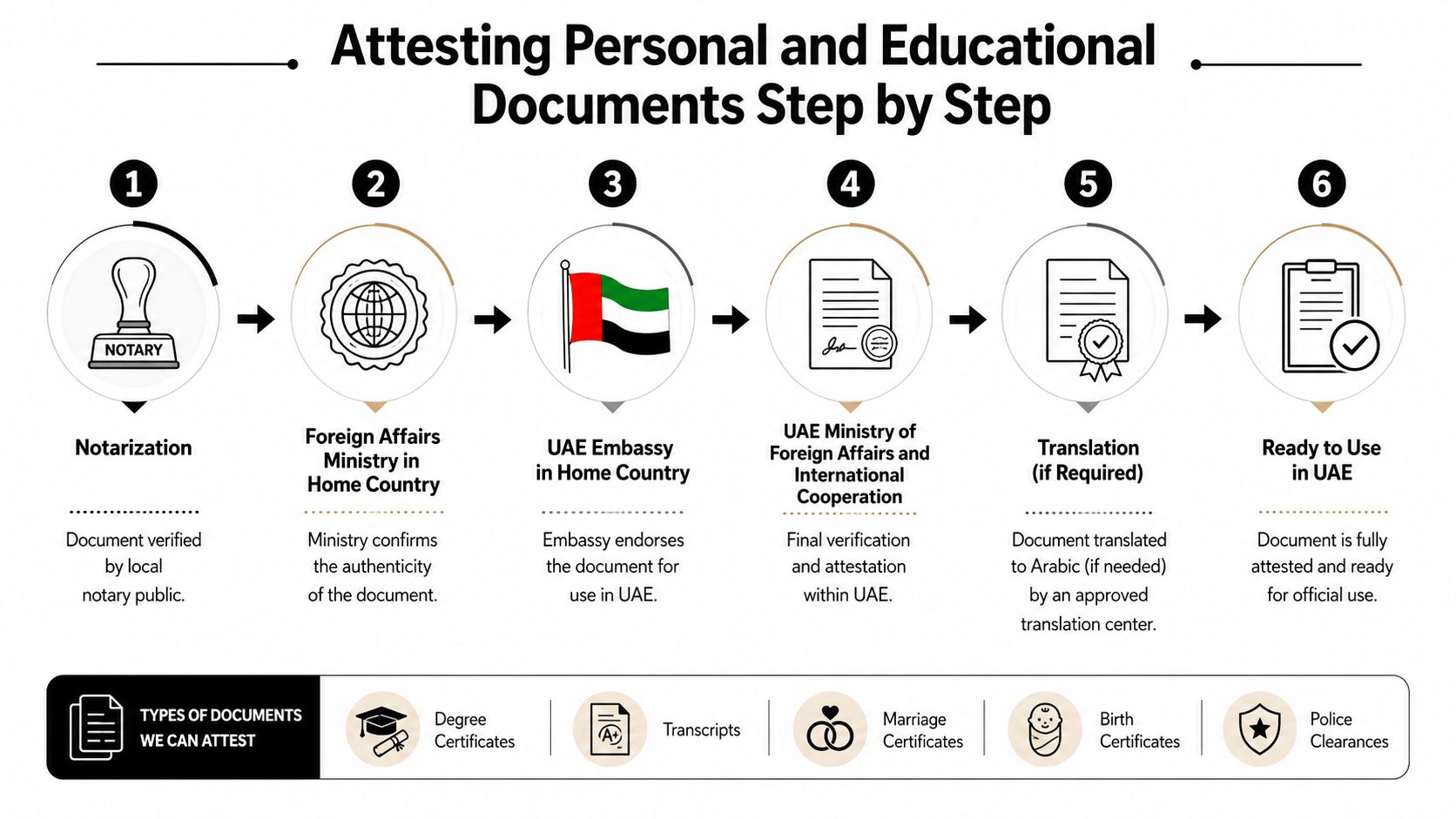
A degree certificate, transcript, marriage certificate, birth certificate, or police clearance all follow the same logic, even if the paperwork looks different on the surface. The order is what matters. If you skip a stamp or send the file to the wrong desk, the UAE side will not fix it for you.
The chain you need to follow
Start in the country that issued the document. The paper must first be notarised or institutionally verified, depending on the document type and the authority that issued it. After that, it goes to that country's Ministry of Foreign Affairs or equivalent, then to the UAE Embassy or Consulate there, and finally to MOFA in the UAE. For documents issued inside the UAE, the original usually needs attestation by the issuing entity unless it is a digital government-issued document or already electronically attested. MOFA attestation guidance and UAE-issued documents
If you want the government process in plain language, the UAE Ministry of Foreign Affairs explains the attestation service and the document categories it handles on its official attestation page. For a practical processing overview, UAE attestation processing guidance is a useful reference before you start paying couriers and translators.
For practical processing, the overall pathway can take 15 to 25 days when the foreign authentication and embassy stages are included, while the accepted MOFA stage itself may complete in 0 to 3 business days once the application is in the system. UAE attestation processing guidance
What to prepare before you submit
- Original document: Bring the actual certificate or certificate set, not a photocopy pretending to be enough.
- Clear copies: Keep a clean scan and a spare copy ready for upload and filing.
- Passport copy: Match the name exactly with the document name, especially for degrees and marriage papers.
- Translation check: If the receiving authority wants Arabic, arrange it before the file gets stuck at the UAE end.
- Supporting pages: For police clearance or transcripts, keep the full set together so a clerk doesn't reject it as incomplete.
For police clearance specifics, keep an eye on the format and validity expectations in this Dubai PCC reference, because that document gets handled differently by different receiving desks.
A degree certificate in real life
A university degree is issued, then verified by the school, then stamped by the home country's foreign ministry, then legalised by the UAE mission abroad, then accepted by MOFA inside the UAE. That is the correct sequence. If any stamp is skipped, the file is not “almost done”, it is not done.
A marriage certificate or birth certificate follows the same basic logic, but the starting point is often different because the issuing authority is different. That is where people waste time. They treat every personal document as if it can enter the chain at the same point, then spend days correcting the first step.
Translation is another place where files get stuck. Do not assume a loose English note or an informal translation will work. If Arabic is required by the receiving authority, use a proper translation before you submit the file, not after you have already booked the courier.
Attesting Commercial and Corporate Documents in the UAE
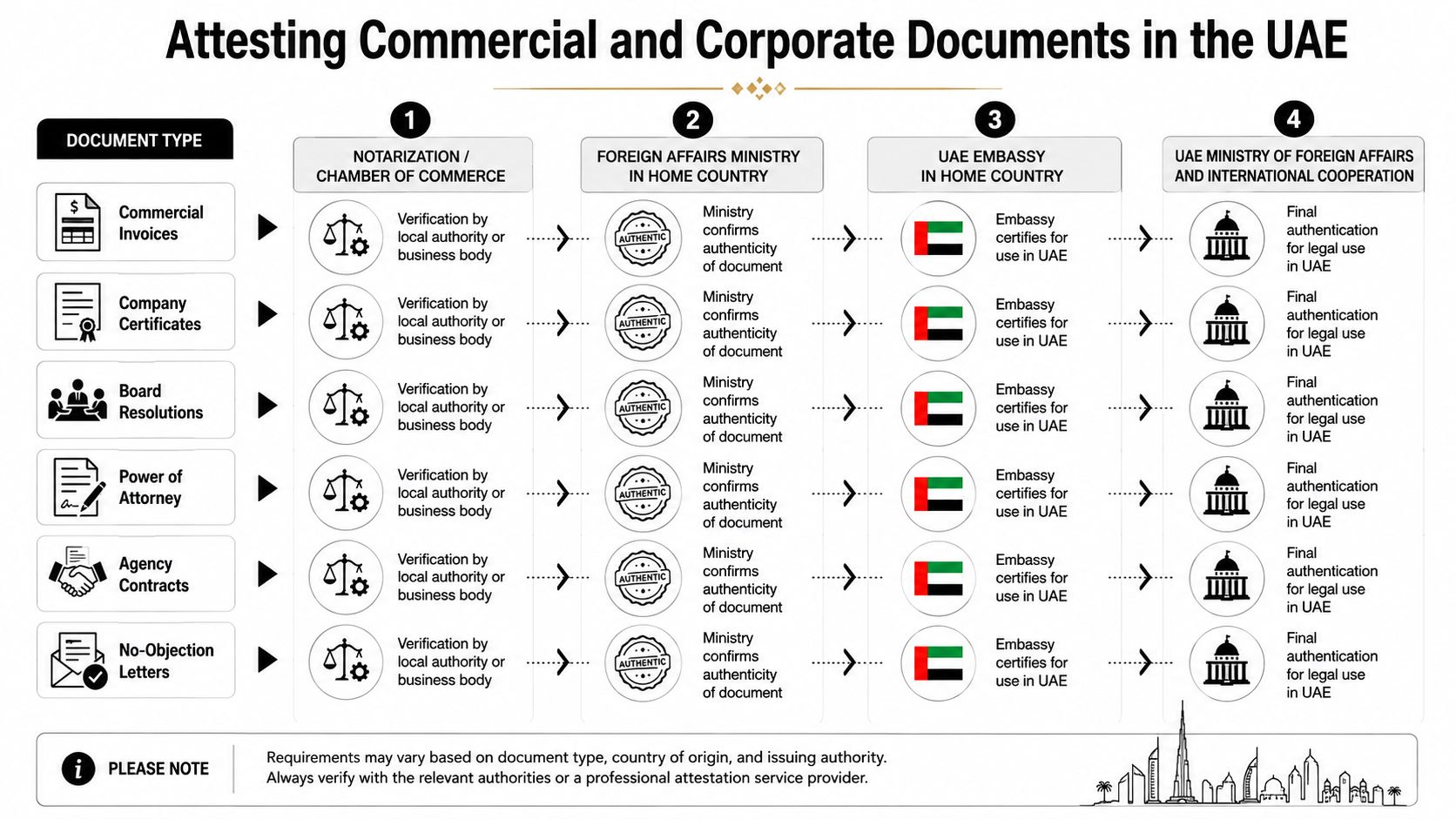
Commercial attestation is where business owners make the most expensive mistakes. They assume company papers move like personal documents. They don't. A commercial invoice, company certificate, board resolution, power of attorney, agency contract, or no-objection letter sits in a business compliance chain that gets checked hard by chambers, ministries, embassies, and the UAE side.
Why business paperwork gets a separate route
A trade paper is not just a document. It's evidence that a business relationship, authority, or transaction exists. That's why commercial papers often need Chamber of Commerce attestation in the UAE before they move into the MOFA stage. For setting up or expanding a mainland or free zone entity, some authorities want an additional layer of verification before they treat the file as usable.
Dubai Chamber attested 11,740 documents in H1 2024, a 20.5% increase from the same period in the previous year, and the number of customers using the attestation service rose 17.3% in that period. Agency contracts recorded 85.6% year-over-year growth, which tells you exactly where business activity is concentrated. Dubai Chamber attestation statistics for H1 2024
That growth matters because agency contracts, invoices, licences, and no-objection certificates aren't side paperwork. They're routine operating documents. In other words, commercial attestation is part of doing business, not an occasional admin headache.
Which commercial documents usually need attention
A power of attorney needs special care because it gives someone authority to act. A board resolution needs the right signatures and corporate provenance. A commercial invoice needs to align with the underlying trade paper trail. A company certificate or agency contract often needs chamber and embassy treatment before MOFA will touch it.
Business rule: if the document creates authority, confirms ownership, or supports trade, assume it needs attestation until the receiving authority says otherwise.
The UAE Ministry of Foreign Affairs reported 156,498 commercial document requests in 2025, while the broader dataset also showed 13,560 corporate users. MOFA's 2025 attestation data That's not fringe activity. That's a standard compliance lane for companies operating in the country.
If your business file is tied to incorporation, representation, or licensing, treat it like a legal chain, not a typing job. The missing stamp usually costs more than the original paperwork ever did.
Fees, Timelines, and the Digital MOFA Submission Process
People want a flat price for attestation. That is the wrong question. The cost changes with the document type, the number of upstream stamps it needs, whether translation is required, and whether you hand the work to a PRO or courier service.
What the cost structure looks like
Government charges sit in one layer, and PRO or courier service fees sit in another. Translation is a separate line. A degree certificate can cost very differently from a power of attorney or a commercial invoice, even if all three end up at the same UAE counter.
The cheapest route is the one that avoids corrections. A wrong stamp, a missing translation, or a poor scan can force a fresh submission, and that is where hidden costs start. If the file has to be re-couriered, re-printed, or re-legalised, you are no longer paying for attestation. You are paying to fix a mistake.
How the digital MOFA flow works
The digital MOFA process is simple once the file is ready. You log in with UAE Pass, choose the document origin and document type, confirm the earlier legalisation steps, upload clear copies, pay online, and arrange courier pickup of the original. Once the file is accepted, completion is usually handled within the stated service window. MOFA-linked digital submission guidance
That speed starts after intake approval. It does not remove the earlier chain. A foreign document still has to pass the home-country checks and any embassy legalisation before MOFA can finish the UAE side. In practice, that full chain is where the wait stretches.
Where applicants lose time
- Foreign authority delays: The issuing country's ministry may move slower than the UAE stage.
- Embassy queueing: Mission workload can slow the handoff.
- Translation timing: Arabic translation becomes the bottleneck when it is left too late.
- Courier mistakes: One wrong pickup detail can set the file back by days.
A degree certificate for a visa file, a power of attorney for a company appointment, and a commercial invoice for trade all fail for the same boring reason, someone planned the UAE step and ignored the earlier ones. Work backwards from the earliest required stamp, count every handoff, and build in time for translation, courier movement, and re-checks. If a deadline is tight, a PRO service can save money by preventing repeat submissions. If the file is clean, simple, and already organised, paying for extra handling does not help.
Common Mistakes That Delay or Reject UAE Attestation
A file can look perfect and still fail at the counter because applicants confuse attestation with proof of truth. It is not a content approval. It confirms that the document came from a legitimate issuing authority and that the seals and signatures are genuine, while the receiving body still decides whether the document is enough for a job, licence, or visa file. That gap is where a lot of people waste time, especially on a degree certificate, a power of attorney, or a commercial invoice. MOFA attestation FAQs and verification limits
The mistakes that burn time
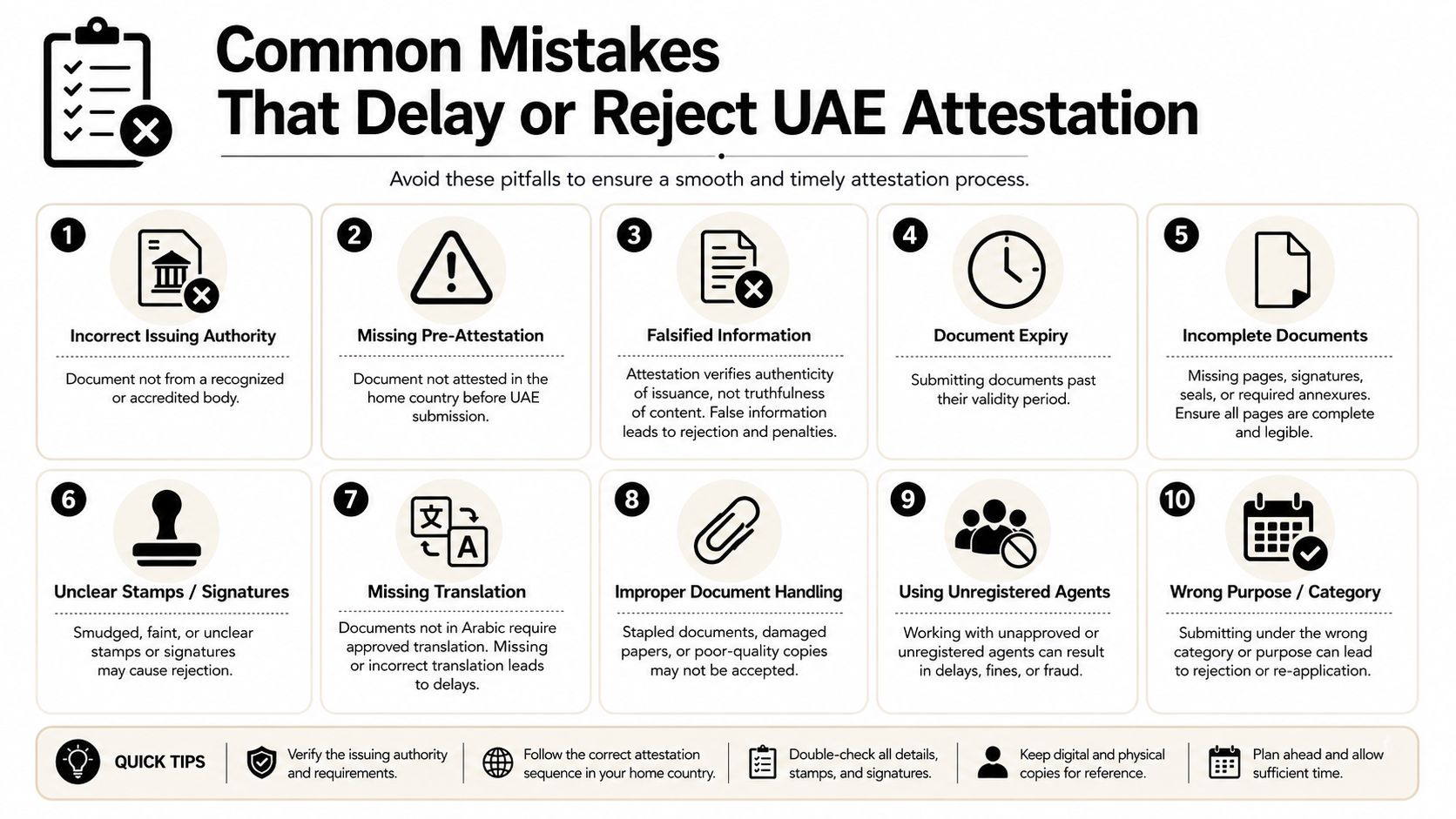
The problems are usually basic. That is why they keep getting repeated.
- Wrong issuing authority: The document came from a body that the chain will not accept.
- Skipped pre-attestation: The home-country step was never completed.
- Bad translation timing: Arabic was needed, but the translation was not ready.
- Expired police clearance: The document was valid when issued, then sat too long.
- Laminated originals: The surface was altered before attestation.
- Mismatch of names: Passport spelling and certificate spelling do not line up.
- Unclear scans: The upload is blurry, cropped, or missing a page.
- Wrong document type selection: The file was submitted under the wrong category.
- Assuming every PRO can attest: A runner can coordinate logistics, but that does not create legal authority.
- Treating attestation as approval: A stamped paper can still be rejected later by the receiving body.
A clean file starts with a boring review. That is the part people skip, then pay for later.
Your before-you-submit check
Start with the original document itself. It must be intact, with no lamination, damage, or other alteration.
Then check the names across every paper in the file. Passport, certificate, and supporting documents need to match exactly. If the timing matters, do not leave an expiring document sitting on a desk. If the receiving authority wants Arabic, get the translation done before submission, not after the file is already stuck. Personal, educational, and commercial documents also follow different paths, so do not force everything into one process.
For a no objection certificate, the wording should be right before the stamp is even discussed, so keep this NOC format reference nearby if that is the document you are handling.
A quick pre-check usually turns attestation into a filing exercise. Skip it, and you are buying repeat fees, courier delays, and another round of corrections.
When to Use a PRO Service and How Smart Classic Helps
A PRO service makes sense when the file has multiple handoffs, the deadline is tight, or the applicant isn't in the UAE to chase the process themselves. That's where the value is real. If you're managing company formation, multiple family certificates, or a rejected file that already failed once, paying for coordination usually costs less than fixing mistakes on your own. For a broader view of what PRO work covers, see this PRO services reference.
When DIY is the smarter move
If you already know the exact route, the document is simple, and you're comfortable using MOFA directly through UAE Pass, DIY can be the right call. A single straightforward file with no translation issue and no upstream confusion doesn't need an expensive middle layer. Don't pay for a runner when you only need a clean submission.
Where Smart Classic fits
Smart Classic Business Hub handles document clearing, chain-of-custody tracking, UAE Pass submissions, Chamber and MOFA coordination, courier logistics, and Arabic translation support. That makes sense for founders, SMEs, investors, and families who need the file done without juggling five separate vendors.
If the document is commercial, time-sensitive, or already delayed once, coordination is usually the expensive part you want someone else to own.
Simple next-step checklist
- Personal or educational file: Check the issuing authority, then confirm the foreign ministry, embassy, and UAE MOFA sequence.
- Commercial file: Confirm chamber involvement before you assume MOFA can accept it.
- Deadline-driven file: Use a PRO if one missed handoff would hurt the deal or visa date.
- Simple file with enough time: Submit directly if you already understand the route and the file is clean.
Quick FAQ
Do I always need UAE attestation? No. You need it when the UAE authority receiving the document requires legalised proof of origin.
Can one stamp fix a missing earlier step? No. The chain has to be complete.
Is attestation the same as approval? No. It proves origin and authenticity, not that the content will automatically be accepted.
Can I do it myself? Yes, if the document is simple and you're comfortable with the submission route.
Smart Classic Business Hub supports this work through its government relations services, and it's the kind of file handling that saves time when the document is already part of a wider setup, licensing, or compliance task.
If you want this handled without the usual back-and-forth, visit Smart Classic Business Hub and speak with a team that deals with document clearing, PRO coordination, and UAE compliance workflows every day. Bring the document type, the issuing country, and the deadline, and they'll tell you the cleanest route instead of sending you in circles.