
PRO services in Dubai are outsourced government-liaison work that handles visa, labour, licensing, and document tasks on behalf of a business. In practice, that means a market that was valued at USD 93 million in 2024 and is projected to reach USD 121 million by 2030 keeps growing because founders would rather not spend their week chasing approvals and counter stamps than running the company itself. For a first-time founder, the primary problem usually shows up as a stack of tasks you didn't budget mental space for, not as a neat definition on a website.
You might be staring at passport copies, trade licence renewals, labour files, and an attestation request that suddenly needs three different signatures. Or you may already be trading, and now every visa renewal feels like a small fire drill. That's the moment people start asking what is pro services in dubai, because the paperwork is no longer a setup issue, it's part of how the business survives day to day.
The Day a Founder Realises They Need a PRO
You usually don't wake up thinking, “I need a PRO.” You realise it after a morning spent moving between portals, email threads, and a counter where one missing document means you're sent away again. In Dubai, that friction comes from the fact that your business touches several authorities at once, not one.
A founder can be dealing with a licence file in one place, immigration in another, and labour-related paperwork somewhere else. Add document attestation, renewal dates, and the need to keep records consistent, and the job stops feeling like a side admin task. It starts to look like an operating function.
That is why people search for what is PRO services in Dubai after incorporation, not before it. The service exists because the government touchpoints are real and recurring, and most founders do not have the time or internal bandwidth to sit in every queue themselves. A useful way to think about it is the same way teams use process tools elsewhere, where the work is not glamorous but it keeps the business moving. If that analogy helps, automation examples for support teams is a good reference point for seeing how structured admin support reduces friction without changing the business itself.
Practical rule: if a task requires you to coordinate across more than one authority, the value of a PRO rises fast.
Dubai's setup also matters here. Depending on your structure, you may deal with free zone bodies, the DED, MOHRE, immigration, municipality offices, and other agencies. A founder can know their product cold and still feel out of place on the government side of the business. That's where a service such as Smart Classic's company PRO services package fits into the picture, as an outsourced layer between the founder and the paperwork.
What PRO Services Actually Mean
A PRO in this context is a Public Relations Officer, but not in the marketing sense. In Dubai business language, it means the person or firm that handles government liaison work so the company can stay compliant without the founder personally managing every form, stamp, and submission.
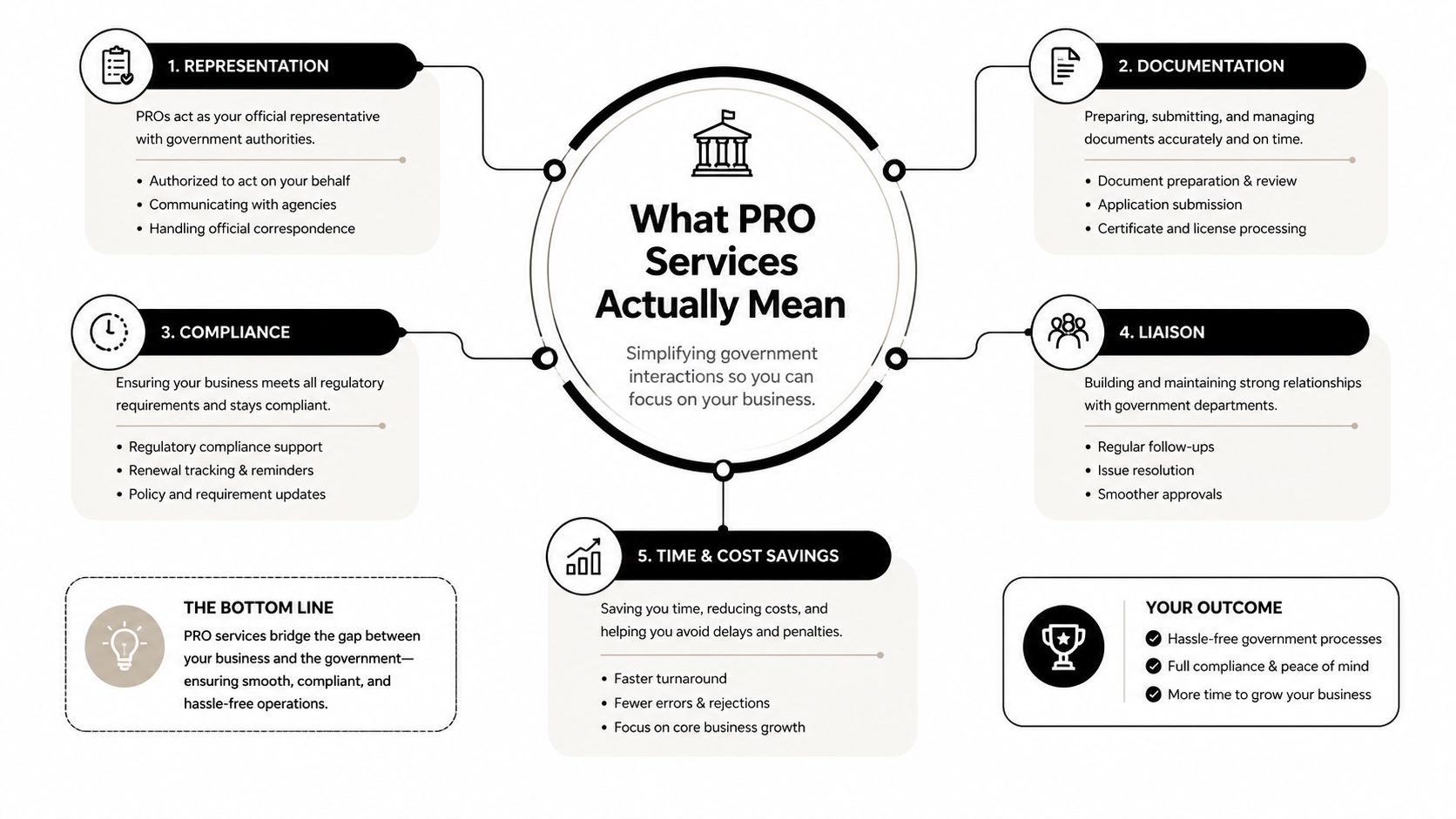
The cleanest way to understand it is this. A PRO sits between your business and the authorities, translates what the authority needs into something your company can complete, and keeps the file moving. In other words, it's part translator, part queue manager, part compliance handler.
That definition matters because people often reduce PRO work to “typing visas” or “filling forms”. The actual scope is broader. In the UAE, PRO services are the outsourced government-relations functions that cover visa processing, labour and immigration services, trade licensing, document attestation, and other administrative compliance tasks for businesses. That scope is what makes the role useful after the licence is issued, not just at launch. You can see the same broad remit described in the business-formation explanations of PRO work, including visa handling, licensing, legal documents, and regulatory compliance, as outlined in the UAE PRO outsourcing services market overview.
A second point people miss is that PRO services can mean either an in-house person or an outsourced firm. The article here is focused on the outsourced version because that's what most founders use once the company is operating. For a broader view of process-heavy document handling, find what IDP means for finance is a useful comparison, since it shows how businesses separate manual handling from structured workflow support.
The Core Tasks a PRO Handles Day to Day
The easiest way to understand the job is by task group, because no two founders need the same mix. One business may only need help with visa renewals. Another may need ongoing support across labour files, licensing, and attestations. A third may need all of that at once, especially once the licence is already in place and the work becomes repetitive instead of one-off.
Visas and Emirates ID
This is the part many founders notice first, because it shows up every time someone joins, renews, or changes status. A PRO may prepare employee visa applications, coordinate entry permits, handle renewal steps, and track the file through to Emirates ID collection. The process often involves medical checks, biometrics, and status updates that the founder does not want to chase personally.
A useful way to see the recurring side of that work is the renew Emirates ID process, which shows how one familiar filing sits inside a wider compliance routine.
Labour and MOHRE files
Once a company has staff, the labour side becomes ongoing. That can include work permits, labour file updates, and coordination with the relevant employment authorities when a new hire joins or an existing employee's status changes. These are not glamorous tasks, but they are the kind that slow everything else down when nobody is watching the file.
Licensing and trade licence interactions
A PRO also handles trade licence renewals, amendments, and authority follow-ups tied to the company's legal existence. If your activity changes, your shareholder structure shifts, or your licensing details need updating, someone has to manage the paperwork and the back-and-forth with the relevant body. For a founder, this is often the difference between a file that stays current and one that starts collecting avoidable delays.
Document attestation and clearance
Founders are often surprised by how many business documents need formal validation. Educational certificates, commercial papers, and legal documents can all need attestation or clearance before they are accepted by another authority. That is one reason a PRO still matters even when the company feels set up and the early incorporation work is already behind you.
Other government liaison work
There are also the smaller but necessary tasks, such as getting NOCs, handling chamber-related registrations, or following up on approval letters. These items may look minor separately, but together they create the steady admin load that keeps a business operational. A good PRO takes those errands off the founder's plate and keeps them from turning into a pile of unfinished follow-ups.
| PRO Task Categories at a Glance | Example Transactions | Typical Frequency |
|---|---|---|
| Visas and Emirates ID | New employee visa, renewal, ID collection | Recurring |
| Labour and MOHRE files | Work permits, employee status changes | Recurring |
| Licensing and trade licence interactions | Renewals, amendments, approvals | Recurring and periodic |
| Document attestation and clearance | Certificate attestation, legal document clearance | Often one-off, sometimes recurring |
| Other government liaison work | NOCs, chamber registrations, follow-ups | Mixed |
A founder usually feels the difference between one-time setup help and ongoing PRO support only after the first renewal cycle.
If you want a cleaner way to picture those handoffs, the workflow guide for small and medium businesses is a useful parallel. PRO work becomes easier to understand when you treat it as a chain of submissions, checks, and approvals instead of a single administrative task.
How a Typical PRO Workflow Runs
A typical PRO workflow starts the moment a founder passes over the paperwork, but the real work begins after that handoff. The PRO checks what is missing, confirms which authority the file belongs to, and separates what can go through digital channels from what still needs in-person handling. That distinction matters in Dubai, because some steps are now self-service while others still depend on physical submission or follow-up.
A common example is bringing in a new employee. The file usually moves through document collection, submission, medical steps, biometric appointments, and then the final visa or ID stage. The founder's part is simple but time-sensitive, approve the papers, share the source documents, and respond quickly when something is missing. The PRO keeps the file moving, catches gaps early, and prevents a small error from turning into a rejected application.
The pace depends on the transaction and on whether the case is routine or urgent. Standard processing follows the normal queue, while priority handling depends more on how quickly the provider can coordinate each step and keep the file clean. A PRO cannot force a government system to move faster than it will. The value is in reducing avoidable delays and keeping the paperwork ready for the next approval step.
That is why this work is better understood as a workflow, not a single errand. The workflow guide for small and medium businesses is a useful parallel, because PRO handling follows a chain of submissions, checks, and approvals that has to stay in order.
For a founder, the monthly retainer usually pays for that ongoing coordination after incorporation, not just one-off submissions. It covers the person who watches deadlines, prepares files, follows up with authorities, and handles the recurring admin that keeps piling up once the licence is active. Smart Classic Business Hub fits into that model when company formation and ongoing compliance sit together, which reduces the need to repeat the same details to different providers. The government steps still remain, but the process becomes easier to keep track of when one team owns the handoff from setup to maintenance.
What PRO Services Really Cost in Dubai
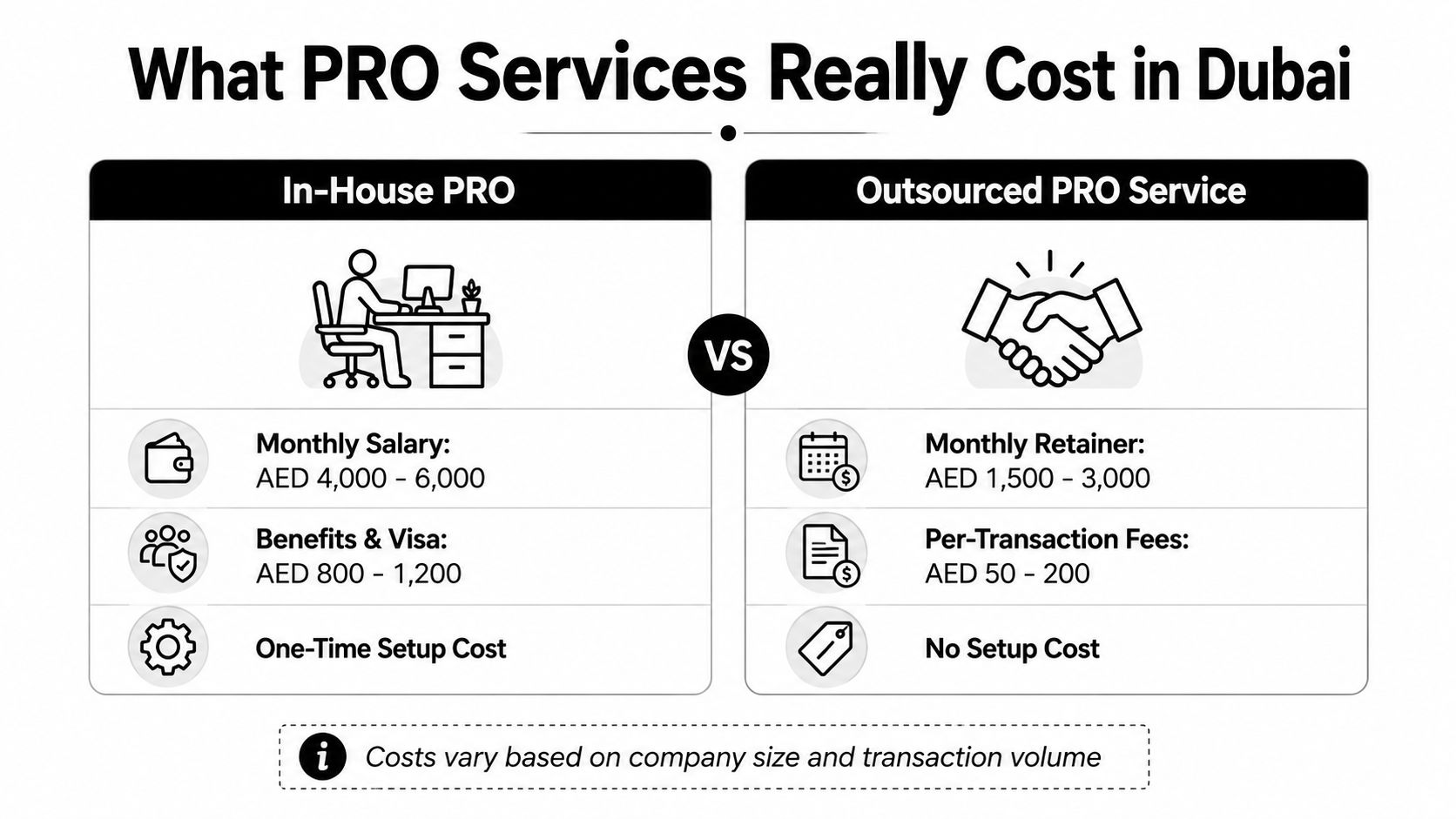
A Dubai founder usually runs into PRO pricing after the licence is already in place, when the work becomes the steady stream of renewals, employee files, and government follow-ups. Pricing usually falls into two broad models, a fee for each task or a monthly retainer for ongoing support. Market rates often sit around AED 350–800 for a visa-related transaction, while broader monthly support is often quoted at AED 2,500–6,000. A separate market range for outsourced PRO service retainers in the UAE is often described as AED 1,500–5,000 per month, which shows why providers package the work differently depending on how much admin the business creates.
A useful way to judge the cost is to compare it with the amount of work sitting on your desk. A one-off filing can feel expensive if you only use it once. Once the business starts renewing visas, updating licences, and handling onboarding paperwork, the fee begins to look less like a discretionary add-on and more like part of the cost of keeping the company compliant. That is the same reason many founders compare outsourcing with the cost of an in-house administrative hire, which can approach AED 120,000 annually.
Per-transaction versus retainer
A transaction model fits businesses with irregular needs. You pay for a single service, then stop paying until the next request comes up. That works well when the admin is occasional and easy to define.
A retainer makes more sense when the work keeps returning. The provider stays involved, tracks recurring files, and stays ready for the next submission or follow-up. It is closer to having a standing arrangement than buying a single task.
Outsourcing versus hiring in-house
Hiring in-house gives you someone close to the business, but it also brings salary, employment overhead, and the need to manage another employee directly. Outsourcing shifts that responsibility to the provider. For many SMEs with repeat visa activity, renewals, and document handling, that is the cleaner option because the workload changes from month to month and is tied to compliance rather than to one fixed desk.
The choice often becomes clearer only after the admin load shows up in practice. A company with one straightforward transaction may not need an ongoing PRO arrangement. A company with staff, renewals, amendments, and regular document activity usually does.
For founders who are trying to place these fees inside the wider setup budget, cost of starting a business in Dubai is a useful reference point for how compliance costs sit alongside formation expenses.
Do You Still Need a PRO When So Much Is Online
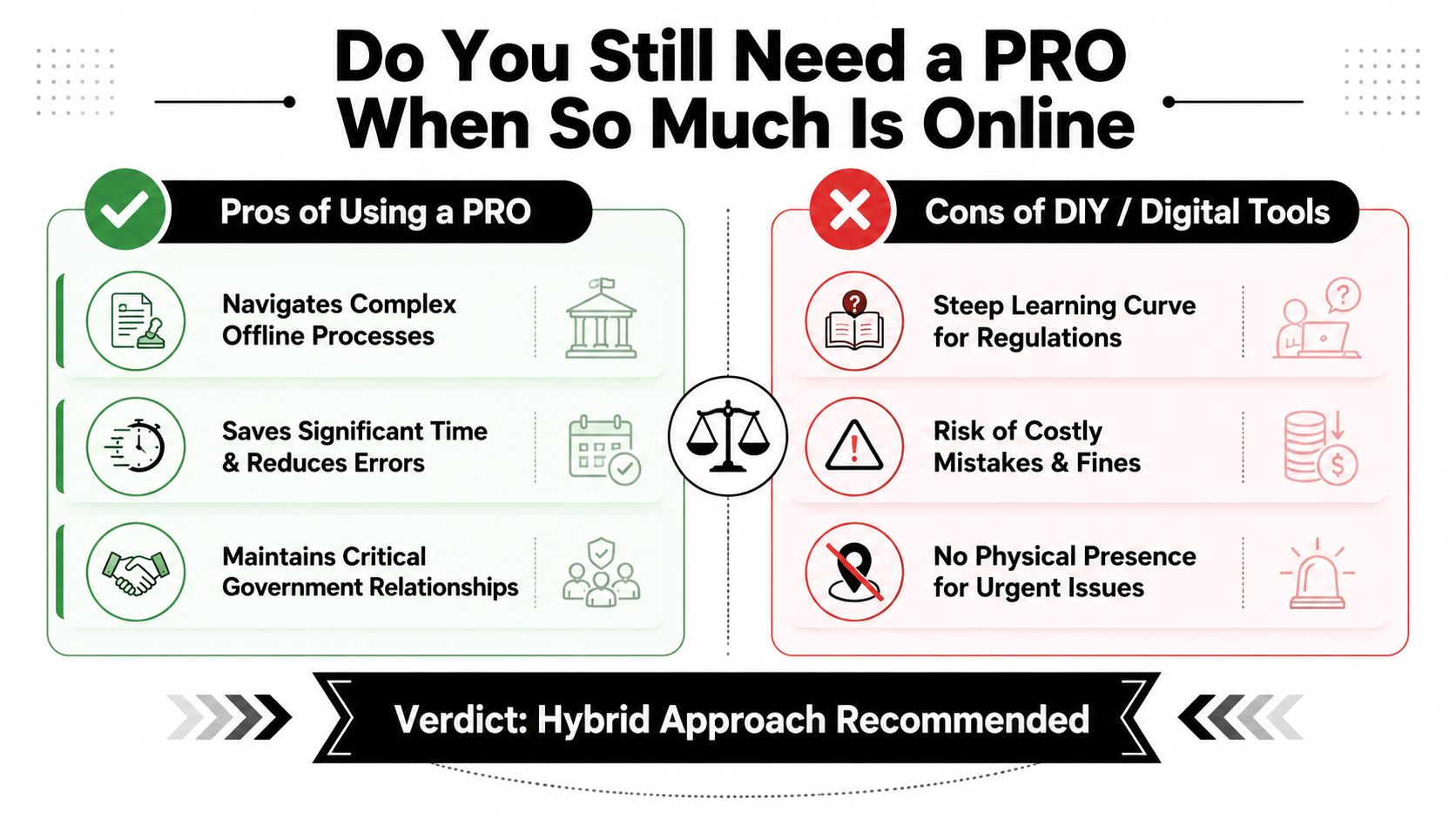
Yes, for some work. Dubai's systems are more digital now, so a few straightforward checks can be handled directly by a founder or an internal admin. A trade-name check, a portal status update, or another simple step may no longer need a person in the middle. The key question is whether the task can be finished cleanly without creating a compliance problem later.
That question matters more once the file starts crossing lines. If one step depends on another authority's approval, if original documents need to be moved, or if a physical verification is involved, the risk of getting stuck rises quickly. A founder can usually manage one portal and one fee. A founder usually does not want to coordinate a file that moves through several bodies, especially when each step has to be accepted in the right order.
Dubai still sees high transaction volumes as more businesses register and license operations. That is why the admin burden has not disappeared, even though more services now sit online. Digital systems reduce some waiting, but they do not remove the need for someone to keep the file moving, spot exceptions, and make sure the paperwork matches what each authority expects.
The practical rule is simple.
- Self-serve it: if the task uses one portal, one authority, and no document chain.
- Use a PRO: if it crosses two or more authorities, needs original paperwork, or includes a face-to-face step.
- Treat it as shared work: if the portal is online but the consequences of a mistake are compliance-related.
If a task feels easy only because you have not hit the exception case yet, it probably still belongs with a PRO.
That is why the service has not disappeared in a digitised market. It has changed shape. The value is less about standing in a queue and more about knowing which post-licence steps still need careful handling, which ones can be self-served, and where a monthly retainer is really buying time, follow-up, and fewer avoidable mistakes.
How to Choose a PRO Provider That Actually Fits
Start with the obvious question, which authorities do they cover? Some firms are fine with visa work but weak on licensing. Others can handle renewals but struggle when a file gets rejected or needs re-submission. You want a provider that can name the exact work they take on, not just promise “full support”.
Then ask how they communicate. Do you get one account manager, or do you chase a different person each time? If a transaction is delayed, who tells you why? If a document is rejected, what happens next? These questions sound basic, but they tell you whether the provider is built for real operating work or for sales brochures.
Fees should also be itemised clearly. If the quote is bundled, ask what's included and what isn't. Government fees, typing charges, courier costs, and re-submission handling are not the same thing, and a founder should be able to see the difference before agreeing.
Smart Classic Business Hub is one option for founders who want PRO support alongside company formation, tax residency certificates, accounting, and other ongoing compliance services. That kind of setup can reduce handoff problems because the company setup and the post-setup admin sit with the same team, instead of being split between separate vendors.
A simple filter for shortlisting providers
- Coverage: confirm they handle the authorities and transaction types you need.
- Process clarity: ask how they handle rejections, delays, and missing documents.
- Account ownership: check whether one person tracks your file end to end.
- Pricing transparency: get the fee split in writing before work starts.
A good provider should make the administrative side feel calmer, not more confusing. If you're still having to interpret every message yourself, the service is not pulling its weight.
Next Steps and Common Founder Questions
Before you contact a PRO, have the basics ready. That usually means your trade licence copy, establishment card, passport copies, any power of attorney if one exists, and a plain description of what needs doing. The clearer the brief, the faster the provider can tell you whether the job is a simple submission or a multi-step file.
A few FAQs come up again and again. A PRO can usually act for the company, but the exact authority depends on the mandate you've given them. A standard visa process can involve several steps from entry to Emirates ID, and the pacing depends on document accuracy and government queues. Free zone companies may work through different channels from mainland companies, but the same basic logic applies, someone still has to manage the paperwork. Long-term retainers can sometimes be negotiated, especially when the transaction volume is predictable.
The main thing to remember is that PRO support is not about replacing your role as founder. It's about keeping the administrative layer from swallowing your week. If your business is now in the recurring stage, not the launch stage, that distinction matters a lot.
A CTA for Smart Classic Business Hub. If you're ready to stop treating government paperwork as a side job, speak with the team about PRO support, company formation, and ongoing compliance so you can keep the business moving without chasing every counter yourself.