
You've signed a few good customers, the bank balance looks healthier, and then someone asks a question you can't answer cleanly. Are you close to the VAT threshold, already past it, or importing enough services that the threshold isn't even the right test? That uncertainty is where most founders lose time. They treat registration as a portal task, rush into EmaraTax, and discover later that their licence details, sales figures and invoices don't tell the same story. Don't start with the form. Start with the decision, prove it with documents, then build the controls that'll run after your Tax Registration Number, or TRN, arrives.
Understanding UAE VAT Registration
You're preparing an invoice, checking your rolling sales, and you're close enough to AED 375,000 that guessing is no longer safe. Your first job isn't to open an application. It's to decide whether you face mandatory registration, should consider voluntary registration, or fall under the separate non-resident responsibility rule. Those routes use different tests, even though they converge on a similar online application.
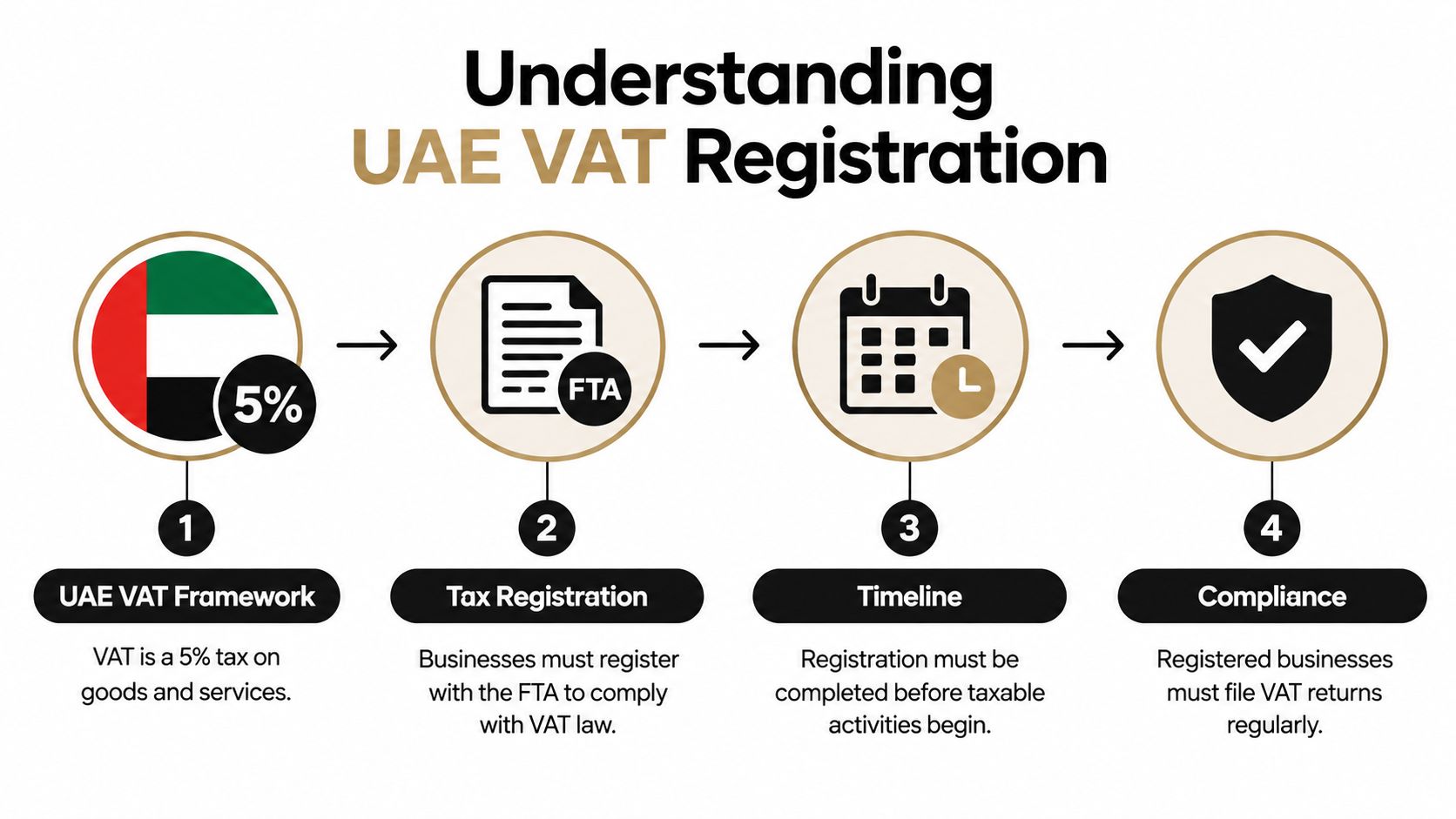
The UAE Government confirms VAT was introduced on 1 January 2018 at a standard rate of 5%, creating the federal framework every taxable business now works within. VAT isn't charged just because money enters your account. You must test taxable supplies and imports, not gross receipts, because exempt activity and non-taxable receipts can distort the answer. A founder who uses total revenue may register late, register unnecessarily, or file an application the evidence can't support.
What Registration Actually Changes
A TRN identifies you as a registered taxable person for VAT. It belongs on your tax invoices and connects your sales, purchases, imports and returns in one compliance record. From the effective registration date, you're no longer just recording income and costs. You're expected to distinguish output VAT charged to customers from input VAT you may recover on eligible purchases, and to retain evidence for both.
That lifecycle matters. Registration, invoicing, bookkeeping, return preparation and payment aren't separate projects owned by different people at different times. If your sales ledger can't show which supplies were taxable, your return preparer can't fix that at quarter end without reconstructing transactions. Build the categories before you submit, not after the Federal Tax Authority, or FTA, asks questions.
Practical rule: Decide the registration route first, then assemble evidence that proves that exact route. A complete-looking folder built around the wrong test is still the wrong application.
The VAT Registration Process UAE founders should follow is therefore a sequence of decisions. Test turnover on the correct basis, confirm who is responsible for tax on cross-border supplies, prepare consistent records, apply through EmaraTax, and activate invoicing and filing controls immediately after approval. If any link is weak, the weakness doesn't disappear. It reappears as an FTA query, a rejected expense claim, or a stressful first filing.
Choose Your VAT Registration Route
Don't choose by company size, free-zone address, or what another founder did. Choose by transaction type, customer responsibility, place of supply and evidence. The three routes below look similar from a distance, but they answer different legal questions.
Three Routes in Practice
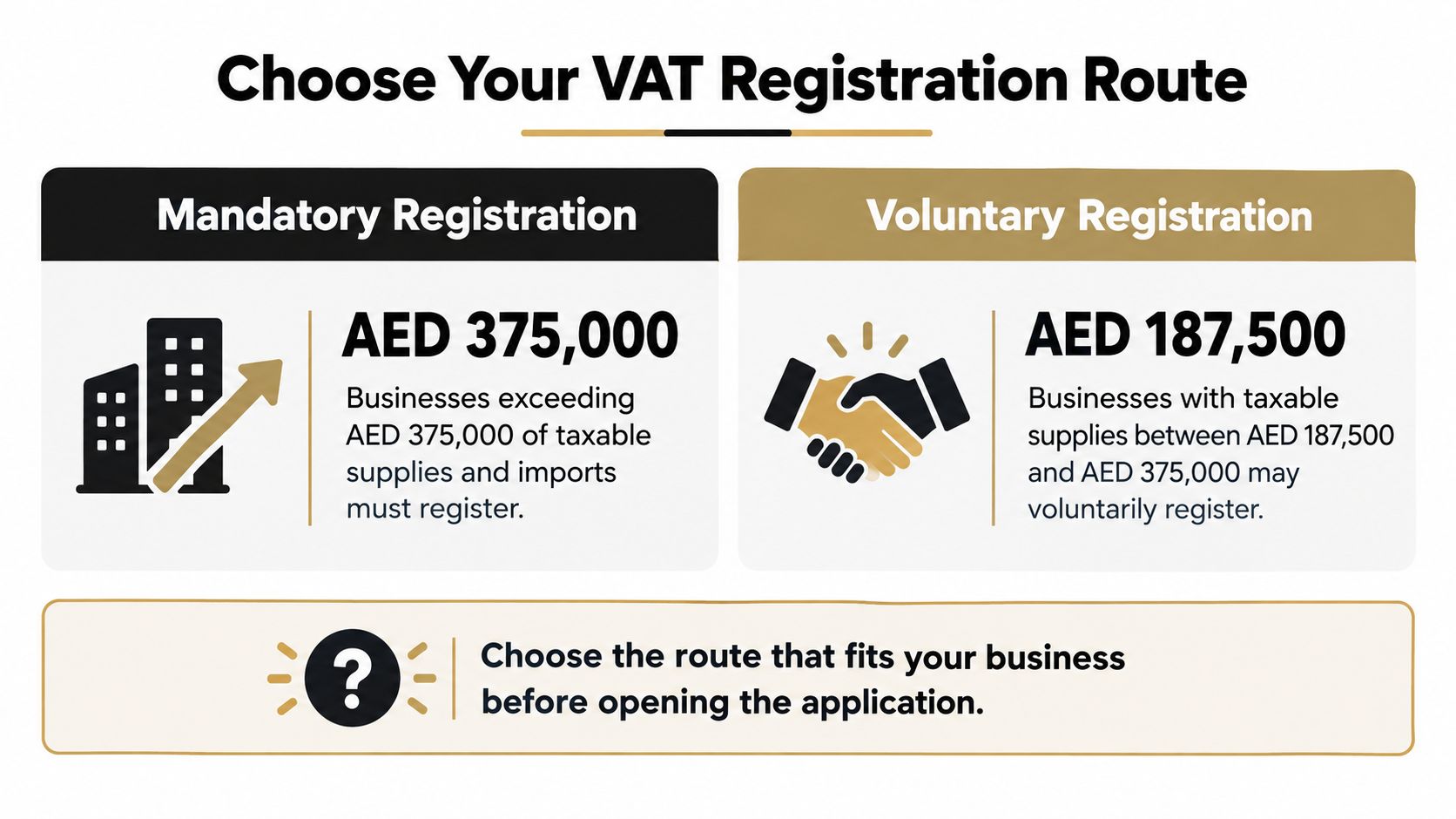
A Dubai trading company buying stock locally and selling to UAE customers should track its taxable supplies and imports continuously. Under the UAE VAT registration threshold rules, mandatory registration applies at AED 375,000 over the previous 12 months or where that level is expected within the next 30 days, while voluntary registration becomes available at AED 187,500 on the comparable past or expected test. If a signed contract will push the trading company over the mandatory level next month, it shouldn't wait until cash arrives.
A small digital-services business below the mandatory level faces a commercial choice, not an automatic yes. Voluntary registration may help where customers expect tax invoices and the business incurs meaningful VAT on eligible costs. It also creates returns, record-keeping and payment deadlines. If the firm's clients are mainly consumers who can't recover VAT, adding tax to prices may affect competitiveness, so pricing must be modelled before applying.
An overseas seller is different again. If it makes taxable supplies in the UAE and no UAE party is responsible for accounting for the VAT, low UAE turnover doesn't protect it. The key question is who must account for tax on that exact supply, taking account of customer status, place of supply, imported services, any UAE agent, and whether a UAE recipient must apply the reverse-charge treatment. Don't import resident-business threshold advice into a non-resident fact pattern.
| Business situation | Registration position | Decision focus |
|---|---|---|
| UAE trader near the mandatory limit | Register when the past or expected mandatory test is met | Taxable turnover, imports and signed future work |
| Small service firm below that limit | Voluntary registration may be available once its lower test is met | Customer profile, recoverable costs and pricing |
| Overseas seller supplying UAE customers | Registration may be required regardless of turnover | Who accounts for VAT on each supply |
| UAE buyer importing foreign services | Registration status alone doesn't settle the treatment | Reverse-charge analysis and supplier documentation |
My Recommendation for Borderline Cases
Create a rolling schedule that separates taxable sales, zero-rated supplies, exempt income, imports and non-business receipts. Compare the past period with contracted and highly probable work for the coming month. If the result depends on one large invoice or one cross-border arrangement, get that transaction classified before you apply. Borderline doesn't mean optional. It means your evidence needs to be unusually clear.
Prepare Documents Before You Apply
Most delays I see aren't caused by a missing trade licence. They're caused by inconsistency. The licence shows one activity, the declaration describes another, bank receipts suggest a third, and the authorised signatory in the application doesn't match the corporate records. Fix those gaps while you still control the timetable.
Core Records and People
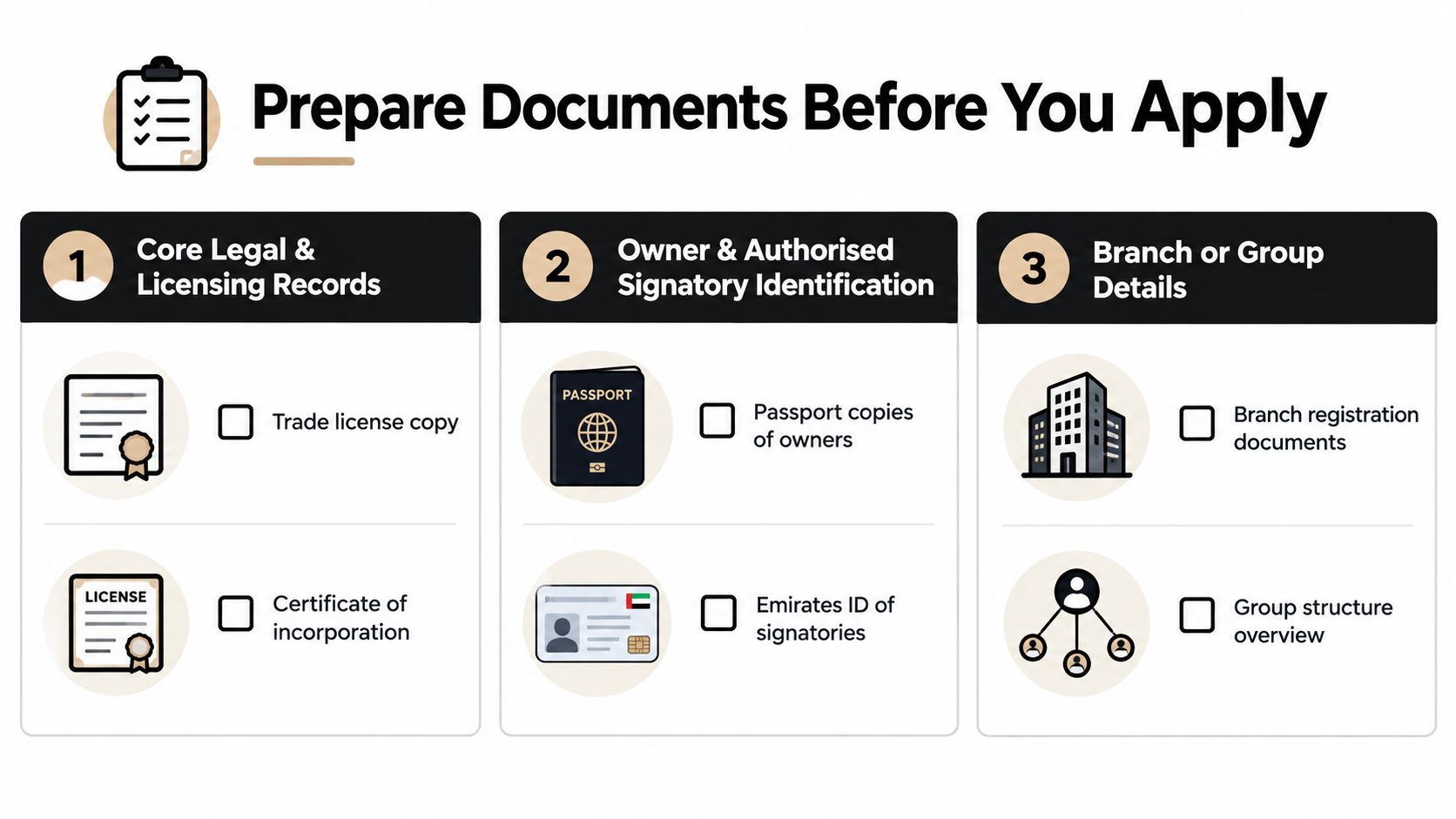
Start with the legal file. Depending on your legal form, the FTA VAT registration service lists supporting evidence that commonly includes your certificate of incorporation, memorandum of association or partnership agreement, commercial registration certificate, valid trade licence and any branch licences. Add passport and Emirates ID copies for owners and authorised signatories, plus a power of attorney where someone is acting for the applicant.
Check names, licence numbers, activities, addresses and expiry dates across every document. If a branch trades under the same legal entity, make that relationship obvious. If ownership changed recently, organise the updated corporate record before submission rather than explaining conflicting copies later. Reviewers shouldn't have to infer which version is current.
Evidence of Trading Activity
Next, prove why you're registering now. The FTA may require a signed declaration describing taxable supplies and monthly sales since establishment, supported by invoices, purchase orders, contracts and lease agreements. For expected revenue, use signed contracts and credible pipeline evidence, not an optimistic spreadsheet with no customer commitment behind it. Your declaration, accounting reports and sample invoices should reconcile without manual explanations scattered across emails.
Expense-based voluntary applicants need particular discipline. For that route, the FTA specifies at least five VAT invoices with amounts exceeding the applicable registration threshold, as referenced in the service requirements linked above. Don't submit five unrelated invoices and hope quantity solves relevance. Confirm each invoice relates to the applicant, shows the supplier's tax details clearly, and supports the expense test you're relying on.
- Licence check: Confirm activity, legal name and validity match the taxable-person profile you'll create.
- Ownership check: Match owners, managers and authorised signatories to current corporate documents and ID copies.
- Turnover check: Tie monthly sales in the declaration to ledgers, invoices, contracts and import records.
- Expense check: Isolate qualifying VAT invoices and remove duplicates, personal costs and unsupported payments.
Don't upload documents as you find them. Rename, order and reconcile the file so a reviewer can follow your route in minutes.
Finish with a one-page internal note stating the route selected, the period tested, the transactions included and the documents proving them. That note isn't bureaucracy. It's the map your team will use if the FTA requests clarification weeks later.
Register Through the FTA EmaraTax Platform
EmaraTax is the submission channel, not a substitute for preparation. Work through it in order, keep the evidence file open beside you, and don't let the person entering data improvise answers that finance hasn't approved.

Account and Taxable-Person Profile
Create and activate the correct EmaraTax account first. Use an email address the business controls long term, not a temporary employee inbox, because access and FTA notifications must survive staff changes. Then create the taxable-person profile using the legal details exactly as they appear in your licensing and corporate records. Small variations in a company name or licence number create avoidable follow-up.
From the account dashboard, select the VAT registration service and open the application. Before typing, confirm you're working under the intended taxable person, especially if an adviser or group finance team manages several entities. Applying under the wrong profile is an operational error, but it can become a compliance problem if invoices are issued before anyone notices.
Application Fields and Uploads
Complete the form by reference to your prepared file. You'll need legal structure, licence data, business activities, contact details, owner and authorised-signatory information, branch details where relevant, and information about current or expected taxable supplies. Describe activities in plain commercial terms that match the licence and your contracts. Don't copy a generic activity description if your actual revenue comes from a narrower service.
Upload documents at the points requested and check that each file opens, is legible and corresponds to the category selected. A correct passport uploaded under the wrong person's section is still wrong. Where the form asks about turnover or expected supplies, use the figures from your reconciled schedule. If a forecast supports the application, keep the contract or purchase order behind that forecast in the same evidence pack.
Review the declaration carefully before submission. Ask a second person to compare three things against source records: the legal identity, the registration basis, and the monthly sales or expense evidence. That reviewer should also confirm the authorised signatory has authority to submit. Don't treat the final click as administration. It's a formal representation to the FTA.
After You Submit
Save the submission reference, a copy of the completed application where available, and the exact versions of uploaded documents. Diary regular checks for FTA requests and assign one owner to respond. If clarification is requested, answer the specific point and keep new evidence consistent with the original declaration. Sending a revised sales schedule without explaining the change invites another round of questions.
Track the outcome until the TRN and effective registration position are confirmed. Then notify finance, sales and procurement immediately, because invoice templates, supplier onboarding and accounting codes may all need updating. The VAT Registration Process UAE applicants complete online ends at approval. Your business process shouldn't.
Activate Your TRN and VAT Controls
Approval day is not the finish line. It's the first day your invoices, purchase approvals and ledgers must work as a VAT system. Set the controls before the next invoice leaves the business, even if that means pausing non-urgent billing for a short configuration check.
Put the TRN Into Daily Workflows
If you're still clarifying what the number is and where it belongs, review what a TRN number means for a UAE business before updating templates. Add the TRN to tax invoice formats, accounting software, customer records and relevant correspondence. Then remove old invoice templates from shared drives so staff can't keep using a pre-registration version by habit.
Map every revenue stream to its treatment before billing resumes. Separate standard-rated, zero-rated and exempt supplies, and identify imported goods or services that require special reporting. Don't rely on product names alone. A service sold to a UAE customer, supplied from abroad, or bundled with another supply may need a documented treatment decision and evidence of customer location or status.
On the purchase side, create an input VAT review point before payment. Staff should check that the supplier invoice is addressed correctly, shows the necessary tax information, relates to the business, and hasn't already been claimed. Personal expenses, blocked categories and poorly documented purchases should be routed for review, not posted automatically because the supplier charged VAT.
Reconcile and File on a Fixed Cadence
Maintain separate output VAT and input VAT ledgers. Reconcile output VAT to the sales ledger and issued tax invoices, and reconcile input VAT to eligible purchase records and import documents. Investigate credit notes, cancelled invoices, unmatched customs records and supplier invoices received late. A return built from bank movements alone won't explain timing differences or non-cash adjustments.
FTA FAQ guidance states VAT returns and related payments are generally due within 28 days from the end of the tax period, subject to non-working-day and public-holiday rules. The standard tax period is quarterly for businesses below the annual turnover level specified by the UAE Government, but you must work to the period assigned to your registration. Don't assume your filing quarters match calendar quarters.
Set an internal close 7 to 10 days before the statutory deadline. That gives management time to review unusual transactions, approve the return, and arrange payment without using the final day for basic bookkeeping. Record who prepared the return, who reviewed it, what reconciliations support it, and whether payment cleared.
Month-end discipline: Close sales, purchases and imports monthly even if you file quarterly. Quarterly filing with quarterly bookkeeping is how small errors become unidentifiable.
Retain the return, ledgers, invoices, import evidence and management sign-off together by tax period. If a customer disputes VAT or the FTA queries a claim, you should be able to retrieve the full trail without searching individual inboxes. Good retention is not storage volume. It's retrieval speed with context.
Avoid Mistakes Before They Disrupt Compliance
The costliest VAT mistakes usually begin as shortcuts. Someone uses the wrong turnover figure, trusts a supplier invoice without checking it, or assumes a foreign supplier handled the tax. Catch the symptom early and install a control, not just a correction.
Application Errors
Gross revenue replaces taxable turnover. A business includes exempt or out-of-scope receipts and reaches the wrong registration conclusion. Rebuild the test from transaction categories and keep a signed schedule showing inclusions and exclusions.
Licence and ownership records don't match. The application names a manager who left, or a branch licence is missing. Update the legal file first, then assign one person to compare the EmaraTax profile against current documents before submission.
Expense evidence is thin. A voluntary applicant uploads invoices that don't support the stated basis or don't clearly belong to the applicant. Create an expense pack that ties each invoice to the ledger and payment record, and remove anything you can't explain.
Post-Registration Errors
Imports are overlooked. Goods arrive through customs or foreign services are purchased by card, but nobody tells finance. Give procurement and operations a simple rule: no foreign purchase is complete until the invoice and import evidence reach the VAT folder.
Input VAT is claimed from weak documents. A receipt, pro forma invoice or supplier statement gets treated as enough. Make the accounting system flag claims missing key invoice details and require approval before posting.
The wrong tax period drives the diary. Staff prepare a return for a period that doesn't match the assigned period, then rush when the actual deadline arrives. Put the assigned period and internal close date in the finance calendar, with a named preparer and reviewer.
Cross-border responsibility is never assessed. A UAE business buys software or consulting from abroad and assumes the overseas invoice settles VAT. Review customer and supplier status, place of supply and reverse-charge treatment for recurring foreign services, then document the conclusion once and revisit it when contracts change.
Late filing or payment can expose the business to administrative penalties, but penalties aren't the only cost. Corrections consume management time and weaken confidence in every number that follows. Prevention is cheaper because it's mostly calendar discipline and document discipline.
Build a Reliable Post-Registration Routine
Turn registration into a short operating routine your team can repeat without heroics. Confirm the route, keep the turnover schedule rolling, reconcile sales and purchases monthly, review imports and foreign services, close early, and store each period as one evidence pack. Pair that routine with a structured approach to VAT filing in the UAE so return preparation doesn't become a separate rescue exercise every quarter.
Some questions still need case-specific advice. How should several related entities assess registration when they trade with each other or share costs? What should you do in the month turnover crosses the threshold mid-contract? Which records should you send first if the FTA requests clarification? And remember, non-UAE-resident businesses generally face mandatory registration regardless of turnover when no other UAE party is responsible for paying the VAT, so cross-border arrangements deserve a separate answer.
Your Next Actions
- This week: Rebuild the rolling taxable-turnover test and note the expected position for the next month.
- Before applying: Reconcile licence, ownership, sales, expense and import evidence into one indexed file.
- On approval: Update invoice templates, tax codes, supplier checks and the assigned filing calendar the same day.
- Every month: Reconcile output VAT, input VAT and imports, then clear unmatched documents before close.
Smart Classic Business Hub can assist with business setup, VAT-compliant accounting, bookkeeping, audit, tax-residency support and ongoing compliance. Confirm the exact scope and availability directly before relying on any timetable or outcome, because your registration route and document quality will drive the work required.
If your turnover test, cross-border supplies or document file still doesn't produce a clear answer, speak to Smart Classic Business Hub before you submit anything through EmaraTax. The team can help you assess the registration route, organise supporting evidence and set up VAT-compliant bookkeeping for the first filing period. Bring your licence, rolling sales schedule and recent supplier invoices to the conversation so the advice starts from your actual transactions, not assumptions.